Q1. The length of chord which is at a distance of 12 cm from centre of circle of radius 13 cm is:
Solution
 Using Pythagoras theorem:
OA2 = OM2 + AM2
AM2 = OA2 - OM2
AM2 = 132 - 122
AM2 = 169 - 144
AM2 = 25
AM = 5 cm
AB = 2
Using Pythagoras theorem:
OA2 = OM2 + AM2
AM2 = OA2 - OM2
AM2 = 132 - 122
AM2 = 169 - 144
AM2 = 25
AM = 5 cm
AB = 2  AM
AB = 2 5 cm = 10 cm
AM
AB = 2 5 cm = 10 cm
Q2. If AB = 12 cm, BC = 16 cm and AB  BC, then radius of the circle passing through A,B and C is
BC, then radius of the circle passing through A,B and C is Solution
 Since the vertices of the triangle ABC form a right angled triangle, right angled at B, ABCOA is a semicircle, where O is the centre of the circle.
Thus, AC is the diameter of the circle passing through the points A, B and C.
Using Pythagoras theorem in
Since the vertices of the triangle ABC form a right angled triangle, right angled at B, ABCOA is a semicircle, where O is the centre of the circle.
Thus, AC is the diameter of the circle passing through the points A, B and C.
Using Pythagoras theorem in  ABC,
AC2 = AB2 + BC2
= (12 cm)2 + (16 cm)2
= 144 cm2 + 256 cm2
= 400 cm2
ABC,
AC2 = AB2 + BC2
= (12 cm)2 + (16 cm)2
= 144 cm2 + 256 cm2
= 400 cm2
 AC = 20 cm
 Radius of the circle =
  =10 cm
Q3. 

Solution

Q4. Prove that the perpendicular from the centre of the circle to a chord bisects the chord.
Solution
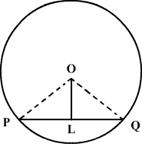
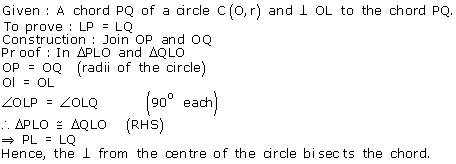
Q5. The two intersecting chords of a circle make equal angles with the diameter passing through their point of intersection. Prove that the chords are equal.
Solution
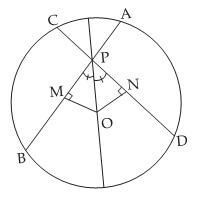 Draw OM
  AB and ON CD
 MOP = 180o - 90o - MPO
= 90o - MPO
= 90o - NPO
= NOP
In
MOP = 180o - 90o - MPO
= 90o - MPO
= 90o - NPO
= NOP
In  OMP and ONP,
OMP = ONP = 90o (by construction)
MOP = NOP (shown above)
OP = OP (common)
OMP and ONP,
OMP = ONP = 90o (by construction)
MOP = NOP (shown above)
OP = OP (common)
 Chords AB and CD are equidistant from centre O.
Therefore, AB = CD
(Chords which are equidistant from the centre are equal)
Chords AB and CD are equidistant from centre O.
Therefore, AB = CD
(Chords which are equidistant from the centre are equal)
Q6. 
Solution
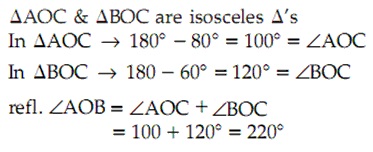
Q7. In the given figure, if  OAB = 40o then ACB is equal to:

OAB = 40o then ACB is equal to:
Solution
OA = OB = radius of the circle.
Therefore,
OAB = OBA = 40o
In  AOB + OBA + AOB = 1800
400 + 400 + AOB = 1800
AOB = 1000
Therefore, ACB = 50o
Since, the angle subtended by an arc at the centre is double the angle subtended by it at any point on the remaining part of the circle.
AOB + OBA + AOB = 1800
400 + 400 + AOB = 1800
AOB = 1000
Therefore, ACB = 50o
Since, the angle subtended by an arc at the centre is double the angle subtended by it at any point on the remaining part of the circle.
OAB = OBA = 40o
In
AOB + OBA + AOB = 1800
400 + 400 + AOB = 1800
AOB = 1000
Therefore, ACB = 50o
Since, the angle subtended by an arc at the centre is double the angle subtended by it at any point on the remaining part of the circle.
Q8. O is the centre of the circle and PQ is a diameter. If  ROS is equal to 40o find RTQ.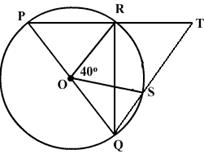
ROS is equal to 40o find RTQ. Solution
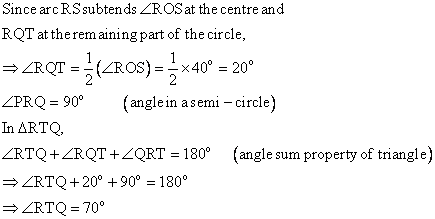
Q9. In the given figure,  M is 75o then O is equal to.

M is 75o then O is equal to.
Solution
The sum of a pair of opposite angles of a cyclic quadrilateral is 180º
Therefore,
 M + O =
  75º + O =
O = 105o
75º + O =
O = 105o
M + O =
75º + O =
O = 105o
Q10. For what value of x in the figure, points A, B, C and D are concyclic?

Solution
Sum of opposite angles of a cyclic quadrilateral is 180 .
.

.
Q11. In a circle of radius 5 cm, NG and AG are two chords such that
NG = AG = 6 m. Find the length of the chord AN.

Solution

Q12. AD is a diameter of a circle and AB is chord. If AB = 24 cm, AD = 30 cm, the distance of AB from the centre of the circle is :

Solution
 The distance of AB from the centre of the circle is 9 cm.
Q13. The perpendicular distance of a chord 8 cm long from the centre of a circle of radius 5 cm is
Solution
 Let OP be perpendicular to the chord AB.
We know that perpendicular drawn from the centre of a circle to a chord bisects the chord.
So, AP = BP =
Let OP be perpendicular to the chord AB.
We know that perpendicular drawn from the centre of a circle to a chord bisects the chord.
So, AP = BP =  = 4 cm We know that triangle OPB is right-angled at P, so we can use Pythagoras theorem: OP2 + BP2 = OB2
OP2 + 42 = 52
OP2 + 16 = 25
OP2 = 25 - 16
OP2 = 9
OP = 3 cm
= 4 cm We know that triangle OPB is right-angled at P, so we can use Pythagoras theorem: OP2 + BP2 = OB2
OP2 + 42 = 52
OP2 + 16 = 25
OP2 = 25 - 16
OP2 = 9
OP = 3 cm
Q14. In the figure, two circles intersect at B
and C. Through B two line segments ABD and PBQ are drawn to intersect the
circles at A, D and P, Q respectively. Prove that  ACP = DCQ.

ACP = DCQ.
Solution
segments
AD and PQ intersect at B
PBA
= DBQ ….(i) (Vertically opposite angles)
In major
circle, angle subtended by minor arc AP:
 ....(ii)
In minor
circle, angle subtended by minor arc DQ:
....(ii)
In minor
circle, angle subtended by minor arc DQ:
 ….(iii)
from (i)
,(ii) and (iii)
….(iii)
from (i)
,(ii) and (iii)

PBA
= DBQ ….(i) (Vertically opposite angles)
In major
circle, angle subtended by minor arc AP:
....(ii)
In minor
circle, angle subtended by minor arc DQ:
….(iii)
from (i)
,(ii) and (iii)
Q15. The region bounded by an arc and a chord of a circle is called a ______.
Solution
The region bounded by an arc and a chord of a circle is called a segment.
Q16. AOB is a diameter of the circle and C, D, E
are any three points on the semicircle. Find the value of  ACD + BED.

ACD + BED.
Solution
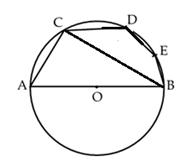 Join
BC.
Then
ACB = 90o [Angle in a semi circle]
Since
DCBE is a cyclic quad.
Join
BC.
Then
ACB = 90o [Angle in a semi circle]
Since
DCBE is a cyclic quad.
 BCD + BED = 180o
Adding
ACB on both sides
BCD
+ BED + ACB = ACB + 180o.
(BCD + ACB) + BED = 90o + 180o
ACD
+ BED = 270o
BCD + BED = 180o
Adding
ACB on both sides
BCD
+ BED + ACB = ACB + 180o.
(BCD + ACB) + BED = 90o + 180o
ACD
+ BED = 270o
Q17. If  C = D = 50o then four points A, B, C, D:

C = D = 50o then four points A, B, C, D:
Solution
If a line segment joining two points subtends equal angles at the two points lying on the same side of the line segment, then the four points are con-cyclic.
Q18. 
Solution
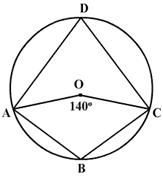
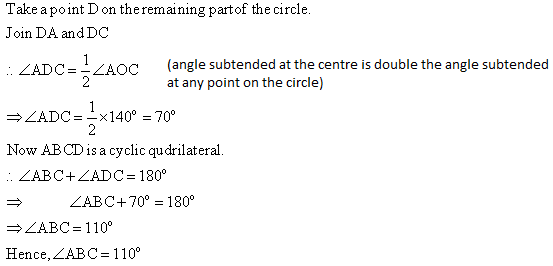
Q19. In a cyclic quadrilateral ABCD, if AB||DC
and  B = 70o find the measures of the
remaining angles of the quadrilateral.
B = 70o find the measures of the
remaining angles of the quadrilateral.
B = 70o find the measures of the
remaining angles of the quadrilateral. Solution
In
cyclic quad. ABCD, if B = 70o
Then
D = 180o - 70o = 110o
(opp. angles of cyclic
quad. are supplementary)
Since
AB||CD, B + C = 180o
(adj. angles of cyclic
quad. are supplementary)
And
A + D = 180o
(adj. angles of cyclic
quad. are supplementary)
 C = 110o, A = 70o
B = 70o
Then
D = 180o - 70o = 110o
(opp. angles of cyclic
quad. are supplementary)
Since
AB||CD, B + C = 180o
(adj. angles of cyclic
quad. are supplementary)
And
A + D = 180o
(adj. angles of cyclic
quad. are supplementary)
C = 110o, A = 70o
Q20. An equilateral  ABC is inscribed in a circle with centre O. The measure of
  BOC is:
ABC is inscribed in a circle with centre O. The measure of BOC is:Solution
 Since ABC is an equilateral triangle, therefore,
BAC = 600
We know,
The angle subtended by an arc at the centre is double the angle subtended by it at any point on the remaining part of the circle.
Therefore, BOC = 120o
Since ABC is an equilateral triangle, therefore,
BAC = 600
We know,
The angle subtended by an arc at the centre is double the angle subtended by it at any point on the remaining part of the circle.
Therefore, BOC = 120o
Q21. Find the length of the chord, which is at a distance of 3 cm from the centre of a circle of radius 5 cm.
Solution
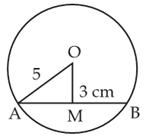 In right
 OMA, by Pythagoras theorem,
OA2 = OM2 + AM2 (The line drawn through the centre of a circle to bisect a chord is perpendicular to the chord.)
AM2 = 52 - 32 = 16
AM = 4 cm
OMA, by Pythagoras theorem,
OA2 = OM2 + AM2 (The line drawn through the centre of a circle to bisect a chord is perpendicular to the chord.)
AM2 = 52 - 32 = 16
AM = 4 cm
 AB = 2AM = 2
  4 cm = 8 cm
Q22. In the figure, AB and CD are two equal chords of a circle with centre O. OP and OQ are perpendiculars on chords AB and CD respectively. If  POQ = 150o, find APQ.

POQ = 150o, find APQ.
Solution
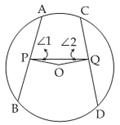 As AB = CD
So, OP = OQ (equal chords are equidistant from the centre)
1 = 2 (angles oppsite to equal sides are equal)
1 + 2 + POQ = 180o
1 + 1 + 150 o = 180o
As AB = CD
So, OP = OQ (equal chords are equidistant from the centre)
1 = 2 (angles oppsite to equal sides are equal)
1 + 2 + POQ = 180o
1 + 1 + 150 o = 180o
 1 = 15o
Since APB is a line segment
BPO + 1 + APQ = 180o
90o + 15 o + APQ = 180o
APQ = 75o
1 = 15o
Since APB is a line segment
BPO + 1 + APQ = 180o
90o + 15 o + APQ = 180o
APQ = 75o
Q23. In the given figure, AB is a side of a regular hexagon and AC is a side of a regular octagon inscribed in a circle with centre O. Calculate angles AOB and AOC.

Solution

Q24. In the figure, O is the center of the circle. If  ACB = 30o then ABC equal to:

ACB = 30o then ABC equal to:
Solution
In the given figure,
ACB = 30o
BC is the diameter, therefore,
CAB = 90o(Angle in a semi-circle)
Now, in  ABC
ACB + CAB + ABC = 180o
(sum of angles of a triangle = 1800)
300 + 900 + ABC = 1800
ABC = 60o
ABC
ACB + CAB + ABC = 180o
(sum of angles of a triangle = 1800)
300 + 900 + ABC = 1800
ABC = 60o
ACB = 30o
BC is the diameter, therefore,
CAB = 90o(Angle in a semi-circle)
Now, in ABC
ACB + CAB + ABC = 180o
(sum of angles of a triangle = 1800)
300 + 900 + ABC = 1800
ABC = 60o
Q25. The vertices of a parallelogram lie on a
circle. Prove that its diagonals are equal.
Solution
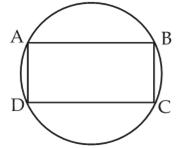
 B
= D (opposite
angles of a parallelogram)
But
B + D = 180o (opposite angles of a cyclic
quad. are supplementary)
B
= D (opposite
angles of a parallelogram)
But
B + D = 180o (opposite angles of a cyclic
quad. are supplementary)
 B = D = 90o
We
know that, a parallelogram with one angle as 90o is a rectangle.
So,
ABCD is a rectangle.
AC = BD (diagonals of a rectangle are equal)
B = D = 90o
We
know that, a parallelogram with one angle as 90o is a rectangle.
So,
ABCD is a rectangle.
AC = BD (diagonals of a rectangle are equal)
Q26. In the figure, ABCD is a parallelogram. The
circle through A, B and C intersects CD produced at E. Prove that AE = AD.

Solution
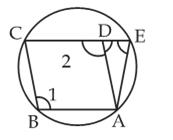
 1
= 2 (Opp.
angles of a parallelogram are equal)…(i)
1
+ AED = 180o (Opp. Angles of cyclic Quad.)…(ii)
2
+ ADE = 180o (Linear pair)…….(iii)
1
= 2 (Opp.
angles of a parallelogram are equal)…(i)
1
+ AED = 180o (Opp. Angles of cyclic Quad.)…(ii)
2
+ ADE = 180o (Linear pair)…….(iii)
 AED = ADE….from (i),(ii),(iii).
AD = AE
(in
AED = ADE….from (i),(ii),(iii).
AD = AE
(in  ADE, lines opp. to equal angles are equal)
Q27. In the figure, B and E are points on line
segment AC and DF respectively. Prove that AD||CF.

Solution
Join
B and E.
ABED
is a cyclic quadrilateral.

 ADE = EBC … (1)
(exterior
angle of a cyclic quadrilateral = Interior opposite angle)
Similarly,
EFCB is a cyclic quadrilateral.
EBC + CFE = 180o … (2)
(opposite
angles of a cyclic quadrilateral are supplementary)
From
(1) and (2),
ADE
+ CFE = 180o
But
these are interior angles made by the transversal DF on the same side of the
lines AD and CF. Since, these angles are supplementary, therefore,
AD||CF
ADE = EBC … (1)
(exterior
angle of a cyclic quadrilateral = Interior opposite angle)
Similarly,
EFCB is a cyclic quadrilateral.
EBC + CFE = 180o … (2)
(opposite
angles of a cyclic quadrilateral are supplementary)
From
(1) and (2),
ADE
+ CFE = 180o
But
these are interior angles made by the transversal DF on the same side of the
lines AD and CF. Since, these angles are supplementary, therefore,
AD||CF
ADE = EBC … (1)
(exterior
angle of a cyclic quadrilateral = Interior opposite angle)
Similarly,
EFCB is a cyclic quadrilateral.
EBC + CFE = 180o … (2)
(opposite
angles of a cyclic quadrilateral are supplementary)
From
(1) and (2),
ADE
+ CFE = 180o
But
these are interior angles made by the transversal DF on the same side of the
lines AD and CF. Since, these angles are supplementary, therefore,
AD||CF
Q28. AD is a diameter of a circle and AB is a chord. If AD = 34 cm and AB = 30 cm, the distance of AB from the centre of the circle is :
Solution
 Let O be the centre.Draw OC perpendicular to AB.
We know that the perpendicular from the centre to a chord bisects the chord.
So, CA=
Let O be the centre.Draw OC perpendicular to AB.
We know that the perpendicular from the centre to a chord bisects the chord.
So, CA= =15 cm
OA =
=15 cm
OA = 17 cm
Using Pythagoras theorem:
OC2 = OA2 - AC2
OC2 = (17
17 cm
Using Pythagoras theorem:
OC2 = OA2 - AC2
OC2 = (17  17) - (15 15)
OC2 = 289 - 225
OC2 = 64
OC = 8 cm
17) - (15 15)
OC2 = 289 - 225
OC2 = 64
OC = 8 cm
Q29. 
Solution
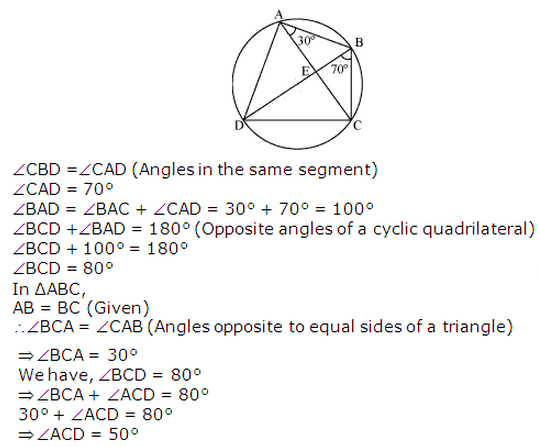
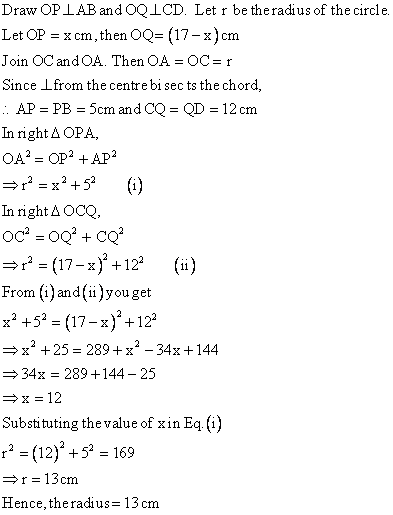
Q30. AB and CD are two parallel chords of a circle such that AB = 12 cm and CD = 24 cm. The chords are on the opposite sides of the centre and the distance between them is 17 cm. Find the distance between them. 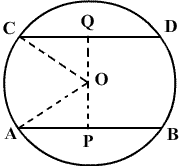
Solution
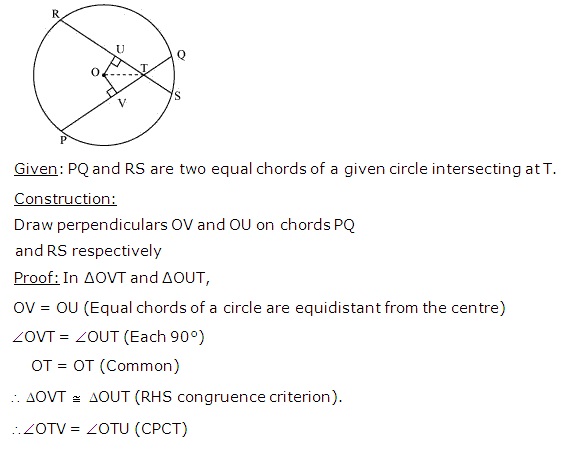
Q31. Two equal chords of a circle intersect within the circle; prove that the line joining the point of intersection to the centre makes equal angles with the chords.
Solution
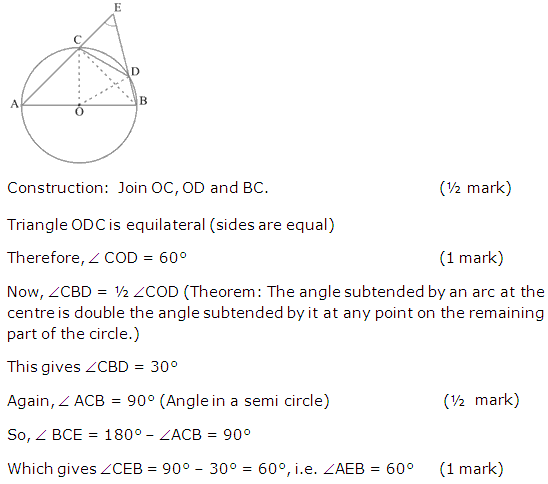
Q32. 
Solution
Q33. O is the circumcentre of the  ABC and D is the mid point of the base BC.
Prove that
ABC and D is the mid point of the base BC.
Prove that  BOD = A.

ABC and D is the mid point of the base BC.
Prove that BOD = A.
Solution
OD
 BC [A line drawn through the centre of a
circle bisecting a chord is to the chord]
In
rt. OBD and OCD
OB
= OC (radii)
OD
= OD (common)
ODB
= ODC [each
90o]
BC [A line drawn through the centre of a
circle bisecting a chord is to the chord]
In
rt. OBD and OCD
OB
= OC (radii)
OD
= OD (common)
ODB
= ODC [each
90o]
 (The angle subtended by
an arc at the centre is double the angle subtended by it at any point on the
remaining part of the circle.)
From (i) and (ii)
BOD
= A
(The angle subtended by
an arc at the centre is double the angle subtended by it at any point on the
remaining part of the circle.)
From (i) and (ii)
BOD
= A
BC [A line drawn through the centre of a
circle bisecting a chord is to the chord]
In
rt. OBD and OCD
OB
= OC (radii)
OD
= OD (common)
ODB
= ODC [each
90o]
(The angle subtended by
an arc at the centre is double the angle subtended by it at any point on the
remaining part of the circle.)
From (i) and (ii)
BOD
= A
Q34. Prove that the angle subtended by an arc at
the centre is double the angle subtended by it at any point on the remaining
part of the circle.
Solution
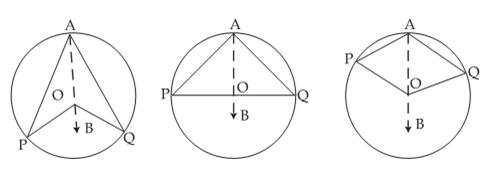
Let arc PQ
of a circle with centre O, subtends  POQ at the centre and PAQ at a point P which
lies on the remaining part of the circle.
To prove: POQ = 2 PAB
POQ at the centre and PAQ at a point P which
lies on the remaining part of the circle.
To prove: POQ = 2 PAB
 Proof:
There are 3 cases:
(a)
Arc PQ is minor
(b)
Arc PQ is a semi-circle
(c)
Arc PQ is major
In
all the three cases, we have:
Proof:
There are 3 cases:
(a)
Arc PQ is minor
(b)
Arc PQ is a semi-circle
(c)
Arc PQ is major
In
all the three cases, we have:
 BOQ
= OAQ + AQO ...(1)
(exterior angle is equal to the sum of int.
opp. angles.)
Also,
in
BOQ
= OAQ + AQO ...(1)
(exterior angle is equal to the sum of int.
opp. angles.)
Also,
in  OAQ,
OA
= OQ ... (Radii of a circle)
OAQ
= OQA
...(2)
From
(1) and (2),
BOQ = 2OAQ …..(3)
Similarly,
BOP = 2OAP ……(4)
Adding
(3) and (4),
BOP
+ BOQ = 2(OAP + OAQ)
Or,
POQ = 2PAQ ...(5)
OAQ,
OA
= OQ ... (Radii of a circle)
OAQ
= OQA
...(2)
From
(1) and (2),
BOQ = 2OAQ …..(3)
Similarly,
BOP = 2OAP ……(4)
Adding
(3) and (4),
BOP
+ BOQ = 2(OAP + OAQ)
Or,
POQ = 2PAQ ...(5)
POQ at the centre and PAQ at a point P which
lies on the remaining part of the circle.
To prove: POQ = 2 PAB
Proof:
There are 3 cases:
(a)
Arc PQ is minor
(b)
Arc PQ is a semi-circle
(c)
Arc PQ is major
In
all the three cases, we have:
BOQ
= OAQ + AQO ...(1)
(exterior angle is equal to the sum of int.
opp. angles.)
Also,
in OAQ,
OA
= OQ ... (Radii of a circle)
OAQ
= OQA
...(2)
From
(1) and (2),
BOQ = 2OAQ …..(3)
Similarly,
BOP = 2OAP ……(4)
Adding
(3) and (4),
BOP
+ BOQ = 2(OAP + OAQ)
Or,
POQ = 2PAQ ...(5)
Q35. In the figure, O is the centre of the
circle and  BAC = 60o. Find the value
of x.
BAC = 60o. Find the value
of x.

BAC = 60o. Find the value
of x.
Solution
The angle subtended by an arc at the centre is
double the angle subtended by it at any point on the remaining part of the
circle.)
 BOC
= 2BAC = 2
BOC
= 2BAC = 2  60o
= 120o
x = 360o - 120o = 240o
60o
= 120o
x = 360o - 120o = 240o
BOC
= 2BAC = 2 60o
= 120o
x = 360o - 120o = 240o
Q36. 
Solution
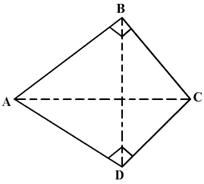 ΔABC and ΔADC are right triangles with AC as common hypotenuse.
Two triangles together make a quadrilateral ABCD
In quadrilateral ABCD,
ΔABC and ΔADC are right triangles with AC as common hypotenuse.
Two triangles together make a quadrilateral ABCD
In quadrilateral ABCD,
 ABC + ADC = 90° + 90° = 180°
Now, sum of opposite angles of a quadrilateral is 180°. (∵ by thm.)
∴ ABCD is a cyclic quadrilateral.
Then, CAD = CBD (∵ angles in the same segment of a circle are equal)
ABC + ADC = 90° + 90° = 180°
Now, sum of opposite angles of a quadrilateral is 180°. (∵ by thm.)
∴ ABCD is a cyclic quadrilateral.
Then, CAD = CBD (∵ angles in the same segment of a circle are equal)
Q37. Two congruent circles interest each other at points A and B. Through point A, line segment PAQ is drawn so that P and Q lie on the two circles. Prove that BP = BQ.
Solution
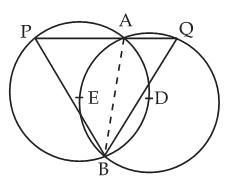 Join AB.
AB is the common chord.
We know that equal chords subtends equal angles,and here two circles are congruent.
Join AB.
AB is the common chord.
We know that equal chords subtends equal angles,and here two circles are congruent.

Q38. Prove that the angle subtended by an arc at
the center is double the angle subtended by it at any point on the remaining
part of the circle.
Solution
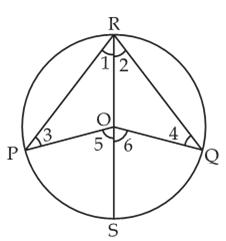 Given:
A circle with centre O in which PQ is any arc which makes
Given:
A circle with centre O in which PQ is any arc which makes  POQ at the centre and PRQ on the circle at R.
To
Prove: POQ = 2PRQ
Construction:
Join RO and produce which meet the circle at point S.
Proof
: In
POQ at the centre and PRQ on the circle at R.
To
Prove: POQ = 2PRQ
Construction:
Join RO and produce which meet the circle at point S.
Proof
: In  OPR
OP
= OR (Radii of the same circle)
1 = 3 (Opposite angles of equal sides)
Exterior
5 = 1 + 3 (by exterior angle theorem)
5
= 1 + 1
5
= 21
...(1)
Similarly,
6 = 22
...(2)
On
adding equation (1) and (2)
5
+ 6 = 21 + 22
POQ
= 2[1 + 2]
POQ
= 2PRQ
OPR
OP
= OR (Radii of the same circle)
1 = 3 (Opposite angles of equal sides)
Exterior
5 = 1 + 3 (by exterior angle theorem)
5
= 1 + 1
5
= 21
...(1)
Similarly,
6 = 22
...(2)
On
adding equation (1) and (2)
5
+ 6 = 21 + 22
POQ
= 2[1 + 2]
POQ
= 2PRQ
Q39. In the figure, chord AB of circle with
centre O, is produced to C such that BC = OB. CO is joined and produced to
meet the circle in D. If  ACD = y and AOD = x, show that x = 3y.

ACD = y and AOD = x, show that x = 3y.
Solution
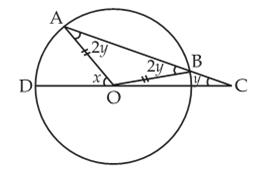 In
In
 OBC, OB = BC
BOC = BCO = y (angles
opp. to equal sides are equal)
ABO is the exterior angle of BCO
So,
ABO = 2y (ext.
angle is equal to the sum of int. opp. Angles)
ABO
= BAO (OA and OB
are radius of same circle)
Similarly,
AOD is the exterior angle of AOC.
OBC, OB = BC
BOC = BCO = y (angles
opp. to equal sides are equal)
ABO is the exterior angle of BCO
So,
ABO = 2y (ext.
angle is equal to the sum of int. opp. Angles)
ABO
= BAO (OA and OB
are radius of same circle)
Similarly,
AOD is the exterior angle of AOC.
 AOD
= BAO + ACO
AOD
= BAO + ACO
 = 2y + y = 3y
Q40. In the figure, if AB is the diameter of the circle, then the value of x is:

Solution
AB is the diameter.
Therefore,
 (angle in a semicircle)
In
(angle in a semicircle)
In  ,
,

(angle in a semicircle)
In ,
Q41. 
Solution
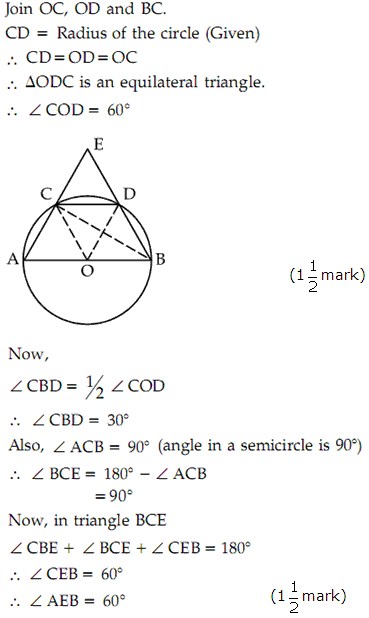
Q42. A regular polygon is inscribed in a circle. If a side subtends an angle of 36o at the centre, find the number of sides of the polygon. Name the polygon.
Solution

Q43. ABCD is a cyclic quadrilateral. Find  ADB
ADB

ADB
Solution
In a cyclic quadrilateral, opposite angles are
supplementary.
DAB
+ BCD = 180o
DAB
+ 120o = 180o
DAB
= 60o
In
 DAB,
DAB
+ ABD + ADB = 180o
60o + 50o + ADB = 180o
ADB
= 180o - 110o = 70o
DAB,
DAB
+ ABD + ADB = 180o
60o + 50o + ADB = 180o
ADB
= 180o - 110o = 70o
DAB
+ BCD = 180o
DAB
+ 120o = 180o
DAB
= 60o
In
DAB,
DAB
+ ABD + ADB = 180o
60o + 50o + ADB = 180o
ADB
= 180o - 110o = 70o
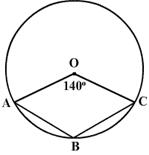
Q44. In the given figure, O is the centre of the
circle. The angle subtended by arc ABC at the centre is 140o. AB
is produced to P. Determine  ADC and CBP

ADC and CBP
Solution
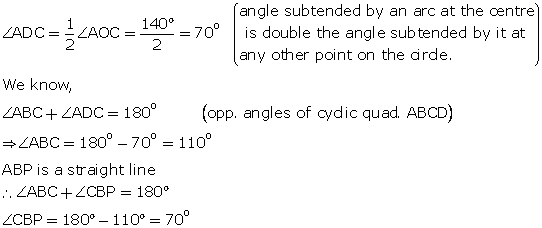
Q45. ABDC is a cyclic quadrilateral and AB = AC.
If  ACB = 70o find BDC.

ACB = 70o find BDC.
Solution
In
 AB
= AC
AB
= AC  ABC = ACB = 70o
 BAC + 70o+ + 70o = 180o
BAC
= 180o - 140o = 40o
ABCD
is a cyclic quadrilateral and opposite angles of a cyclic quadrilateral are
supplementary
BAC
+ BDC = 180o
40o+
BDC = 180o
BDC = 140o
BAC + 70o+ + 70o = 180o
BAC
= 180o - 140o = 40o
ABCD
is a cyclic quadrilateral and opposite angles of a cyclic quadrilateral are
supplementary
BAC
+ BDC = 180o
40o+
BDC = 180o
BDC = 140o
AB
= AC ABC = ACB = 70o
BAC + 70o+ + 70o = 180o
BAC
= 180o - 140o = 40o
ABCD
is a cyclic quadrilateral and opposite angles of a cyclic quadrilateral are
supplementary
BAC
+ BDC = 180o
40o+
BDC = 180o
BDC = 140o
Q46. 
Solution
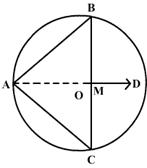
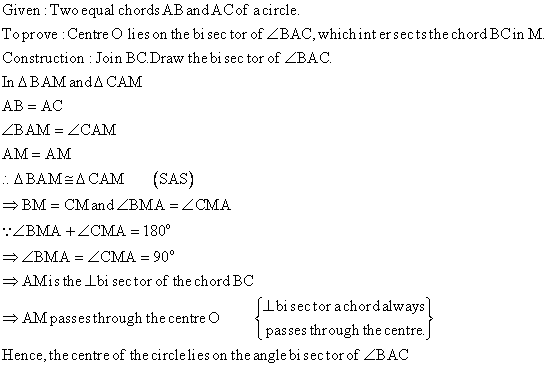
Q47. In the given figure, if  PQR is 40o, then the value of PSR is.

PQR is 40o, then the value of PSR is.
Solution
Angles in the same segment are equal.
Therefore, PQR = PSR = 40o
PQR = PSR = 40o
Q48. In a circle of radius 5 cm, AB and CD are two parallel chords of lengths 8 cm and 6 cm respectively. Find the distance between the chords if they are (i) on the same side of the centre. (ii) on the opposite sides of the centre.
Solution
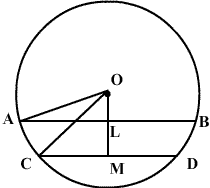
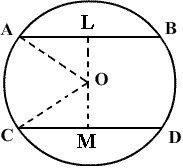
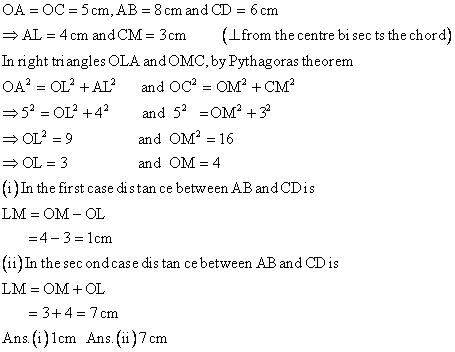
Q49. 
Solution
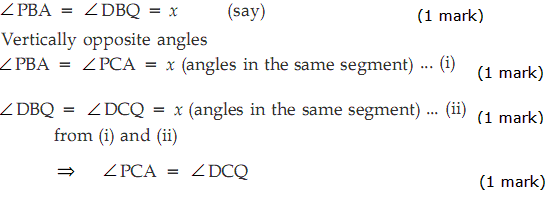
Q50. Draw a circle whose diameter is 4 cm. Mark the points P, Q, and R in the interior, exterior and on the circle respectively.
Solution
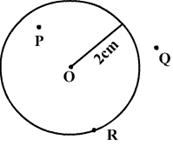
Q51. In the figure, if  BAC = 60o, ACB = 20o find ADC.

BAC = 60o, ACB = 20o find ADC.
Solution
ABC
= 180o - (BAC + BCA) (Angle sum property)
= 180o - 800 = 100o
ABCD
is a cyclic quadrilateral,
ABC
+ ADC = 180o
ADC
= 180o - 100 = 80o
Q52. In the figure, quadrilateral PQRS is cyclic. If  P = 80o, thenR =

P = 80o, thenR =
Solution
The sum of either pair of opposite angles of a cyclic quadrilateral is 180º.
Hence,
P + R = 180o
80o + R = 180o
R = 100o
P + R = 180o
80o + R = 180o
R = 100o
Q53. In the figure, if O is the centre of the circle and  BOA = 120o, then the value of x is

BOA = 120o, then the value of x is
Solution
OA = OC (radii of same circle)
 OAC =
OAC =  OCA(angles opposite to equal sides)
BOA = OAC + OCA
(Exterior angle of a triangle is equal to sum of interior angles)
1200 = 2OAC = 2x
OCA(angles opposite to equal sides)
BOA = OAC + OCA
(Exterior angle of a triangle is equal to sum of interior angles)
1200 = 2OAC = 2x
 x = 600
OAC = OCA(angles opposite to equal sides)
BOA = OAC + OCA
(Exterior angle of a triangle is equal to sum of interior angles)
1200 = 2OAC = 2x
x = 600
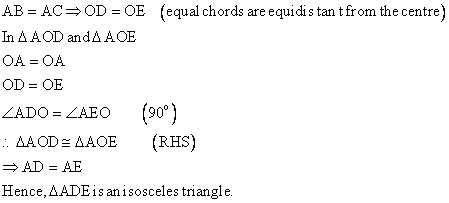
Q54. AB and AC are two equal chords of a circle whose centre is O. If OD is perpendicular to AB and OE is perpendicular to AC, prove that
 ADE is an isosceles triangle.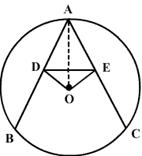
ADE is an isosceles triangle. Solution
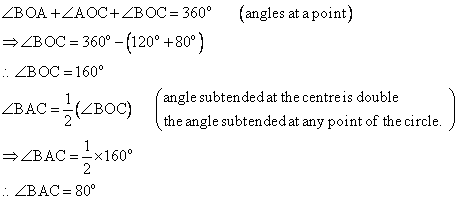
Q55. In the figure A, B and C are three points on a circle such that the angle subtended by the chords AB and AC at the centre are 120o and 80o respectively. Determine angle BAC. 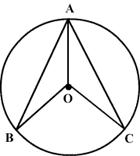
Solution
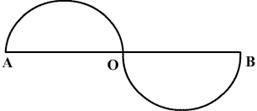
Q56. Draw a line segment AB of length 4.8 cm. Construct two semi-circles on opposite sides of AB such that half the length of AB is the diameter of each of the semi-circles.
Solution
Half the length of AB = 2.4. Let O be the mid point of AB.
Construct two semi-circles on opposite sides of AB, with AO and OB as diameters.
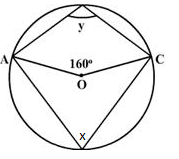
Q57. In the figure, O is the centre of the circle and  .
.
.Solution
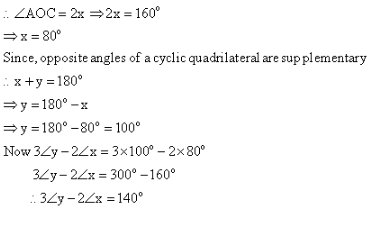
Since, angle at the centres is twice the angle at the remaining part of circumference.
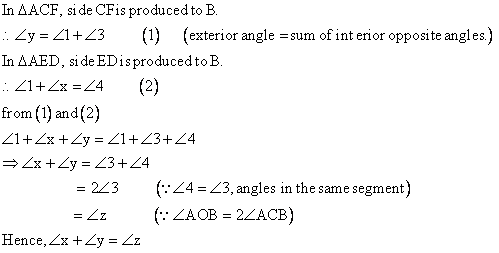
Q58. In the figure, O is the centre of a circle. Prove that x + y = z. 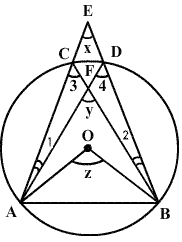
Solution
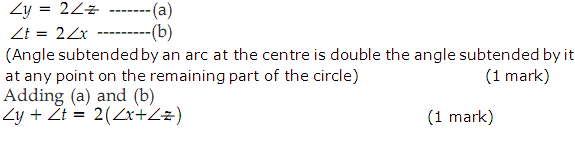
Q59. 
Solution
Q60. In the figure, O is the centre of the
circle, OM  BC, OL
AB, ON AC and OM = ON
= OL.
BC, OL
AB, ON AC and OM = ON
= OL.
 Is
Is  ABC equilateral? Given reasons.
BC, OL
AB, ON AC and OM = ON
= OL.
Is ABC equilateral? Given reasons. Solution
OL
AB, OM BC and ON AC
OM
= ON = OL
Perpendicular
distance of chords from the centre of a circle
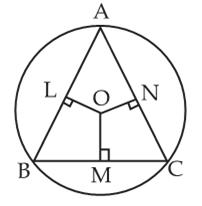
 AB = BC = AC [chords equidistant from the
centre of a circle are equal.]
ABC is an equilateral triangle.
AB = BC = AC [chords equidistant from the
centre of a circle are equal.]
ABC is an equilateral triangle.
AB, OM BC and ON AC
OM
= ON = OL
Perpendicular
distance of chords from the centre of a circle
AB = BC = AC [chords equidistant from the
centre of a circle are equal.]
ABC is an equilateral triangle.
Q61. Two parallel chords of a circle whose diameter is 13 cm are respectively 5 cm and 12 cm. Find the distance between them if they lie on opposite sides of centre.
Solution
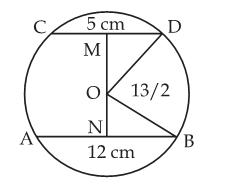 Let OM = x cm and ON = y cm

 .....(OM is perpendicular from centre to the chord)

 ....(ON is perpendicular from centre to the chord)

 Distance MN
Q62. Prove that quadrilateral formed (if
possible) by the internal angle bisectors of any quadrilateral is cyclic.
Solution
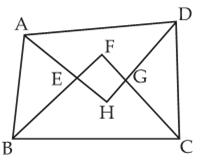 AH,
BF, CF and DH are bisectors of
AH,
BF, CF and DH are bisectors of  A, B, C and D respectively which form quadrilateral EFGH.
FEH
= AEB = 180o - EAB - EBA
(angles of
A, B, C and D respectively which form quadrilateral EFGH.
FEH
= AEB = 180o - EAB - EBA
(angles of  AEB)
= 180o
-
AEB)
= 180o
-  (A + B)
FGH = DGC = 180o - GDC - GCD (angles of
DGC)
= 180o
- (D + C)
(A + B)
FGH = DGC = 180o - GDC - GCD (angles of
DGC)
= 180o
- (D + C)
 FEH + FGH = 180o -

 EFGH is a cyclic quadrilateral
(If the sum of a pair of opposite angles of
a quadrilateral is 180º, then the quadrilateral is cyclic)
EFGH is a cyclic quadrilateral
(If the sum of a pair of opposite angles of
a quadrilateral is 180º, then the quadrilateral is cyclic)
Q63. O is the centre of the circle as shown in
the figure. Find  CBD
CBD

CBD
Solution
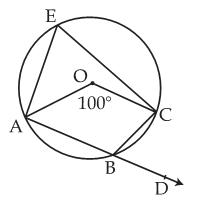 Take
a point E on the circle, join AE and CE.
Take
a point E on the circle, join AE and CE.
 AEC
+ ABC = 180o
(Opposite
Angles of a cyclic quadrilaterals)
AEC
+ ABC = 180o
(Opposite
Angles of a cyclic quadrilaterals)
 ABC = 130o
ABC
+ CBD = 180o (linear pair)
130o + CBD = 180o
CBD = 50o
ABC = 130o
ABC
+ CBD = 180o (linear pair)
130o + CBD = 180o
CBD = 50o
Q64. If two intersecting chord of a circle make equal angles with the diameter passing through their point of intersection, prove that the chords are equal.
Solution
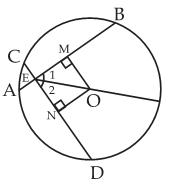 Let AB and CD be the two chords.
Construct OM
Let AB and CD be the two chords.
Construct OM  AB and ON CD
In
AB and ON CD
In  OME and ONE,
 1 = 2 (given)
OME = ONE = 90o
OE = OE (common)
1 = 2 (given)
OME = ONE = 90o
OE = OE (common)
 By AAS congruence rule,
 OM = ON (c.p.c.t)
Hence, AB = CD
(Since, chords equidistant from the centre are equal)
OM = ON (c.p.c.t)
Hence, AB = CD
(Since, chords equidistant from the centre are equal)
Q65. Prove that the angle subtended by an arc at the centre is double the angle subtended by it at any point on the remaining part of the circle.
Solution
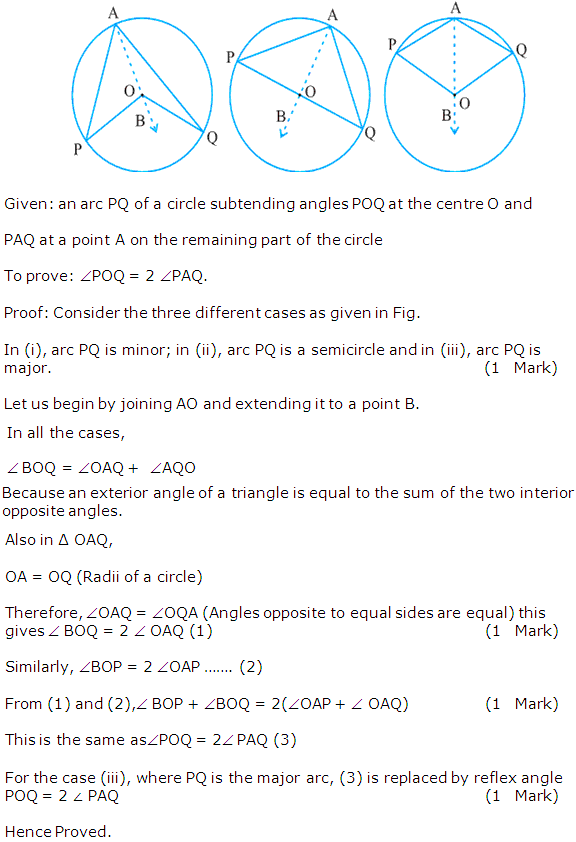
Q66. AC and BD are chords of a circle which bisect each other. Prove that
(i) AC and BD are diameters of the circle and
(ii) ABCD is a rectangle. 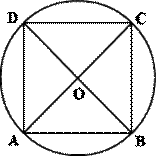
Solution

Q67. Two circles intersect at two points A and
B. AD and AC respectively are diameters to the two circles. Prove that B lies
on the line segment DC.
Solution
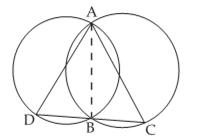 Join
AB.
Join
AB.
 ABD
= 90o (angle in a semicircle)
ABC
= 90o (angle in a semicircle)
ABD
= 90o (angle in a semicircle)
ABC
= 90o (angle in a semicircle)
 ABD + ABC = 90o + 90o = 180o
 DBC is a straight line and hence, B lies on
line DC
DBC is a straight line and hence, B lies on
line DC
Q68. 
Solution
Q69. 
Solution
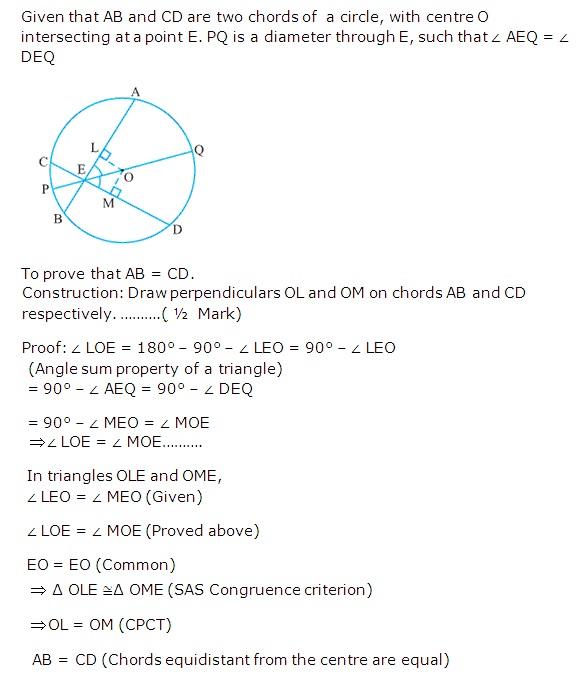
Q70. 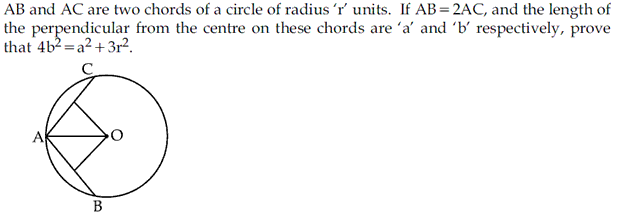
Solution
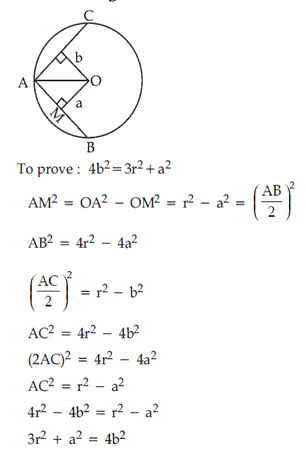
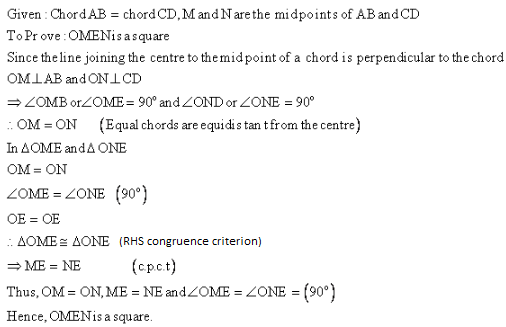
Q71. In the given figure, equal chords AB and CD of a circle C(O, r) cut at right angles at E. If M and N are the mid points of AB and CD respectively, prove that OMEN is a square. 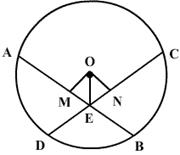
Solution
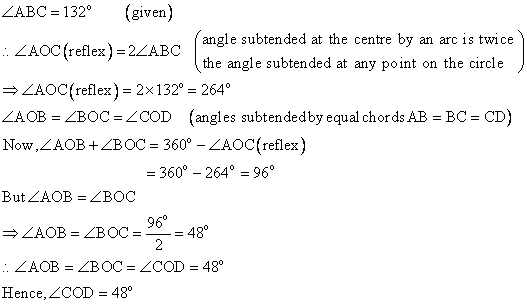
Q72. In the given figure, AB = BC = CD and angle ABC is 132o. Calculate angle COD.

Solution
Q73. Two circles of radii 10 cm and 8 cm intersect
each other at two points, and the length of the common chord is 12 cm. Find
the distance between their centers.
Solution
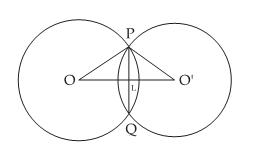 Let
O and O' be the centers of the circle of radii 10 cm and 8 cm respectively.
Let
PQ be their common chord.
We
have,
OP
= 10 cm
O'P
= 8 cm
PQ
= 12 cm
Let
O and O' be the centers of the circle of radii 10 cm and 8 cm respectively.
Let
PQ be their common chord.
We
have,
OP
= 10 cm
O'P
= 8 cm
PQ
= 12 cm
 (Perpendicular
from the center of the circle to a chord bisects the chord).
In
right
(Perpendicular
from the center of the circle to a chord bisects the chord).
In
right  OLP, we have
OP2
= OL2 + PL2
OLP, we have
OP2
= OL2 + PL2
 In
right O'LP we have
(O'P)2
= (PL)2 + (O'L)2
In
right O'LP we have
(O'P)2
= (PL)2 + (O'L)2

 OO' = 8 + 5.29
= 13.29 cm
OO' = 8 + 5.29
= 13.29 cm
Q74. In the given figure, O is the centre of the
circle. If  OAC = 35o and OBC = 40o, find the value of x.

OAC = 35o and OBC = 40o, find the value of x.
Solution
Join
OC
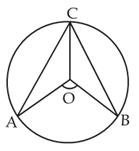 Since
OA = OC
Since
OA = OC
 ACO = OAC = 35o
Similarly,
OB = OC and OCB = OBC = 40o
ACO = OAC = 35o
Similarly,
OB = OC and OCB = OBC = 40o
 ACB = 35o + 40o = 75o
AOB = 2
ACB = 35o + 40o = 75o
AOB = 2  750 = 1500
(The
angle subtended by an arc at the centre is double the angle subtended by it
at any point on the remaining part of the circle.)
750 = 1500
(The
angle subtended by an arc at the centre is double the angle subtended by it
at any point on the remaining part of the circle.)
Since
OA = OC
ACO = OAC = 35o
Similarly,
OB = OC and OCB = OBC = 40o
ACB = 35o + 40o = 75o
AOB = 2 750 = 1500
(The
angle subtended by an arc at the centre is double the angle subtended by it
at any point on the remaining part of the circle.)
Q75. Prove that the opposite angles of a cyclic quadrilateral are supplementary.
Solution
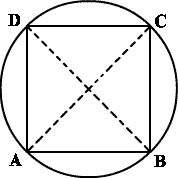
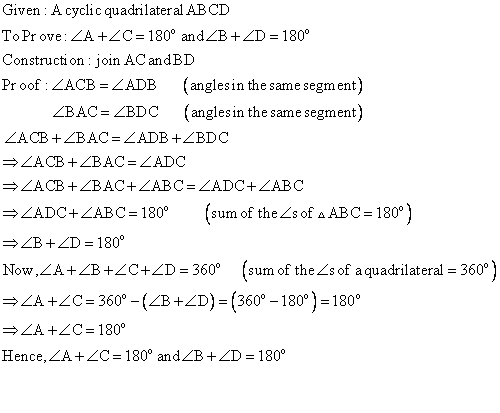
Q76. Prove that equal chords of congruent circles subtend equal angles at their centres
Solution
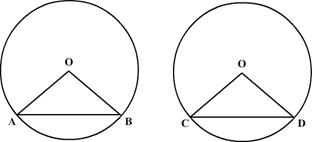 Given: Two congruent circles C(O, r) and C(P, r) such that AB and CD are equal chords of C(O, r) and C(P, r) respectively.

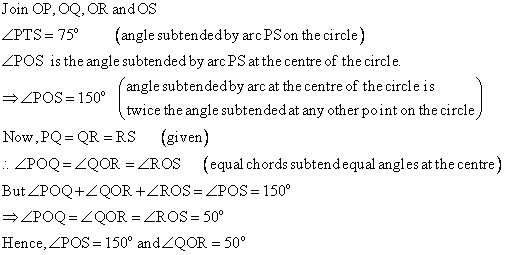
Q77. The given figure shows a circle with centre O. Also PQ = QR = RS and angle PTS = 75o. Calculate:
 .
.

.
Solution
Q78. Two equal chords AB and CD of a circle when
produced, intersect at point P. Prove that PB = PD.
Solution
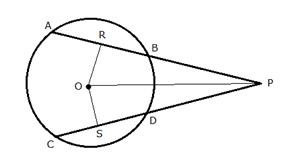 Const:
Join centre O to P. Draw
Const:
Join centre O to P. Draw  Proof: We have,
AB
= CD (given)
Proof: We have,
AB
= CD (given)
 OR = OS
(equal chords are equidistant from the centre)
In
OR = OS
(equal chords are equidistant from the centre)
In
 ORP and
  OSP,
OR
= OS
OSP,
OR
= OS
 (each 900)
and,
OP = OP (common)
ORP
(each 900)
and,
OP = OP (common)
ORP  OSP (RHS criterion)
RP
= SP …..(i)
Now,
AB = CD
OSP (RHS criterion)
RP
= SP …..(i)
Now,
AB = CD
 BR
= DS ……(ii)
Subtracting
(ii) from (i)
RP
- BR = SP - DS
PB
= PD
BR
= DS ……(ii)
Subtracting
(ii) from (i)
RP
- BR = SP - DS
PB
= PD
Q79. In the figure,  ABC = 45o, Prove that OA
  OC.
OC.

ABC = 45o, Prove that OA OC.
Solution
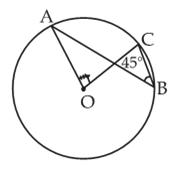 Join AC.
ABC
= 45o AOC AOC = 2 ABC
AOC
= 2
Join AC.
ABC
= 45o AOC AOC = 2 ABC
AOC
= 2  45o = 90o
Since,
the angle subtended by an
arc (here AC)at the centre is double the angle subtended by it at any point
on the remaining part of the circle.
45o = 90o
Since,
the angle subtended by an
arc (here AC)at the centre is double the angle subtended by it at any point
on the remaining part of the circle.
 OA OC.
Q80. Draw a circle with radius 2.1 cm. Draw three chords of the circle such that they form an equilateral triangle.
Solution
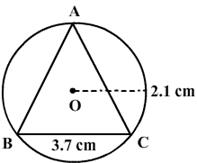 ABC is an equilateral triangle. Measure of each side is 3.7cm.
Q81. In fig., O is the center of the circle of
radius 5 cm. OP  AB, OQ
CD, AB||CD.
AB, OQ
CD, AB||CD.  = 6 cm,
  = 8 cm.
Determine PQ.
= 8 cm.
Determine PQ.

AB, OQ
CD, AB||CD. = 6 cm, = 8 cm.
Determine PQ.
Solution
Since
the perpendicular from the center of the circle to a chord bisects the chord.
 P and Q are the mid points of AB and CD
 In
right triangles OAP and OCQ, we have
OA2 = OP2 + AP2 and OC2 = OQ2
+ CQ2
52 = OP2 + 32 and 52 = OQ2 + 42
In
right triangles OAP and OCQ, we have
OA2 = OP2 + AP2 and OC2 = OQ2
+ CQ2
52 = OP2 + 32 and 52 = OQ2 + 42
 OP2 = 52 - 32 and OQ2
= 52 - 42
OP2 = 16 and OQ2 = 9
OP
= 4 and OQ = 3
PQ = OP
+ OQ = 4 + 3 = 7 cm
OP2 = 52 - 32 and OQ2
= 52 - 42
OP2 = 16 and OQ2 = 9
OP
= 4 and OQ = 3
PQ = OP
+ OQ = 4 + 3 = 7 cm
P and Q are the mid points of AB and CD
In
right triangles OAP and OCQ, we have
OA2 = OP2 + AP2 and OC2 = OQ2
+ CQ2
52 = OP2 + 32 and 52 = OQ2 + 42
OP2 = 52 - 32 and OQ2
= 52 - 42
OP2 = 16 and OQ2 = 9
OP
= 4 and OQ = 3
PQ = OP
+ OQ = 4 + 3 = 7 cm
Q82. Prove that a cyclic parallelogram is a
rectangle.
Solution
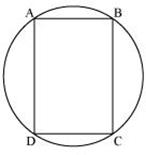 Let
ABCD be a cyclic parallelogram.
Let
ABCD be a cyclic parallelogram.
 ... (1)
(Opp. angles of a cyclic quadrilateral)
We
know that opposite angles of a parallelogram are equal.
... (1)
(Opp. angles of a cyclic quadrilateral)
We
know that opposite angles of a parallelogram are equal.
 From
equation (1),
From
equation (1),
 Parallelogram
ABCD has one of its interior angles as 90°. Therefore, it is a rectangle.
Parallelogram
ABCD has one of its interior angles as 90°. Therefore, it is a rectangle.
Q83. Prove that the line drawn through the centre of a circle to bisect a chord is perpendicular to the chord.
Solution
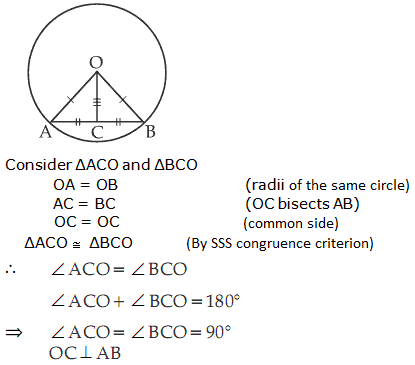
Q84. In a circle of radius 5 cm, AB and AC are
two chords such that AB = AC = 6 cm. Find length of chord BC.
Solution
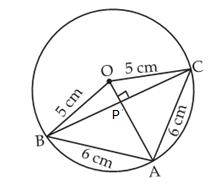 Given - AB and AC
are two equal words of a circle, therefore the centre of the circle lies on
the bisector of
Given - AB and AC
are two equal words of a circle, therefore the centre of the circle lies on
the bisector of  BAC.
BAC.
 OA is the bisector of BAC.
Again, the
internal bisector of an angle divides the opposite sides in the ratio of the
sides containing the angle.
OA is the bisector of BAC.
Again, the
internal bisector of an angle divides the opposite sides in the ratio of the
sides containing the angle.
 P divides BC in the ratio = 6 : 6 = 1 : 1.
P is mid-point of BC.
OP
P divides BC in the ratio = 6 : 6 = 1 : 1.
P is mid-point of BC.
OP  BC.
In
BC.
In  ABP, by Pythagoras theorem,
 In right OBP, we have
 Equating
(1) and (2), we get
Equating
(1) and (2), we get
 Putting AP
in (1), we get
Putting AP
in (1), we get
 or,alternate
method:
or,alternate
method:
 Area
of AOB by Heron's formula
Area
of AOB by Heron's formula
 arAOB) =
 Also
arAOB =
Also
arAOB = 

 BM
= h = 4.8 cm
BC
= 2 BM = 9.6 cm.
BM
= h = 4.8 cm
BC
= 2 BM = 9.6 cm.
Q85. The radius of a circle is 5 cm and the length of a chord in the circle is 8 cm. Find the distance of the chord from the centre of the circle.
Solution
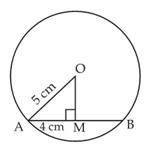 Radius of circle (r) = 5 cm
AB = 8 cm
OM
Radius of circle (r) = 5 cm
AB = 8 cm
OM  AB
AM = MB = 4 cm [ drawn from the centre of the circle bisects the chord]
In right
AB
AM = MB = 4 cm [ drawn from the centre of the circle bisects the chord]
In right  OMA, by Pythagoras theorem
OA2 = OM2 + AM2
52 = OM2 + (4)2
25 = OM2 + 16
OM2 = 9
OM = 3 cm
OMA, by Pythagoras theorem
OA2 = OM2 + AM2
52 = OM2 + (4)2
25 = OM2 + 16
OM2 = 9
OM = 3 cm
Q86. In the figure, ABCD is a cyclic
quadrilateral and  ABC = 85o. Find the
measure of ADE.
ABC = 85o. Find the
measure of ADE.

ABC = 85o. Find the
measure of ADE.
Solution
ABCD
is a cyclic quadrilateral.
ABC
+ ADC = 180o (opp. s are supplementary)
ADC
= 180o - 85o = 95o
ADE
= 180o - 95o = 85o (linear pair)
ABC
+ ADC = 180o (opp. s are supplementary)
ADC
= 180o - 85o = 95o
ADE
= 180o - 95o = 85o (linear pair)
Q87. Find the length of the chord which is at a distance of 4 cm from the center of a circle whose radius is 5 cm.
Solution
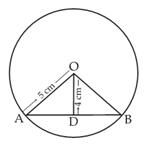 Since ODA is a right angled triangle
 By Pythagoras Theorem
(OA)2= (OD)2 + (AD)2
(5)2 = (4)2 + (AD)2
25 - 16= (AD)2
By Pythagoras Theorem
(OA)2= (OD)2 + (AD)2
(5)2 = (4)2 + (AD)2
25 - 16= (AD)2
 AD2 = 9
AD = 3 cm
Chord AB = 2
AD2 = 9
AD = 3 cm
Chord AB = 2  AD[
AD[ from the center on a chord bisects the chord]
= 2 3 = 6 cm
from the center on a chord bisects the chord]
= 2 3 = 6 cm
Q88. In the figure, PQ is a diameter of the
circle and XY is chord equal to the radius of the circle. PX and QY when
extended intersect at point E. Prove that  PEQ = 60o

PEQ = 60o
Solution
PQ
is the diameter of the circle, chord XY = r (radius of circle)
PX
and QY extended intersect at a point E.
To
prove PEQ = 60o
XY
= OX = OY [radii of a circle, Given]
 XOY
is an equilateral triangle
XOY
is an equilateral triangle

 XQY
= 30o [Inscribed angle is
half of the central angle]
PXQ = 90o [Angle in a semi circle]
XQY
= 30o [Inscribed angle is
half of the central angle]
PXQ = 90o [Angle in a semi circle]
 QXE = 180o - PXQ = 900 [Linear pair]
In
QXE = 180o - PXQ = 900 [Linear pair]
In
 XEQ,
XEQ
= 180o - (EXQ + EQX) (Angle
sum property)
XEQ = 180o - (900 + 300)
= 600
PEQ = 60o
XEQ,
XEQ
= 180o - (EXQ + EQX) (Angle
sum property)
XEQ = 180o - (900 + 300)
= 600
PEQ = 60o
PEQ = 60o
XY
= OX = OY [radii of a circle, Given]
XOY
is an equilateral triangle
XQY
= 30o [Inscribed angle is
half of the central angle]
PXQ = 90o [Angle in a semi circle]
QXE = 180o - PXQ = 900 [Linear pair]
In
XEQ,
XEQ
= 180o - (EXQ + EQX) (Angle
sum property)
XEQ = 180o - (900 + 300)
= 600
PEQ = 60o
Q89. 
Solution
Comments
Post a Comment