Q1. Which of the following polynomials has -3 as a zero?
Solution
Let p(x) = x2 - 9
Therefore, p(-3) = 9 - 9 = 0.
So -3 is the zero of p(x).
Q2. Factorize
: 
Solution

Q3. Simplify:
 .
.
.Solution



Q4. Zero of the polynomial p(x) where p (x) = ax, a  0 is :
0 is :- 1) 1
- 2) a
-
3)

- 4) 0
Solution
Since, p(0) = a x 0 = 0
Therefore, x = 0 is the zero.
Q5. Factorise : (x2
- 2x)2 - 2 (x2 - 2x) - 3.
Solution
(x2
- 2x)2 - 2(x2 - 2x) - 3
Put
y = (x2 - 2x)
 (x2 - 2x)2 - 2(x2
- 2x) -3 = y2 - 2y - 3
= y2 - 3y + y - 3
= y(y - 3) + 1(y - 3)
= (y + 1) (y - 3)
= (x2 - 2x+ 1) (x2
- 2x - 3)
= (x - 1)2 (x2
- 3x + x - 3)
= (x - 1)2 (x
(x- 3) + 1 (x - 3))
= (x - 1)2 (x -
3) (x + 1)
(x2 - 2x)2 - 2(x2
- 2x) -3 = y2 - 2y - 3
= y2 - 3y + y - 3
= y(y - 3) + 1(y - 3)
= (y + 1) (y - 3)
= (x2 - 2x+ 1) (x2
- 2x - 3)
= (x - 1)2 (x2
- 3x + x - 3)
= (x - 1)2 (x
(x- 3) + 1 (x - 3))
= (x - 1)2 (x -
3) (x + 1)
(x2 - 2x)2 - 2(x2
- 2x) -3 = y2 - 2y - 3
= y2 - 3y + y - 3
= y(y - 3) + 1(y - 3)
= (y + 1) (y - 3)
= (x2 - 2x+ 1) (x2
- 2x - 3)
= (x - 1)2 (x2
- 3x + x - 3)
= (x - 1)2 (x
(x- 3) + 1 (x - 3))
= (x - 1)2 (x -
3) (x + 1)
Q6. 
Solution
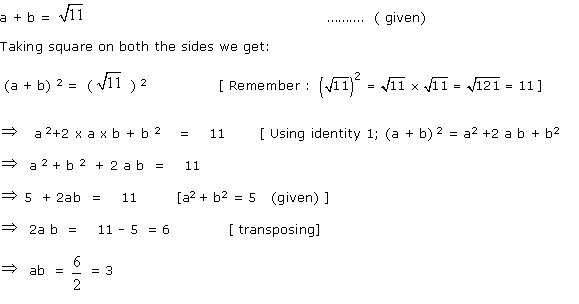
Q7. P(x) = q(x) × g(x) + r(x);

Solution
 P(x) = q(x) × g(x) + r(x)
r(x) is either
zero, a constant or a polynomial whose degree is less than q(x).
When a polynomial f(x) is divided by a
linear polynomial (x - a), then the remainder is f(a).
P(x) = q(x) × g(x) + r(x)
r(x) is either
zero, a constant or a polynomial whose degree is less than q(x).
When a polynomial f(x) is divided by a
linear polynomial (x - a), then the remainder is f(a).
Q8. In
y6 − 10y4 − 12y3 + 1, the coefficient of y3
is
Solution
In
y6 − 10y4 − 12y3 + 1, the coefficient of y3
is −12.
Q9. Which of the following is a trinomial in x?
- 1) x3 + 1
- 2) x3 + x2 + x
- 3) x3 + 2x
-
4)

Solution
 is trinomial in x.
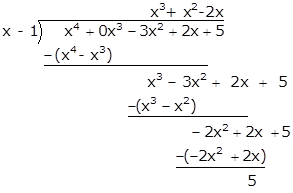
Q10. Divide p(x) = x4 − 3x2
+ 2x + 5 by (x − 1) using the long division method. Find the remainder.
Solution
f(x)
= x4 + 0x3 − 3x2 + 2x + 5
Long division method:
Q11. In
p(x) = 0, r is ___ of a polynomial p(x) if p(r) =
0.
Solution
In
p(x) = 0, r is a root, zero or the solution of a
polynomial p(x) if p(r) = 0.
Q12. Prove that x + 3 is a multiple of q(x) = x3 + 6x2 + 11x + 6 using Remainder theorem.
Solution

Q13. If p(x) = 7 - 3x + 2x2 then value of p(-2) is:
Solution
p(x) = 7 - 3x + 2x2
p(-2) = 7 + 6 + 8 = 21.
21
Q14. On dividing f(x) = 2x4 −
9x3 − 21x2 + 88x + 48 by (x − 2), we get the remainder
Solution
f(x)
= 2x4 − 9x3 − 21x2 + 88x + 48
We have (x − 2) =
0
∴ x = 2
By the remainder
theorem,
∴ f(2) = 2(2)4
- 9(2)3 − 21(2)2 + 88(2) + 48
= 32 - 72 - 84 + 176 + 48 = 100
Q15. Factorise : (i) (8b3 - 1)
(ii) (p3q3 + 343)
Solution
(i) (8b3 - 1) = [(2b)3 - 1]
= (2b - 1) [(2b)2 + 2b  1 + 12)
= (2b - 1) (4b2 + 2b + 1)
(ii) (p3q3 + 343)
= [(pq)3 + 73]
= (pq + 7) ((pq)2 - pq7 + 72)
= (pq + 7) (p2q2 - 7pq + 49)
1 + 12)
= (2b - 1) (4b2 + 2b + 1)
(ii) (p3q3 + 343)
= [(pq)3 + 73]
= (pq + 7) ((pq)2 - pq7 + 72)
= (pq + 7) (p2q2 - 7pq + 49)
1 + 12)
= (2b - 1) (4b2 + 2b + 1)
(ii) (p3q3 + 343)
= [(pq)3 + 73]
= (pq + 7) ((pq)2 - pq7 + 72)
= (pq + 7) (p2q2 - 7pq + 49)
Q16. q(x) is a multiple of (x + a); if on
dividing q(x) by (x + a), the remainder is
Solution
q(x) is a
multiple of (x + a); if on dividing q(x) by (x + a), the remainder is zero.
Q17. Degree of which of the following polynomial is zero?
Solution
Degree of the polynomial 15 is zero.
Q18. The factors of (2a - b)3 + (b - 2c)3 + 8(c - a)3 are
Solution
(2a - b)3 + (b - 2c)3 + 8(c - a)3
= (2a - b)3 + (b - 2c)3 + (2c - 2a)3
Since (2a - b) + (b - 2c) + (2c - 2a) = 0
Therefore, (2a - b)3 + (b - 2c)3 + (2c - 2a)3
= 3(2a - b)(b - 2c)(2c - 2a)
= 6(2a - b)(b - 2c)(c - a)
Q19. Which of the following is a binomial in y?
-
1)

-
2) y2 +

-
3) y +

-
4)

Solution
y2 + is a binomial in y.
is a binomial in y.
Q20. In
−1x + 2y = z, what are the variables?
Solution
A variable is a symbol which takes on
numerical values.
∴ x, y, z
are variables.
Q21. If x +
y + z = 1, xy + yz + zx = -1 and xyz = -1 then find the value of x3
+ y3 + z3.
Solution
Since
(x + y + z)2 = x2 + y2 + z2 - 2xy
- 2yz - 2zx
Or,
1 = x2 + y2 + z2 - 2 x -1
Or,
1 = x2 + y2 + z2 + 2
Or,
x2 + y2 + z2 = -1
Now,
x3
+ y3 + z3 - 3xyz = (x + y + z) (x2 + y2
+ z2 - xy - yz - zx)
x3
+ y3 + z3 = 3xyz + (x + y + z) (x2 + y2
+ z2 - xy - yz - zx)
= -3 + 1(-1 + 1)
x3
+ y3 + z3 = -3.
Q22. A
coefficient is a constant in the term of a
Solution
A coefficient is a constant in the
term of a polynomial.
Q23. 
Solution




Q24. What is the remainder when x5
+ 5x4 + 9x3 + 11x2 + 12x + 13 is divided by
x + 2? (Use the remainder theorem)
Solution
P(x) = x5 + 5x4
+ 9x3 + 11x2 + 12x + 13
x + 2 = 0
x = −2
P(−2) = (−2)5 + 5(−2)4
+ 9(−2)3 + 11(−2)2 + 12(−2) + 13
= −32 + 80 - 72 + 44 - 24 + 13 = 9
Q25. Zero of the polynomial p(x) = cx + d is:
-
1)

- 2) -c
-
3)

- 4) -d
Solution

Q26. Find the remainder when p(x) = 2x3
- 13x2 + 17x + 12 is divided by (x - 2).
Solution
f(x)
= 2x3 - 13x2 + 17x + 12
We
have (x − 2) = 0
∴ x = 2
By
the remainder theorem,
∴ f(2) = 2(2)3 − 13(2)2
+ 17(2) + 12
= 10
Q27. Which of the following is a polynomial in one variable?
-
1)

- 2) 3 - x2 + x
-
3)

- 4) x3 + y3 + 7
Solution
3 - x2 + x is a polynomial in one variable
Q28. (a) if p(y) = 4 + 3y - y2 + 5y3, find p(2).(b) Check whether (y + 2) is a factor of p(y).(c) Find the remainder when p(y) is divided by  .
.
.Solution
(a) Since p(y) = 4 + 3y - y2 + 5y3
Therefore, p(2) = 4 + 3(2) - (2)2 + 5(2)3 = 46
(b) p(-2) = 4 + 3(-2) - (-2)2 + 5(-2)3 = -46  0
0
 (y + 2) is not a factor of p(y)
(c) Required remainder = p
(y + 2) is not a factor of p(y)
(c) Required remainder = p


0
(y + 2) is not a factor of p(y)
(c) Required remainder = p
Q29. A monomial in a is a single term of
the form axn, a is a real number and n
is
Solution
A monomial in a is
a single term of the form axn, a is a
real number and n is a whole number.
Q30. If ,
then the remainder is
,
then the remainder is
,
then the remainder is -
1)

-
2)

-
3)

-
4)

Solution
If ,
then ax − b = 0,
,
then ax − b = 0,  ∴ Remainder =
,
then ax − b = 0,
∴ Remainder =
Q31. If 1875 is divided by 12, then what
is the remainder?
Solution
1875 = (12 × 156) + 3 …Dividend = (Divisor × Quotient) +
Remainder
Q32. If a - b = 7, a2 + b2
= 85 find a3 - b3.
Solution
a - b = 7
a2 + b2 = (a - b)2
+ 2ab  85 = 49 + 2ab
2ab =
36
ab = 18
a3 - b3 = (a - b)3
+ 3ab (a - b) = 343 + 54
85 = 49 + 2ab
2ab =
36
ab = 18
a3 - b3 = (a - b)3
+ 3ab (a - b) = 343 + 54  7
= 343 + 378 = 721
7
= 343 + 378 = 721
85 = 49 + 2ab
2ab =
36
ab = 18
a3 - b3 = (a - b)3
+ 3ab (a - b) = 343 + 54 7
= 343 + 378 = 721
Q33. What is the remainder when 2x2 −
5x − 1 is divided by x −3? (Use the remainder theorem)
Solution
P(x) = 2x2 − 5x − 1
x − 3 = 0
x = 3
P(3) = 2(3)2 - 5(3) − 1 = 18 -
15 − 1 = 2
Q34. If , the value of x3 - y3 is:
, the value of x3 - y3 is:- 1) 1
- 2) -1
- 3) 0
-
4)

Solution

Q35. Prove
that  = 1.
= 1.
= 1.Solution



 = a + b
= 0.75 + 0.25 = 1
= a + b
= 0.75 + 0.25 = 1
Q36. Prove
that:
2x3
+ 2y3 + 2z3 - 6xyz = (x + y + z) [(x - y)2 +
(y - z)2 + (z - x)2 hence evaluate 2(7)3 +
2(9)3 + 2(13)3 - 6(7) (9) (13).
Solution
 Now,
put x = 7, y = 9 and z = 13, we get
Now,
put x = 7, y = 9 and z = 13, we get

Q37.
In the following problem use the factor theorem to find if g(x) is a factor of p(x):
p(x) = x3 + x2 + 3x + 175 and g(x) = x + 5
Solution

Q38. In
a polynomial, none of the variables has a _____power.
Solution
In a polynomial, none of the
variables has a negative power.
Q39. Factorize
: 3x2 - x - 4
Solution
3x2
- x - 4
=
3x2 + 3x - 4x - 4
=
3x (x + 1) -4 (x + 1)
=
(x + 1) (3x - 4)
Q40. Evaluate
using suitable identity (999)3.
Solution

Q41. In
3z3 - 9x6 - 6y4 + z, the degree of the
polynomial is
Solution
The
degree of a polynomial is the degree of the leading term.
In
3z3 - 9x6 - 6y4 + z, the leading term is -9x6.
∴ The degree of
the polynomial is 6.
Q42. Factorise:

Solution
 = (3p)3
-
= (3p)3
-  =
= 
Q43. Find
the remainder when 3x3 - 4x2 + 7x - 5 is divided by (x
- 3) and (x + 3).
Solution
p(x) = 3x3 - 4x2 + 7x - 5
Remainder
when (x - 3) divides p(x) is
= p(3) = 3  33 -
4 32
+ 7 3 - 5
= 3 27 - 4 9 + 21 - 5 =
61
Remainder
when (x + 3) divides p(x) is
= p(-3) = 3 (-3)3
- 4(-3)2 + 7 (-3) - 5
= 3 (-27) - 4 9 - 21 - 5
= -143
Therefore,
the required remainders are 61 and -143.
33 -
4 32
+ 7 3 - 5
= 3 27 - 4 9 + 21 - 5 =
61
Remainder
when (x + 3) divides p(x) is
= p(-3) = 3 (-3)3
- 4(-3)2 + 7 (-3) - 5
= 3 (-27) - 4 9 - 21 - 5
= -143
Therefore,
the required remainders are 61 and -143.
33 -
4 32
+ 7 3 - 5
= 3 27 - 4 9 + 21 - 5 =
61
Remainder
when (x + 3) divides p(x) is
= p(-3) = 3 (-3)3
- 4(-3)2 + 7 (-3) - 5
= 3 (-27) - 4 9 - 21 - 5
= -143
Therefore,
the required remainders are 61 and -143.
Q44. Which of the following is a
polynomial?
-
1)

- 2) 2x + 3y + 5z
- 3) x−2 + 2
-
4)

Solution
An algebraic expression in which the
variable has non-negative integral exponents only is a polynomial.
∴ 2x + 3y + 5z is a polynomial.
Q45. Degree of the polynomial p(x) = 4x4 + 2x3 + x5 + 2x + 7 is:
Solution
The exponent of the highest degree term in a polynomial is known as its degree.
Here, highest degree of a term = 5.Therefore,degree ofpolynomial=5
Q46. If (x
+ y + z) = 0, then prove that (x3 + y3 + z3)
= 3xyz.
Solution
x+y+z = 0  x+y = -z
(x+y)3= (-z)3
x3+y3+3xy(x+y)=
-z3
x3+y3+3xy(-z)=
-z3 [x+y= -z]
x3+y3-3xyz=
-z3
x3+y3+z3=
3xyz
Hence, x+y+z= 0 x3+y3+z3= 3xyz
x+y = -z
(x+y)3= (-z)3
x3+y3+3xy(x+y)=
-z3
x3+y3+3xy(-z)=
-z3 [x+y= -z]
x3+y3-3xyz=
-z3
x3+y3+z3=
3xyz
Hence, x+y+z= 0 x3+y3+z3= 3xyz
x+y = -z
(x+y)3= (-z)3
x3+y3+3xy(x+y)=
-z3
x3+y3+3xy(-z)=
-z3 [x+y= -z]
x3+y3-3xyz=
-z3
x3+y3+z3=
3xyz
Hence, x+y+z= 0 x3+y3+z3= 3xyz
Q47. Factorize
:
8
- 27x3 - 36x + 54x2
Solution
8
- 27x3 - 36x + 54x2
=
(2)3 + (-3x)3 + 3(2)2(-3x)
+ 3(2)( - 3x)2
=
(2 - 3x)3
=
(2 - 3x) (2 - 3x) (2 - 3x)
Q48. Factorize: x3 + 6x2 + 11x + 6.
Solution

Q49. Factorize:
 .
.
.
Solution




Q50. What is
the remainder when 5x3 - x2 + 6 is divided by x − 4?
Solution
P(x) = 5x3 - x2 + 6
x − 4 = 0
x = 4
P(4) = 5(4)3 - 42 +
6 = 310
Q51. If a polynomial f(x) is divided by x - a then remainder is
Solution
By remainder theorem the remainder is f(a).
Q52. The remainder obtained when the polynomial p(x) is divided by (b - ax) is:
-
1)

-
2)

-
3)

-
4)

Solution
Taking, b - ax = 0 we get x= b/a, therefore remainder is:
Q53. Factorise: 2x3 + 7x2 - 3x - 18.
Solution
p(x) = 2x3 + 7x2 - 3x - 18
consider, p(1) = 2 + 7 - 3 - 18  0
p(-1) = -2 + 7 + 3 - 18 0
p(2) = 16 + 28 - 6 - 18 0
p(-2) = -16 + 28 + 6 - 18 = 0
0
p(-1) = -2 + 7 + 3 - 18 0
p(2) = 16 + 28 - 6 - 18 0
p(-2) = -16 + 28 + 6 - 18 = 0
 (x + 2) is a factor of p(x).
 p(x) = (x + 2) (2x2 + 3x - 9)
= (x + 2) (2x2 + 6x - 3x - 9)
= (x + 2) (2x (x + 3) - 3 (x + 3)
= (x + 2) (x + 3) (2x - 3)
p(x) = (x + 2) (2x2 + 3x - 9)
= (x + 2) (2x2 + 6x - 3x - 9)
= (x + 2) (2x (x + 3) - 3 (x + 3)
= (x + 2) (x + 3) (2x - 3)
0
p(-1) = -2 + 7 + 3 - 18 0
p(2) = 16 + 28 - 6 - 18 0
p(-2) = -16 + 28 + 6 - 18 = 0
(x + 2) is a factor of p(x).
p(x) = (x + 2) (2x2 + 3x - 9)
= (x + 2) (2x2 + 6x - 3x - 9)
= (x + 2) (2x (x + 3) - 3 (x + 3)
= (x + 2) (x + 3) (2x - 3)
Q54. A
polynomial with 3 terms is called a
Solution
A
polynomial with 3 terms is called a trinomial.
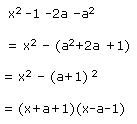
Q55. Factorise x2 -1 -2a - a2
Solution
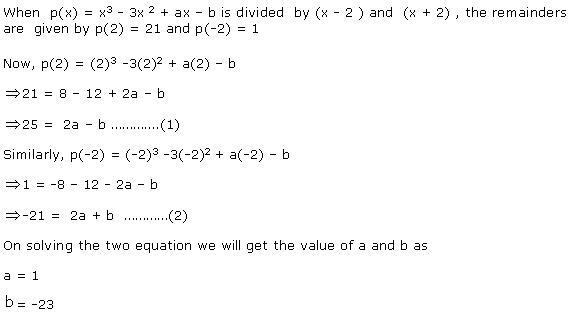
Q56. If the polynomial p(x) = x3 - 3x2 + ax - b is such that when divided by (x - 2 ) and (x + 2), the remainders are 21 and 1 respectively. Find the values of a and b.
Solution
Q57. One of the factors of (16y2 - 1) + (1 - 4y)2 is
Solution

Q58. What is remainder when x3 - 2x2 + x + 1 is divided by (x -1)?
Solution
Remainder = 1 - 2 + 1 + 1 = 1.
Q59. If (x - 2) is a factor of the polynomial x3 - 2ax2 + ax - 1, find the value of 'a'.
Solution

Q60. If x51 + 51 is divided by (x + 1) the remainder is:
Solution
If f(x) = x51 + 51 is divided by (x + 1) the remainder is given by:
f(-1) = (-1)51 + 51 = -1 + 51 = 50.
Q61. The coefficient of x2 in (3x + x3)  is:
is:
is:Solution
 Hence the coefficient of x2 is 4.
Q62. The degree of a non-zero constant
polynomial is always
Solution
The
degree of a non-zero constant polynomial is always zero.
Q63. Degree of zero polynomial is:
Solution
Degree of zero polynomial is not defined.
Q64. Factorise: (x2 - 2x)2
- 11 (x2 - 2x) + 24
Solution
Put
x2 - 2x = y
So,
(x2 - 2x)2 - 11 (x2 - 2x) + 24
= y2 - 11y +
24
= y2 - 8y -
3y + 24
= y(y - 8) - 3(y - 8)
= (y - 8) (y - 3)
= (x2 - 2x -
8)(x2 - 2x - 3)
= (x2 - 4x + 2x
- 8)(x2 - 3x + x - 3)
= (x + 2) (x - 4)
(x - 3) (x + 1)
Q65. Factorize
: (x - y)3 + (y - z)3 + (z - x)3
Solution
Let
a = x - y, b = y - z, c = z - x
Here,
a + b + c = x - y + y - z + z - x = 0
Now
if a + b + c = 0 then x3 + y3 + z3 = 3xyz
Hence,
(x
- y)3 + (y - z)3 + (z - x)3 = 3(x - y) (y - z) (z - x).
Q66. Find the remainder when f(x) = 2x2
- 11x − 20 is divided by (2x + 3).
Solution
2x + 3 = 0
∴ x =  We have f(x) = 2x2
- 11x − 20
We have f(x) = 2x2
- 11x − 20

We have f(x) = 2x2
- 11x − 20
Q67. Factorise : a7b +ab7
Solution
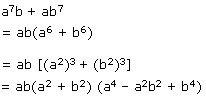
Q68. Evaluate (999)3.
Solution
(999)3
= (1000 - 1)3
(a
- b)3 = a3 - b3 - 3a2b + 3ab2
(999)3
= (1000)3 - (1)3 - 3 (1000)2  1 + 3 1000 12
= 1000000000 - 1 - 3000000 + 3000
= 997000000 + 3000 - 1 = 997002999
1 + 3 1000 12
= 1000000000 - 1 - 3000000 + 3000
= 997000000 + 3000 - 1 = 997002999
1 + 3 1000 12
= 1000000000 - 1 - 3000000 + 3000
= 997000000 + 3000 - 1 = 997002999
Q69. If p(x) =  then p (-1) is:
then p (-1) is:-
1)

-
2)

-
3)

-
4)

Solution

Q70. The value of p for which x + p is a factor of x2 + px + 3 - p is:
Solution
(x + p) is a factor if
(-p)2 + p(-p) +3 - p =0

Q71. On dividing f(x) = x3 −
4x2 + 2x − 3 by (x + 2), we get the remainder
Solution
f(x)
= x3 − 4x2 + 2x - 3
We
have (x + 2) = 0
∴ x = −2
By
the remainder theorem,
∴ f(−2) = (−2)3
- 4(−2)2 + 2(−2) - 5 = −8 - 16 - 4 − 3= −31
Q72. If a +
b = 10 and a2 + b2 = 58, find the value of a3
+ b3.
Solution






Q73. Prove that x2 + 6x + 15 has no zero.
Solution
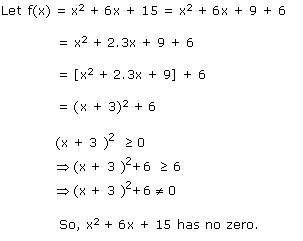
Q74. Without
actually calculating the cubes, find the value of 753 - 253
- 503.
Solution
Let x
= 75, y = -25, z = -50
x + y
+ z = 75 - 25 - 50 = 0
We
know, if x + y + z = 0 then x3 + y3 + z3 =
3xyz
753
- 253 - 503 = 3(75) (-25) (-50)
= 281250
Q75. 
Solution
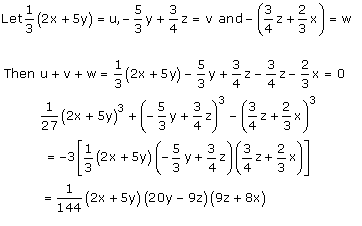
Q76. Which of the following is a multiple
of x3 + 7x2 + 7x − 6?
Solution
q(x)
= x3 + 7x2 + 7x − 6
x
+ 2 = 0
∴ x = −2
q(−2)
= (−2)3 + 7(−2)2 + 7(−2) − 6 = −8 + 8 - 14 - 6 = 0
Q77. If
x and y be two positive real number such that 8x3 + 27y3
= 730 and 2x2y + 3xy2 = 15 then show that 2x + 3y = 10.
Solution
8x3
+ 27y3 = 730
2x2y
+ 3xy2 = 15
(2x
+ 3y)3 = (2x)3 + (3y)3 + 3 (2x) (3y) (2x +
3y)
= 8x3 + 27y3
+ 18xy (2x + 3y)
(2x
+ 3y)3 = 8x3 +
27y3 + 18 (2x2y + 3xy2)
(2x
+ 3y)3 = 730 + 18 (15)
= 730 + 270
(2x
+ 3y)3 = 1000
2x
+ 3y = 10
Q78. If a2
+ b2 + c2 = 30 and a + b + c = 10 then find the value
of ab + bc + ca.
Solution
We
have
(a
+ b + c)2 = a2 + +b2 + c2 + 2ab +
2bc + 2ca
(a
+ b+ c)2 = a2 + b2 + c2 + 2(ab +
bc + c + ca)
(10)2
= 30 + 2(ab + bc + ca)
100
- 30 = 2(ab + bc + ca)
70
= 2(ab + bc + ca)
35
= ab + bc + ca
Q79. If a = 1 -  , find
, find Solution
a
= 1 - , 

,
Q80. If
(x-2) is a factor of the polynomial x3 + ax2 + b x + 6
and when divided by (x-3), it leaves remainder 3. Find the values of a and b.
Solution
Let p(x) = x3 + ax2 + bx +6
(x-2) is a factor of the polynomial x3
+ ax2 + b x +6
 p(2) = 0
p(2) = 23 + ax 22 + b x 2 +6
=8+4a+2b+6
=14+ 4a+ 2b = 0
7 +2 a +b = 0
b = - 7
-2a…(i)
x3 + ax2 + bx +6 when
divided by (x-3) leaves remainder 3.
p(3) = 3
p(3) = 33 + ax 32 + b x 3 +6
= 27+9a +3b +6
=33+9a+3b = 3
11+3a +b =1
3a+b =-10
b=-10-3a….(ii)
Equating the value of b from (ii) and (i) , we have
(- 7 -
2a) = (-10 - 3a)
a =
-3
Substituting a = -3 in (i), we get
b = - 7 -2(-3) = -7 + 6 = -1
Thus the values of a and b are -3 and -1
respectively.
p(2) = 0
p(2) = 23 + ax 22 + b x 2 +6
=8+4a+2b+6
=14+ 4a+ 2b = 0
7 +2 a +b = 0
b = - 7
-2a…(i)
x3 + ax2 + bx +6 when
divided by (x-3) leaves remainder 3.
p(3) = 3
p(3) = 33 + ax 32 + b x 3 +6
= 27+9a +3b +6
=33+9a+3b = 3
11+3a +b =1
3a+b =-10
b=-10-3a….(ii)
Equating the value of b from (ii) and (i) , we have
(- 7 -
2a) = (-10 - 3a)
a =
-3
Substituting a = -3 in (i), we get
b = - 7 -2(-3) = -7 + 6 = -1
Thus the values of a and b are -3 and -1
respectively.
p(2) = 0
p(2) = 23 + ax 22 + b x 2 +6
=8+4a+2b+6
=14+ 4a+ 2b = 0
7 +2 a +b = 0
b = - 7
-2a…(i)
x3 + ax2 + bx +6 when
divided by (x-3) leaves remainder 3.
p(3) = 3
p(3) = 33 + ax 32 + b x 3 +6
= 27+9a +3b +6
=33+9a+3b = 3
11+3a +b =1
3a+b =-10
b=-10-3a….(ii)
Equating the value of b from (ii) and (i) , we have
(- 7 -
2a) = (-10 - 3a)
a =
-3
Substituting a = -3 in (i), we get
b = - 7 -2(-3) = -7 + 6 = -1
Thus the values of a and b are -3 and -1
respectively.
Q81. Prove
that (x+y)3 - (x - y)3 - 6y (x2 - y2) = 8y3.
Solution
(x+y)3 -(x-y)3-6y(x2
- y2)


 i.e.,
i.e.,
 where a =x+y
b = x-y
But
where a =x+y
b = x-y
But  = (a-b)3
Therefore, (a-b)3 = {x+y-(x-y)}3
=
= (a-b)3
Therefore, (a-b)3 = {x+y-(x-y)}3
=
i.e.,
where a =x+y
b = x-y
But = (a-b)3
Therefore, (a-b)3 = {x+y-(x-y)}3
=
Q82. In
y6 − 10y4 − 12y3 + 1, the degree of the
polynomial is
Solution
The highest power of the variable in the
polynomial is the degree of the polynomial.
In
y6 − 10y4 − 12y3 + 1, the degree of the
polynomial is 6.
Q83. Factorize: p(x) = 2x3 - 13x2 + 12x + 10
Solution
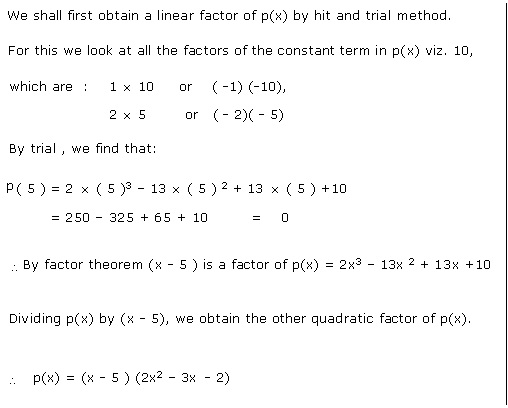
Q84. Simplify:
 .
.
.Solution
(a
+ b + c)2 + (a - b + c)2 + (a + b - c)2
=
a2 + b2 + c2 + 2 b + 2
b + 2  c + 2a
 + a2 + b2 + c2
- 2b - 2c + 2ca
+ a2 + b2 + c2
+ 2ab - 2bc - 2c
=
2(a2 + b2 + c2) +2(ca + ab - bc)
+ a2 + b2 + c2
- 2b - 2c + 2ca
+ a2 + b2 + c2
+ 2ab - 2bc - 2c
=
2(a2 + b2 + c2) +2(ca + ab - bc)
b + 2 c + 2a
+ a2 + b2 + c2
- 2b - 2c + 2ca
+ a2 + b2 + c2
+ 2ab - 2bc - 2c
=
2(a2 + b2 + c2) +2(ca + ab - bc)
Q85. For what value of a if the
polynomial 2x3 + ax2 + 11x + a + 3 is exactly divisible
by 2x - 1.
Solution
Let p(x) =  If p(x) is exactly divisible by (2x-1) then
(2x-1) is a factor of p(x)
Thus p
If p(x) is exactly divisible by (2x-1) then
(2x-1) is a factor of p(x)
Thus p = 0
= 0


 Thus p(x) is exactly divisible by (2x-1) at a =
-7
Thus p(x) is exactly divisible by (2x-1) at a =
-7
If p(x) is exactly divisible by (2x-1) then
(2x-1) is a factor of p(x)
Thus p = 0
Thus p(x) is exactly divisible by (2x-1) at a =
-7
Q86. Expand:
(a)
 (b)
(b) 
(b) Solution
(a) =  =
=  =
=  (b) =
(b) =  =
= 
=
=
=
(b) =
=
Q87. What is the remainder when x3 −
12x2 − 42 is divided by x − 3?
Solution
P(x) = x3 −
12x2 − 42
x − 3 = 0
x = 3
P(3) = (3)3
- 12(3)2 − 42 = 27 - 108 - 42
= −123
Q88. If
f(x) = x4 - 2x3 + 3x2 - ax + b is divided
by(x - 1) and (x + 1), it leaves the remainder 5 and 19 respectively. Find
'a' and 'b'.
Solution
Given f(x) = x4 - 2x3 +
3x2 - ax + b
When f(x) is divided by (x-1), it leaves a
remainder 5
 f(1) = 5
 1 - 2(1)3
+ 3(1)2 - a(1) + b = 5
1 - 2
+ 3 - a +b = 5
-a +
b = 3 … (i)
When f(x) is divided by (x+1), it leaves a
remainder 19
f(-1) = 19
(-1)4
- 2(-1)3 + 3(-1)2 - a(-1) + b = 19
1 + 2 + 3 + a + b = 19
a +b = 13 … (ii)
Adding (i) and (ii),
2b = 16 b = 8
(i) a = b - 3 = 8 - 3 =
5
1 - 2(1)3
+ 3(1)2 - a(1) + b = 5
1 - 2
+ 3 - a +b = 5
-a +
b = 3 … (i)
When f(x) is divided by (x+1), it leaves a
remainder 19
f(-1) = 19
(-1)4
- 2(-1)3 + 3(-1)2 - a(-1) + b = 19
1 + 2 + 3 + a + b = 19
a +b = 13 … (ii)
Adding (i) and (ii),
2b = 16 b = 8
(i) a = b - 3 = 8 - 3 =
5
f(1) = 5
1 - 2(1)3
+ 3(1)2 - a(1) + b = 5
1 - 2
+ 3 - a +b = 5
-a +
b = 3 … (i)
When f(x) is divided by (x+1), it leaves a
remainder 19
f(-1) = 19
(-1)4
- 2(-1)3 + 3(-1)2 - a(-1) + b = 19
1 + 2 + 3 + a + b = 19
a +b = 13 … (ii)
Adding (i) and (ii),
2b = 16 b = 8
(i) a = b - 3 = 8 - 3 =
5
Q89. If both (x - 2) and (2x - 1) are factors of ax2 + 5x + b, show that a - b = 0.
Solution
Let p(x) = ax2 + 5x + b
Since both (x - 2) and (2x - 1) are factors of ax2 + 5x + b.
x = 2 or x = 1/2
Therefore, substituting x = 2 in the equation,
4a + 10 + b = 0
Or, 4a + b = -10… (1)
Also, x = 1/2, therefore, substituting x = 1/2 in the equation,

 On solving (1) and (2), a = -2 and b = -2
Hence, a - b = -2 - (-2) = 0.
On solving (1) and (2), a = -2 and b = -2
Hence, a - b = -2 - (-2) = 0.
On solving (1) and (2), a = -2 and b = -2
Hence, a - b = -2 - (-2) = 0.
Q90. Verify x3
+ y3 + z3 - 3xyz =  (x + y + z)
[(x - y)2 + (y - z)2 + (z - x)2] and
factorise 64x3 - 125y3 - 64z3 + 240 xyz.
(x + y + z)
[(x - y)2 + (y - z)2 + (z - x)2] and
factorise 64x3 - 125y3 - 64z3 + 240 xyz.
(x + y + z)
[(x - y)2 + (y - z)2 + (z - x)2] and
factorise 64x3 - 125y3 - 64z3 + 240 xyz.Solution
 (x + y + z) [ (x - y)2 + (y - z)2
+ (z - x)2]
(x + y + z) [ (x - y)2 + (y - z)2
+ (z - x)2]
 (x + y + z) (x2 + y2 -
2xy + y2 + z2 - 2yz + z2 + x2 -
2xz)
=
(x + y + z)
(2x2 + 2y2 + 2z2 - 2xy - 2yz - 2xz)
=
(x + y + z) (x2 + y2 -
2xy + y2 + z2 - 2yz + z2 + x2 -
2xz)
=
(x + y + z)
(2x2 + 2y2 + 2z2 - 2xy - 2yz - 2xz)
=
 2 (x + y + z)
(x2 + y2 + z2 - xy - yz - xz)
=
(x + y + z) (x2 + y2 + z2 - xy - yz - xz)
=
x3 + y3 + z3 - 3xyz = LHS.
Consider,
64x3
+ 125y3 - 64z3 + 240 xyz
=
(4x)3 + (5y)3 + (-4z)3 - 3 (4x) (5y) (-4z)
=
(4x + 5y - 4z) (16x2 + 25y2 + 16z2 - 20xy + 20yz + 16xz)
2 (x + y + z)
(x2 + y2 + z2 - xy - yz - xz)
=
(x + y + z) (x2 + y2 + z2 - xy - yz - xz)
=
x3 + y3 + z3 - 3xyz = LHS.
Consider,
64x3
+ 125y3 - 64z3 + 240 xyz
=
(4x)3 + (5y)3 + (-4z)3 - 3 (4x) (5y) (-4z)
=
(4x + 5y - 4z) (16x2 + 25y2 + 16z2 - 20xy + 20yz + 16xz)
Q91. Find  for p(t) = t2 - t + 2
for p(t) = t2 - t + 2-
1)

-
2)

-
3)

-
4)

Solution

Q92. Without calculating the square of any number , calculate the value of the following: 497  503
503
503Solution
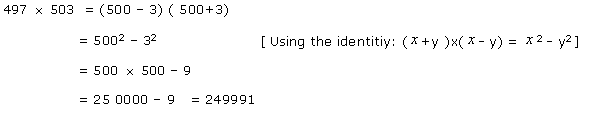
Q93. Factorize:
a7 + ab6.
Solution





Q94. Find
the zeroes of the polynomial 
Solution

Q95. Without actually evaluating the cubes, find the value of: 153 - 63 - 93
Solution
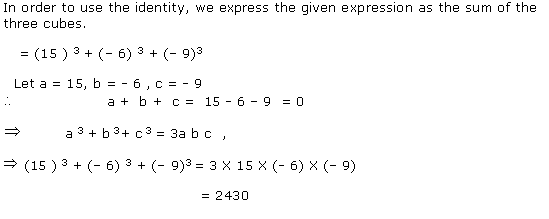
Q96. Factorise:
x6 - 729.
Solution
x6
- 729
=
(x2)3 - (9)3
[(x2)
- (9)] [(x2)2 + (x2) (9) + (9)2]
=
(x2 - 9) (x4 + 9x2 + 81)
=
(x - 3)(x + 3) (x4 + 9x2 + 81)
Q97. The coefficient of 
Solution
 So the coef. of x2 is 17.
Q98. Factorise the polynomial x4 + 5x2 - 6
Solution
x4 + 5x2 - 6
Putting x2 = y ,
the polynomial can be written as y2 + 5y - 6
Factorizing it further,
here a = 1, c = -6 , ac = -6
b = 5 = 6 - 1
y2 + 5y - 6
= y2 + 6y - y - 6
= y(y + 6) - 1(y + 6)
= (y - 1)( y + 6)
= ( x2 - 1) (x2 + 6) [ putting back x2 = y ]
= ( x - 1) (x + 1) (x2 + 6)
Q99. If
x +  = 7 then find
the value of x3 +
= 7 then find
the value of x3 +  .
.
= 7 then find
the value of x3 + .Solution
We know

 …
(i)
…
(i)



…
(i)
Q100. Factorise
: a3(b - c)3 + b3 (c - a)3 + c3
(a - b)3
Solution
[a
(b - c)]3 + [b (c - a)]3 + [c (a - b)]3
Here,
a
(b - c) + b (c - a) + c (a - b)
=
ab - ac + bc - ab + ca - bc
=
0
 [a (b - c)]3 + [b (c - a)]3
+ [c (a - b)]3
= 3 a (b - c)
[a (b - c)]3 + [b (c - a)]3
+ [c (a - b)]3
= 3 a (b - c)  b (c - a) c (a - b)
=
3 abc (a - b) (b -c) (c - a)
b (c - a) c (a - b)
=
3 abc (a - b) (b -c) (c - a)
[a (b - c)]3 + [b (c - a)]3
+ [c (a - b)]3
= 3 a (b - c) b (c - a) c (a - b)
=
3 abc (a - b) (b -c) (c - a)
Q101. Without actual division prove that
x4 + 2x3 - 2x2 + 2x -3 is exactly divisible
by x2 + 2x - 3.
Solution
Let f(x) =  and g(x)
=
and g(x)
= =
=
 =
(x + 3)(x - 1)
=
(x + 3)(x - 1)
 of g(x)




 f(x) is
divisible by (x+3) and (x-1). Hence f(x) is exactly divisible by g(x).
f(x) is
divisible by (x+3) and (x-1). Hence f(x) is exactly divisible by g(x).
and g(x)
=
=
=
(x + 3)(x - 1)
of g(x)
f(x) is
divisible by (x+3) and (x-1). Hence f(x) is exactly divisible by g(x).
Q102. Using
suitable identity evaluate (-32)3 + (18)3 + (14)3.
Solution
We
know
x3 + y3 + z3
- 3xyz = 0, if x + +y + z = 0
Let
x = -32,
y = 18, z = 14
x + y + z = (-32) + (18) + (14) = 0
Therefore,
(-32)3
+ (18)3 + (14)3 = 3(-32) (18) (14)
= -24192
Q103. If
x + y + z = 1, xy + yz + zx = -1 and xyz = -1 find the value of x3+y3+z3.
Solution
Identity:x3
+y3 +z3 -3xyz = (x+y+z)( x2 +y2
+z2 -xy-yz-zx)
Since
x + y + z = 1, xy + yz + zx = -1and
xyz= -1,
Putting
values, we get:
So 
 Now
(x+y+z)2
= x2 +y2 +z2 +2xy +2yz +2zx
12
= x2 +y2 +z2
+2(-1)
x2
+y2 +z2 = 3
Put
in eq (i)
x3
+y3 +z3 =3-2 = 1
Now
(x+y+z)2
= x2 +y2 +z2 +2xy +2yz +2zx
12
= x2 +y2 +z2
+2(-1)
x2
+y2 +z2 = 3
Put
in eq (i)
x3
+y3 +z3 =3-2 = 1
Now
(x+y+z)2
= x2 +y2 +z2 +2xy +2yz +2zx
12
= x2 +y2 +z2
+2(-1)
x2
+y2 +z2 = 3
Put
in eq (i)
x3
+y3 +z3 =3-2 = 1
Q104. Find
the values of a and b so that (x + 1) and (x - 2) are factors of (x3
+ ax2 + 2x + b).
Solution
If
(x + 1) is a factor of x3 + ax2 + 2x + b then
(-1)3
+ a(-1)2 + 2(-1) + b = 0
-1
+ a - 2 + b = 0
a
+ b = 3 ...(1)
If
(x - 2) is a factor of x3 + ax2 + 2x+ b then
(2)3
+ a(2)2 + 2(2) + b = 0
4a
+ b = -12 ...(2)
Subtracting
(1) from (2), we get
3a
= -15
Or,
a = -5
Using
in (1), we get
-5
+ b = 3
Or,
b = 8
Hence,
a = -5, b = 8.
Q105. The
volume of a cube is given by the polynomial p(x) = 8x3 - 36x2
+ 54x - 27.
Find
the possible expression for the sides of cube.
Solution
8x3
- 36x2 + 54x - 27
=
(2x)3 + 3(2x)2(-3) + 3(2x)(-3)2 + (-3)3
=
(2x - 3)3
Since
volume of a cube is give by (side)3.
Therefore
the expression for side is: 2x - 3.
Q106. The area of a square field is 9x2 - 24x + 16 sq units. Find the side of the field if x = 8 units.
Solution
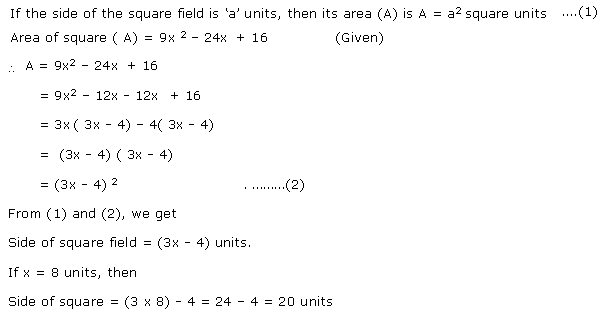
Q107.

Solution

Q108. Which of the following is a
binomial?
Solution
A binomial has two terms.
x + y is a binomial.
Q109. Factorize: 
Solution
Let
p(x) =
Then
p(1) =  Thus
(x -1) is a factor of p(x).
Now
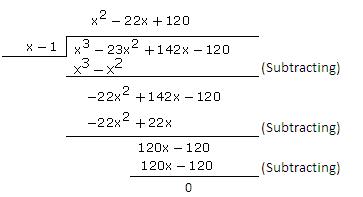
by long division,
Thus
(x -1) is a factor of p(x).
Now
by long division,
 Thus,
Thus,



Then
p(1) =
Thus
(x -1) is a factor of p(x).
Now
by long division,
Thus,
Q110. Check
whether the polynomial t + 1 is a factor of 4t3 + 4t2 -
t - 1.
Solution
p(x)
= 4t3 + 4t2 - t - 1
p(-1)
= 4(-1)3 + 4(-1)2 - (-1) - 1
= -4 + 4 + 1 - 1
= 0
Thus,
(t + 1) is a factor of p(x).
Q111. Factorize
: 4x4 + 7x2 - 2
Solution
Let
x2 = y then equation is
4y2
+ 7y - 2
=
4y2 + 7y - 2
=
4y2 + 8y - y - 2
=
4y(y + 2) - (y + 2)
=
(y + 2)(4y - 1)
=
(x2 + 2) (4x2 - 1)
=
(x2 + 2) ((2x)2 - 1)
=
(x2 + 2) (2x + 1) (2x - 1)
Q112. Factorize:
a12y4 - a4y12.
Solution
a12y4
-a4y12
a4y4
(a8 - y8) (Taking
common terms)
a4y4
[(a4)2 - (y4)2]
a4y4
[(a4 + y4) (a4 -y4)]
a4y4
[(a4 + y4) (a2 + y2) (a2
- y2)]
a4y4
[(a4 + y4) (a2 + y2) (a + y) (a -
y)]
Q113. 
Solution
(i) No

 has negative power of
  ( ii ) Yes
 (iii ) Yes
 ( iv ) No

 has fractional power of
( v ) No
has fractional power of
( v ) No

 has negative power of
has negative power of
( ii ) Yes
(iii ) Yes
( iv ) No
has fractional power of
( v ) No
has negative power of
Q114. In 8m - 3m3 + m8 -
13m2, the leading term is
Solution
A leading term is the term of the highest
degree in the polynomial.
In 8m - 3m3 + m8 -
13m2, the leading term is m8
Q115. If a2
+ b2 + c2 = 90 and a + b + c = 20 then find the value
of ab + bc + ca.
Solution
(a
+ b + c)2 = a2 + b2 + c2 + 2ab +
2bc + 2ca
(a+ b + c)2 = a2 + b2
+ c2+ 2 (ab + bc + ca)
(20)2
= 90 + 2 (ab + bc + ca)
400
- 90 = 2 (ab + bc + ca)
 ab
+ bc + ca = 155
ab
+ bc + ca = 155
ab
+ bc + ca = 155
Q116. Find
the value of 'a' if (x - a) is a factor of x5
- a2x3 + 2x + a + 3. Hence, factorise
x2 - 2ax - 3.
Solution
Let p(x) = x5-a2x3+2x+a+3
Since, (x-a) is a factor of p(x), so p(a) = 0





Q117. Use suitable identities to Factorise  3 - 8y 3 - 62y+ 12y2
3 - 8y 3 - 62y+ 12y2Solution
3 - 8y 3 - 62y+ 12y2
=3 - (2y) 3 - 6y(- 2y)
=3 - (2y) 3 – 3XX 2y(- 2y) { [(a - b) 3= a3 - b3- 3 a b(a - b)] where a = , b = 2y}
= (- 2y) 3
= (- 2y) (- 2y) (- 2y)
Q118. Simplify by factorization method:  .
.
.Solution

Q119. Factorise:
x3 + 13x2 + 32x + 20.
Solution
Let
p(x) = x3 + 13x2 + 32x + 20
p(-1)
= -1 + 13 - 32 + 20 = -33 + 33 = 0
Therefore
(x + 1) is a factor of p(x).
On
dividing p(x) by (x + 1) we get
p(x)
 (x + 1) = x2
+ 12x + 20
Thus,
x3
+ 13x2 + 32x + 20 = (x + 1)(x2 + 12x + 20)
= (x + 1) (x2 + 10x + 2x + 20)
= (x + 1)[x(x
+ 10) + 2(x + 10)]
= (x + 1) (x
+2) (x + 10)
Hence,
x3 + 13x2 + 32x + 20 = (x + 1) (x +2) (x + 10).
(x + 1) = x2
+ 12x + 20
Thus,
x3
+ 13x2 + 32x + 20 = (x + 1)(x2 + 12x + 20)
= (x + 1) (x2 + 10x + 2x + 20)
= (x + 1)[x(x
+ 10) + 2(x + 10)]
= (x + 1) (x
+2) (x + 10)
Hence,
x3 + 13x2 + 32x + 20 = (x + 1) (x +2) (x + 10).
(x + 1) = x2
+ 12x + 20
Thus,
x3
+ 13x2 + 32x + 20 = (x + 1)(x2 + 12x + 20)
= (x + 1) (x2 + 10x + 2x + 20)
= (x + 1)[x(x
+ 10) + 2(x + 10)]
= (x + 1) (x
+2) (x + 10)
Hence,
x3 + 13x2 + 32x + 20 = (x + 1) (x +2) (x + 10).
Q120. Determine
whether the indicated numbers are zeroes of the given polynomial?
(i)
g(x) = 3x2 -2; x =  .
(ii)
f(x) = x3 -6x2 + 11x -6; x = 1, 3.
.
(ii)
f(x) = x3 -6x2 + 11x -6; x = 1, 3.
.
(ii)
f(x) = x3 -6x2 + 11x -6; x = 1, 3.Solution
(i) g(x) = 3x2-2
At x = 


 (ii) f(x) = x3-6x2+11x-6

 f(1)
and f(3) are equal to zero
f(1)
and f(3) are equal to zero
 x= 1,3 are the zeroes
(ii) f(x) = x3-6x2+11x-6
f(1)
and f(3) are equal to zero
x= 1,3 are the zeroes
Q121. Find the remainder when p(x) = x3
- ax2 + 6x - a is divided by (x - a).
Solution
f(x)
= x3 - ax2 + 6x - a
We
have (x − a) = 0
∴ x = a
By
the remainder theorem,
∴ f(a) = (a)3 − a(a)2
+ 6(a) − a
= 5a
Q122. Find
the product of  .
.
.Solution

Q123. Using
suitable identity evaluate (42)3 - (18)3 - (24)3.
Solution
(42)3
- (18)3 - (24)3
Let
x = 42, y = -18, z = -24
Now
x + y + z = 42 - 18 - 24 = 0
Therefore,
x3
+ y3 + z3 = 3xyz
= 3 (42) (-18) (-24)
= 54432
Q124. Find the value of the polynomial p(z) = 3z2 - 4z +  when z = 3.
when z = 3.Solution
P (z) =  P (3) =
  = (3
= (3 9) - 12 +
  = 27 - 12 +
= 15 +
= 27 - 12 +
= 15 +
P (3) =
= (39) - 12 +
= 27 - 12 +
= 15 +
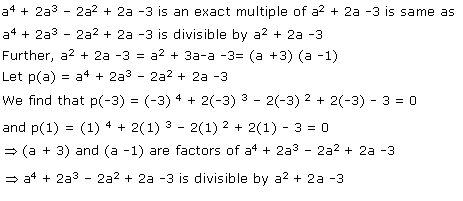
Q125. Without actual division, prove that a4 + 2a3 - 2a2 + 2a - 3 is an exact multiple of a2 + 2a - 3.
Solution
Q126. a2 + b2
+ c2 - ab - bc - ca equals:
- 1) (a + b + c)2
- 2) (a – b – c)2
- 3) (a – b + c)2
-
4)

Solution
a2 + b2 + c2
- ab - bc - ca
=  (2a2
+ 2b2 + 2c2 - 2ab - 2bc - 2ca)
= (a2 - 2ab + b2 +
b2 - 2bc + c2 + c2 - 2ca + a2)
= [(a - b)2 + (b - c)2 +
(c - a)2]
(2a2
+ 2b2 + 2c2 - 2ab - 2bc - 2ca)
= (a2 - 2ab + b2 +
b2 - 2bc + c2 + c2 - 2ca + a2)
= [(a - b)2 + (b - c)2 +
(c - a)2]
(2a2
+ 2b2 + 2c2 - 2ab - 2bc - 2ca)
= (a2 - 2ab + b2 +
b2 - 2bc + c2 + c2 - 2ca + a2)
= [(a - b)2 + (b - c)2 +
(c - a)2]
Q127. (x + 2) is a factor of 2x3 + 5x2 - x - k. The value of k is:
Solution
Here, 2(-2)3 + 5(-2)2 - (-2) - k =0
Or, -16 + 20 + 2 - k =0
Or, k = 6.
Q128. If p =
4 - q, prove that p3 + q3 + 12pq = 64.
Solution
We
have p = 4 - q
Or,
p + q - 4 =0
 p3 + q3 + (-4)3
= 3
p3 + q3 + (-4)3
= 3  p q (-4)
P3
+ q3 + 12pq = 64.
p q (-4)
P3
+ q3 + 12pq = 64.
p3 + q3 + (-4)3
= 3 p q (-4)
P3
+ q3 + 12pq = 64.
Q129. If
x3 + ax2 + bx + 6 has x - 2 as a factor and leaves a
remainder 3 when divided by x - 3, find the values of a and b.
Solution
f(x)
= x3 + ax2 + bx + 6
Since
(x - 2) is a factor therefore
f(2)
= 8 + 4a + 2b + 6 = 0  2a + b = -7
...(i)
Again,
On dividing by (x - 3) it gives remainder 3 therefore
f(3)
= 27 + 9a + 3b + 6 = 3 3a + b = -30
... (ii)
Subtracting
(i) from (ii), we get
a
= -23
From
(i), b = -7 + 46 = 39
Hence,
a = -23, b = 39.
2a + b = -7
...(i)
Again,
On dividing by (x - 3) it gives remainder 3 therefore
f(3)
= 27 + 9a + 3b + 6 = 3 3a + b = -30
... (ii)
Subtracting
(i) from (ii), we get
a
= -23
From
(i), b = -7 + 46 = 39
Hence,
a = -23, b = 39.
2a + b = -7
...(i)
Again,
On dividing by (x - 3) it gives remainder 3 therefore
f(3)
= 27 + 9a + 3b + 6 = 3 3a + b = -30
... (ii)
Subtracting
(i) from (ii), we get
a
= -23
From
(i), b = -7 + 46 = 39
Hence,
a = -23, b = 39.
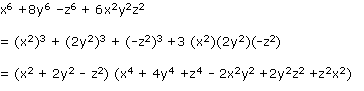
Q130. Factorise : x6 +8y6 - z6 + 6x2y2z2
Solution
Q131. Factorize
: x3 - 8y3 - 27z3 - 18xyz.
Solution
x3
- 8y3 - 27z3 - 18xyz
=
(x)3 + (-2y)3 + (-3z)3 - 3(x)(-2y) (-3z)
Using
the identity:
a3
+ b3 + c3 - 3abc - (a+ b + c) (a2 + b2
+ c2 - ab - bc - ca)
=
(x - 2y - 3z) (x2 + 4y2 + 9z2 - 2xy + 6yz - 3xz)
Q132. Which of the following options is a quadratic polynomial in one variable?
-
1)

-
2)

-
3)

-
4)

Solution
is a quadratic polynomial in one variable.
Q133. Find the volume of a cubical aquarium of edge 84 m.
Solution
84 = 80 + 4
(80 + 4)3
= 803 + 43 + 3 × 80 × 4 (80 + 4)
… using (x + y)3 = x3 + y3 + 3xy(x + y)
= 512000 + 64 + 80640
= 592704
Q134. If
x = 2 +  , then find the value of
  .
.
, then find the value of .Solution

Q135. Factorize:
x2 +  x + 6.
x + 6.
Solution
x2+3√3x
+6
=
x2+2√3x +√3x+6
=
x(x+2√3)+√3(x+2√3)
=
(x+√3) (x+2√3)
Q136. Find
the value of a and b so that the polynomial x3 + 10x2 +
ax + b has (x - 1) and (x + 2) as factors.
Solution
Let
f(x) = x3 + 10x2 + ax + b
Since
(x - 1) is a factor therefore
f(1)
= 0
 1 + 10 + a + b = 0
a + b = -11 … (1)
Also,
(x + 2) is a factor, therefore
f(-2)
= 0
(-2)3 + 10(-2)2 +
a(-2) + b = 0
-8 + 40 -2a + b = 0
2a - b = 32 … (2)
Adding
(1) and (2), we get
3a
= 21
Or,
a = 7
From
(1), we get b = -11 - 7 = -18.
Hence,
a = 7, b = -18.
1 + 10 + a + b = 0
a + b = -11 … (1)
Also,
(x + 2) is a factor, therefore
f(-2)
= 0
(-2)3 + 10(-2)2 +
a(-2) + b = 0
-8 + 40 -2a + b = 0
2a - b = 32 … (2)
Adding
(1) and (2), we get
3a
= 21
Or,
a = 7
From
(1), we get b = -11 - 7 = -18.
Hence,
a = 7, b = -18.
1 + 10 + a + b = 0
a + b = -11 … (1)
Also,
(x + 2) is a factor, therefore
f(-2)
= 0
(-2)3 + 10(-2)2 +
a(-2) + b = 0
-8 + 40 -2a + b = 0
2a - b = 32 … (2)
Adding
(1) and (2), we get
3a
= 21
Or,
a = 7
From
(1), we get b = -11 - 7 = -18.
Hence,
a = 7, b = -18.
Q137. The
term mxn… m is
Solution
The
term mxn… m is a real number.
Q138. Find the reminder
when 3x3 - 4x2 + 7x - 5 is divided by (x - 3) and (x +
3).
Solution
Let,
p(x) = 3x3 - 4x2 + 7x - 5
Remainder
when p(x) is divided by (x - 3) is
p(3)
= 3(3)3 - 4(3)2 + 7  3 - 5
= 81 - 36 + 21 - 5 = 102 - 41 = 61
Remainder
when p(x) is divided by (x + 3) is
p(-3)
= 3(-3)3 - 4(-3)2 + 7 (-3) - 5
= -81 - 36 - 21 - 5 = -143
3 - 5
= 81 - 36 + 21 - 5 = 102 - 41 = 61
Remainder
when p(x) is divided by (x + 3) is
p(-3)
= 3(-3)3 - 4(-3)2 + 7 (-3) - 5
= -81 - 36 - 21 - 5 = -143
3 - 5
= 81 - 36 + 21 - 5 = 102 - 41 = 61
Remainder
when p(x) is divided by (x + 3) is
p(-3)
= 3(-3)3 - 4(-3)2 + 7 (-3) - 5
= -81 - 36 - 21 - 5 = -143
Q139. Using
suitable identity evaluate (-28)3 + (9)3 + (19)3
Solution
x3
+ y3 + z3 = 3xyz if x + y + z = 0
Let
x = -28
y
= 9
z
= 19
x
+ y + z = (-28) + (9) + (19)
= 0
(-28)3
+ (9)3 + (19)3 = 3(-28) (9) (19)
= -14364
Q140. Factorize : .
.
.Solution

Q141. Given a polynomial p(x) = x2 - 5x + 4.
(A) Find the value of the polynomial p(x) at x = 2
(B) Check whether x is a factor of p(x).
(C) Factorise p(x).
Solution
p(x) = x2 - 5x + 4
(A)
p(2) = 22 - 5(2) + 4 = 4 - 10 + 4 = -2
(B)
p(0) = 02 - 5  0 + 4 = 4
 x - 0 = x is not a factor of p(x).
(C)
x2 - 5x + 4
= x2 - 4x - x + 4
= x(x - 4) - (x - 4)
= (x - 1)(x - 4)
x - 0 = x is not a factor of p(x).
(C)
x2 - 5x + 4
= x2 - 4x - x + 4
= x(x - 4) - (x - 4)
= (x - 1)(x - 4)
0 + 4 = 4
x - 0 = x is not a factor of p(x).
(C)
x2 - 5x + 4
= x2 - 4x - x + 4
= x(x - 4) - (x - 4)
= (x - 1)(x - 4)
Q142. Factorize
9x2 + y2 + z2 - 6xy + 2yz - 6zx. Hence find
its value if x = 1, y = 2 and z = -1.
Solution
9x2 + y2 + z2 -
6xy + 2yz - 6zx
= (3x)2 + y2 + z2
- 2  3x y + 2yz - 2 z 3x
= (3x - y - z)2
{Using (a-b-c)2=a2+b2+c2-2ab+2bc-2ca}
When x=1,y=2 and z=-1,
9x2 + y2 + z2 -
6xy + 2yz - 6zx
= (3x - y - z)2
= [3(1) - 2 - (-1)]2
= (3 - 2 + 1)2 = 22 = 4
3x y + 2yz - 2 z 3x
= (3x - y - z)2
{Using (a-b-c)2=a2+b2+c2-2ab+2bc-2ca}
When x=1,y=2 and z=-1,
9x2 + y2 + z2 -
6xy + 2yz - 6zx
= (3x - y - z)2
= [3(1) - 2 - (-1)]2
= (3 - 2 + 1)2 = 22 = 4
3x y + 2yz - 2 z 3x
= (3x - y - z)2
{Using (a-b-c)2=a2+b2+c2-2ab+2bc-2ca}
When x=1,y=2 and z=-1,
9x2 + y2 + z2 -
6xy + 2yz - 6zx
= (3x - y - z)2
= [3(1) - 2 - (-1)]2
= (3 - 2 + 1)2 = 22 = 4
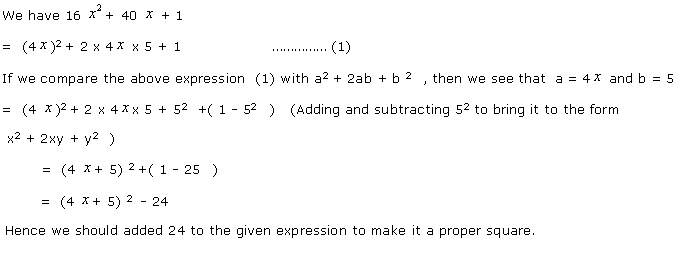
Q143. What should be added from 16x2 + 40x + 1 to make it a perfect square?
Solution
Q144. If
p(x) = x3 - ax2 + bx + 3 leaves a remainder - 19 when
divided by (x + 2) and a remainder 17 when divided by
(x
- 2), prove that a + b = 6.
Solution
Here,
p(-2) = -8 - 4a - 2b + 3 = -19
 4a + 2b = 14 … (1)
And,
p(2) = 8 - 4a + 2b + 3 = 17
-4a + 2b = 6 … (2)
Adding
(1) and (2), we get
4b
= 20 b = 5
From (1), 4a + 10 = 14
Or,
4a = 4
Or,
a = 1
Hence,
a + b = 6
4a + 2b = 14 … (1)
And,
p(2) = 8 - 4a + 2b + 3 = 17
-4a + 2b = 6 … (2)
Adding
(1) and (2), we get
4b
= 20 b = 5
From (1), 4a + 10 = 14
Or,
4a = 4
Or,
a = 1
Hence,
a + b = 6
4a + 2b = 14 … (1)
And,
p(2) = 8 - 4a + 2b + 3 = 17
-4a + 2b = 6 … (2)
Adding
(1) and (2), we get
4b
= 20 b = 5
From (1), 4a + 10 = 14
Or,
4a = 4
Or,
a = 1
Hence,
a + b = 6
Q145. Without
finding the cubes, factorize and find the value of: 
Solution

 So
a3+ b3 +c3-3abc = 0
a3+
b3 +c3=3abc
So
a3+ b3 +c3-3abc = 0
a3+
b3 +c3=3abc
 =
=

Q146. If a +
b = 8 and a2 + b2 = 40 find the value of a3
+ b3=.
Solution
a
+ b= 8
Now,
a2 + b2 = (a + b)2 - 2ab
 40 = 82 - 2ab
2ab
= 64 - 40 = 24
ab = 12
Therefore,
a3 + b3 = (a + b)3 - 3ab (a + b)
= 83 -
3 x 12 x 8
= 512 - 288 = 224
40 = 82 - 2ab
2ab
= 64 - 40 = 24
ab = 12
Therefore,
a3 + b3 = (a + b)3 - 3ab (a + b)
= 83 -
3 x 12 x 8
= 512 - 288 = 224
40 = 82 - 2ab
2ab
= 64 - 40 = 24
ab = 12
Therefore,
a3 + b3 = (a + b)3 - 3ab (a + b)
= 83 -
3 x 12 x 8
= 512 - 288 = 224
Q147. Check whether (p
+ 1) is a factor of p100 - 1 and p101 - 1.
Solution
Q
(p) = p100 - 1
Q(-1)
= (-1)100 - 1 = 1 - 1 = 0
 (p + 1) is a factor of Q(p)
R(p)
= p101 - 1
R(-1)
= (-1)101 - 1 = -1 - 1 = -2
(p + 1) is not a factor of R(p)
(p + 1) is a factor of Q(p)
R(p)
= p101 - 1
R(-1)
= (-1)101 - 1 = -1 - 1 = -2
(p + 1) is not a factor of R(p)
(p + 1) is a factor of Q(p)
R(p)
= p101 - 1
R(-1)
= (-1)101 - 1 = -1 - 1 = -2
(p + 1) is not a factor of R(p)
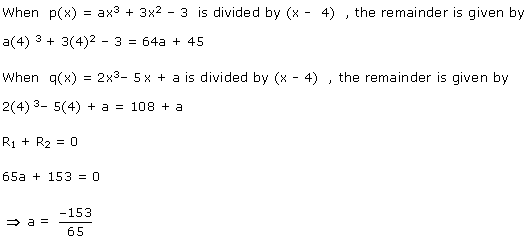
Q148. The polynomials p(x) = ax3 + 3x2 - 3 and q(x) = 2x3 - 5 + a , when divided by (x - 4) leave the remainders R1 and R2. Find 'a' if R1 + R2 = 0.
Solution
Q149. Factorize:(a) 4a2 -9b2 -2a -3b
(b) a2 + b2 -2(ab -ac + bc)
Solution
(a)
4a2-9b2-2a-3b
=[(2a)2-(3b)2]-(2a+3b)
=(2a-3b) (2a+3b)-(2a+3b)
=(2a+3b) [2a-3b-1]
=(2a+3b) (2a-3b-1)
(b)
a2+b2-2(ab-ac+bc)
=a2+b2-2ab+2ac-2bc
=(a-b)2+2c(a-b)
=(a-b)(a-b)+2c(a-b)
=(a-b)(a-b+2c)
Q150. Factorize:
 .
.
.Solution


Q151. What
are the possible expressions for the dimensions of the cuboid whose volume is
given below?
Volume = 12ky2 + 8ky - 20k.
Solution
Volume = 12ky2 + 8ky - 20k
= 4k (3y2 + 2y - 5)
= 4k
(3y2 + 5y -3y - 5)
= 4k (y (3y+5) - 1(3y+5))
= 4k (3y +5) (y-1)
Dimensions are l = 4k, b = 3y+5, h = y-1
Q152. Simplify
by factorization method: 
Solution

Q153. Find
the values of p and q if the polynomial  is divisible
by the polynomial
is divisible
by the polynomial 
is divisible
by the polynomial Solution

Q154. In
5y2 + 8y - 3y3, 8 is the coefficient of
Solution
A coefficient is the constant in the term
of a polynomial.
In
5y2 + 8y - 3y3, 8 is the coefficient of y.
Q155. (a) Find the value
of 34 x 36 using suitable identify.
(b) Simplify using
identify: 
Solution
(a) 34  36 = (30 + 4)
(30 + 6)
Using identity (x+ a) (x + b) = x2 +
(a + b) x + ab
Let x = 30, a = 4, b = 6
36 = (30 + 4)
(30 + 6)
Using identity (x+ a) (x + b) = x2 +
(a + b) x + ab
Let x = 30, a = 4, b = 6
 34 36 = (30 + 4)
(30 + 6)
= 302 + 30 (4 + 6) + 4 6
= 900 + 300 + 24
= 1224
(b)
34 36 = (30 + 4)
(30 + 6)
= 302 + 30 (4 + 6) + 4 6
= 900 + 300 + 24
= 1224
(b)


36 = (30 + 4)
(30 + 6)
Using identity (x+ a) (x + b) = x2 +
(a + b) x + ab
Let x = 30, a = 4, b = 6
34 36 = (30 + 4)
(30 + 6)
= 302 + 30 (4 + 6) + 4 6
= 900 + 300 + 24
= 1224
(b)
Q156. Factorize
:  a3 + 8b3 - 27c2 + 18
 abc.
abc.
a3 + 8b3 - 27c2 + 18 abc.Solution
a3
+ 8b3 - 27c2 + 18 abc
=
(a)3 + (2b)3 + (-3c)3
+ 18 abc
=(a)3 + (2b)3 + (-3c)3
- 3(a) (2b) (-3c)
We
know that
x3 + y3 + z3
- 3xyz = (x + y + z) (x2 + y2 + z2 - xy - yz
- zx)
Therefore,
(a)3 + (2b)3 + (-3c)3
- 3(a) (2b) (-3c)
=
(a + 2b - 3c) (2a2 + 4b2 + 9c2 - 2ab + 6bc + 3 ac)
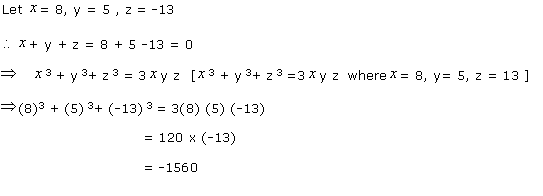
Q157. Without actually evaluating the cubes, find the value of: (8)3 + (5)3 + (-13)3
Solution
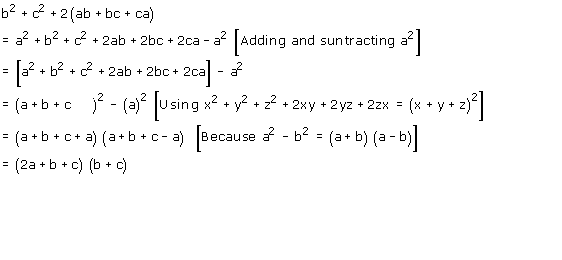
Q158. Factorise: b2 + c2 + 2 (ab + bc + ca)
Solution
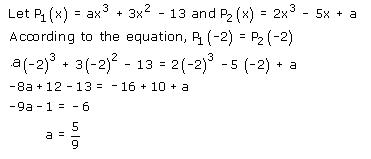
Q159. If the polynomial ax3 + 3x2 - 13 and 2x3 - 5x + a, when divided by (x + 2) leaves the same remainder, find the value of 'a'.
Solution
Q160. Using
factor theorem, show that (x + 1) is a factor of x19 + 1.
Solution
Let
f(x) = x19 + 1
(x
+ 1) is a factor if f(-1) = 0
Now,
f(-1) = (-1)19 + 1 = -1 + 1 = 0
Hence
(x + 1) is a factor of x19 + 1.
Q161. 
Solution

Q162. The
polynomials kx3 + 3x2 - 8 and 3x3 - 5x + k
are divided by x + 2. If the remainder in each case is the same, find the
value of k.
Solution
Let p(x) = kx3 +3x2 -8
and q(x) = 3x3 -5x +k
When divided by (x+2), the remainders are p(-2) and q(-2).
p(-2) = k(-2)3+3(-2)2-8=-8k
+ 4
q(-2) = 3(-2)3-5(-2)+k= -14 + k
Given that, p(-2) = q(-2)
-8k + 4 = -14 + k
-9k = -18
k = 2
Q163. Factorise:
a3 - b3 + 1 + 3ab.
Solution
a3 - b3 +1 + 3ab





Q164. If
a+b+c=9 and ab+bc+ca=40.
Find the value 
Solution

Q165. Factorise: 
Solution

Q166. Find
the value of a if (x + a) is a factor of x4 -a2x2
+ 3x -a.
Solution
Let f(x) = x4-a2x2+3x-a
(x+a) is a factor of f (x)
f (-a) = 0
(-a)4-a2(-a)2+3(-a)-a
= 0
a4-a4-3a-a =
0
-4a = 0
a = 0
Q167. If a =
 and b =
  , find a2 -b2.
and b = , find a2 -b2.Solution





Q168. 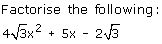
Solution
Q169. If
a+b = 12 and ab= 27, find the value of a3+b3.
Solution
We
know the identity: Given
a+b=12 and ab=27, substituting values in the identity above, we get:
=
Given
a+b=12 and ab=27, substituting values in the identity above, we get:
=
 =
1728 - 972
=
756
=
1728 - 972
=
756
Given
a+b=12 and ab=27, substituting values in the identity above, we get:
=
=
1728 - 972
=
756
Q170. Expand
the following:
(i)
(x-2y-3z)2.
(ii)
(y- )2.
)2.
)2.Solution
(i)

 (ii)
Using
identity:
(ii)
Using
identity: 


(ii)
Using
identity:
Q171. Factorize
: 8 a3 - b3 - 12a2b + 6ab2
Solution
8a3
- b3 - 12a2b + 6ab2
=
(2a)3 - (b)3 - 3 (2a)2 b + 3 (2a) b2
=
(2a - b)3
=
(2a - b) (2a - b) (2a - b)
Q172. If x =
1 -  , find value of
  .
.
, find value of .
Solution
x= 1-√2

 = 22
= 4
= 22
= 4
= 22
= 4
Q173. Show that (x - 2) is a factor of the Polynomial f(x) = 2x3 - 3x2 - 17x + 30 and hence factorize f(x).
Solution
 So (x-2) is a factor of f(x)
Factorisation of f(x):
So (x-2) is a factor of f(x)
Factorisation of f(x):

Q174. The
polynomials x3 + 2x2 - 5ax - 8 and x3 + ax2
- 12x - 6 when divided by (x - 2) and (x - 3) leave remainder p and q
respectively. If q - p = 10, find the value of a.
Solution
Let f(x) = x3 + 2x2 -5ax
-8 and
g(x) = x3 + ax2 -12x -6
When divided by (x-2) and (x-3),f(x) and g(x)
leave remainder p and q respectively

 g(x) = x3 + ax2 -12x -6



g(x) = x3 + ax2 -12x -6
Q175. What is the remainder when h(y) = 4y3 - 12y2 + 14y - 3 is divided by (2x - 1)
Solution

Q176. Using
factor theorem, show that x2 + 5x + 6 is a factor of x4
+ 5x3 + 9x2 + 15x + 18.
Solution
We
have,
x2
+ 5x + 6
=
x2 + 3x + 2x + 6
=
x (x + 3) +2 (x + 3)
=
(x + 2) (x + 3)
Let
p(x) = x4 + 5x3 + 9x2 + 15x + 18
Put
x = -2
p(-2)
= (-2)4 + 5(-2)3 + 9(-2)2 + 15 (-2) + 18
=
16 - 40 + 36 - 30 + 18
=
70 - 70 = 0  (x + 2) is a
factor
Put
x = -3
p(-3)
= (-3)4 + 5(-3)3 + 9(-3)2 + 15 (-3) + 18
=
81 - 135 + 81 - 45 + 18
=
180 - 180 = 0 (x + 3) is a
factor
Hence
x2 + 5x + 6
Is a factor of p(x).
(x + 2) is a
factor
Put
x = -3
p(-3)
= (-3)4 + 5(-3)3 + 9(-3)2 + 15 (-3) + 18
=
81 - 135 + 81 - 45 + 18
=
180 - 180 = 0 (x + 3) is a
factor
Hence
x2 + 5x + 6
Is a factor of p(x).
(x + 2) is a
factor
Put
x = -3
p(-3)
= (-3)4 + 5(-3)3 + 9(-3)2 + 15 (-3) + 18
=
81 - 135 + 81 - 45 + 18
=
180 - 180 = 0 (x + 3) is a
factor
Hence
x2 + 5x + 6
Is a factor of p(x).
Q177. Using
factor theorem, show that (2x + 1) is a factor of 2x3 + 3x2
- 11x - 6.
Solution
2x
+ 1 is a factor of polynomial p(x) only if  = 0
Now,
= 0
Now,

= 0
Now,
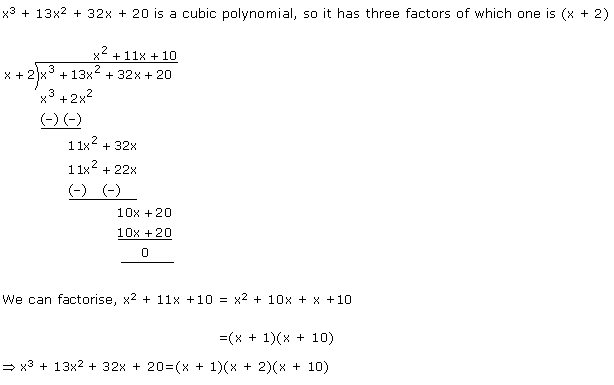
Q178. (x + 2) is one of the factors of the polynomial x3 + 13x2 + 32x + 20. Find its remaining factors.
Solution
Q179. Simplify
(x + y + z)2 - (x + y - z)2.
Solution
(x + y + z)2 - (x + y - z)2
=(x2 + y2 + z2
+ 2xy + 2yz + 2zx) - (x2 + y2 + z2 + 2xy -
2yz - 2zx)
=  = 4yz + 4zx
= 4z(y + x)
= 4yz + 4zx
= 4z(y + x)
= 4yz + 4zx
= 4z(y + x)
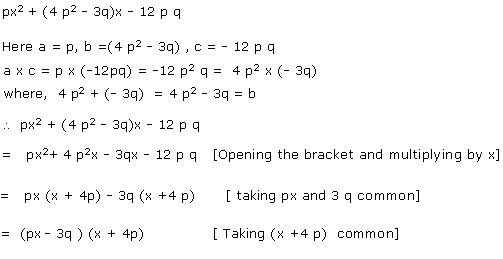
Q180. Factorise the following:px2 + (4p2 - 3q)x - 12pq
Solution
Comments
Post a Comment