Q1. In the given figure, PQ||RS and EF||QS. If  PQS = 60°, then the measure of RFE is:

PQS = 60°, then the measure of RFE is:
Solution
 RSQ + PQS = 180o
 RSQ = 1800-600=120o
So,RFE = RSQ = 1200(corresponding angles)
RSQ = 1800-600=120o
So,RFE = RSQ = 1200(corresponding angles)
Q2. In figure, if AB||CD,  FAE = 90o and AFE = 40o then find ECD.

FAE = 90o and AFE = 40o then find ECD.
Solution
By angle sum property in triangle FAE.
90o + 40o + AEF = 180o
Or, AEF = 50o
CEB = AEF = 50o (vertically opp. angles)
ECD + CEB = 180o
Or, ECD + 50o = 180o
ECD = 130o
AEF = 180o
Or, AEF = 50o
CEB = AEF = 50o (vertically opp. angles)
ECD + CEB = 180o
Or, ECD + 50o = 180o
ECD = 130o
Q3. The angles of a triangle are in the ratio 5:3:7, the triangle is:
Solution
Let the angles be 5x, 3x and 7x respectively.
By sum property, 5x + 3x + 7x = 1800
 15x = 180ox = 180o/15 = 12
So, the angles are 60o, 36o and 84o, i.e. the triangle is acute angled.
15x = 180ox = 180o/15 = 12
So, the angles are 60o, 36o and 84o, i.e. the triangle is acute angled.
15x = 180ox = 180o/15 = 12
So, the angles are 60o, 36o and 84o, i.e. the triangle is acute angled.
Q4. In figure, lines AB and CD intersect at O. If  then
then  COB is:

then COB is:
Solution
Here,
4x + 5x = 180o
Or, 9x = 180o
Or, x = 20o
Thus, COB = AOD = 4 x 20o = 80o.
COB = AOD = 4 x 20o = 80o.
Q5. In the given figure , AD is the median, then  BAD is:

BAD is:
Solution
Since triangle ABC is isosceles and hence median is also the angle bisector.


Q6. In the given fig., the measure of  ABC is:

ABC is:
Solution
 Here, x = 20o as vertically opp.
And, y = 180o - 100o = 80o as linear pair.
Therefore, B = 180o - 20o- 80o = 80o
Here, x = 20o as vertically opp.
And, y = 180o - 100o = 80o as linear pair.
Therefore, B = 180o - 20o- 80o = 80o
Q7. An exterior angle of triangle is 80o and the interior opposite angles are in the ratio 1:3. Measure of each interior opposite angle is:
Solution
Let interior opposite angles are: x and 3x
Therefore, x + 3x = 80o
Or, 4x = 80o
Or, x = 20o
Hence, required angles are: 20o, 60o
Q8. Prove
that if two lines intersect, the vertically opposite angles are equal.
Solution
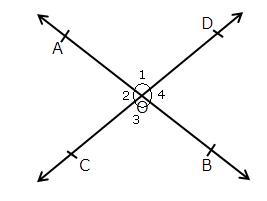 Since,
 1 + 2 = 180o … (1) (linear pair)
And,
2 + 3 = 180o … (2) (linear pair)
From
(1) and (2), we get
1
+ 2 = 2 + 3
Or,
1 = 3
Similarly, 2 = 4
Hence
proved.
1 + 2 = 180o … (1) (linear pair)
And,
2 + 3 = 180o … (2) (linear pair)
From
(1) and (2), we get
1
+ 2 = 2 + 3
Or,
1 = 3
Similarly, 2 = 4
Hence
proved.
Q9. In fig. if x°, y° and z° are exterior angles of ΔABC, then x° + y° + z° is:

Solution
Sum of exterior angles of a triangle is 360o
Q10. If the
angles of a triangle are in the ratio 1:2:3 then find the measure of angles.
Solution
Let
the angles are: x, 2x and 3x
Thus
by angle sum property,
x
+ 2x + 3x = 180o
Or,
6x = 180o
Or,
x = 30o
Hence
angles are: 30o, 60o, 90o.
Q11. The
sides BA and DC of a quadrilateral ABCD are produced as shown in fig. Show
that  x + y = a + b.

x + y = a + b.
Solution
Here,
BAD
= (180o - b)
(linear pair)
BCD
= (180o - a)
(linear pair)
Now
by angle sum property of quadrilateral, we have
x
+ (180 - b) + y + (180 - a) = 360o
x
+ y - b - a = 0
x
+ y = a + b
 x + y = a + b
BAD
= (180o - b)
(linear pair)
BCD
= (180o - a)
(linear pair)
Now
by angle sum property of quadrilateral, we have
x
+ (180 - b) + y + (180 - a) = 360o
x
+ y - b - a = 0
x
+ y = a + b
x + y = a + b
Q12. One of the angles of a triangle is 75o. If the difference of the other two angles is 35o, then the larger angle of the other two angles of the triangle has a measure of:
Solution
Sum of other two angles = 180o - 75o = 105o
Difference of other two angles = 35o
Measure of the larger angle = 
Q13. In
figure, AB||DC,  BDC = 30° and BAD = 80°, find x, y and z.

BDC = 30° and BAD = 80°, find x, y and z.
Solution
Since




Q14. In  ABC, BC = AB and
  B = 80°, then A is equal to:
ABC, BC = AB and B = 80°, then A is equal to:Solution
Given BC = AB
 C=A
B= 80o
In triangle ABC,A+B+C = 180o
A+B+A = 180o
2A + 80o=180o
2A = 100
A = 50o
C=A
B= 80o
In triangle ABC,A+B+C = 180o
A+B+A = 180o
2A + 80o=180o
2A = 100
A = 50o
C=A
B= 80o
In triangle ABC,A+B+C = 180o
A+B+A = 180o
2A + 80o=180o
2A = 100
A = 50o
Q15. In fig., if m||n and  a : b = 2 : 3, the measure of h is

a : b = 2 : 3, the measure of h is
Solution


Q16. 
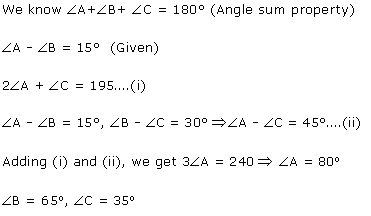
Solution
Q17. In fig., in  ABC, AB = AC. The value of x is:

ABC, AB = AC. The value of x is:
Solution
Here,  B + C = 180o - 80o = 100o.
But, B = C therefore C = 50o.
So, x = 180o - 50o = 130o.
B + C = 180o - 80o = 100o.
But, B = C therefore C = 50o.
So, x = 180o - 50o = 130o.
B + C = 180o - 80o = 100o.
But, B = C therefore C = 50o.
So, x = 180o - 50o = 130o.
Q18. Given ∠ POR = 3x and ∠ QOR = 2x + 10.
If POQ is a straight line, then the value of x is
Solution
POQ is a straight line.
∴ ∠ POR + ∠ QOR =
180˚
∴ 3x + 2x + 10 =
180˚
∴ 5x = 170˚
∴ x = 34˚
Q19. Find the measure of the angle which is complement of itself.
Solution

Q20. An exterior angle of a triangle is 80o and two interior opposite angles are equal. Measure of each of these angle is:
Solution
Since, Sum of two interior opp. angles = Measure of ext. angle
Therefore, Sum of two interior opp. angles = 80o
Hence, the measure of each angle = 40o.
Q21. 
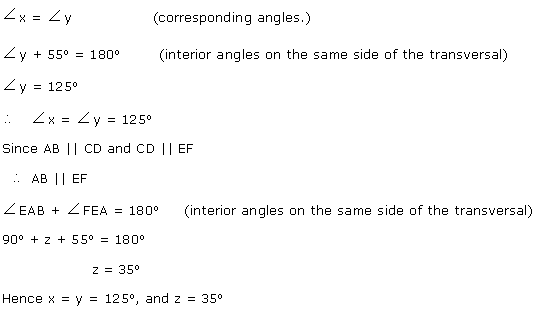
Solution
Q22. The number of lines that can pass through a given point is:
Solution
Infinitely many
Q23. In figure, value of x is:

Solution
Here, 4x + 2x + x + 150o = 360o
Or, 7x = 210o
Or, x = 30o
Q24. Given lines l1 l2 and l3 in fig., are parallel. The value of x is :

Solution
 We know corresponding angles are equal.
So,
We know corresponding angles are equal.
So,  1 = 2 = 40o
Therefore, x = 180o - 40o = 140o
1 = 2 = 40o
Therefore, x = 180o - 40o = 140o
Q25. In
fig., if QT PR,
PR,  TQR = 40° and SPR = 30° find the value of x and y.

PR, TQR = 40° and SPR = 30° find the value of x and y.
Solution
Consider  QTR
QTR
 TQR + QTR + R = 180o
(Sum of angle of a triangle in 180o)
40o + 90o + R = 180o
TQR + QTR + R = 180o
(Sum of angle of a triangle in 180o)
40o + 90o + R = 180o
 R = 50o
Now ,Consider PRS
y = SPR + x
(Exterior angle is equal to sum of interior angles)
y = 30o+50o
=80o
Hence,
x=50o, y=80o
R = 50o
Now ,Consider PRS
y = SPR + x
(Exterior angle is equal to sum of interior angles)
y = 30o+50o
=80o
Hence,
x=50o, y=80o
QTR
TQR + QTR + R = 180o
(Sum of angle of a triangle in 180o)
40o + 90o + R = 180o
R = 50o
Now ,Consider PRS
y = SPR + x
(Exterior angle is equal to sum of interior angles)
y = 30o+50o
=80o
Hence,
x=50o, y=80o
Q26. In a triangle ABC if  A = 53o and C = 44o then the value of B is:
A = 53o and C = 44o then the value of B is:Solution
B = 180o - 53o - 44o = 83o
Q27. Measure of an angle which is supplement of itself is :
Solution
Since 90o + 90o = 180o.
Q28. If the bisectors of  B and C of triangle of a
  ABC intersect at O, then prove that BOC = 90o +
  .
.

B and C of triangle of a ABC intersect at O, then prove that BOC = 90o + .
Solution
In ABC A + B + C =180o (angle sum of a )
OBC + BCO + BOC =180o (angle sum of BOC)
But OBC =  B and BCO = C
 B +C + BOC =180o
(B + C + A) +BOC = 180o + A (adding A to both sides)
(180o) + BOC = 180o + A
90o + BOC = 180o + A
BOC = 90o +A
Hence proved.
B +C + BOC =180o
(B + C + A) +BOC = 180o + A (adding A to both sides)
(180o) + BOC = 180o + A
90o + BOC = 180o + A
BOC = 90o +A
Hence proved.
ABC A + B + C =180o (angle sum of a )
OBC + BCO + BOC =180o (angle sum of BOC)
But OBC = B and BCO = C
B +C + BOC =180o
(B + C + A) +BOC = 180o + A (adding A to both sides)
(180o) + BOC = 180o + A
90o + BOC = 180o + A
BOC = 90o +A
Hence proved.
Q29. In
figure, if line segment AB intersects CD at O such that  OAD = 800, ODA= 500 and OCB= 400, then find OBC.

OAD = 800, ODA= 500 and OCB= 400, then find OBC.
Solution
In  AOD
ADO+OAD+AOD
= 180o (Angle sum
property of)
AOD
ADO+OAD+AOD
= 180o (Angle sum
property of)

 BOC = 50o (Vertically
opposite angles of)
Now,
in COB
OCB+OBC+BOC = 180o
BOC = 50o (Vertically
opposite angles of)
Now,
in COB
OCB+OBC+BOC = 180o
 OBC
= 90o (Angle sum
property of)
OBC
= 90o (Angle sum
property of)
AOD
ADO+OAD+AOD
= 180o (Angle sum
property of)
BOC = 50o (Vertically
opposite angles of)
Now,
in COB
OCB+OBC+BOC = 180o
OBC
= 90o (Angle sum
property of)
Q30. In
fig., in  PQR, right angled at P. PS is perpendicular to QR.
Prove that
PQR, right angled at P. PS is perpendicular to QR.
Prove that  QPS = PRQ.

PQR, right angled at P. PS is perpendicular to QR.
Prove that QPS = PRQ.
Solution
Given:
In PQR, right at P. PS is perpendicular to QR.
To
prove: QPS = PRQ
Proof:
In
QPS, QPS + PSQ + PQS = 180o
QPS + 90o + PQS = 180o
QPS = 90o - PQS
QPS = 90o - Q ...(i)
In
PQR
P + Q + R = 180o
Q + R = 180o - P = 180o - 90o = 90o
Or, R
= 90o - Q ...(ii)
(i)
and (ii)  QPS = PRQ.
PQR, right at P. PS is perpendicular to QR.
To
prove: QPS = PRQ
Proof:
In
QPS, QPS + PSQ + PQS = 180o
QPS + 90o + PQS = 180o
QPS = 90o - PQS
QPS = 90o - Q ...(i)
In
PQR
P + Q + R = 180o
Q + R = 180o - P = 180o - 90o = 90o
Or, R
= 90o - Q ...(ii)
(i)
and (ii) QPS = PRQ.
Q31. Two complementary angles
are such that two times the measure of one is equal to three times the
measure of the other. The measure of the smaller angle is
Solution
Let the measure of one angle be x.
Then, the measure of its complement is 90˚ - x.
According to the question,
2x = 3(90˚ - x)
∴ 2x = 270˚ - 3x
∴ 5x = 270˚
∴ x = 54˚
∴ 90˚ - x = 90˚ - 54˚ = 36˚
Hence, the measure of smaller angle is 36˚.
Q32. If two parallel lines are intersected by a transversal then, pair of alternate interior angles are:
Solution
If two parallel lines are intersected by a transversal then pair of alternate interior angles are equal.
Q33. In figure, value of x is:

Solution
Since, x + 10o + x + x + 20o = 180o
Or, 3x = 150o
Or, x = 50o.
Q34. Two supplementary angles are in the ratio 4:5. The angles are :
Solution
Here, 4x + 5x = 180o
Or, 9x = 180o
Or, x = 20o
4x = 4 x 20o = 80o
5x = 5 x 20o = 100o
Thus, angles are: 80o, 100o
Q35. 

Solution

Q36. 

Solution
Here, 2x + 10 + 3x = 180o
Or, 5x = 170o
Or, x = 34o
Q37. In
fig., find the value of x.

Solution
In
 ABC
ABC
 ABC+1000=
1800 (linear pair)
ABC
= 800
x+
800 = 1150
(Exterior angle property)
x
= 350
ABC+1000=
1800 (linear pair)
ABC
= 800
x+
800 = 1150
(Exterior angle property)
x
= 350
ABC
ABC+1000=
1800 (linear pair)
ABC
= 800
x+
800 = 1150
(Exterior angle property)
x
= 350
Q38. In
figure,  and bisector of
  meets BC at a
point D. Find the value of
meets BC at a
point D. Find the value of 

and bisector of meets BC at a
point D. Find the value of
Solution

Q39. 
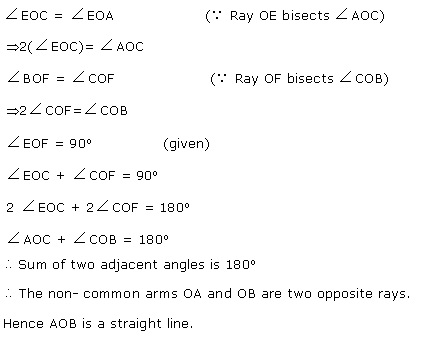
Solution
Q40. In figure, the value of ( x + y) is:

x + y) is:
Solution
By exterior angle theorem, the sum is 100o.
Q41. In
fig., find the value of x.

Solution
Here  Since
Since  forma straight line
 3x + 30o = 180o

Since forma straight line
3x + 30o = 180o
Q42. In triangle ABC, if  A + B = 108o and B +C = 130o, find A, B and.
C
A + B = 108o and B +C = 130o, find A, B and.
C
A + B = 108o and B +C = 130o, find A, B and.
CSolution
A + B = 108o and B +C = 130o
A + B + B +C = (108o + 130o)
 (A + B +C) + B = 238o
B = 238o – 180o (A + B +C = 180o)
B = 58o
(A + B +C) + B = 238o
B = 238o – 180o (A + B +C = 180o)
B = 58o
 C = 130o – 58o= 72o A = 108o – 58o = 50o
Hence, A = 50o, B = 58o and C = 72o
C = 130o – 58o= 72o A = 108o – 58o = 50o
Hence, A = 50o, B = 58o and C = 72o
Q43. In  ABC fig.,
  x + y + z is equal to:

ABC fig., x + y + z is equal to:
Solution
Sum of exterior angles of a triangle is 360o.
Q44. Find the value of x.

Solution
From the figure, the interior angles are supplementary.
x + 3x - 40° = 180°
∴ 4x = 180° + 40°
∴ 4x = 220°
∴ x = 55°
Q45. If one angle of a triangle is equal to the sum of the other two angles, then the triangle is:
Solution
If one angle of a triangle is equal to the sum of the other two angles, then the triangle is a right angled triangle.
Q46. In
given figure, find the values of x and y.
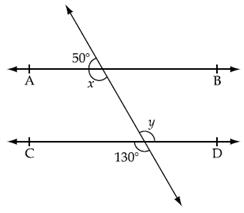
Solution
Here,
x=180O - 50O =
130O (Linear
pair)
y=130O (Vertically opp.
angles)
Q47. Given four points such that no three of them are collinear, then the number of lines that can be drawn through them are:
Solution
A line can be drawn with every pair of two points. Thus 6 lines can be drawn.
Q48. From figure, identify the incorrect statement, given that l||m and t is transversal.

-
1)
 2 and 8 are supplementary
-
2) 2 and 1 are supplementary
-
3) 2 and 3 are supplementary
-
4) 2 and 5 are supplementary
Solution
2 and 8 are not supplementary.
Q49. If E is a point on side QR of  then:
then:

then:
Solution

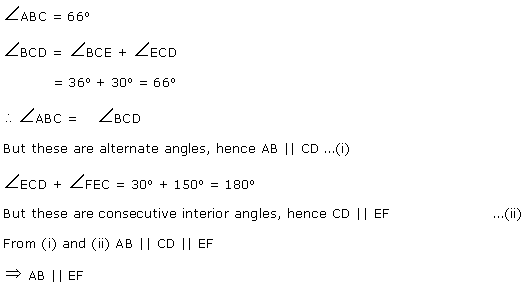
Q50. Show that in the given figure, AB || EF.
Solution
Q51. Lines
PQ and RS intersect each other at point O. If  POR: ROQ= 5:7, find all the remaining angles.
POR: ROQ= 5:7, find all the remaining angles.Solution
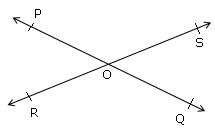
 But
POR : ROQ = 5 : 7
But
POR : ROQ = 5 : 7



 (Vertically opposite angles)
Q52. The angles of a triangle are in the ratio 2 : 3 : 4. The angles, in order, are :
Solution
Let the angles are: 2x, 3x and 4x.
Thus, 2x + 3x + 4x = 180o
Or, 9x = 180o
Or, x = 20o
Hence angles are: 40o, 60o, 80o.
Q53. In figure, if
AB||DE,  ABC = 75o and CDE = 145o, then find BCD.

ABC = 75o and CDE = 145o, then find BCD.
Solution
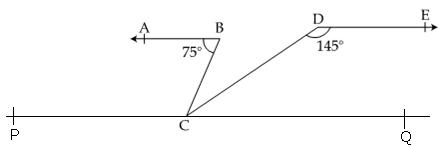 Construction: Draw PCQ || to AB
and DE.
DCQ
+ CDE = 180o (DE || CQ, co-interior angles
are supplementary)
Construction: Draw PCQ || to AB
and DE.
DCQ
+ CDE = 180o (DE || CQ, co-interior angles
are supplementary)
 QCD = 180o -145o = 35o
BCP
+ CBA = 180o (
QCD = 180o -145o = 35o
BCP
+ CBA = 180o ( AB||PQ, co-interior
angles are supplementary)
BCP =180o - 75o = 105o
BCP
+ BCD + DCQ = 180o (Angles in straight line)
BCD
= 180o - 105o - 35o = 40o
AB||PQ, co-interior
angles are supplementary)
BCP =180o - 75o = 105o
BCP
+ BCD + DCQ = 180o (Angles in straight line)
BCD
= 180o - 105o - 35o = 40o
Q54. In
given figure, OA, OB are opposite rays and


Solution

Q55. In figure, BP  AC,
AC,  PBC = 25o and DAC = 30o. Find the value of x.

AC, PBC = 25o and DAC = 30o. Find the value of x.
Solution
OPA + PAO +  AOP = 180o
Or, 90o + 30o + AOP = 180o
Or, AOP = 180o - 120o = 60o
AOP = 180o
Or, 90o + 30o + AOP = 180o
Or, AOP = 180o - 120o = 60o
 AOP = BOD = 60o (vertically opp. angles)
25o + x+ 60o = 180 o (Angle sum property)
x = 180o - 85o = 95o
AOP = BOD = 60o (vertically opp. angles)
25o + x+ 60o = 180 o (Angle sum property)
x = 180o - 85o = 95o
Q56. In
figure, the side QR of  PQR is produced to a point S. If the bisectors of
  PQR and PRS meet at point T, then prove that QTR =
  QPR.
QPR.

PQR is produced to a point S. If the bisectors of PQR and PRS meet at point T, then prove that QTR = QPR.
Solution

 (Angle sum property of triangle)

 (TR bisects PRS)

 Hence
Proved
Hence
Proved
Q57. In figure, POQ is
a line, ray OR is perpendicular to line PQ. OS is another ray lying between
rays OP and OR. Prove that
 ROS
=
ROS
=  .
.

ROS
= .
Solution
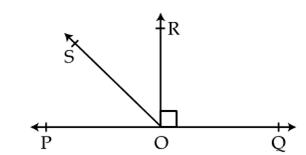 From
the figure ROS = QOS - ROQ
From
the figure ROS = QOS - ROQ
 ROS = QOS - 90o ...(i)
(
ROS = QOS - 90o ...(i)
( OR
OR  QO)
ROS
= ROP - POS
ROS
= 90o - POS ...(2)
( OR PQ)
(1)
+ (2)
QO)
ROS
= ROP - POS
ROS
= 90o - POS ...(2)
( OR PQ)
(1)
+ (2)  ROS + ROS = QOS - 90o + 90o - POS
2ROS = QOS - POS
ROS =
ROS + ROS = QOS - 90o + 90o - POS
2ROS = QOS - POS
ROS =  (QOS - POS)
Q58. In figure, PQ||RS  QPO = 70o ROT = 20o. Find the value of x.

QPO = 70o ROT = 20o. Find the value of x.
Solution

Q59. A pair of angles is called linear pair if sum of two adjacent angles is:
Solution
A pair of angles is called linear pair if sum of two adjacent angles is 180o
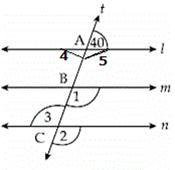
Q60. l, m
and n are parallel lines intersected by transversal 't' at A, B and C
respectively. Find the measure of  1, 2 and 3. Give reasons.

1, 2 and 3. Give reasons.
Solution

Q61. If the measure of an angle is twice the measure of its supplementary angle then the measure of the angle is:
Solution
Let x be the angle.
x=2(180o -x)
x = 360o - 2x
Or, 3x=360o
Or, x=120o
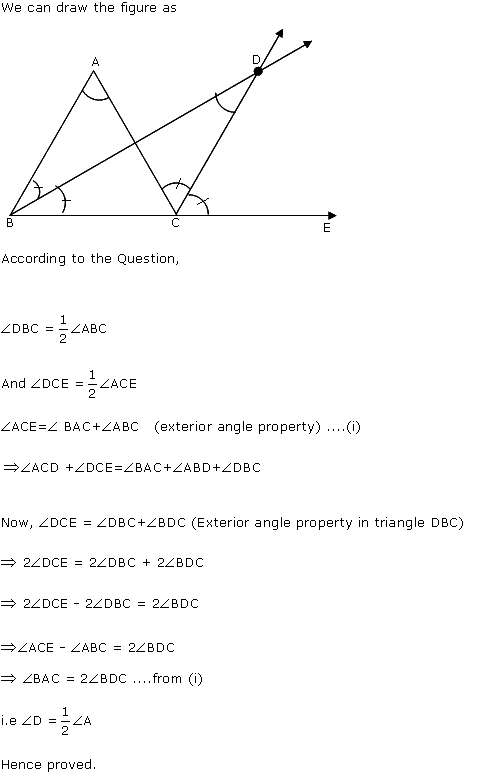
Q62. In
figure, prove that  .
.

.
Solution

Q63. 
Solution
Q64. In figure, the value of x is:

Solution
2x + 5x + 40o = 180o
Or, 7x = 140o
Or, x = 20o
Q65. 
Solution
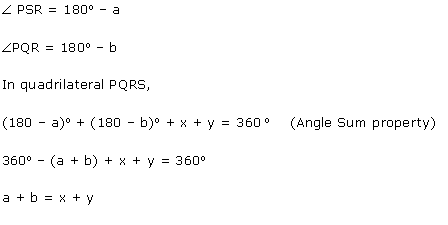
Q66. In
figure find the value of  QRP when QP||TR.

QRP when QP||TR.
Solution
Here,
PRT = 64o (vertically opp. angles as PQ||TR)
Therefore,
QRP = 180o - (64o + 67o) (linear pair)
Or,
QRP = 180o - 131o = 49o.
PRT = 64o (vertically opp. angles as PQ||TR)
Therefore,
QRP = 180o - (64o + 67o) (linear pair)
Or,
QRP = 180o - 131o = 49o.
Q67. 
Solution


Q68. If x +
y = s + w, prove that AOB is straight line.

Solution
x
+ y + w + s = 360o
Let
x + y = s + w = t
Therefore,
2t = 360o
Or,
t = 180o
Or,
x + y = 180o
Thus,
AOB is a straight line.
Q69. RS || PQ. Find the value of x.
Solution

Q70. In fig., l||m, show that  1 + 2 - 3 = 180o

1 + 2 - 3 = 180o
Solution
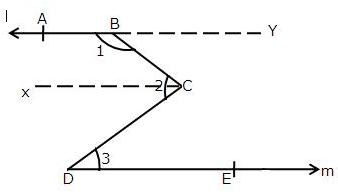 Given: l||m
To prove: 1 + 2 - 3 = 180o
Construction: Draw XC||AB and extend AB to Y.
Proof:
BCX = 180o - 1 (sum of int. s on same side of transversal is 180o)
XCD = 3 (Alternate int. s)
Now, 2 = BCX + XCD
Or, 2 = (180o - 1) + 3
Given: l||m
To prove: 1 + 2 - 3 = 180o
Construction: Draw XC||AB and extend AB to Y.
Proof:
BCX = 180o - 1 (sum of int. s on same side of transversal is 180o)
XCD = 3 (Alternate int. s)
Now, 2 = BCX + XCD
Or, 2 = (180o - 1) + 3
 1 + 2 - 3 = 180o
Q71. An
angle is  of its
complement. Find the angles.
of its
complement. Find the angles.
of its
complement. Find the angles.Solution
Let
Angle = x, So complement =
5x
Therefore,
x + 5x = 90o
So,
x = 15o
And,
5x = 5  15o
= 75o
Angles
are: 15o and 75o
15o
= 75o
Angles
are: 15o and 75o
15o
= 75o
Angles
are: 15o and 75o
Q72. The arms of an angle are respectively parallel to the arms of another angle as shown in the figure. Show that the two angles are equal.
Solution
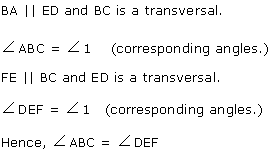
Q73. In
figure the side QR of  PQR is produce to a point S. If the bisectors of
  PQR and PRS meet at T, then prove that QTR =
 .
.

PQR is produce to a point S. If the bisectors of PQR and PRS meet at T, then prove that QTR =.
Solution
QPR
= PRS - PQR (by
exterior angle property) … (1)
QTR
= TRS - RQT (by
exterior angle property) … (2)
PQR
= 2TQR (as QT is
bisector) … (3)
PRS
= 2TRS (as RT is
bisector) … (4)
From (1), (3) and (4) we get
QPR
= 2TRS - 2TQR
Or,
QPR = 2(TRS - TQR)
Or,
QPR = 2(QTR)
Using (2)
Or,
 Hence proved.
Q74. In fig., BO and CO are bisectors of DBC and ECB respectively. If  BAC = 50o and ABC = 60o then find the measure of BOC.

BAC = 50o and ABC = 60o then find the measure of BOC.
Solution
By angle sum property in triangle ABC
50o + 60o + ACB = 180o
This gives, ACB = 180o - 110o = 70o
Now by exterior angle theorem,
DBC = A + ACB = 50o + 70o = 120o.
Therefore, OBC =  DBC = 60o.
Again,
ECB = A + ABC = 50o + 60o = 110o.
Therefore, OCB = DBC = 55o.
By angle sum property in triangle OBC, we get
OBC + OCB + BOC = 180o
This gives, 60o + 55o + BOC = 180o
Or, BOC = 65o
DBC = 60o.
Again,
ECB = A + ABC = 50o + 60o = 110o.
Therefore, OCB = DBC = 55o.
By angle sum property in triangle OBC, we get
OBC + OCB + BOC = 180o
This gives, 60o + 55o + BOC = 180o
Or, BOC = 65o
ACB = 180o
This gives, ACB = 180o - 110o = 70o
Now by exterior angle theorem,
DBC = A + ACB = 50o + 70o = 120o.
Therefore, OBC = DBC = 60o.
Again,
ECB = A + ABC = 50o + 60o = 110o.
Therefore, OCB = DBC = 55o.
By angle sum property in triangle OBC, we get
OBC + OCB + BOC = 180o
This gives, 60o + 55o + BOC = 180o
Or, BOC = 65o
Q75. In
fig., PQ||RS and T is any point as shown in figure then show that  PQT + QTS + RST = 360o

PQT + QTS + RST = 360o
Solution
Construction:
Draw a line AB parallel to PQ through T.
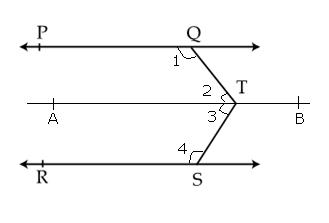 Since,
AB||PQ and PQ||RS therefore PQ||AB||RS.
If
the lines are parallel then the sum of interior angles on the same side of
transversal is 180o, therefore
1
+ 2 = 180o … (i)
And,
3 + 4 = 180o … (ii)
Adding
(i) and (ii), we get
1
+ 2 + 3 + 4= 180o + 180o
Or, PQT + QTS + RST = 360o
Hence
proved.
Since,
AB||PQ and PQ||RS therefore PQ||AB||RS.
If
the lines are parallel then the sum of interior angles on the same side of
transversal is 180o, therefore
1
+ 2 = 180o … (i)
And,
3 + 4 = 180o … (ii)
Adding
(i) and (ii), we get
1
+ 2 + 3 + 4= 180o + 180o
Or, PQT + QTS + RST = 360o
Hence
proved.
Since,
AB||PQ and PQ||RS therefore PQ||AB||RS.
If
the lines are parallel then the sum of interior angles on the same side of
transversal is 180o, therefore
1
+ 2 = 180o … (i)
And,
3 + 4 = 180o … (ii)
Adding
(i) and (ii), we get
1
+ 2 + 3 + 4= 180o + 180o
Or, PQT + QTS + RST = 360o
Hence
proved.
Q76. An
angle is equal to five times of its complement. Find the measure of the
angle.
Solution
Let
the angle be a. Its complement = 90o - a
Therefore,
a
= 5(90o - a)
 a = 450o - 5a
6a = 450o
a
= 75o
a = 450o - 5a
6a = 450o
a
= 75o
a = 450o - 5a
6a = 450o
a
= 75o
Q77. In
figure, if AB||CD then find  PQR.
PQR.

PQR.
Solution
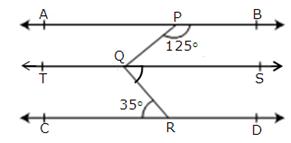 RQS
= 35o (alternate
op. angles as TS||CD)
SQP
= 180o - 125o = 55o (angles on same side as AB||TS)
PQR
= RQS + SQP
= 35o + 55o
= 90o
RQS
= 35o (alternate
op. angles as TS||CD)
SQP
= 180o - 125o = 55o (angles on same side as AB||TS)
PQR
= RQS + SQP
= 35o + 55o
= 90o
Q78. In the figure AC CE and
  A:B :C = 3: 2: 1, find the value of ECD

CE and A:B :C = 3: 2: 1, find the value of ECD
Solution
Let A, B and C be 3x, 2x and x respectively.
 3x +2x +x = 180o (angle sum of
  )
6x = 180o
)
6x = 180o  x = 30
A = 90o, B = 60o and ACB =30o
Now, ACB + ACE + ECD = 180o (angles on a straight line)
30o + 90o + ECD = 180o
ECD = 180o – 120o = 60o
Hence, ECD = 60o
x = 30
A = 90o, B = 60o and ACB =30o
Now, ACB + ACE + ECD = 180o (angles on a straight line)
30o + 90o + ECD = 180o
ECD = 180o – 120o = 60o
Hence, ECD = 60o
A, B and C be 3x, 2x and x respectively.
3x +2x +x = 180o (angle sum of )
6x = 180o x = 30
A = 90o, B = 60o and ACB =30o
Now, ACB + ACE + ECD = 180o (angles on a straight line)
30o + 90o + ECD = 180o
ECD = 180o – 120o = 60o
Hence, ECD = 60o
Q79. The exterior angles obtained on producing the base of a triangle both ways are 100° and 120° respectively. Find all the angles.
Solution
 2 + 3 = 100o (exterior angle property)
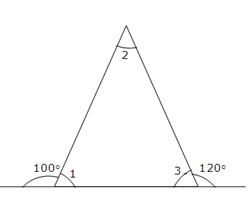 1 + 100o = 180o (Linear pair)
 1 = 80o
1 + 2 = 120o (exterior angle property)
1 = 80o
1 + 2 = 120o (exterior angle property)
 80o + 2 = 120o
2 = 40o
1 + 2 + 3 = 180o (Angle sum property of
80o + 2 = 120o
2 = 40o
1 + 2 + 3 = 180o (Angle sum property of  )
80o + 40o + 3 = 180o
3 = 60o
Hence, 1 = 80o, 2= 40o, 3 = 60o
)
80o + 40o + 3 = 180o
3 = 60o
Hence, 1 = 80o, 2= 40o, 3 = 60o
Q80. 
Solution
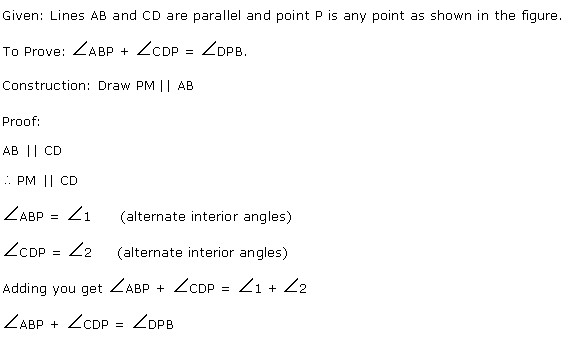
Q81. In
fig., OP bisects  AOC, OQ bisects BOC and OP
 OQ. Show that points A, O and B are collinear.

AOC, OQ bisects BOC and OPOQ. Show that points A, O and B are collinear.
Solution
OR
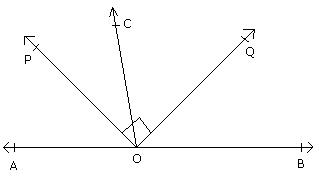 Since OP and OQ bisects angles AOC and BOC
respectively.
Since OP and OQ bisects angles AOC and BOC
respectively.
 …(I)
And
…(I)
And  COB = 2COQ … (II)
Add (I) and (II)
AOC + COB = 2POC + 2COQ
COB = 2COQ … (II)
Add (I) and (II)
AOC + COB = 2POC + 2COQ





 is a straight line
 A, O and B are collinear points.
Since OP and OQ bisects angles AOC and BOC
respectively.
…(I)
And COB = 2COQ … (II)
Add (I) and (II)
AOC + COB = 2POC + 2COQ
is a straight line
A, O and B are collinear points.
Q82. In given figure, if a ray OC stands on line AB such that  then show that

then show that
Solution

Q83. 
Solution
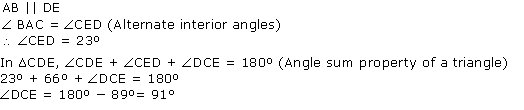
Q84. In
fig., AB||CD and CD||EF. Also EA  AB. If
  BEF= 40o, then find x, y, z.

AB. If BEF= 40o, then find x, y, z.
Solution
Since
sum of the interior angles on the same side of transversal is 180o,
we have
y
= 180o - 40o = 140o
x
= y = 140o (corresponding angles)
z
= 90o - 40o = 50o
Q85. In
fig., l1||l2 and m1||m2.
Prove that  1 + 2 = 180o.

1 + 2 = 180o.
Solution
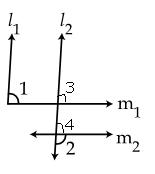 1
= 3 (corresponding angle )
3
= 4
(corresponding angle)
1
= 3 (corresponding angle )
3
= 4
(corresponding angle)
 1 = 4
But, 4
+ 2 = 180o (linear pair)
1 + 2 = 180o
1 = 4
But, 4
+ 2 = 180o (linear pair)
1 + 2 = 180o
Q86. 
Solution
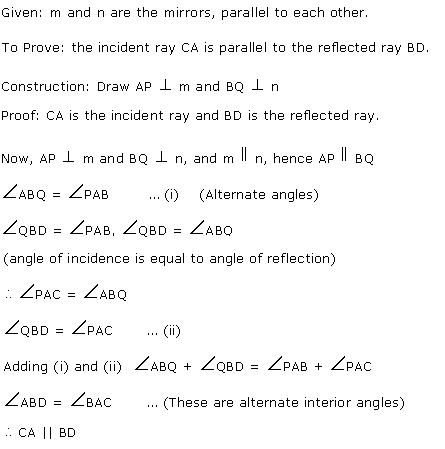
Q87. 
Solution
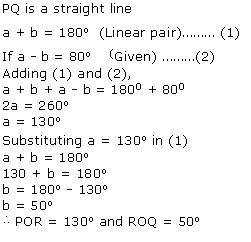
Q88. Lines AB and CD
are parallel and P is any point between the two lines as shown in figure.
Show that  DPB = x + y.

DPB = x + y.
Solution
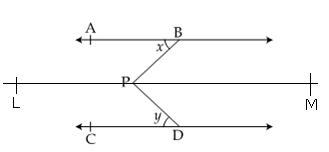 Construction
:- Draw LM||AB and CD
ABP
= BPM = x
...(1)
(Alternate
interior angles)
DPM
= PDC = y ...(2)
(Alternate
interior angles)
DPB
= BPM + DPM
Construction
:- Draw LM||AB and CD
ABP
= BPM = x
...(1)
(Alternate
interior angles)
DPM
= PDC = y ...(2)
(Alternate
interior angles)
DPB
= BPM + DPM
 From (1) and (2), DPB = x + y
Q89. If
fig., if AB||CD, EF CD and
  GED = 126°, find AGE, GEF and FGE.

CD and GED = 126°, find AGE, GEF and FGE.
Solution
 GED
= AGE [alternate
interior angles]
AGE
= 1260
GED
= 1260
GEF+FED = 1260
GEF+900=
1260 [FED = 900]
GEF
= 360
GEC+GED = 1800 (linear
pair)
GEC+1260=
1800
GEC = 540
GEC=
FGE= 540 [Alternate
interior angles]
GED
= AGE [alternate
interior angles]
AGE
= 1260
GED
= 1260
GEF+FED = 1260
GEF+900=
1260 [FED = 900]
GEF
= 360
GEC+GED = 1800 (linear
pair)
GEC+1260=
1800
GEC = 540
GEC=
FGE= 540 [Alternate
interior angles]
Q90. If two interior angles on the same side of a traversal intersecting two parallel lines are in the ratio 2: 3, then the smaller of the two angles is:
Solution

Q91. If the
bisectors of the angles  ABC and ACB of a triangle ABC meet at point O then prove that
BOC = 90o +
ABC and ACB of a triangle ABC meet at point O then prove that
BOC = 90o +  .
.
ABC and ACB of a triangle ABC meet at point O then prove that
BOC = 90o + .Solution
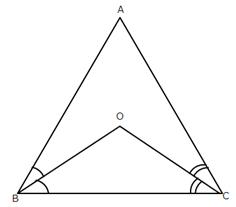 Given
: In
Given
: In  ABC, BO and CO are bisectors of ABC and ACB
To
prove : BOC =
ABC, BO and CO are bisectors of ABC and ACB
To
prove : BOC =  A
Proof:
In BOC,
OBC
+ BCO + BOC = 180o
OBC
+ BCO = 180o
- BOC ...(i)
In
ABC,
ABC + BCA + A = 180o
A
Proof:
In BOC,
OBC
+ BCO + BOC = 180o
OBC
+ BCO = 180o
- BOC ...(i)
In
ABC,
ABC + BCA + A = 180o

 From
(i) and (ii)
From
(i) and (ii)
 Hence proved.
Q92. In
figure, if PQ||RS, then find  SRO.
SRO.

SRO.
Solution
Since
PQ || RS, then OSR = 50o as alternate interior angles are
equal.
Now
in triangle RSO,
SRO
+ 50o + 20o = 180o
Or,
SRO = 180o - 70o = 110o
OSR = 50o as alternate interior angles are
equal.
Now
in triangle RSO,
SRO
+ 50o + 20o = 180o
Or,
SRO = 180o - 70o = 110o
Q93. In figure, PQ  PS, PQ||SR,
  SQR = 25o and QRT = 65o. Find the value of x and y.
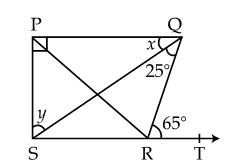
PS, PQ||SR, SQR = 25o and QRT = 65o. Find the value of x and y.
Solution
QSR
+ SQR = QRT
(exterior
angle property)
 QSR = 65o - 25o = 40o
PSR
+ SPQ = 180o
(PQ||SR,
Co-interior angles are supplementary)
PSR = 180o - 90o = 90o
PSR
= y + QSR
y = 90 o - 40 o = 50o
Also
x = QSR (PQ||SR, alternate interior angles are equal)
x = 40o
QSR = 65o - 25o = 40o
PSR
+ SPQ = 180o
(PQ||SR,
Co-interior angles are supplementary)
PSR = 180o - 90o = 90o
PSR
= y + QSR
y = 90 o - 40 o = 50o
Also
x = QSR (PQ||SR, alternate interior angles are equal)
x = 40o
Q94. In figure,  PQR is:

PQR is:
Solution
SincePQR + 75o = 105o
Since, 105o is exterior angle. Therefore, PQR = 30o.
PQR + 75o = 105o
Since, 105o is exterior angle. Therefore, PQR = 30o.
Q95. In
fig., if AB||CD,  APQ = 50o and PRD = 127o, find x and y.

APQ = 50o and PRD = 127o, find x and y.
Solution
Since
AB||CD,
x
= APQ = 50o (alternate interior
angles)
Also, y + 50o = 127o (alternate interior angles)
Or,
y = 77o.
APQ = 50o (alternate interior
angles)
Also, y + 50o = 127o (alternate interior angles)
Or,
y = 77o.
Q96. In
figure prove that l||m.

Solution
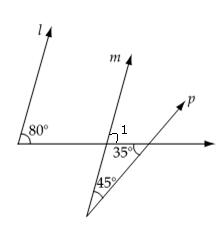 By
exterior angle theorem,
By
exterior angle theorem,
 1
= 45o + 35o = 80o
Thus
1 is equal to given angle of 80o, Since
they are corresponding angles so l || m.
1
= 45o + 35o = 80o
Thus
1 is equal to given angle of 80o, Since
they are corresponding angles so l || m.
Q97. In the
given figure, Prove that x = a + b + c.

Solution
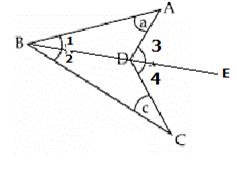 Construction: We join B and D and produce to E
Proof:
Construction: We join B and D and produce to E
Proof:  1 +2 =b and 3+4=x … (i)
In
1 +2 =b and 3+4=x … (i)
In  ABD,3 = 1+ a [external
angle property]
In BDC, 4 =2 + c [external
angle property] … (ii)
Adding (i) and (ii), we get
3+4 = (1+2) +a +c
ABD,3 = 1+ a [external
angle property]
In BDC, 4 =2 + c [external
angle property] … (ii)
Adding (i) and (ii), we get
3+4 = (1+2) +a +c
 x= b +
a + c using (i)
x= b +
a + c using (i)
Q98. In fig., ray OC
stands on the line AB, ray OL and ray OM are angle bisector of  AOC and BOC respectively. Prove that LOM = 90o.

AOC and BOC respectively. Prove that LOM = 90o.
Solution
Let AOL
= LOC = x
( OL is the
bisector)
Let COM
= MOB = y
( OM is the
bisector)
Now, AOL
+ LOC + COM + MOB = 180o (Linear pair)
x
+ x + y + y = 180
OL is the
bisector)
Let COM
= MOB = y
( OM is the
bisector)
Now, AOL
+ LOC + COM + MOB = 180o (Linear pair)
x
+ x + y + y = 180  x + y = 90o
LOC + COM = 90o LOM = 90o
x + y = 90o
LOC + COM = 90o LOM = 90o
AOL
= LOC = x
( OL is the
bisector)
Let COM
= MOB = y
( OM is the
bisector)
Now, AOL
+ LOC + COM + MOB = 180o (Linear pair)
x
+ x + y + y = 180 x + y = 90o
LOC + COM = 90o LOM = 90o
Q99. In
figure, if PQ||RS,  ACS = 117o then find (x - y).

ACS = 117o then find (x - y).
Solution
60o
+ y = 117o (alternate
interior angle as PQ||RS)
y
= 117o - 60o = 57o
Again,
x + y = 117o (exterior
angle theorem)
x
= 117o - 57o
x
= 60o
x
- y = 3o
Q100. AB
and CD are the bisectors of the two alternate interior angles formed by the
intersection of a transversal 't' with
parallel lines l and m (Shown in Figure) Show that AB||CD.

Solution
Since
l m, t is transversal line
 EAC=
ACH (alt. interior angles)
EAC=
ACH (alt. interior angles)

m, t is transversal line
EAC=
ACH (alt. interior angles)
Q101. In figure,  is an isosceles triangle with LM = LN, and LP bisects
  NLQ, prove that LP|| MN.

is an isosceles triangle with LM = LN, and LP bisects NLQ, prove that LP|| MN.
Solution
Here in  LMN we have
LM= LN
LMN we have
LM= LN
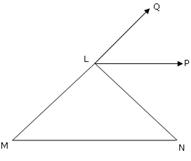


 But they are alternate interior angles.
Hence, LP || MN.
But they are alternate interior angles.
Hence, LP || MN.
LMN we have
LM= LN
But they are alternate interior angles.
Hence, LP || MN.
Q102. Prove
that the sum of the angles of a triangle is 1800.
Solution
Stat: Sum
of the angle of a triangle is 180º.
Given: A
triangle ABC in which the angles are a degree, b degree and c degree.
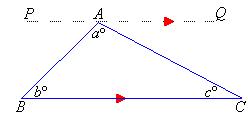 Construction Draw
the line PAQ parallel to BC. Take the
replica of ÐABC and put it in ÐPAB
and ÐACB in ÐQAC
Proof: Now angle PAB= b degree and angle
QAC= c degree since they are the pairs of alternate interior angles.
Construction Draw
the line PAQ parallel to BC. Take the
replica of ÐABC and put it in ÐPAB
and ÐACB in ÐQAC
Proof: Now angle PAB= b degree and angle
QAC= c degree since they are the pairs of alternate interior angles.
 ÐPAB = b º
[ Alternate interior angle]
ÐQAC = c º
[ Alternate interior angle]
Now Angle PAB plus
angle BAC plus angle QAC is equal to 180 degree
ÐPAB+ÐBAC+ÐQAC= 180º º [ Angle sum of straight line]
b º+ c º+ a º = 180º
Hence the angle sum of triangle is 180 º
Hence we have proved the sum of angles of a
triangle to be 180 degree.
ÐPAB = b º
[ Alternate interior angle]
ÐQAC = c º
[ Alternate interior angle]
Now Angle PAB plus
angle BAC plus angle QAC is equal to 180 degree
ÐPAB+ÐBAC+ÐQAC= 180º º [ Angle sum of straight line]
b º+ c º+ a º = 180º
Hence the angle sum of triangle is 180 º
Hence we have proved the sum of angles of a
triangle to be 180 degree.
Construction Draw
the line PAQ parallel to BC. Take the
replica of ÐABC and put it in ÐPAB
and ÐACB in ÐQAC
Proof: Now angle PAB= b degree and angle
QAC= c degree since they are the pairs of alternate interior angles.
ÐPAB = b º
[ Alternate interior angle]
ÐQAC = c º
[ Alternate interior angle]
Now Angle PAB plus
angle BAC plus angle QAC is equal to 180 degree
ÐPAB+ÐBAC+ÐQAC= 180º º [ Angle sum of straight line]
b º+ c º+ a º = 180º
Hence the angle sum of triangle is 180 º
Hence we have proved the sum of angles of a
triangle to be 180 degree.
Q103. In the
figure,  POR and QOR form a linear pair. If b - a = 60°, find the
value of a and b.
POR and QOR form a linear pair. If b - a = 60°, find the
value of a and b.

POR and QOR form a linear pair. If b - a = 60°, find the
value of a and b.
Solution
POQ is a straight line
b-a = 60O (given) …..(i)
a+b = 1800 (linear pair axiom)
…..(ii)
Adding (i) and (ii)
2b = 2400
b= 1200
Equation (i) gives a = b - 60o = 120o-60o=
600
Hence, a = 600 and b = 1200
Q104. If
l, m, n are three lines such that l||m and n  l. Prove that
n
m.
l. Prove that
n
m.
l. Prove that
n
m. Solution
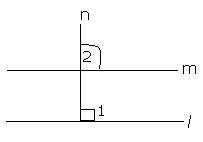 n
l (given)
Therefore,
n
l (given)
Therefore,
 1 = 90o
Also,
l||m, gives 2 = 90o
1 = 90o
Also,
l||m, gives 2 = 90o
 n is perpendicular to m.
Q105. In
figure, if x : y = 3 : 7, then find the value of x,y,z and w.

Solution
x
: y = 3 : 7
 3a + 7a = 180
10a = 180
a = 18o
Thus, x
= 54, y = 126
Since vertically opp. Angles are equal, therefore
y = w = 126o
x = z = 54o
3a + 7a = 180
10a = 180
a = 18o
Thus, x
= 54, y = 126
Since vertically opp. Angles are equal, therefore
y = w = 126o
x = z = 54o
3a + 7a = 180
10a = 180
a = 18o
Thus, x
= 54, y = 126
Since vertically opp. Angles are equal, therefore
y = w = 126o
x = z = 54o
Q106. In
ΔXYZ, YO and ZO are the bisectors of ÐXYZ and ÐXZY respectively of ΔXYZ. If  X = 62°, XYZ = 54°, then find ÐOZY.
X = 62°, XYZ = 54°, then find ÐOZY.Solution
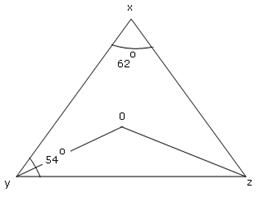 In
In  XYZ
XYZ
 X+Y+Z= 1800
620+540+Z= 1800
Z
= 640.
OZY
=
X+Y+Z= 1800
620+540+Z= 1800
Z
= 640.
OZY
=  =
= OZY
= 320
OZY
= 320
Q107. In fig., if y = 20°, prove that
the line AOB is a straight line.

Solution
We know angle at a point is 360o.
y+3x-15+y+5+2y+4y+10+x=360o
8y + 4x = 360o
160o + 4x = 360o (Since, y=20o)
4x = 200  x= 50o
Now, we have:
y + 5 + 3x - 15
+ y = 40 + 150 - 10 = 180o
x= 50o
Now, we have:
y + 5 + 3x - 15
+ y = 40 + 150 - 10 = 180o
 AOB is a
straight line.
AOB is a
straight line.
x= 50o
Now, we have:
y + 5 + 3x - 15
+ y = 40 + 150 - 10 = 180o
AOB is a
straight line.
Q108. 
Solution
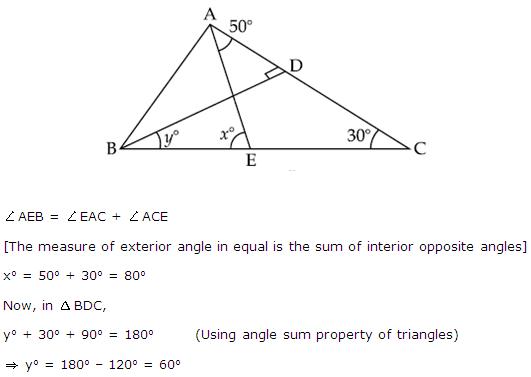
Q109. 
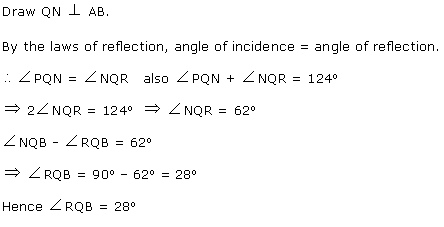
Solution
Q110. In
fig., the side BC of  ABC is produced to D, the bisector of
  BAC intersects the side BC at E. Prove that ABC + ACD = 2AEC.

ABC is produced to D, the bisector of BAC intersects the side BC at E. Prove that ABC + ACD = 2AEC.
Solution
Given:
The side BC of ABC is produced to D, the bisector of BAC intersects the side BC at E.
To
prove: ABC + ACD = 2AEC
Proof:
We
know that ACD = ABC + BAC …
(1)
(ext. angle theorem)
AE
is bisector of BAC, thus
i.e.,
BAC = 2BAE
Thus
equation (1) reduce to
ACD
= ABC + 2BAE
Adding
ABC on both sides,
Now
ABC + ACD = ABC + ABC + 2BAE
= 2 (ABC + BAE)
= 2 (AEC) [Ext angle of ABE]
Hence
proved.
ABC is produced to D, the bisector of BAC intersects the side BC at E.
To
prove: ABC + ACD = 2AEC
Proof:
We
know that ACD = ABC + BAC …
(1)
(ext. angle theorem)
AE
is bisector of BAC, thus
i.e.,
BAC = 2BAE
Thus
equation (1) reduce to
ACD
= ABC + 2BAE
Adding
ABC on both sides,
Now
ABC + ACD = ABC + ABC + 2BAE
= 2 (ABC + BAE)
= 2 (AEC) [Ext angle of ABE]
Hence
proved.
Q111. Find x
and y in the given figure.

Solution
Using
angle sum property in  AOD,
x - 6
+ x = 90o
AOD,
x - 6
+ x = 90o
 2x = 96o
x = 48o
Using
angle sum property in BOC,
4y +
3y + 6 = 90o
7y = 84
y = 12o
2x = 96o
x = 48o
Using
angle sum property in BOC,
4y +
3y + 6 = 90o
7y = 84
y = 12o
AOD,
x - 6
+ x = 90o
2x = 96o
x = 48o
Using
angle sum property in BOC,
4y +
3y + 6 = 90o
7y = 84
y = 12o
Q112. If
two lines are perpendicular to the same line, prove that they are parallel to
each other.
Solution
Let
l  n and m n.

 1 = 2 = (each is 90o)
But
these are corresponding angles.
1 = 2 = (each is 90o)
But
these are corresponding angles.
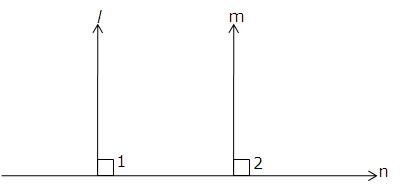 Hence
l || m.
Hence
l || m.
n and m n.
1 = 2 = (each is 90o)
But
these are corresponding angles.
Hence
l || m.
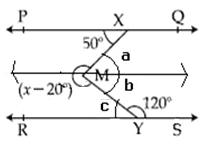
Q113. In fig., if PQ||RS and  PXM = 50° and MYS = 120°, find the value of x.

PXM = 50° and MYS = 120°, find the value of x.
Solution

Q114. In
fig., lines l and m intersect each other at O. If x = 40o then,
find the value of y, z and w.

Solution
x
= 40o  z = x (vertically opposite angles)
 z = 40o
xo
+ yo = 180o
40o + yo = 180o
y
= 140o
Again
x o + w o = 180o
40o + w o = 180o w o
= 140o
Thus
y
z = 40o
xo
+ yo = 180o
40o + yo = 180o
y
= 140o
Again
x o + w o = 180o
40o + w o = 180o w o
= 140o
Thus
y = w = 140o,
z = 40o
= w = 140o,
z = 40o
z = x (vertically opposite angles)
z = 40o
xo
+ yo = 180o
40o + yo = 180o
y
= 140o
Again
x o + w o = 180o
40o + w o = 180o w o
= 140o
Thus
y = w = 140o,
z = 40o
Q115. In
fig, if  POR and QOR form a linear pair and a - b = 80° then find the value
of a and b.
POR and QOR form a linear pair and a - b = 80° then find the value
of a and b.

POR and QOR form a linear pair and a - b = 80° then find the value
of a and b.
Solution
a + b = 180o (linear pair) … (i)
a - b = 80o (given) …(ii)
Add (i) and (ii)
 2a = 260o
a = 130o
Put value of a in (i)
we get,
b = 50o
Hence
a = 130o, b = 50o
2a = 260o
a = 130o
Put value of a in (i)
we get,
b = 50o
Hence
a = 130o, b = 50o
2a = 260o
a = 130o
Put value of a in (i)
we get,
b = 50o
Hence
a = 130o, b = 50o
Q116. In figure,
PQ||SR,  SQR = 25o, QRT = 65 o, find x and y:

SQR = 25o, QRT = 65 o, find x and y:
Solution
Since x + 25 o = 65 o
(Alternate interior angles)
x = 65 o - 25 o = 40o
In  PQS, by angle sum property, we have:
40 o + 90 o + y = 180o
PQS, by angle sum property, we have:
40 o + 90 o + y = 180o
 y = 50o
PQS, by angle sum property, we have:
40 o + 90 o + y = 180o
y = 50o
Q117. In figure,
TQ and TR are the bisectors of  Q and R respectively, QPR = 80°, PRT = 30°.Determine TQR and QTR.
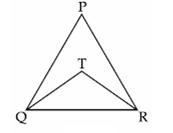
Q and R respectively, QPR = 80°, PRT = 30°.Determine TQR and QTR.
Solution






Q118. In
figure, lines AB and CD intersect at O. If
 AOD
: DOC = 4 : 5, then find COB
AOD
: DOC = 4 : 5, then find COB

AOD
: DOC = 4 : 5, then find COB
Solution
Let AOD
= 4x
And,
DOC = 5x
Therefore,
4x + 5x = 180o
Or,
9x = 180o
Or,
x = 20o
Therefore,
AOD = 4 x 20o = 80o
Now,
COB = AOD (Vertically
opp. angles)
COB
= 80o.
AOD
= 4x
And,
DOC = 5x
Therefore,
4x + 5x = 180o
Or,
9x = 180o
Or,
x = 20o
Therefore,
AOD = 4 x 20o = 80o
Now,
COB = AOD (Vertically
opp. angles)
COB
= 80o.
Q119. 
Solution
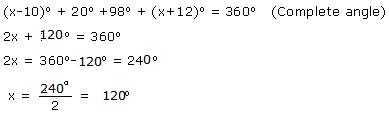
Q120. In
fig., two straight lines AB and CD intersect each other at O. If  COE = 70o, find the values of a, b and c.

COE = 70o, find the values of a, b and c.
Solution
CO
and EO stand on AB, therefore
 4b + 70o + b = 180o
 5b = 110o
b = 22o
Also,
a = 4b (vertically app s)
a = 4
5b = 110o
b = 22o
Also,
a = 4b (vertically app s)
a = 4  22o
= 88o
Now
a + 2c = 180o
88 + 2c = 180o 2c = 92o
c = 46o
Hence
a = 88o, b = 22o, c = 46o
22o
= 88o
Now
a + 2c = 180o
88 + 2c = 180o 2c = 92o
c = 46o
Hence
a = 88o, b = 22o, c = 46o
4b + 70o + b = 180o
5b = 110o
b = 22o
Also,
a = 4b (vertically app s)
a = 4 22o
= 88o
Now
a + 2c = 180o
88 + 2c = 180o 2c = 92o
c = 46o
Hence
a = 88o, b = 22o, c = 46o
Q121. In
figure, find the value of x and y and then show that AB||CD.
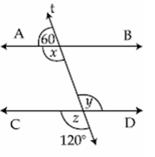
Solution
60+x = 1800 (linear pair axiom)
x = 1200
 z = y = 1200 [vertically
opposite s]
y = x = 1200
But x = y are alternate angles
So AB
z = y = 1200 [vertically
opposite s]
y = x = 1200
But x = y are alternate angles
So AB  CD
CD
Q122. In
fig., find the value of x.

Solution
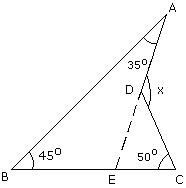 Produce AD to meet BC at point E
In
Produce AD to meet BC at point E
In  AEB
We have,
AEB
We have,
 A + B + AEB = 180o
(Sum of 3 angles of a triangle is 180o)
Thus,
A + B + AEB = 180o
(Sum of 3 angles of a triangle is 180o)
Thus, 
 Now, AEB + AEC = 108o (Linear pair axiom)
100o + AEC = 180o
Now, AEB + AEC = 108o (Linear pair axiom)
100o + AEC = 180o
 … (i)
Now in DEC
DEC + 50o = xo
(Exterior
angle is equal to sum of the opp. Interior angles)
Hence,
x = 130o (By
using (i))
… (i)
Now in DEC
DEC + 50o = xo
(Exterior
angle is equal to sum of the opp. Interior angles)
Hence,
x = 130o (By
using (i))
Q123. Prove
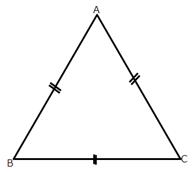
that each angle of an equilateral triangle is 60o.
Solution
Since  ABC
is an equilateral triangle, therefore
AB
= BC = CA
BA
= BC
ABC
is an equilateral triangle, therefore
AB
= BC = CA
BA
= BC 
 ...(1)
Similarly,
...(1)
Similarly,
 A = B ...(2)
 From
(1) and (2)
A
= B = C
So
A + B + C = 180o
Gives, A
= B = C = 60o
From
(1) and (2)
A
= B = C
So
A + B + C = 180o
Gives, A
= B = C = 60o
ABC
is an equilateral triangle, therefore
AB
= BC = CA
BA
= BC ...(1)
Similarly,
A = B ...(2)
From
(1) and (2)
A
= B = C
So
A + B + C = 180o
Gives, A
= B = C = 60o
Q124. In
the given figure, l||m, then find the value of x?

Solution
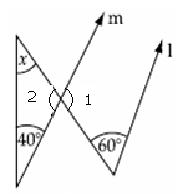
 1
= 180-60= 1200 (sum of angle on the same side of transversal is
1800)
1=
2 (vertically opposite angles)
2=
1200
x+ 40 +2= 1800 (Angle sum property of a triangle)
x
= 180- (40+120)
x
= 200
1
= 180-60= 1200 (sum of angle on the same side of transversal is
1800)
1=
2 (vertically opposite angles)
2=
1200
x+ 40 +2= 1800 (Angle sum property of a triangle)
x
= 180- (40+120)
x
= 200
Q125. Prove
that sum of the exterior angle of a triangle is 360o.
Solution
Let
x, y and z be the exterior angles of a triangle.
Then
the corresponding interior angles are:
180o
- x, 180o - y, 180o - z.
Since
the sum of interior angles is 180o, therefore
180o
- x + 180o - y + 180o - z = 180o
Or,
540o - (x + y + z) = 180o
Or,
x + y + z = 540o - 180o = 360o.
Hence
the sum of exterior angles is 360o.
Q126. Prove
that an equilateral triangle can be constructed on any given line segment.
Solution
Let
x be the length of the sides of an equilateral triangle.
Now
in a triangle, sum of any two sides is always greater than the third side.
In
this case, Sum of any two sides = x + x = 2x which is more than x.
Hence
the construction of an equilateral triangle on any given line segment is
possible.
Comments
Post a Comment