Q1. Construct a  ABC in which AB = 5.8 cm, BC + CA = 8.4 cm
and
ABC in which AB = 5.8 cm, BC + CA = 8.4 cm
and  B = 60o
ABC in which AB = 5.8 cm, BC + CA = 8.4 cm
and B = 60oSolution
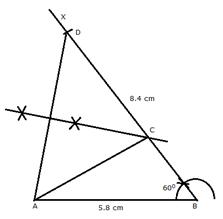 Steps
of construction:
(i) Draw
a line segment AB = 5.8 cm.
(ii) Draw
Steps
of construction:
(i) Draw
a line segment AB = 5.8 cm.
(ii) Draw  B = 60°.
(iii) With
Center B and radius 8.4 cm, make an arc which intersects BX at D.
(iv)
Join D to A.
(v) Draw a
perpendicular bisector of segment DA it intersect the line segment BD at
point C.
(vi) Join C to A.
ABC is the required triangle.
B = 60°.
(iii) With
Center B and radius 8.4 cm, make an arc which intersects BX at D.
(iv)
Join D to A.
(v) Draw a
perpendicular bisector of segment DA it intersect the line segment BD at
point C.
(vi) Join C to A.
ABC is the required triangle.
Q2. 
Solution
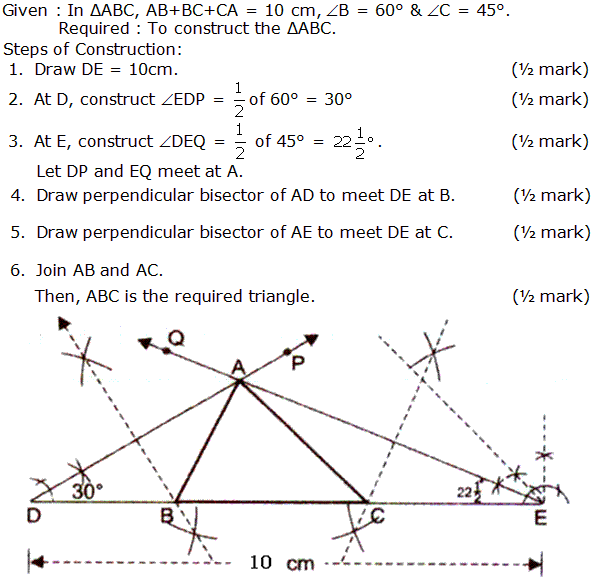
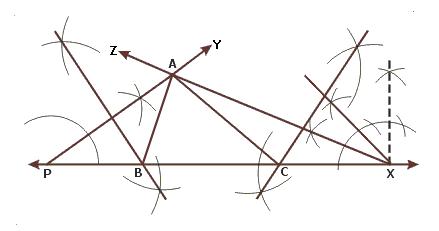
Q3. Construct a  ABC whose perimeter is 12 cm,
  B = 60o and C = 45o. Justify the construction.
ABC whose perimeter is 12 cm, B = 60o and C = 45o. Justify the construction.Solution
 Steps
of construction:
i)
Draw a ray and on it mark PX=12cm.
ii)
At P construct
Steps
of construction:
i)
Draw a ray and on it mark PX=12cm.
ii)
At P construct  iii)
At X construct
iii)
At X construct  iv)
Let the rays PY and XZ intersect at A.
v)
Let the perpendicular bisectors of AP and AX intersect PX at B and C
respectively.
vi)
Join AB and AC.
ABC
is the required triangle.
Justify
: After measurement by ruler
AB
+ BC + AC = 12 cm
iv)
Let the rays PY and XZ intersect at A.
v)
Let the perpendicular bisectors of AP and AX intersect PX at B and C
respectively.
vi)
Join AB and AC.
ABC
is the required triangle.
Justify
: After measurement by ruler
AB
+ BC + AC = 12 cm
Q4. Draw an obtuse angle. Bisect it. Measure each of the angles so obtained.
Solution
An angle, whose measure is more than 90o is an obtuse angle.
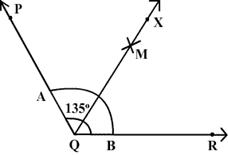 Steps of Construction.

Steps of Construction.
Q5. With the help of ruler and compass, draw an angle of 75o and bisect it. Write its steps of construction also.
Solution
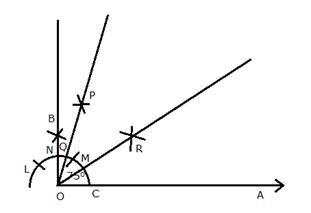 Step of Construction:
(i) Take a ray OA. (ii) With O as centre and any convenient radius, draw an arc cutting OA at C. (iii) With C as centre and the same radius, draw an arc cutting the first arc at M. (iv) With M as centre and the same radius, cut off an arc cutting again the first arc at L. (v) With L and M as centre and radius of more than half of LM, draw two arcs cutting each other at B, join OB which is making 90°. (vi) Now with N and M as centres again draw two arcs cutting each other at P. (vii) Join OP.Then,
Step of Construction:
(i) Take a ray OA. (ii) With O as centre and any convenient radius, draw an arc cutting OA at C. (iii) With C as centre and the same radius, draw an arc cutting the first arc at M. (iv) With M as centre and the same radius, cut off an arc cutting again the first arc at L. (v) With L and M as centre and radius of more than half of LM, draw two arcs cutting each other at B, join OB which is making 90°. (vi) Now with N and M as centres again draw two arcs cutting each other at P. (vii) Join OP.Then,  POA = 75°.
(viii) Again with Q and C as centres, draw two arcs cutting each other at R.
(ix) OR bisects the POA which is 75°.
POA = 75°.
(viii) Again with Q and C as centres, draw two arcs cutting each other at R.
(ix) OR bisects the POA which is 75°.
Q6. Draw a circle with centre at point O. Draw its two chords AB and CD such that AB is not parallel to CD. Draw the perpendicular bisectors of AB and CD. At what point do they intersect?
Solution
Bisector of a line segment is at right angle to the line segment. Hence steps of construction for perpendicular bisector will be the same as that of bisector of a line segment.
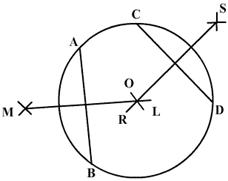 Steps of construction.
i. Draw a circle with centre O.
ii. Draw any two chords AB and CD such that AB is not parallel to CD.
iii. With A as centre and radius more than half of AB, draw two arcs above and below AB.
iv. With B as centre and same radius draw two arcs intersecting the previous arcs at L and M.
v. Join LM.
vi. Then LM is the perpendicular bisector of AB.
vii. Similarly, draw RS the perpendicular bisector of CD.
viii. LM and RS intersect at O, the centre of the circle.
Steps of construction.
i. Draw a circle with centre O.
ii. Draw any two chords AB and CD such that AB is not parallel to CD.
iii. With A as centre and radius more than half of AB, draw two arcs above and below AB.
iv. With B as centre and same radius draw two arcs intersecting the previous arcs at L and M.
v. Join LM.
vi. Then LM is the perpendicular bisector of AB.
vii. Similarly, draw RS the perpendicular bisector of CD.
viii. LM and RS intersect at O, the centre of the circle.
Steps of construction.
i. Draw a circle with centre O.
ii. Draw any two chords AB and CD such that AB is not parallel to CD.
iii. With A as centre and radius more than half of AB, draw two arcs above and below AB.
iv. With B as centre and same radius draw two arcs intersecting the previous arcs at L and M.
v. Join LM.
vi. Then LM is the perpendicular bisector of AB.
vii. Similarly, draw RS the perpendicular bisector of CD.
viii. LM and RS intersect at O, the centre of the circle.
Q7. Construct a triangle ABC in which BC = 5.6cm, AC – BC = 1.6cm and angle B = 45o. Justify your construction.
Solution
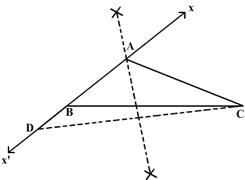 Steps of construction:

Q8. Construct a right triangle whose base is 6
cm and the difference of its hypotenuse and the other side is 2 cm.
Solution
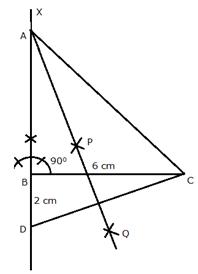 Steps of Construction :
1. Draw
the base BC = 6 cm and at point B make an angle
of 900.
2. Cut a line
segment BD equal to AC - AB = 2 cm from the
line BX
extended on opposite side of line segment
BC.
3. Join DC
and draw the perpendicular bisector, say
PQ of DC.
4. Let PQ
intersect BX at A. Join AC
Then, ABC
is the required triangle.
Steps of Construction :
1. Draw
the base BC = 6 cm and at point B make an angle
of 900.
2. Cut a line
segment BD equal to AC - AB = 2 cm from the
line BX
extended on opposite side of line segment
BC.
3. Join DC
and draw the perpendicular bisector, say
PQ of DC.
4. Let PQ
intersect BX at A. Join AC
Then, ABC
is the required triangle.
Q9. Construct a triangle ABC in which  B
= 60o, C = 45o and the perimeter
of the triangle is 11 cm.
B
= 60o, C = 45o and the perimeter
of the triangle is 11 cm.
B
= 60o, C = 45o and the perimeter
of the triangle is 11 cm.Solution
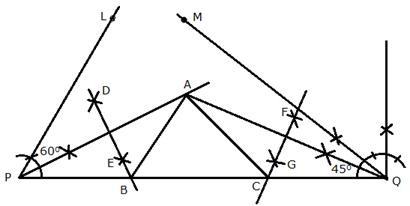 Steps of Construction :
1. Draw a
line segment PQ = 11 cm (= AB + BC + CA).
2. At P
construct an angle of 60° and at Q, an angle of 45°.
3. Bisect
these angles. Let the bisectors of these angles intersect at a point A.
4. Draw
perpendicular bisectors DE of AP to intersect PQ at B and FG of AQ to intersect
PQ at C.
5. Join AB
and AC
ABC is the
required triangle.
Steps of Construction :
1. Draw a
line segment PQ = 11 cm (= AB + BC + CA).
2. At P
construct an angle of 60° and at Q, an angle of 45°.
3. Bisect
these angles. Let the bisectors of these angles intersect at a point A.
4. Draw
perpendicular bisectors DE of AP to intersect PQ at B and FG of AQ to intersect
PQ at C.
5. Join AB
and AC
ABC is the
required triangle.
Q10. Construct a  ABC in which BC = 5.7 cm
  B = 30o and AB - AC = 3 cm.
ABC in which BC = 5.7 cm B = 30o and AB - AC = 3 cm.Solution
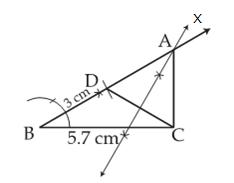 Steps
of Construction :
1. Draw the base BC=5.7 cm
and at point B make an angle
say XBC = 300.
2. Cut the line segment BD
equal to AB - AC = 3 cm from
ray BX.
3. Join DC and draw the
perpendicular bisector of DC.
4. Let it intersect BX at a
point A. Join AC.
ABC
is the required triangle.
Steps
of Construction :
1. Draw the base BC=5.7 cm
and at point B make an angle
say XBC = 300.
2. Cut the line segment BD
equal to AB - AC = 3 cm from
ray BX.
3. Join DC and draw the
perpendicular bisector of DC.
4. Let it intersect BX at a
point A. Join AC.
ABC
is the required triangle.
Q11. Construct a right triangle whose base is 12
cm and sum of its hypotenuse and other side is 18 cm.
Solution
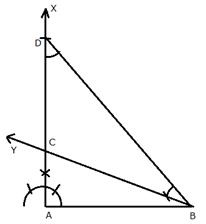 Steps Of
Construction:
1.
Draw a line segment AB = 12cm.
2.
Draw a ray AX making right angle with AB.
3.
Cut a line segment AD of length 18 cm from ray AX.
4.
Join BD and make an angle DBY equal to ADB.
5.
Let BY intersect AX at C. Join AC and BC.
Triangle
ABC is the required triangle.
Steps Of
Construction:
1.
Draw a line segment AB = 12cm.
2.
Draw a ray AX making right angle with AB.
3.
Cut a line segment AD of length 18 cm from ray AX.
4.
Join BD and make an angle DBY equal to ADB.
5.
Let BY intersect AX at C. Join AC and BC.
Triangle
ABC is the required triangle.
Q12. Construct a triangle PQR with base PQ = 8.4
cm,  P
= 45o and PR - QR = 2.8 cm.
P
= 45o and PR - QR = 2.8 cm.
P
= 45o and PR - QR = 2.8 cm.Solution
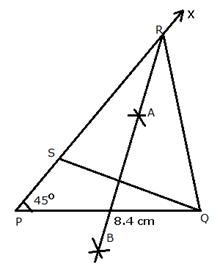 Steps of
Construction :
1. Draw
the base PQ = 8.4 cm and at point P make an angle of 45o.
2. Cut the
line segment PS equal to the length of PR - QR, that is 2.8 cm
3. Join SQ
and draw the perpendicular bisector, say
AB of SQ.
4. Let it
intersect BX at a point R. Join RQ
Then, PQR
is the required triangle.
Steps of
Construction :
1. Draw
the base PQ = 8.4 cm and at point P make an angle of 45o.
2. Cut the
line segment PS equal to the length of PR - QR, that is 2.8 cm
3. Join SQ
and draw the perpendicular bisector, say
AB of SQ.
4. Let it
intersect BX at a point R. Join RQ
Then, PQR
is the required triangle.
Q13. Construct a triangle ABC in which BC = 5 cm, angle B = 75o and the median bisecting BC is 3.6 cm.
Solution
Steps of construction.

Q14. Construct a  ABC such that
  B = 60o, C = 45o and its perimeter is 10 cm.
ABC such that B = 60o, C = 45o and its perimeter is 10 cm.Solution
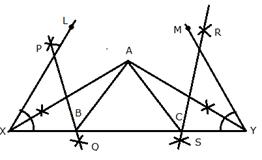 Steps of Construction :
1. Draw a
line segment, say XY equal to BC + CA + AB = 10 cm.
2. Make
angle LXY equal to 60o and angle MYX equal to 45o.
3. Bisect
Steps of Construction :
1. Draw a
line segment, say XY equal to BC + CA + AB = 10 cm.
2. Make
angle LXY equal to 60o and angle MYX equal to 45o.
3. Bisect  LXY and MYX. Let these bisectors intersect at point A.
4. Draw
perpendicular bisector PQ of AX and RS of AY.
5. Let PQ
intersect XY at B and RS intersect XY at C.
6. Join AB
and AC.
ABC is the
required triangle.
LXY and MYX. Let these bisectors intersect at point A.
4. Draw
perpendicular bisector PQ of AX and RS of AY.
5. Let PQ
intersect XY at B and RS intersect XY at C.
6. Join AB
and AC.
ABC is the
required triangle.
Q15. Construct a triangle XYZ in which  Y = 30o, Z = 90o and XY + YZ + ZX = 11 cm.
Y = 30o, Z = 90o and XY + YZ + ZX = 11 cm.Solution
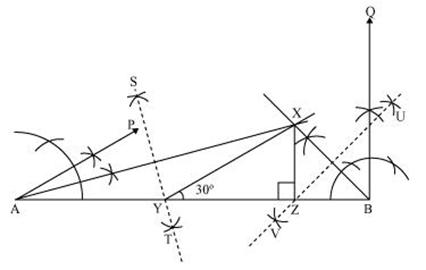 Steps
of construction:
(i) Draw a
line segment AB of 11 cm. (As XY + YZ + ZX = 11 cm)
(ii)
Construct an angle,
Steps
of construction:
(i) Draw a
line segment AB of 11 cm. (As XY + YZ + ZX = 11 cm)
(ii)
Construct an angle,  PAB, of 30° at point A
and an angle, QBA, of 90° at point B.
(iii)
Bisect PAB and QBA. Let these bisectors intersect each other at
point X.
(iv) Draw
perpendicular bisector ST of AX and UV of BX.
(v) Let ST
intersect AB at Y and UV intersect AB at Z.
Join XY,
XZ.
PAB, of 30° at point A
and an angle, QBA, of 90° at point B.
(iii)
Bisect PAB and QBA. Let these bisectors intersect each other at
point X.
(iv) Draw
perpendicular bisector ST of AX and UV of BX.
(v) Let ST
intersect AB at Y and UV intersect AB at Z.
Join XY,
XZ.
 XYZ is the required triangle.
Q16. Draw a line segment of length 5.8cm. Bisect it and measure the length of each part.
Solution
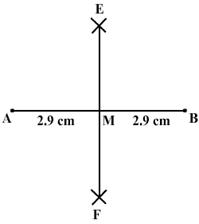 Steps of construction;
1. Draw a line segment AB= 5.8cm.
2. With A as centre and radius more than half of AB, draw two arcs above and below AB.
3. With B as centre and same radius, draw two arcs cutting the arcs drawn in step 2 at E and F respectively.
4. Join EF.
EF is the bisector of AB, and M is the point of bisection.
By measurement AM = MB = 2.9cm.
Steps of construction;
1. Draw a line segment AB= 5.8cm.
2. With A as centre and radius more than half of AB, draw two arcs above and below AB.
3. With B as centre and same radius, draw two arcs cutting the arcs drawn in step 2 at E and F respectively.
4. Join EF.
EF is the bisector of AB, and M is the point of bisection.
By measurement AM = MB = 2.9cm.
Q17. Construct a right angled triangle PQR right
angled at Q where base QR is 4 cm and the sum of other side and hypotenuse is
8 cm.
Solution
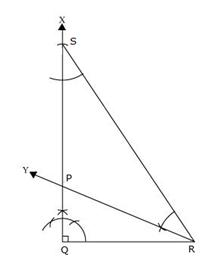 Steps of
construction:
(i) Draw
line segment QR of 4 cm.
(ii) Draw
a ray QX making 90° with QR.
(iii) Cut
a line segment QS of 8 cm (as the sum of the other two sides is 8) from ray QX.
(iv) Join SR
and make an angle SRY equal to QSR.
(v) Let RY
intersect QX at P. Join QP, RP.
Steps of
construction:
(i) Draw
line segment QR of 4 cm.
(ii) Draw
a ray QX making 90° with QR.
(iii) Cut
a line segment QS of 8 cm (as the sum of the other two sides is 8) from ray QX.
(iv) Join SR
and make an angle SRY equal to QSR.
(v) Let RY
intersect QX at P. Join QP, RP.
 PQR is the required triangle.
Q18. Using a protractor, draw an angle of measure 136o. With this angle as given draw an angle of measure 102o.
Solution


Q19. Construct a triangle XYZ in which angle Y = 30o, angle Z = 90o and XY + YZ + ZX =11cm.
Solution
 Steps of construction
Following steps will be followed to construct the required triangle.
Step I: Draw a line segment AB of 11 cm.(As XY + YZ + ZX = 11 cm)
Step II: Construct an angle
Steps of construction
Following steps will be followed to construct the required triangle.
Step I: Draw a line segment AB of 11 cm.(As XY + YZ + ZX = 11 cm)
Step II: Construct an angle  PAB of 30° at point A and an angle QBA of 90° at point B.
Step III: Bisect PAB and QBA. Let these bisectors intersect each other at point X.
Step IV: Draw perpendicular bisector ST of AX and UV of BX.
Step V: Let ST intersects AB at Y and UV intersects AB at Z.Join XY, XZ.DXYZ is the required triangle.
PAB of 30° at point A and an angle QBA of 90° at point B.
Step III: Bisect PAB and QBA. Let these bisectors intersect each other at point X.
Step IV: Draw perpendicular bisector ST of AX and UV of BX.
Step V: Let ST intersects AB at Y and UV intersects AB at Z.Join XY, XZ.DXYZ is the required triangle.
Q20. Construct a triangle whose base is 12cm and sum of hypotenuse and other side is 18cm.
Solution
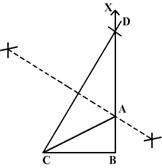 Steps of construction.

Q21. Construct a right angled isosceles triangle whose hypotenuse is 7 cm.
Solution
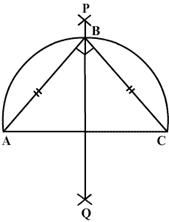 Angle in a semi-circle is a right angle.
Steps of construction.
Angle in a semi-circle is a right angle.
Steps of construction.

Q22. Using ruler and compass only, construct an angle of 105o.
Solution

Q23. Draw a pair of vertically opposite angles. Bisect each of the two angles .Verify that the bisecting rays are in the same line.
Solution
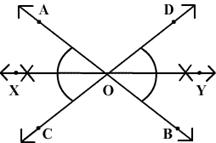 Steps of construction:
i. Draw two lines AB and CD intersecting at point O.
ii. Angle AOC and angle BOD are vertically opposite angles.
iii. With O centre and a convenient radius draw an arc cutting OA and OC at P and Q respectively.
iv. With P as centre and radius more than half of PQ of AB, draw an arc.
v. With Q as centre and the same radius as in step 3 draw another arc intersecting the previous arc at M.
vi. Join OM and produce it to form ray OX.
vii. Then OX bisects angle AOC.
viii. Similarly draw the bisector OY of angle BOD.
To prove XOY is a straight line.
Steps of construction:
i. Draw two lines AB and CD intersecting at point O.
ii. Angle AOC and angle BOD are vertically opposite angles.
iii. With O centre and a convenient radius draw an arc cutting OA and OC at P and Q respectively.
iv. With P as centre and radius more than half of PQ of AB, draw an arc.
v. With Q as centre and the same radius as in step 3 draw another arc intersecting the previous arc at M.
vi. Join OM and produce it to form ray OX.
vii. Then OX bisects angle AOC.
viii. Similarly draw the bisector OY of angle BOD.
To prove XOY is a straight line.
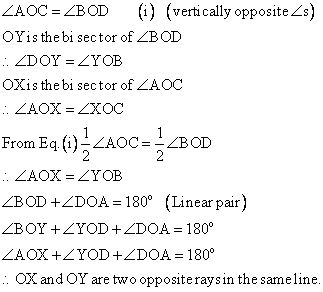
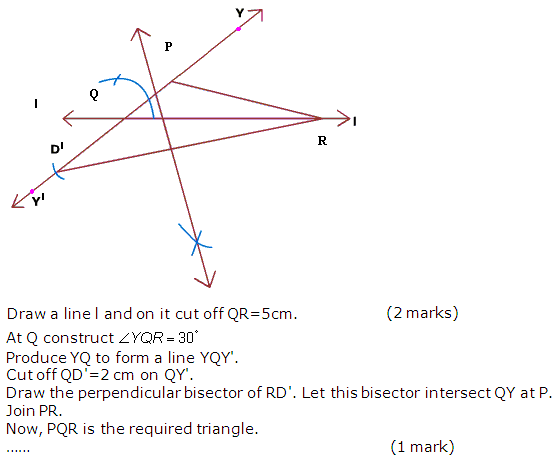
Q24. 
Solution
Q25. Draw a line segment of length 10cm and bisect it. Further bisect one of the equal parts and measure its length.
Solution
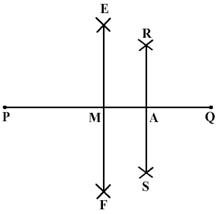 Steps of construction:
i. Draw a line segment PQ of length 10cm.
ii. With P as centre and radius more than half of PQ, draw two arcs above and below PQ.
iii. With Q as centre and same radius, draw two arcs cutting the arcs drawn in step 2 at E and F respectively.
iv. Draw the line segment EF as end points. Suppose it meets PQ at M.Then M bisects the line segment PQ.
v. With Q as centre and radius more than half of QM, draw two arcs above and below QM.
vi. With M as centre and the same radius as in step 5 draw arcs intersecting the previous arcs at R and S.
vii. Draw the line segment with R and S as end points. Suppose it meets QM at A.
viii. Then A bisects QM. AQ = AM = 2.5cm.
Steps of construction:
i. Draw a line segment PQ of length 10cm.
ii. With P as centre and radius more than half of PQ, draw two arcs above and below PQ.
iii. With Q as centre and same radius, draw two arcs cutting the arcs drawn in step 2 at E and F respectively.
iv. Draw the line segment EF as end points. Suppose it meets PQ at M.Then M bisects the line segment PQ.
v. With Q as centre and radius more than half of QM, draw two arcs above and below QM.
vi. With M as centre and the same radius as in step 5 draw arcs intersecting the previous arcs at R and S.
vii. Draw the line segment with R and S as end points. Suppose it meets QM at A.
viii. Then A bisects QM. AQ = AM = 2.5cm.

Comments
Post a Comment