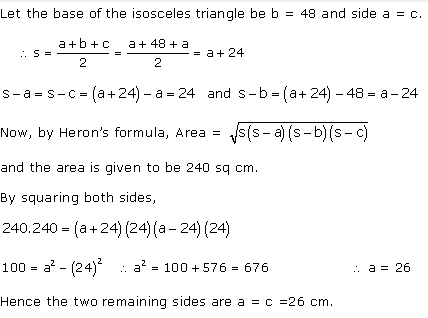
Q1. An isosceles triangle with base 48 cm has area 240 sq cm. Find the remaining two sides of the triangle.
Solution
Q2. Two sides of a triangle are 8 cm and 11 cm and its perimeter is 32 cm. Find the area of the triangle.
Solution
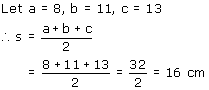
Perimeter = 32 cm, a = 8 cm, b = 11 cm

 = 16 cm
Area of
= 16 cm
Area of


 Area of triangle =
= 16 cm
Area of
Area of triangle =
Q3. Find the area of a triangle whose sides are 8 cm, 11 cm, 13 cm. Hence, find the altitude using longest side as base.
Solution

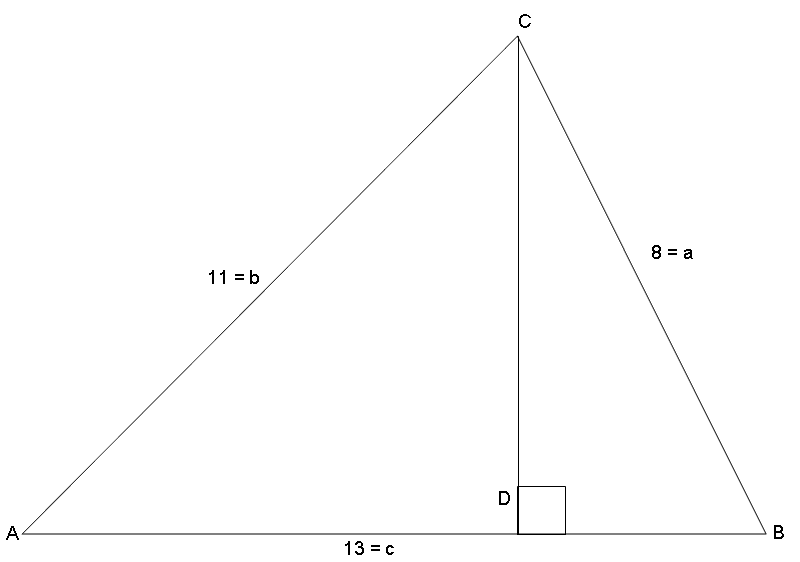 Using Heron's formula,
Height = 6.74 cm
Using Heron's formula,
Height = 6.74 cm
Q4. A
triangular park has sides 120 m, 80 m, 50 m. A gardener has to put a fence
all around it and also plant grass inside. How much area does he need to
plant? Find the cost of fencing it with barbed wire at the rate of Rs 20 per
meter leaving a space 3 m wide for a gate on one side.
Solution
Here,
 Therefore,
area of park
Therefore,
area of park 

 Perimeter
of park = 50 + 80 + 120 = 250 m
Thus,
length of wire needed = 250 - 3 = 247
m
So,
cost of fencing = Rs 20
Perimeter
of park = 50 + 80 + 120 = 250 m
Thus,
length of wire needed = 250 - 3 = 247
m
So,
cost of fencing = Rs 20  247 = Rs 4940
Therefore,
area of park
Perimeter
of park = 50 + 80 + 120 = 250 m
Thus,
length of wire needed = 250 - 3 = 247
m
So,
cost of fencing = Rs 20 247 = Rs 4940
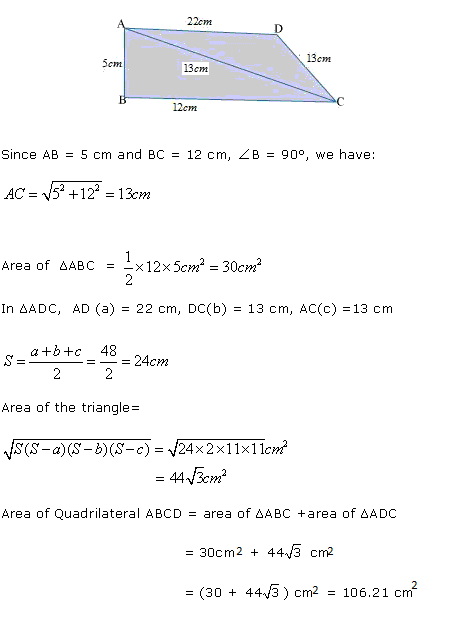
Q5. Find the area of quadrilateral right angled at B, in which AB = 5 cm, BC = 12 cm, AD = 22 cm and CD = 13 cm.
Solution
Q6. The area of an isosceles triangle with base 10 cm and perimeter 36 cm is:
- 1) 360 sq cm
- 2) 65 sq cm
- 3) 60 sq cm
-
4)

Solution

Q7. Find the percentage increase in the area of triangle if its each side is doubled.
Solution
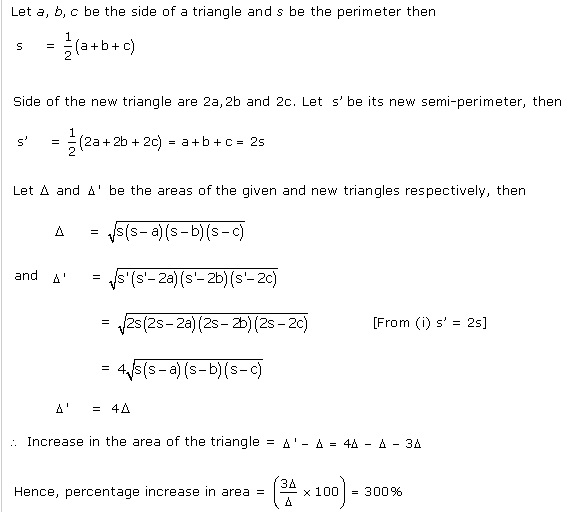
Q8. Find
the area of an equilateral triangle with side 10 cm.
Solution
Side
= 10 cm
S
= 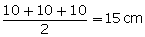 Area
of triangle
Area
of triangle  =
= 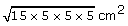 =
= 
Area
of triangle
=
=
Q9. Find the area of a triangle whose sides are 6.5 cm, 7 cm and 7.5 cm.
Solution
Here, P = 6.5 + 7 + 7.5 = 21 cm
 So, s =
  = 10.5 cm
s - a = 4, s - b = 3.5, s - c = 3
Area of triangle =
= 10.5 cm
s - a = 4, s - b = 3.5, s - c = 3
Area of triangle = 
 Δ= 21 cm2
So, s = = 10.5 cm
s - a = 4, s - b = 3.5, s - c = 3
Area of triangle =
Δ= 21 cm2
Q10. Calculate the area of the rhombus of sides 41 cm and length of shorter diagonal is 18 cm.
Solution
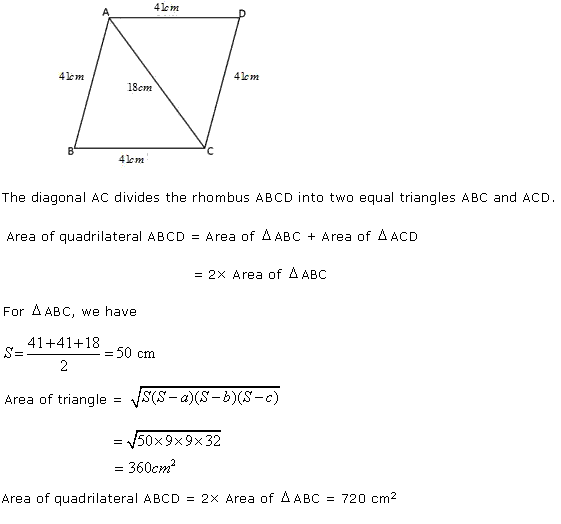
Q11. The parallel sides of an isosceles trapezium are 16 and 28 units and the equal side is 24 units. Find the height of the trapezium.
Solution
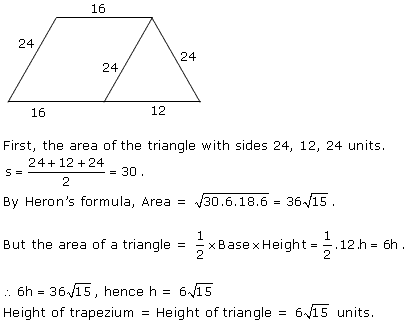
Q12. Heron's formula is:
-
1)

-
2)

-
3)

-
4)

Solution
Q13. The
sides of a triangle are in the ratio 3:5:7 and it's perimeter is 300m. Find
its area.
Solution
Ratio
of sides = 3:5:7
Let
sides be 3x, 5x, 7x
So
3x + 5x + 7x = 300m
15x
= 300m
x
= 20 m
Sides
are 60m, 100m, 140m
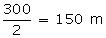
s
= 
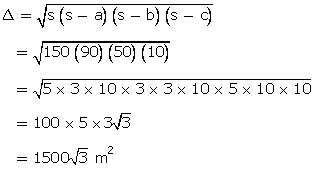
Q14. The sides of a triangular ground are 5m, 7m
and 8 m respectively. Find the cost of leveling the ground at the rate of
Rs.10 per m2. (use  = 1.73).
= 1.73).Solution
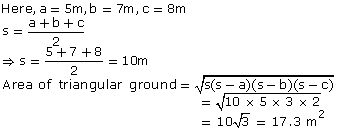 Cost of leveling the ground = 17.3
  10 = Rs 173
Q15. A triangular park in a city has dimensions 30 m x 26 m x 28 m. A gardener has to plant grass inside the park at Rs. 1.50 per m2. Find the amount to be paid to the gardener.
Solution
Here lengths of the sides of park are 30m, 26m, 28m.
 Therefore, area of the triangular park
 The amount to be paid to the gardener= Rs.
Therefore, area of the triangular park
The amount to be paid to the gardener= Rs.
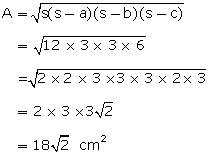
Q16. The
unequal side of an isosceles  is 6 cm and
its perimeter is 24 cm. Find the area.
is 6 cm and
its perimeter is 24 cm. Find the area.
is 6 cm and
its perimeter is 24 cm. Find the area.Solution
Since, P = 24 cm
So,
sum of equal sides = 24 - 6 = 18 cm
Length
of equal side = 9 cm
Thus
sides are: 9 cm, 9 cm and 6 cm.
Also,
s = 12 cm
Q17. Find the area of a triangle with perimeter 22 cm, one side 9 cm and difference of other two sides is 7 cm.
Solution
Let a = 9
Now, a + b + c = 22
 b + c = 22 - 9 = 13
b + c = 13 …(1)
Also, b - c = 7(given)… (2)
Adding (1) and (2) we get
2b = 20
Or, b = 10
From (1), c = 13 - 10 = 3.
Hence, a = 9, b = 10, c = 3 and s = 11
b + c = 22 - 9 = 13
b + c = 13 …(1)
Also, b - c = 7(given)… (2)
Adding (1) and (2) we get
2b = 20
Or, b = 10
From (1), c = 13 - 10 = 3.
Hence, a = 9, b = 10, c = 3 and s = 11

b + c = 22 - 9 = 13
b + c = 13 …(1)
Also, b - c = 7(given)… (2)
Adding (1) and (2) we get
2b = 20
Or, b = 10
From (1), c = 13 - 10 = 3.
Hence, a = 9, b = 10, c = 3 and s = 11
Q18. Find
the area of a triangle, two sides of which are 60 cm and 100 cm and the
perimeter is 300 cm.
Solution
a + b + c =300
 Third side = 300 - 60 - 100= 140cm
Area =
Third side = 300 - 60 - 100= 140cm
Area =  =
=  =
=  =
=  = 1500
  cm2
cm2
Third side = 300 - 60 - 100= 140cm
Area =
=
=
=
= 1500 cm2
Q19. A
garden is in the shape of quadrilateral. The sides of the garden are 9m, 40m,
28m and 15m respectively in consecutive order and the angle between first two
sides is a right angle. Find the area of the garden.
Solution
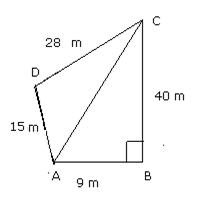 Let ABCD be the garden.
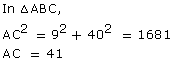


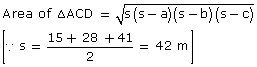

 Area of the garden = 180 + 126 = 306 m2
Q20. The base of an isosceles triangle measures 24 cm and its area is 60 cm2. Find its perimeter.
Solution
Let each equal side of isosceles 



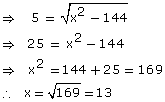 So, Semi-perimeter = (x+12) cm= (13+12) cm= 25 cm
Perimeter = 2 x 25 cm = 50 cm.
So, Semi-perimeter = (x+12) cm= (13+12) cm= 25 cm
Perimeter = 2 x 25 cm = 50 cm.
So, Semi-perimeter = (x+12) cm= (13+12) cm= 25 cm
Perimeter = 2 x 25 cm = 50 cm.
Q21. Find the height of the trapezium in which parallel sides are 25 cm and 10 cm and non-parallel sides are 14 cm and 13 cm.
Solution
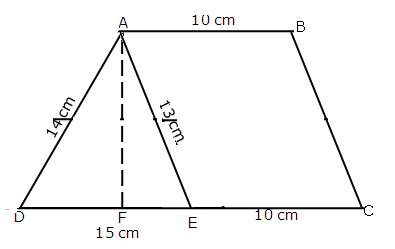 Draw AE||BC, through A.
Draw AF
Draw AE||BC, through A.
Draw AF  CD
For
CD
For  ADE,
s = 21 cm,
Area of
ADE,
s = 21 cm,
Area of  ADE=
ADE=  =
= 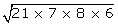 = 84 cm2
 base
base  height = 84 cm2
Height =
height = 84 cm2
Height = 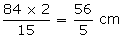 = 11.2 cm
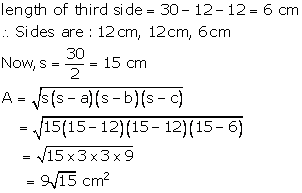
Q22. An isosceles triangle has perimeter 30 cm and each of the equal sides is 12 cm. Find the area of the triangle.
Solution
Perimeter of a triangle = 30 cm
12+12+Third side = 30
Q23. Sides of a triangle are in the ratio 13 : 14 : 15 and its perimeter is 84 cm. Find its area.
Solution
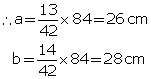
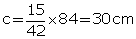
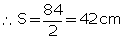
Here, perimeter of a triangle = 84 cm
Sides are in the ratio 13:14:15
Sum of ratio = 42 cm
 By Heron's formula
Area =
By Heron's formula
Area = 


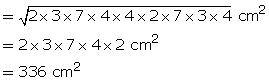 Hence, area of a triangle is 336
 .
.
By Heron's formula
Area =
Hence, area of a triangle is 336.
Q24. 
Solution
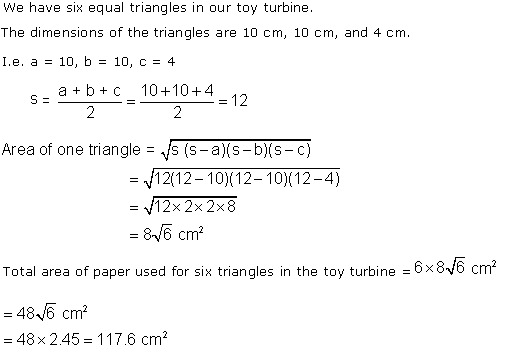 Cost of one square cm paper = Rs 5
Hence, cost of 117.6 sq cm paper = Rs 5 x 117.6 = Rs 588
Cost of one square cm paper = Rs 5
Hence, cost of 117.6 sq cm paper = Rs 5 x 117.6 = Rs 588
Q25. The
adjacent sides of a parallelogram ABCD measure 34 cm and 20 cm and the
diagonal AC measure 42 cm. Find the area of the parallelogram.
Solution
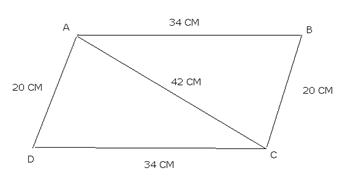 Let
a= 20 cm
b=
34 cm
c=42
cm
Let
a= 20 cm
b=
34 cm
c=42
cm

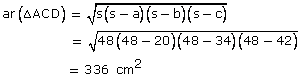 Diagonal
of
Diagonal
of  gm divides it into two congruent triangles

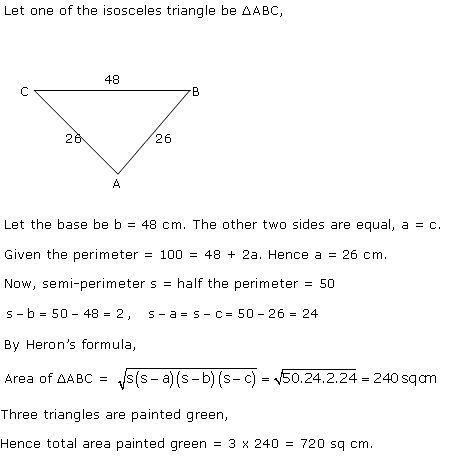
Q26. A floral design on the ceiling is made of 6 isosceles triangles. Each triangle has perimeter 100cm and base 48cm. If the triangles are painted green and blue alternately, then find the area painted green.
Solution
Q27. The sides of a triangle are in the ratio 4:5:5 and its perimeter is 168 m. Find the area of the triangle.
Solution
Length of sides are:  Therefore, a = 48 m, b = 60 m and c = 60 m
S =
Therefore, a = 48 m, b = 60 m and c = 60 m
S = 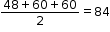
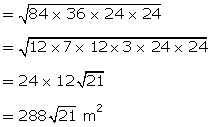
 Area of
  =
= 
Therefore, a = 48 m, b = 60 m and c = 60 m
S =
Area of =
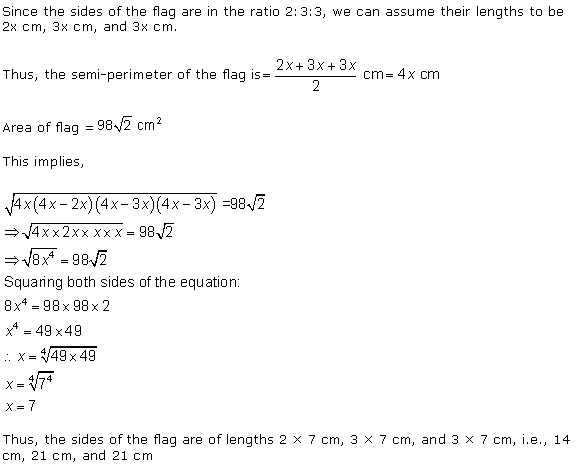
Q28. A popular mathematics club decided to gift each member with a flag. The flag is of the shape of an isosceles triangle and looks like:

Solution
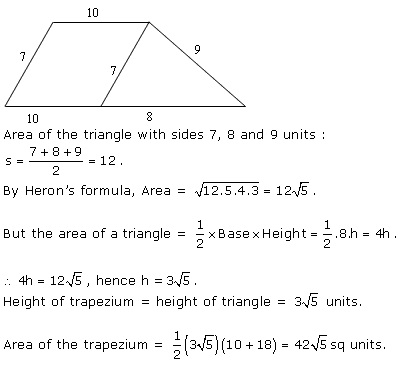
Q29. Find the height of a trapezium with parallel sides 10 and 18 units, adjacent sides 7 and 9 units. Also find the area of the trapezium.
Solution
Comments
Post a Comment