Q1. If the radius of a sphere is halved, the
ratio of the surface area of original sphere to that of the second is
Solution
Let
S be the surface area of the original sphere of radius r
Then, S = 4ᴨr2
When radius is halved, new radius is r/2.
Let S1 be the surface area of
the new sphere.

 The ratio is 4:1.
The ratio is 4:1.
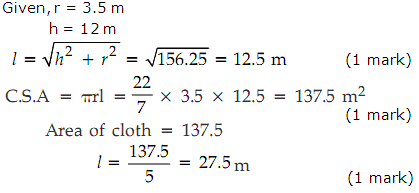
Q2. 
Solution
Q3. The radius and height of a cone are in the
ratio 4 : 3. The area of its base is 154 cm2. Find its curved
surface area.
Solution
Let
the radius and height of the cone be 4x and 3x respectively.
Area of the base =  r2
r2

 l
l 
 Curved
surface area of the cone = rl
Curved
surface area of the cone = rl

r2
l
Curved
surface area of the cone = rl
Q4. Curved surface area of a cone is 308 cm2 and its slant height is 14 cm. Find :
(i) Radius of the base
(ii) Total surface area of the cone.
Solution
Curved surface area of cone = 308 cm2
l = 14 cm
(i)  rl = 308

 (ii) Total surface area of cone = r2 + rl

rl = 308
(ii) Total surface area of cone = r2 + rl
Q5. The curved surface area of right circular cylinder of height 14 cm is 88 cm2. The diameter of the base of the cylinder is:
Solution
 Diameter = 2r
= 2
Diameter = 2r
= 2 1 cm
= 2 cm
1 cm
= 2 cm
Q6. A cylindrical bucket is internally 14 cm in radius and 30 cm deep. It is full of sand and when emptied, the sand stands in the shape of a cone 21 cm in radius. Calculate the height of the heap.
Solution
Given: Radius of the cylindrical bucket (R) = 14 cm, depth (H) = 30 cm
Radius of conical heap (r) = 21 cm
Let h be the height of the heap.
Now, Volume of cylindrical bucket = volume of the conical heap

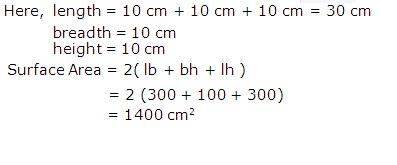
Q7. 
Solution
Q8. Curved surface area of a cone of radius 4
cm is 20 cm2. Find total surface area of the same cone in terms of .
cm2. Find total surface area of the same cone in terms of .Solution
CSA
=  TSA
= r2 + rl
TSA
= r2 + rl

TSA
= r2 + rl
Q9. The difference between the outer lateral
surface area and inner lateral surface area of a cylindrical metallic pipe 28
cm long is 176 cm2. Find the outer and inner radii of the pipe, if
the pipe is made of 352 cm3 of metal.
Solution
Let
R cm and r cm be the external and internal radii of the metallic pipe.
h
= length of the pipe = 28 cm
Now,
Outside
surface area - inner surface area = 176 cm2
 It
is given that volume of metal used = 352 cm3
Therefore,amount
of material in the pipe=
External
volume - internal volume = 352 cm3
It
is given that volume of metal used = 352 cm3
Therefore,amount
of material in the pipe=
External
volume - internal volume = 352 cm3
 Solving
(i) and (ii),
R
= 2.5 cm = Outer radius
r
= 1.5 cm = Inner radius.
Solving
(i) and (ii),
R
= 2.5 cm = Outer radius
r
= 1.5 cm = Inner radius.
It
is given that volume of metal used = 352 cm3
Therefore,amount
of material in the pipe=
External
volume - internal volume = 352 cm3
Solving
(i) and (ii),
R
= 2.5 cm = Outer radius
r
= 1.5 cm = Inner radius.
Q10. The height and base diameter of a conical
tent is 16 m and 24 m respectively. Find the cost of canvas required to make it
at the rate of Rs. 210 per m2?
Solution
Height,
h = 16 m
Diameter
= 24 m
Slant
height (l) = 
 CSA
of the tent =
CSA
of the tent =  rl
rl
 Cost
of the canvas = Rs 210
Cost
of the canvas = Rs 210  = Rs. 158400
CSA
of the tent = rl
Cost
of the canvas = Rs 210
= Rs. 158400
Q11. The inner diameter of a circular well is
3.5 m. It is 10 m deep. Find:
(i) Its inner curved surface area
(ii) The cost of plastering this curved
surface at rate of Rs. 40 per m2
Solution
(i)
Inner curved surface area = 2 rh
rh
 = 110 m2
(ii)
Cost of plastering = Rs. 40
= 110 m2
(ii)
Cost of plastering = Rs. 40  110
= Rs. 4400
110
= Rs. 4400
rh
= 110 m2
(ii)
Cost of plastering = Rs. 40 110
= Rs. 4400
Q12. How many cubes of side 3 cm can be cut from a wooden solid cuboid with dimensions 12 cm  12 cm 9 cm?
12 cm 9 cm?Solution
Volume of a cuboid =  Volume of a cube = a3
No. of cubes =
Volume of a cube = a3
No. of cubes = 

Volume of a cube = a3
No. of cubes =
Q13. The circumference of the base of a 10 m high conical tent is 44 m. Calculate the length of canvas used in making the tent if the canvas is 2 m wide. 
Solution
Let h be the height of the conical tent and r be the radius of its base.
Circumference of the base = 44 m
2 r = 44 m
 Slant height, l=
  Area of canvas = C.S.A of cone
L
Area of canvas = C.S.A of cone
L  B = rl
L =
B = rl
L = 
 Thus, the length of the canvas used is 134.2 m.
r = 44 m
Slant height, l=
Area of canvas = C.S.A of cone
L B = rl
L =
Thus, the length of the canvas used is 134.2 m.
Q14. The radius of a right circular cylinder with curved surface area of 440 cm2 and an altitude of 5 cm is
Solution
Given: Curved surface area(S) = 440 cm2, altitude (h) = 5 cm
Let r be the radius of the cylinder.

Q15. Volume of a right circular cone is 2200/7
cm2 and its diameter is 10 cm. Find its curved surface area.  .
.
.Solution
d
= 10 cm  r = 5 cm
Volume
of cone =
r = 5 cm
Volume
of cone = 

 h
= 12 cm
h
= 12 cm


r = 5 cm
Volume
of cone =
h
= 12 cm
Q16. A sphere of radius 12 cm is melted and recasted into a cylinder of radius 6 cm. Find the height of the recasted cylinder.
Solution
Given: Radius of the base of the cylinder (r) = 6 cm
Radius of the sphere (R) = 12 cm
Let h = height of the cylinder
Sphere is melted and recasted into a cylinder.
Therefore, Volume of cylinder = Volume of sphere

Q17. A cylindrical tub of radius 12 cm contains water to a depth of 20 cm. A spherical ball is dropped into the tub raising the level of water by 6.75 cm. What is the radius of the ball? 
Solution
Let r be the radius of the spherical ball.
When spherical ball is dropped into the tub, the level of water raises by 6.75 cm.
Volume of spherical ball = Volume of water displaced in the cylindrical tub
 r3 =
r3 =  r3 = 729 cm3
r = 9 cm
r3 = 729 cm3
r = 9 cm
r3 =
r3 = 729 cm3
r = 9 cm
Q18. A hemispherical bowl of radius 6 cm is
filled with water. If the water is transferred into cylindrical vessel of
base radius 3 cm, find the height to which the water rises in the cylindrical
vessel.  .
.
.Solution
Let
h be the height upto which the water rises in the cylindrical vessel.
The
water in the hemispherical bowl is transferred into a cylindrical vessel.
 Volume
of hemispherical bowl = Volume of cylindrical vessel
Volume
of hemispherical bowl = Volume of cylindrical vessel
 Thus, the water in the cylindrical vessel will rise
up to the height of 16 cm.
Thus, the water in the cylindrical vessel will rise
up to the height of 16 cm.
Volume
of hemispherical bowl = Volume of cylindrical vessel
Thus, the water in the cylindrical vessel will rise
up to the height of 16 cm.
Q19. A tent is in the form of a cylinder surmounted by a cone of radius 12 m. The height of the conical portion is 7 m, which is equal to the height of the cylindrical portion of the tent. Calculate the volume of the tent.
Solution
Radius of the cylinder = Radius of cone (r) = 12 m
Height of cylinder = Height of cone (h) = 7 m
Volume of the tent = Volume of conical part + volume of cylindrical part

Q20. The total surface area of a solid right
circular cylinder is 231 cm2. If curved surface area is two-third
of the total surface area, find the radius of the base.
Solution
CSA
= 
 231 = 154 cm2
We
know:
TSA
= CSA + 2 area of base
2
area of base = (231 -
154)
2
area of base =
77
2
231 = 154 cm2
We
know:
TSA
= CSA + 2 area of base
2
area of base = (231 -
154)
2
area of base =
77
2
 r r = 77
 r
=
r
=  cm = 3.5 cm
231 = 154 cm2
We
know:
TSA
= CSA + 2 area of base
2
area of base = (231 -
154)
2
area of base =
77
2
r r = 77
r
= cm = 3.5 cm
Q21. Find the volume and surface area of a
sphere of radius 2.1 cm.  .
.
.Solution
r
= 2.1 cm
Volume
=  = 38.808 cm3
SA
= 4
= 38.808 cm3
SA
= 4 r2 =
r2 =  = 55.44 cm2.
= 38.808 cm3
SA
= 4r2 =
= 55.44 cm2.
Q22. Length, breadth and height of a cuboid
shape box of medicines is 20 cm, 12 cm and 10 cm respectively. Find the total
surface area of this box.
Solution
l = 20 cm, b = 12 cm, h
= 10 cm
Total surface area of a box
= 2(lb + bh + hl)
= 2(20 × 12 + 12 × 10 + 20 × 10)
= 2(240 + 120 + 200)
= 2 × 560
= 1120 cm2
Total surface area of a box is 1120 cm2.
Q23. Find the number of 4 cm cubes that can be cut out of a cuboid of dimensions 12 cm × 12 cm × 8 cm.
Solution
Given: In a cuboid,
Length (l) = 12 cm, breadth (b) = 12 cm and height (h) = 8 cm
Volume of cuboid of (V1) = = 1152 cm3
Volume of cube of edge 4 cm (V) = (edge)3 = 64 cm3
Let N number of 4 cm cubes that can be cut out of the cuboid.
Then, N × V = V1
= 1152 cm3
Volume of cube of edge 4 cm (V) = (edge)3 = 64 cm3
Let N number of 4 cm cubes that can be cut out of the cuboid.
Then, N × V = V1

= 1152 cm3
Volume of cube of edge 4 cm (V) = (edge)3 = 64 cm3
Let N number of 4 cm cubes that can be cut out of the cuboid.
Then, N × V = V1
Q24. If the volume and surface area of sphere is numerically equal then its radius is
Solution
Surface area of sphere = Volume of sphere

Q25. Calculate the volume of an ice cream cone of radius 2.8 cm and height 4 cm surmounted by a hemispherical top.
Solution
Given: Radius of the cone = Radius of the sphere (r) = 2.8 cm,
Height of the cone (h) = 4 cm
Now, Total volume = volume of conical part + volume of hemispherical part

Q26. How many spherical lead shots each 4.2 cm diameter can be obtained from a solid cuboid of lead with dimensions 66 cm, 42 cm and 21 cm?
Solution
For lead shots,
d = 4.2 cm  r = 2.1 cm
 Volume of one spherical lead shot =
  Volume of solid cuboid = 66
  42 21 cm3
No. of shots =
42 21 cm3
No. of shots =
 = 1500
r = 2.1 cm
Volume of one spherical lead shot =
Volume of solid cuboid = 66 42 21 cm3
No. of shots =
= 1500
Q27. The paint in a certain container is sufficient to paint an area equal to 9.375 m2. How many bricks of dimension 22.5 cm  10 cm7.5 cm can be painted out of this container?
10 cm7.5 cm can be painted out of this container?Solution
Surface area of one brick = 2(l b + b h + h l)
= 2(22.510 + 107.5 + 7.522.5) cm2
= 2[225 + 75 + 168.75] cm2
= 2[300 + 168.75] cm2
= 937.5 cm2
Number of bricks that can be painted =
 = 100
= 100
b + b h + h l)
= 2(22.510 + 107.5 + 7.522.5) cm2
= 2[225 + 75 + 168.75] cm2
= 2[300 + 168.75] cm2
= 937.5 cm2
Number of bricks that can be painted =
= 100
Q28. The height of a right circular cylinder with lateral surface area 792 sq cm is 21 cm. The diameter of the base is:
Solution
Lateral surface area of a right circular cylinder = 

Q29. The volume of a cylinder of altitude 15 cm is 1200 cm3. The area of its base is
Solution
Volume of the cylinder (V) = 1200 cm3
Altitude (h) = 15 cm
 Thus, area of the base of the cylinder is 80 cm2
Thus, area of the base of the cylinder is 80 cm2
Q30. Find the curved surface area of a
cylindrical pillar which is 1.2 m high and has the diameter of the base as 28
cm. [Use  ]
]
]Solution
r
=  cm
h = 1.2 m = 120 cm
CSA
of the cylinder = 2
cm
h = 1.2 m = 120 cm
CSA
of the cylinder = 2 rh
rh
 = 10560 cm2
cm
h = 1.2 m = 120 cm
CSA
of the cylinder = 2rh
= 10560 cm2
Q31. If the lateral surface area of a cube is 1600 cm2, then its edge is:
Solution
Lateral surface area of a cube = 4b2
4b2 = 1600 cm2
b2 = 400 cm2
b = 20 cm
Q32. A rectangular piece of paper 33 cm long and 16 cm wide is rolled along its breadth to get a cylinder of height 16 cm. Find the volume of the cylinder.
Solution
On rolling a rectangular paper along its breadth, length becomes the circumference of the cylinder and breadth becomes its height.
Given: Circumference of the base of the cylinder (C) = 33 cm, height (h) = 16 cm
 Let V denote the volume of the cylindrical vessel.
 Thus, the volume of the cylinder so formed is 1386 cm3.
Let V denote the volume of the cylindrical vessel.
Thus, the volume of the cylinder so formed is 1386 cm3.
Q33. The volume of a sphere is 905  cm3.
Find its radius.
cm3.
Find its radius.
cm3.
Find its radius. Solution
Volume
of the sphere = 

 r3
= 216
r
=
r3
= 216
r
=  r
= 6 cm
r
= 6 cm
r3
= 216
r
=
r
= 6 cm
Q34. A man built a cubical water tank with lid for his house, with each outer edge 1.5 m long. He gets the outer surface of tank excluding the base covered with square tiles of side 25 cm. Find how much he would spend for the tiles, if cost of tiles is Rs. 480 per dozen.
Solution
Surface Area of tank = 5a2 (Area of 5 faces only)
 Area of one square tile = lb
= 25
Area of one square tile = lb
= 25  25 cm2
 Cost of 180 tiles =
 = Rs. 7200
Area of one square tile = lb
= 25 25 cm2
Cost of 180 tiles =
= Rs. 7200
Q35. An isosceles triangle with a base of 0.4 m and an altitude of 0.3 m is revolved about a line through the vertex and perpendicular to the base. What is the volume of the solid generated by the revolving triangle?
Solution
The solid generated by revolving the triangle is a cone with height (h) = 0.3 m and radius (r) = 0.4 m


Q36. A river 3 m deep and 40 m wide is flowing at the rate of 2 km/hour. How much water will fall into the sea in one minute?
Solution
Depth = 3 m
Width = 40 m
Volume of water that flows into the sea in 1 minute
 = 4000 1000 litres
= 4000 kilo litres
= 4000 1000 litres
= 4000 kilo litres
= 4000 1000 litres
= 4000 kilo litres
Q37. The area of coloured paper required to completely cover a solid cubical box of edge 'x' units is:
Solution
6x2 as area of cube = 6a2 where a is the edge of the cube.
Q38. A wooden box of dimensions 1.5 m × 1.25 m × 0.65 m and open at the top is to be made. Determine the cost of wood required for it, if 1 m2 of wood costs Rs 20.
Solution
Given: length (l)=1.5 m, breadth (b)=1.25 m and height (h)=0.65 m
Area of four walls and base

 Cost of 1 m2 wood = Rs 20
Therefore, cost of 5.45 m2 of wood =Rs {5.45×20}
=Rs 109
Cost of 1 m2 wood = Rs 20
Therefore, cost of 5.45 m2 of wood =Rs {5.45×20}
=Rs 109
Cost of 1 m2 wood = Rs 20
Therefore, cost of 5.45 m2 of wood =Rs {5.45×20}
=Rs 109
Q39. A cubical water tank with lid has each edge 2 m long. If the cost of the tiles is Rs 240 per dozen. Calculate the amount spent to cover the outer surface of the tank excluding the base, with square tiles of side 50 cm.
Solution
Given: Edge of the tank (a) =2 m
Area of four walls and lid= 

 Area of each tile of edge 50 cm =2500 cm2
Let “N” numbers of tiles are required to cover the required area.
N×2500=200000
N=80
Cost of 12 tiles= Rs 240
Cost of 80 tiles= Rs 1600
Area of each tile of edge 50 cm =2500 cm2
Let “N” numbers of tiles are required to cover the required area.
N×2500=200000
N=80
Cost of 12 tiles= Rs 240
Cost of 80 tiles= Rs 1600
Area of each tile of edge 50 cm =2500 cm2
Let “N” numbers of tiles are required to cover the required area.
N×2500=200000
N=80
Cost of 12 tiles= Rs 240
Cost of 80 tiles= Rs 1600
Q40. The pillars of a temple are cylindrically
shaped. If each pillar has a circular base of radius 20 cm and height 10 m,
how much concrete mixture would be required to build 14 such pillars?
Solution
Radius
of each pillar = 20 cm =  Volume
of each pillar =
Volume
of each pillar =  r2h
r2h
 Volume
of 14 pillars = 14
Volume
of 14 pillars = 14  Volume of one
pillar
Volume of one
pillar
 So,
14 pillars would need 17.6 m3 of concrete mixture.
So,
14 pillars would need 17.6 m3 of concrete mixture.
Volume
of each pillar = r2h
Volume
of 14 pillars = 14 Volume of one
pillar
So,
14 pillars would need 17.6 m3 of concrete mixture.
Q41. The length of the longest rod that can be put in a hall of dimension 23 m  10 m 10 m is:
10 m 10 m is:Solution
The longest rod will have length as the diagonal of the cuboidal room.
 Diagonal = D =
 Thus, the length of the longest rod is 27 m.
Diagonal = D =
Thus, the length of the longest rod is 27 m.
Q42. If the volume of a cube is  then total surface area of the cube is
then total surface area of the cube is -
1)

-
2)

- 3) 18 a2
- 4) 6 a2
Solution
Volume of cube = (side)3 =  Therefore, side =
  Surface area = 6 ×(side)2

Therefore, side =
Surface area = 6 ×(side)2
Q43. How many litres of water flow out through a
pipe having an area of cross-section of 5 cm2 in one minute, if
the speed of water in pipe is 30 cm/sec?
Solution
Area of
cross section of pipe = 5 cm2
Speed of
water flowing out of the pipe = 30 cm/sec
Volume
of water that flows out in 1 sec.= 5  30 cm3
= 150 cm3
30 cm3
= 150 cm3
 volume of water that flows out in 1 minute =
150
volume of water that flows out in 1 minute =
150  60
= 9000 cm3
= 9 litres
60
= 9000 cm3
= 9 litres
30 cm3
= 150 cm3
volume of water that flows out in 1 minute =
150 60
= 9000 cm3
= 9 litres
Q44. A cylindrical bucket of diameter 28 cm and height 12 cm is full of water. The water is emptied into a rectangular tub of length 66 cm and breadth 28 cm. Find the height to which water rises in the tub.
Solution
Given: Diameter of cylindrical vessel = 28 cm ⇒ radius of cylindrical vessel (R) = 14 cm
Height of cylindrical vessel (H) = 12 cm
Let V denote the volume of the cylindrical vessel.
 Length of the rectangular tub (l) = 66 cm
Breadth of the rectangular tub (b) = 28 cm
Let h be the height to which the water rises and V1 denote the volume of the rectangular tub.
Length of the rectangular tub (l) = 66 cm
Breadth of the rectangular tub (b) = 28 cm
Let h be the height to which the water rises and V1 denote the volume of the rectangular tub.
 Now, volume of water in the rectangular tub is equal to the volume of water in the cylindrical tub. Therefore,

Length of the rectangular tub (l) = 66 cm
Breadth of the rectangular tub (b) = 28 cm
Let h be the height to which the water rises and V1 denote the volume of the rectangular tub.
Now, volume of water in the rectangular tub is equal to the volume of water in the cylindrical tub. Therefore,
Q45. The total surface are of a solid cylinder is 231 cm2 and its curved surface area is  of the total surface area. Find the volume of the cylinder.
of the total surface area. Find the volume of the cylinder. Solution
TSA of cylinder = 231 cm2
2 r (h + r) = 231 ….(i)
CSA of cylinder =
r (h + r) = 231 ….(i)
CSA of cylinder =  = 154 cm2
 2rh = 154 …..(ii)
Substituting (ii) in (i)
2rh + 2r2 = 231
154 + 2r2 = 2312
r2 = 231 - 154 = 77
2rh = 154 …..(ii)
Substituting (ii) in (i)
2rh + 2r2 = 231
154 + 2r2 = 2312
r2 = 231 - 154 = 77


 = 269.5 cm3
r (h + r) = 231 ….(i)
CSA of cylinder =
= 154 cm2
2rh = 154 …..(ii)
Substituting (ii) in (i)
2rh + 2r2 = 231
154 + 2r2 = 2312
r2 = 231 - 154 = 77
= 269.5 cm3
Q46. An iron pipe 20 cm long has exterior
diameter 25 cm. If the thickness of the pipe is 1 cm, find the whole surface
area of the pipe.
Solution
 Total
surface area of pipe
= 2
Total
surface area of pipe
= 2 Rh + 2rh + 2(R2 - r2)
= 2h(R + r) + 2[(R + r) (R - r)]
= 2(R + r) (h + R - r)
Rh + 2rh + 2(R2 - r2)
= 2h(R + r) + 2[(R + r) (R - r)]
= 2(R + r) (h + R - r)

Q47. Metal spheres, each of radius 2 cm are packed into a rectangular box of dimensions 16 cm  8 cm 8 cm. When 16 spheres are packed into the box, it is filled with preservative liquid. Find the volume of this liquid to the nearest integer. [Use
 = 3.14]
8 cm 8 cm. When 16 spheres are packed into the box, it is filled with preservative liquid. Find the volume of this liquid to the nearest integer. [Use= 3.14]Solution
Volume of cubical box = l b h
= 16 8 8 cm3
= 1024 cm3
Volume of sphere = 
 = 33.49 cm3
Volume of 16 spheres =
= 33.49 cm3
Volume of 16 spheres =  Volume of liquid = Volume of box
  Volume of spheres
= (1024 535.84) cm3
= 488.16 cm3
Volume of spheres
= (1024 535.84) cm3
= 488.16 cm3
b h
= 16 8 8 cm3
= 1024 cm3
Volume of sphere =
= 33.49 cm3
Volume of 16 spheres =
Volume of liquid = Volume of box Volume of spheres
= (1024 535.84) cm3
= 488.16 cm3
Q48. Two cubes of side 6 cm each are joined end to end. Find the surface area of the resultant cuboid.
Solution
Length of cuboid formed = (6 + 6) cm= 12 cm
Base = 6 cm, Height = 6 cm
Surface Area of Cuboid = 2 (lb + bh + hl)
Surface Area of Cuboid = 2 [(12  6) + (6 6) + (6 12)]= 360 cm2
6) + (6 6) + (6 12)]= 360 cm2
Q49. The curved surface area of a cylinder is 2200 sq cm and circumference of its base is 220 cm. Then the height of the cylinder is:
Solution

Q50. The radius and height of cylinder are in the ratio 5 : 7 and its volume is 550 cm3. Find its diameter.  .
.
.Solution
Let the radius be 5x and height be 7x respectively.
Volume of cylinder = 550 cm3
 r2h = 550



 radius = 5x = 5
  1 = 5 cm
Diameter = 2r = 2 5 = 10 cm
1 = 5 cm
Diameter = 2r = 2 5 = 10 cm
r2h = 550
radius = 5x = 5 1 = 5 cm
Diameter = 2r = 2 5 = 10 cm
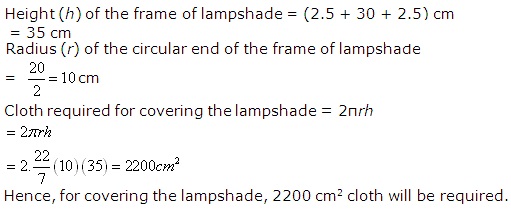
Q51. 
Solution
Q52. Three cubes of metal whose edges are 2 cm, 3 cm and 4 cm are melted and a new cube is made. Find the volume of the new cube.
Solution
Volume of a cube of edge  =
=  Volume of a cube of edge 2 cm (V1) = 8 cm3
Volume of a cube of edge 3 cm (V2) = 27 cm3
Volume of a cube of edge 4 cm (V3) = 64 cm3
Three cubes of metal whose edges are 2 cm, 3 cm and 4 cm are melted and a new cube is made.
Let V be the volume of the new cube.
Therefore, V = V1 + V2 + V3
V = 99 cm3
Volume of a cube of edge 2 cm (V1) = 8 cm3
Volume of a cube of edge 3 cm (V2) = 27 cm3
Volume of a cube of edge 4 cm (V3) = 64 cm3
Three cubes of metal whose edges are 2 cm, 3 cm and 4 cm are melted and a new cube is made.
Let V be the volume of the new cube.
Therefore, V = V1 + V2 + V3
V = 99 cm3
=
Volume of a cube of edge 2 cm (V1) = 8 cm3
Volume of a cube of edge 3 cm (V2) = 27 cm3
Volume of a cube of edge 4 cm (V3) = 64 cm3
Three cubes of metal whose edges are 2 cm, 3 cm and 4 cm are melted and a new cube is made.
Let V be the volume of the new cube.
Therefore, V = V1 + V2 + V3
V = 99 cm3
Q53. If the radius of the base and altitude of a right circular cylinder and a right circular cone are equal. What is the relation between the volumes of a cylinder to that of a cone?
Solution
Radius of the cylinder = Radius of cone =r
Height of cylinder = Height of cone=h
Let V denote the volume of the cylinder and V1 denote the volume of the cone
 and
and  ⇒
⇒ ⇒
⇒ Thus, Volume of cylinder is 3 times the volume of cone.
and
⇒
⇒
Thus, Volume of cylinder is 3 times the volume of cone.
Q54. The height of the cone is 15 cm. If its
volume is 1570 cm3, find the diameter of the base. (use  =
3.14)
=
3.14)
=
3.14)Solution
Let
the radius of the base of the cone be r cm.
Height
= 15 cm
Volume
of cone = 1570 cm3
 Diameter
= 2
Diameter
= 2  10 cm = 20 cm.
Diameter
= 2 10 cm = 20 cm.
Q55. How many litres of milk can a hemispherical bowl of radius 10.5 cm hold?
Solution
Radius of hemisphere = 10.5 cm

 = 2425.5 cm3
= 2.4255 litres
= 2425.5 cm3
= 2.4255 litres
= 2425.5 cm3
= 2.4255 litres
Q56. A solid rectangular block of iron of dimensions 7 cm x 4 cm x 2.75 cm is recast into a cylinder of radius 7 cm. Find the height of the recast cylinder.
Solution
Dimensions of the rectangular block are
Length (l) = 7 cm, breadth (b) = 4 cm and height (h) = 2.75 cm
Volume of the rectangular block (V) = lbh = 77 cm3
Radius of recast cylinder (R) = 7 cm
Let H be the height of the recast cylinder and V1 denotes its volume.
 Rectangular block is recasted into a cylinder. Therefore volume of the cylinder is equal to the volume of the rectangular block.
 Thus, the height of the recast cylinder is 0.5 cm.
Rectangular block is recasted into a cylinder. Therefore volume of the cylinder is equal to the volume of the rectangular block.
Thus, the height of the recast cylinder is 0.5 cm.
Q57. Find the cost of white washing the four walls of a room with dimensions 5 m  4m 3m at the rate of Rs. 12/m2.
4m 3m at the rate of Rs. 12/m2.Solution
Area of four walls= 2(l + b)h (ceiling and floor is not to be included)
= 2 3 (5 + 4)
= 6 9
= 54 m2
Cost @ Rs. 12/m2 = Rs. 54 12
= Rs 648
3 (5 + 4)
= 6 9
= 54 m2
Cost @ Rs. 12/m2 = Rs. 54 12
= Rs 648
Q58. From a right circular cylinder with height 8 cm and radius 6 cm, a right circular cone of the same height and base is removed. Find the total surface area of the remaining solid.
Solution
Cylinder -
h = 8 cm,r=6 cm
length of cone = 

 T.S.A of remaining solid = curved surface area of cylinder + curved surface area of cone + area of 1(upper )base

T.S.A of remaining solid = curved surface area of cylinder + curved surface area of cone + area of 1(upper )base
Q59. The radius of a spherical balloon increases from 2.8 cm to 3.5 cm as air is being pumped into it. Find the ratio of surface areas of the balloon in the two cases
Solution
Case I: when radius (r) = 2.8 cm
 Case II
When radius (R) = 3.5 cm
Case II
When radius (R) = 3.5 cm

 Therefore, S1: S2 = 16:25
Case II
When radius (R) = 3.5 cm
Therefore, S1: S2 = 16:25
Q60. The sum of the radius of the base and height of a solid cylinder is 37 m. If the total surface area of the cylinder is 1628 m2, find the volume of the cylinder.  .
.
.Solution
Let r and h respectively be the radius and the height of the cylinder. We have:
r + h = 37 m
TSA = 1628 m2
2 r (h + r) = 1628
2r(37) = 1628
r (h + r) = 1628
2r(37) = 1628

 Volume of the cylinder = r2h

r (h + r) = 1628
2r(37) = 1628
Volume of the cylinder = r2h
Q61. The circumference of the base of the cone of slant height 35 cm is 88 cm. Find its curved surface area.
Solution
Slant height (l) = 35 cm. Let r = radius of the cone
Circumference of the base = 88 cm

 The curved surface area is 1540 cm2
The curved surface area is 1540 cm2
Q62. The curved surface area of a cylinder is
176 cm2 and area of its base is 38.5 cm2. Find the
volume of the cylinder. (Take  )
)
)Solution
Area of the base = r2
= 38.5 cm2
r2
= 38.5 cm2

 Volume
= r2h
= 38.5
Volume
= r2h
= 38.5  = 308 cm3
Therefore,
the volume of the cylinder is 308 cm3.
= 308 cm3
Therefore,
the volume of the cylinder is 308 cm3.
r2
= 38.5 cm2
Volume
= r2h
= 38.5
= 308 cm3
Therefore,
the volume of the cylinder is 308 cm3.
Q63. It costs Rs 15228 to paint the base of a cuboidal tank of height 10 m. If the cost of painting is Rs 9 per m2, find the volume of the tank.
Solution
Given, height (h) =10 m
Area of base of the tank painted for Rs. 9 = 1 m2
Area of base of the tank painted for Rs. 15228 = 1692 m2
Thus, Volume of the cuboidal tank = Area of base × h =1692×10 m3 = 16920 m3
Q64. The circumference of the base of a cone is 22 cm. If its height is 8 cm, find its volume.
Solution
Circumference of the base = 22 = 2 r, where r is radius of cone

 h = 8 cm
Volume of cone =
h = 8 cm
Volume of cone =  =
= 
r, where r is radius of cone
h = 8 cm
Volume of cone = =
Q65. The surface area of a sphere of radius 5 cm is five times the area of curved surface of a cone of radius 4 cm. Find the height and volume of a cone.  .
.
.Solution
Surface area of sphere = 5 (CSA of cone)
4  l
4
l
4  25 = 5 4 l
 l = 5 cm
We know,
h2 = l2 - r2
= 52 - 42
= 9
h = 3 cm
Volume of cone =
l = 5 cm
We know,
h2 = l2 - r2
= 52 - 42
= 9
h = 3 cm
Volume of cone = 

l
4 25 = 5 4 l
l = 5 cm
We know,
h2 = l2 - r2
= 52 - 42
= 9
h = 3 cm
Volume of cone =
Q66. A metallic sheet is of the rectangular shape with dimensions 48 cm 36 cm. From each one of its corner a square of 8 cm is cut off. An open box is made of the remaining sheet. Find the volume of the box.
36 cm. From each one of its corner a square of 8 cm is cut off. An open box is made of the remaining sheet. Find the volume of the box. Solution
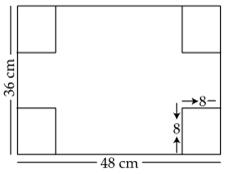 Length of the box = 48 - 8 - 8 = 32 cm
Breadth of the box = 36 - 8 - 8 = 20 cm
Height = 8 cm
Volume of the box formed = l b h
= 32 20 8
= 5120 cm3
Length of the box = 48 - 8 - 8 = 32 cm
Breadth of the box = 36 - 8 - 8 = 20 cm
Height = 8 cm
Volume of the box formed = l b h
= 32 20 8
= 5120 cm3
Q67. A cuboid of dimensions 50 cm × 40 cm × 12 cm is melted and transformed into three cubes of same size. Find the edge of the new cube.
Solution
Given: In a cuboid, Length (l) = 50 cm, breadth (b) = 40 cm, and let height (h) =12 cm
Volume of the cuboid(V1) =  It is melted and transformed into three cubes of same size.
Let ‘a’ be the edge of the formed cube.
Volume of cube of edge ‘a’(V) = a3
3 × V = V1
It is melted and transformed into three cubes of same size.
Let ‘a’ be the edge of the formed cube.
Volume of cube of edge ‘a’(V) = a3
3 × V = V1

It is melted and transformed into three cubes of same size.
Let ‘a’ be the edge of the formed cube.
Volume of cube of edge ‘a’(V) = a3
3 × V = V1
Q68. The radius of a spherical balloon increases
from 7 cm to 14 cm as air is pumped into it. Find the ratio of surface areas
of the balloon in two cases.
Solution
Original
surface areas S1 = 4
 New
surface area S2 =
New
surface area S2 = 


New
surface area S2 =
Q69. A tent is in the form of a cylinder surmounted by a hemisphere. The height and radius of the cylindrical portion is 7.2 cm and 4.2 cm respectively. Calculate its volume.
Solution
Given: Radius of the cylindrical part = Radius of the hemispherical part (r) = 4.2 cm,
Height of the cylindrical portion (h) = 7.2 cm
Now, Total volume = volume of cylindrical part + volume of hemispherical part

Q70. A joker's cap is in the form of a right
circular cone of base with radius 7 cm and height 24 cm. Find the area of the
sheet required to make 10 such caps.
Solution
Radius
= 7 cm, height = 24 cm
Slant
height l = 
 Area
of the sheet required for the cap =
Area
of the sheet required for the cap =  rl
rl
 Sheet
required for 10 such caps = 550
Sheet
required for 10 such caps = 550  10 = 5500 cm2.
Area
of the sheet required for the cap = rl
Sheet
required for 10 such caps = 550 10 = 5500 cm2.
Q71. A hollow cylindrical metal pipe is 80 cm long. Its internal and external radii are 8 cm and 10 cm respectively. It is melted and cast into a solid cylinder 20 cm long. Calculate the radius of the solid cylinder.
Solution
Given: Internal radius (r) =8 cm
External radius (R) = 10 cm
Length of the cylindrical tube (h) = 80 cm
Let V denote the volume of metal in the tube.
 Thus, volume of metal in the pipe is
  It is melted and recasted into a cylinder. Length of the cylinder (H) = 20 cm.
Let R1 be the radius of the recasted cylinder and V1 denote its volume. Then,
It is melted and recasted into a cylinder. Length of the cylinder (H) = 20 cm.
Let R1 be the radius of the recasted cylinder and V1 denote its volume. Then,
 Thus, radius of the solid cylinder is 12 cm.
Thus, volume of metal in the pipe is
It is melted and recasted into a cylinder. Length of the cylinder (H) = 20 cm.
Let R1 be the radius of the recasted cylinder and V1 denote its volume. Then,
Thus, radius of the solid cylinder is 12 cm.
Q72. The hollow sphere, in which the circus motorcyclist performs his stunts, has a radius of 2.8 m. find the area available to the motorcyclist for riding.
Solution
Given: Radius (r) = 2.8 m
Let S be the area available to the motorcyclist in which he performs his stunts = Surface area of the sphere.

Q73. The paint in a certain container is sufficient to paint an area equal to 74295 cm2. How
many bricks of dimensions 19.5 cm × 11 cm × 6.5 cm can be painted out of this container?
Solution
Given: length (l)=19.5 cm, breadth(b)=11 cm and height(h)=6.5 cm
Surface area of the brick= 2{(19.5 × 11) + (11 × 6.5) + (19.5 × 6.5)} cm2
= 825.50 cm2
Let “N” number of bricks be painted by the given amount of paint.
Thus, N×825.50=74295

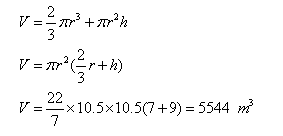
Q74. A tomb is in the form of a cylinder surmounted by a hemisphere. The radius and height of the cylindrical portion are 10.5 m and 9 m. calculate its volume.
Solution
Radius of the cylinder = Radius of hemisphere (r) = 10.5 m
Height of cylinder ( h) = 9 m
Volume of the tomb = Volume of hemispherical part + volume of cylindrical part
Q75. The length, breadth and height of a room
are 5 m, 4m and 3 m respectively. Find the cost of white washing the walls of
the room and the ceiling at the rate of Rs 7.50 per m2.
Solution
Area
to be whitewashed does not include the floor.
Therefore,
area to be whitewashed
= Area of four
walls + area of the ceiling
= 2 (l + b)  h + l b
= [2 (5 + 4) 3 + 5 4] m
=54 + 20 m2
= 74 m2
Cost
of white washing = Rs 7.50 74 = Rs 555
h + l b
= [2 (5 + 4) 3 + 5 4] m
=54 + 20 m2
= 74 m2
Cost
of white washing = Rs 7.50 74 = Rs 555
h + l b
= [2 (5 + 4) 3 + 5 4] m
=54 + 20 m2
= 74 m2
Cost
of white washing = Rs 7.50 74 = Rs 555
Q76. The height of a solid cylinder is 16 cm and the radius of the base is 3.5 cm. Two equal conical holes each of radius 3.5 cm and height 3 cm are cut off from both ends. Calculate the volume of the remaining solid.
Solution
Given: Radius of the cylinder = Radius of cone (r) = 3.5 cm
Height of cylinder (H) = 16 cm
Height of cone (h) = 3 cm
Volume of the remaining solid = Volume of cylinder  (2 × volume of cone)
(2 × volume of cone)
Q77. The lateral surface area of a cube is 100 m2. The volume of the cube is:
Solution
Lateral surface area = 4a2 = 100
a2 = 25
a = 5 cm
Volume of the cube = a3 = (5)3
= 125 m3
Q78. A wall of length 10 m was to be built
across an open ground. The height of the wall is 4 m and thickness of the
well is 24 cm. If this wall is to be built up with bricks whose dimensions
are 24 cm  12 cm 8 cm, how many
bricks would be required?
12 cm 8 cm, how many
bricks would be required?
12 cm 8 cm, how many
bricks would be required?Solution
Length
of the wall = 10 cm = 1000 cm
Height
of the wall = 4 m = 400 cm
Thickness
of the wall = 24 cm
Volume
of the wall = 1000 400 24 cm3
Volume
of each brick = 24 12 8 cm3
No.
of bricks required = 
 Since,
the brick is to be taken as a whole, so to build the wall 4167 bricks are
required.
Since,
the brick is to be taken as a whole, so to build the wall 4167 bricks are
required.
400 24 cm3
Volume
of each brick = 24 12 8 cm3
No.
of bricks required =
Since,
the brick is to be taken as a whole, so to build the wall 4167 bricks are
required.
Q79. The radius of a spherical balloon increases
from 7 cm to 14 cm as air is being pumped into it. Find the ratio of surface
areas of the balloon in two cases.
Solution
Radius
of the spherical balloon = r1 = 7 cm
Surface
area S1 of the balloon = 4 =
4
=
4 (7)2
Radius
of the spherical balloon when air is pumped into it = r2
= 14 cm
Surface
area S2 of the balloon =
(7)2
Radius
of the spherical balloon when air is pumped into it = r2
= 14 cm
Surface
area S2 of the balloon =  =
4(14)2
=
4(14)2

=
4(7)2
Radius
of the spherical balloon when air is pumped into it = r2
= 14 cm
Surface
area S2 of the balloon =
=
4(14)2
Q80. If 1 m2 of sheet costs Rs. 400. Find the cost of sheet required to make a closed cylindrical tank of height 1.4 m and base diameter 210 cm.
Solution
Given: Base diameter of the tank = 210 cm
Then, radius (r) = 105 cm
Height (h) = 1.4 m = 140 cm
Let S denote the total surface area of the tank.
 Cost of 1 m2 of sheet = Rs. 400
Cost of 16.17 m2 of sheet = Rs. (400 x16.17) = Rs. 6468
Cost of 1 m2 of sheet = Rs. 400
Cost of 16.17 m2 of sheet = Rs. (400 x16.17) = Rs. 6468
Cost of 1 m2 of sheet = Rs. 400
Cost of 16.17 m2 of sheet = Rs. (400 x16.17) = Rs. 6468
Q81. A rectangular block of iron metal of dimensions  is recasted into a cylindrical vessel of height 14 cm. Calculate its radius.
is recasted into a cylindrical vessel of height 14 cm. Calculate its radius.Solution
Dimensions of the rectangular block are,
Length (l) = 22 m, breadth (b) = 14 m and height (h) = 7 m
Volume of tank (V) = lbh = 2156 m3
This rectangular block is recasted into a cylindrical vessel.
Height of the cylindrical vessel (h) = 14 cm
Let r be the radius of the cylindrical vessel and V1 denote the volume of the vessel.
Thus, volume of cylindrical wire = volume of cubical mass
 Thus, radius of the cylindrical vessel is 7 cm.
Thus, radius of the cylindrical vessel is 7 cm.
Q82. A cone of slant height 25 cm has a curved surface area 550 cm2. Find the height of the cone and hence its volume.  .
.
.Solution
For a cone, l = 25 cm, CSA = 550 cm2
Curved surface area = rl = 550 cm2



 h = 24 cm
 = 1232 cm3
rl = 550 cm2
h = 24 cm
= 1232 cm3
Q83. A hemispherical dome of a fort needs to be polished. If the circumference of the base of the dome is 27.72 m, find the cost of polishing it at the rate of Rs 25 per 1000 cm2.
Solution
Let r= radius of the base of a hemispherical tomb.
Circumference of the base = 27.72 m=2772 cm

 Cost of polishing 1000 cm2 = Rs 25
Therefore, cost of polishing 1222452 cm2 = Rs
Cost of polishing 1000 cm2 = Rs 25
Therefore, cost of polishing 1222452 cm2 = Rs = Rs 30561.30
Cost of polishing 1000 cm2 = Rs 25
Therefore, cost of polishing 1222452 cm2 = Rs
= Rs 30561.30
Q84. A joker’s cap is in the form of a right circular cone of base radius 3 dm and height 4 dm. Find the area of the sheet required to make 35 such caps.
Solution
Given: Radius (r) = 3 dm, height (h) = 4 dm. Let slant height = l

Q85. A solid right circular cylinder of radius 8 cm and height 3 cm is melted to make a cone of height 3 times that of cylinder. Find the curved surface area of the cone. (use  = 12)
= 12)
= 12)Solution
Height of cone = 3 times height of cylinder
= 3  3 = 9 cm
Volume of cylinder = volume of cone
3 = 9 cm
Volume of cylinder = volume of cone

 r2 = 8 8
 r = 8 cm
l2 = h2 + r2
= (9)2 + (8)2
l =
r = 8 cm
l2 = h2 + r2
= (9)2 + (8)2
l = = 12 cm
C.S.A (cone) =
= 12 cm
C.S.A (cone) =  = 301.71 cm2
3 = 9 cm
Volume of cylinder = volume of cone
r2 = 8 8
r = 8 cm
l2 = h2 + r2
= (9)2 + (8)2
l = = 12 cm
C.S.A (cone) =
= 301.71 cm2
Q86. If the circumference of the base, a hemispherical dome of a building is 352 cm, find the lateral surface area of the dome.
Solution
Let r = radius of the base of a hemispherical tomb.
Circumference of the base = 352 cm

 Lateral surface area of dome is 19712 cm2
Lateral surface area of dome is 19712 cm2
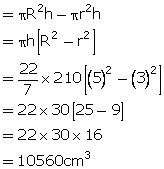
Q87. A hollow cylindrical pipe 21 dm long is made of copper. Its outer and inner diameters are 10 cm and 6 cm respectively. Find the volume of the copper used in making the pipe.
Solution
Let h = height of the pipe = 21 dm = 210 cm
R = External Radius =  r = Internal Radius =
  Volume of copper used in making the pipe
= Volume of External cylinder - Volume of Internal cylinder
Volume of copper used in making the pipe
= Volume of External cylinder - Volume of Internal cylinder
r = Internal Radius =
Volume of copper used in making the pipe
= Volume of External cylinder - Volume of Internal cylinder
Q88. The diameter of a roller 1 m long is 56 cm. If it takes 200 revolutions to level a playground, find the cost of levelling the playground at the rate of 50 paisa per m2.
Solution
Given: Diameter = 56 cm ⇒ radius (r) = 28 cm
Length (h) = 1 m = 100 cm
Let S be the curved surface area of the roller.
 Area covered in 200 revolutions = 200×17600 cm2 = 3520000 cm2 = 352 m2

Area covered in 200 revolutions = 200×17600 cm2 = 3520000 cm2 = 352 m2
Q89. A conical tent is to accommodate 11 persons. Each person must have 4 m2 of the space on the ground and 20 m3 of air to breathe. Find the height of the cone.
Solution
Let the radius of the conical tent be 'r' m and height be 'h' m.
Space on the ground required by each person = 4 m2
 Area of base = 11
  4 = 44 m2
Air required by each person to breathe = 20 m3
Volume of cone = 11 20 = 220 m3
Area of the base of conical tent =
4 = 44 m2
Air required by each person to breathe = 20 m3
Volume of cone = 11 20 = 220 m3
Area of the base of conical tent = 
 Volume of cone = 220
 Thus, height of the cone is 15 m.
Area of base = 11 4 = 44 m2
Air required by each person to breathe = 20 m3
Volume of cone = 11 20 = 220 m3
Area of the base of conical tent =
Volume of cone = 220
Thus, height of the cone is 15 m.
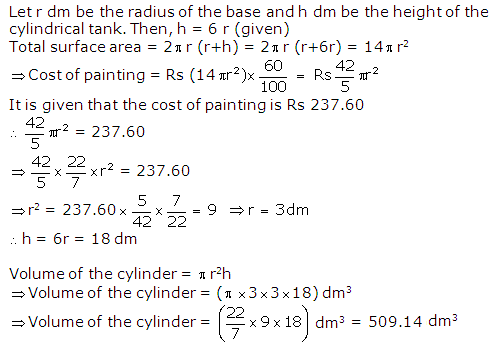
Q90. The cost of painting the total outside surface of a closed cylindrical oil tank at 60 paise per sq. dm is Rs. 237.60. The height of tank is 6 times the radius of the base of the tank. Find volume of cylindrical tank correct to two decimal places.
Solution
Q91. The curved surface area of a solid cylinder is 440 cm2 and its height is 10 cm. Find the circumference of the base of the cylinder.
Solution
Given: Curved surface area(S) = 440 cm2, height (h) = 10 cm
Circumference of the base of the cylinder = 
 Thus circumference of the circle is 44 cm.
Thus circumference of the circle is 44 cm.
Q92. How many solid spheres of diameter 6 cm can be cast out of a solid cylinder with radius of the base 9 cm and height 40 cm?  .
.
.Solution
For a sphere, diameter = 6 cm radius (R) = 3 cm
Now, Volume of sphere =  For cylinder, radius (r) = 9 cm, height (h) = 40 cm
Now, Volume of cylinder =
For cylinder, radius (r) = 9 cm, height (h) = 40 cm
Now, Volume of cylinder =  No. of solid spheres =
  =
=
radius (R) = 3 cm
Now, Volume of sphere =
For cylinder, radius (r) = 9 cm, height (h) = 40 cm
Now, Volume of cylinder =
No. of solid spheres =
=
Q93. Find the height of the cuboidal tank with square base of area 169 m2, if it can hold 253500 litres of water.
Solution
Given, area of the base of the tank = 169 m2
Let height of the tank = h m
Volume of the rectangular tank = Area of the base × height = 169 × h m3 = 169 h m3
A rectangular tank can hold 253500 litres of water =  Thus we have
169 h = 253.5
Thus we have
169 h = 253.5
 Thus height of the tank is 1.5 m.
Thus we have
169 h = 253.5
Thus height of the tank is 1.5 m.
Q94. In a conical vessel of radius 8.4 m and vertical height 3.5 m, how many full bags of wheat can be emptied, if space for wheat in each bag is 1.96 m3?  .
.
.Solution
Volume of conical vessel = 
 No. of bags =
No. of bags =
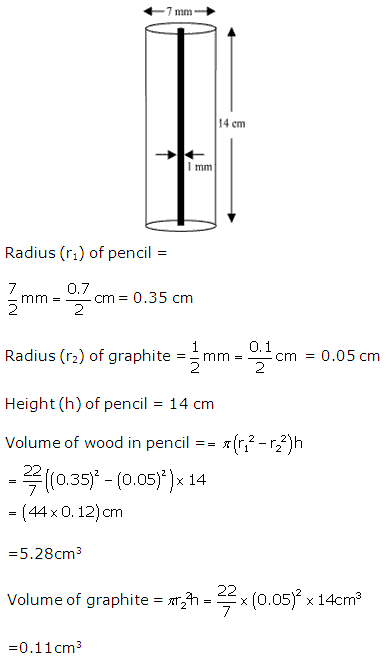
Q95. A lead pencil consists of cylinder of wood with a solid cylinder of graphite filled in the interior. The diameter of the pencil is 7 mm and the diameter of graphite is 1 mm. If the length of the pencil is 14 cm. Find the volume of wood and that of graphite.
Solution
Q96. How many m2 of tin would be required to line the inside of a rectangular tank on the sides and bottom if the inside dimensions of the tank are 8 m × 5 m × 4 m.?
Solution
Given: length (l)=8 m, breadth(b)=5 m and height(h)=4 m
Area of four walls and base= =2(8+5)4+(8 x 5)
=144 m2
Thus 144 m2 of tin is required to line the inside of the tank.
=2(8+5)4+(8 x 5)
=144 m2
Thus 144 m2 of tin is required to line the inside of the tank.
=2(8+5)4+(8 x 5)
=144 m2
Thus 144 m2 of tin is required to line the inside of the tank.
Q97. How many cylindrical glasses of 3 cm base
radius and height 8 cm can be refilled from a cylindrical vessel of base
radius 15 cm which is filled up to a
height of 32 cm?
Solution
Volume
of a glass =  =
=  Volume
of the vessel =
Volume
of the vessel =  Number
of glasses that can be filled
=
Number
of glasses that can be filled
=

 =
5
=
5  5 4 = 100
=
Volume
of the vessel =
Number
of glasses that can be filled
=
=
5 5 4 = 100
Q98. If the ratio of the radii of two sphere is
2 : 3, then the ratio of their volumes is:
Solution
r1
: r2 = 2 : 3

 Or
V1 : V2 = 8 : 27
Or
V1 : V2 = 8 : 27
Or
V1 : V2 = 8 : 27
Q99. The slant height and altitude of a conical tomb are 15 m and 12 m respectively. Find the cost of white-washing its curved surface at the rate of Rs. 70 per m2.
Solution
Altitude (h) = 12 m, slant height (l) =15 m. Let radius = r
 Thus, r = 9 m.
 Cost of white washing 1 m2 of canvas = Rs. 70
Therefore, cost of whitewashing
Cost of white washing 1 m2 of canvas = Rs. 70
Therefore, cost of whitewashing  = Rs. (
 ×70)
= Rs. 29700
×70)
= Rs. 29700
Thus, r = 9 m.
Cost of white washing 1 m2 of canvas = Rs. 70
Therefore, cost of whitewashing = Rs. (×70)
= Rs. 29700
Q100. A hemispherical dome of a building is to be white washed and the total cost of white wash of dome building is Rs. 924 at the rate of Rs. 3 per m2 then find the
(a) Surface area of hemisphere
(b) Volume of air in the dome
Solution
(i) Total cost of white wash = Rs. 924
Cost per m2= Rs. 3
 Total area to be white wash =
 = 308 m2
Surface area of hemisphere = 308 m2
(ii) Now, surface area of hemisphere = 308 m2
2
= 308 m2
Surface area of hemisphere = 308 m2
(ii) Now, surface area of hemisphere = 308 m2
2 r2 = 308 m2

 r = 7 m
Volume of hemisphere =
r = 7 m
Volume of hemisphere = 
 718.66 m2 air is present inside the dome.
Total area to be white wash =
= 308 m2
Surface area of hemisphere = 308 m2
(ii) Now, surface area of hemisphere = 308 m2
2r2 = 308 m2
r = 7 m
Volume of hemisphere =
718.66 m2 air is present inside the dome.
Q101. A building is cylindrical to a height of 9 m and conical above it. If the base radius is 15 m and height of the cone is 8 m, find the area of the building.
Solution
Diameter= 24 m
⇒ radius =12 m
Radius of the conical part = Radius of the cylindrical part (r) = 15 m
Height of cylindrical part (h) = 9 m, height of the cone (h) = 8 m
For the conical part of the building,
 Thus, l = 17 m
Surface area of the building = Curved surface area of the conical part + curved surface area of the cylindrical part
Thus, l = 17 m
Surface area of the building = Curved surface area of the conical part + curved surface area of the cylindrical part
 The surface of the building is 1650 m2
Thus, l = 17 m
Surface area of the building = Curved surface area of the conical part + curved surface area of the cylindrical part
The surface of the building is 1650 m2
Q102. Find the length of 2 m wide tarpaulin required to make conical tent of height 6 m and base diameter 16 m?
Solution
Given: Diameter = 16 m
Radius (r) = 8 m, height (h) = 6 m
Let slant height = l
 Breadth of tarpaulin (B) = 2 m, let length of tarpaulin = L
Area of tarpaulin required = curved surface area of the tent
Breadth of tarpaulin (B) = 2 m, let length of tarpaulin = L
Area of tarpaulin required = curved surface area of the tent
 Area of tarpaulin required is 125.7 m
Breadth of tarpaulin (B) = 2 m, let length of tarpaulin = L
Area of tarpaulin required = curved surface area of the tent
Area of tarpaulin required is 125.7 m
Q103. A hemispherical bowl is made of steel 0.25
cm thick. The inner radius of the bowl is 5 cm. Find the outer curved surface
area of the bowl.
Solution
Outer
radius R = 5 + 0.25 = 5.25 cm
Outer
curved surface area = 2 R2
R2

R2
Q104. The surface area of a sphere is 5544 cm2. Calculate its volume.
Solution
Let r = radius of the sphere.
Surface area of the sphere = 5544 cm2
 Let V be its volume.

Let V be its volume.
Q105. The radii of two right circular cylinders are in the ratio 2 : 3 and their heights are in the ratio 5 : 4. Find the ratio of their curved surface areas.
Solution
Let r1 = 2x, r2 = 3x
h1 = 5h, h2 = 4h
Curved surface area of cylinder = 2  rh
Ratio of Curved Surface Areas =
rh
Ratio of Curved Surface Areas = 

rh
Ratio of Curved Surface Areas =
Q106. Three spheres of radii 3 cm, 4 cm and 5 cm are melted together to form a single sphere. Find the radius of new sphere.
Solution
Let R be the radius of the new sphere.
Volume of new sphere = sum of volumes of three spheres
 = (3 cm)3 + (4 cm)3 + (5 cm)3
= 27 cm3 + 64 cm3 + 125 cm3
= 216 cm3
= (6 cm)3
= (3 cm)3 + (4 cm)3 + (5 cm)3
= 27 cm3 + 64 cm3 + 125 cm3
= 216 cm3
= (6 cm)3
 R = 6 cm
Thus, the radius of the new sphere is 6 cm.
R = 6 cm
Thus, the radius of the new sphere is 6 cm.
= (3 cm)3 + (4 cm)3 + (5 cm)3
= 27 cm3 + 64 cm3 + 125 cm3
= 216 cm3
= (6 cm)3
R = 6 cm
Thus, the radius of the new sphere is 6 cm.
Q107. The capacity of a closed cylindrical vessel
of height 1 m is 15.4 litres. How many square meters of metal sheet would be
needed to make it?  .
.
.Solution
Height
of the vessel = 1 m
Capacity
of the vessel = 15.4 litres
 .
Volume
of the cylindrical vessel =
.
Volume
of the cylindrical vessel =  r2h.
r2h
= 0.0154
r2h.
r2h
= 0.0154

 r
= 0.07 m
Metal
sheet needed to make the cylindrical vessel.
=
Total surface area of the cylindrical vessel.
=
2r(r + h)
r
= 0.07 m
Metal
sheet needed to make the cylindrical vessel.
=
Total surface area of the cylindrical vessel.
=
2r(r + h)
 =
0.4708 m2
Therefore,
0.4708 m2 of sheet will be required to make the vessel.
=
0.4708 m2
Therefore,
0.4708 m2 of sheet will be required to make the vessel.
.
Volume
of the cylindrical vessel = r2h.
r2h
= 0.0154
r
= 0.07 m
Metal
sheet needed to make the cylindrical vessel.
=
Total surface area of the cylindrical vessel.
=
2r(r + h)
=
0.4708 m2
Therefore,
0.4708 m2 of sheet will be required to make the vessel.
Q108. The volume of a right circular cylinder is
3850 cubic cm. Find its height if it's diameter is 14 cm.
Solution
Volume
of cylinder =  r2 h = 3850cm3


 =
25 cm
=
25 cm
r2 h = 3850cm3
=
25 cm
Q109. Find the curved surface area of a 44 m long metal pipe if diameter of its cross section is 4.2 cm.
Solution
Given: Diameter=4.2 cm ⇒ radius (r) = 2.1 cm
Length (h) =44 m= 4400 cm
Let S be the curved surface area of the roller

Q110. Find the volume of metal used in making a hollow hemispherical bowl with internal and external diameters 4 m and 10 m respectively.  .
.
.Solution
External radius = R = 5 m
Internal radius = r = 2 m
Volume of metal = 

Q111. An open cylindrical vessel has base
diameter 14 cm and height 21 cm. Find the cost of tin plating its inner
surface area at the rate of Rs 3 per 10 cm2.  .
.
.Solution
Inner
CSA = 2 rh =
rh =  = 924 cm2
Cost
@ Rs 3 per 10 cm2 = Rs 3
= 924 cm2
Cost
@ Rs 3 per 10 cm2 = Rs 3  = Rs 3
  = Rs
277.20
= Rs
277.20
rh =
= 924 cm2
Cost
@ Rs 3 per 10 cm2 = Rs 3
= Rs 3
= Rs
277.20
Q112. The length of a room is double its breadth. Its height is 3 m. The area of four walls excluding a door of dimensions 4 m  2 m is 100 m2. Find the volume.
2 m is 100 m2. Find the volume.Solution
l = 2b, h = 3m
Area of four walls (including the door) = 100 + 8 = 108 m2
108 = 2(l + b)h
108 = 2(2b + b) 3
108 = 6(3b)
 = 3b
18 = 3b
b = 6 m
l = 12 m
Volume = l b h = 12 6 3 = 216 m3
= 3b
18 = 3b
b = 6 m
l = 12 m
Volume = l b h = 12 6 3 = 216 m3
3
108 = 6(3b)
= 3b
18 = 3b
b = 6 m
l = 12 m
Volume = l b h = 12 6 3 = 216 m3
Q113. A cube and cuboid have same volume. The dimensions of the cuboid are in the ratio 1 : 2 : 4. If the difference between the cost of polishing the cube and cuboid at the rate of Rs. 5 per m2 is Rs. 80, find their volumes.
Solution
Let the dimensions of cuboid be x, 2x, 4x
Volume of cuboid = 8x3
 Volume of cube = 8x3 = side3
So, side of cube = 2x
TSA of cuboid = 2(lb + bh + hl) = 2(2x2 + 8x2 + 4x2) = 28x2
Cost of polishing the cuboid = Rs. 5
Volume of cube = 8x3 = side3
So, side of cube = 2x
TSA of cuboid = 2(lb + bh + hl) = 2(2x2 + 8x2 + 4x2) = 28x2
Cost of polishing the cuboid = Rs. 5  28 x2 = 140x2
TSA of cube = 6(side)2 = 6(2x)2 = 24x2
Cost of polishing the cube = Rs. 5 24 x2 = 120x2
Now, from the given information, we have
140x2 - 120x2 = 80
20x2 = 80
x2 = 4
x = 2
Volume of cuboid = Volume of cube = 8 (2)3 cubic cm= 64 cubic m
28 x2 = 140x2
TSA of cube = 6(side)2 = 6(2x)2 = 24x2
Cost of polishing the cube = Rs. 5 24 x2 = 120x2
Now, from the given information, we have
140x2 - 120x2 = 80
20x2 = 80
x2 = 4
x = 2
Volume of cuboid = Volume of cube = 8 (2)3 cubic cm= 64 cubic m
Volume of cube = 8x3 = side3
So, side of cube = 2x
TSA of cuboid = 2(lb + bh + hl) = 2(2x2 + 8x2 + 4x2) = 28x2
Cost of polishing the cuboid = Rs. 5 28 x2 = 140x2
TSA of cube = 6(side)2 = 6(2x)2 = 24x2
Cost of polishing the cube = Rs. 5 24 x2 = 120x2
Now, from the given information, we have
140x2 - 120x2 = 80
20x2 = 80
x2 = 4
x = 2
Volume of cuboid = Volume of cube = 8 (2)3 cubic cm= 64 cubic m
Q114. The dimensions of a match box is 5 cm × 3 cm × 2 cm. Find the volume of a cardboard box containing 10 such match boxes.
Solution
Dimensions of the match box are
Length (l) = 5 cm, breadth (b) = 3 cm and height (h) = 2 cm
Volume of the match box = Length x Breadth x Height = 5 x 3 x 2 = 30 cm3
Thus, Volume of cardboard box containing 10 such matchboxes
= 10 x 30 cm3
= 300 cm3
Q115. The volume of a cylinder is 350  cm3
and its height is 14 cm. Find the curved surface area.
cm3
and its height is 14 cm. Find the curved surface area.
cm3
and its height is 14 cm. Find the curved surface area. Solution
Volume
of cylinder = 350 cm2
Height
(h) = 14 cm
Volume
of cylinder = r2h
350 = r2  14
14
 r
=
r
=  r
= 5 cm
Curved
surface area of cylinder = 2rh
r
= 5 cm
Curved
surface area of cylinder = 2rh
 = 440 cm2
cm2
Height
(h) = 14 cm
Volume
of cylinder = r2h
350 = r2 14
r
=
r
= 5 cm
Curved
surface area of cylinder = 2rh
= 440 cm2
Q116. Two hemispherical bowls are formed by cutting a spherical ball of diameter 28 cm from the centre. Calculate the total surface area of each of the hemispherical bowls so formed.
Solution
Diameter = 28 cm⇒ radius (r) =14 cm.
Let S be the total surface area of the hemispherical bowl.

Q117. A solid spherical ball of diameter 4.2 cm
is completely immersed in water. How much water is displaced?
Solution
Radius
of ball (r) =  = 2.1 cm
Volume
=
= 2.1 cm
Volume
= 
 r3
=
r3
=  = 38.808 cm3
Quantity
of water displaced = volume of ball immersed = 38.808 cm3
= 38.808 cm3
Quantity
of water displaced = volume of ball immersed = 38.808 cm3
= 2.1 cm
Volume
= r3
=
= 38.808 cm3
Quantity
of water displaced = volume of ball immersed = 38.808 cm3
Q118. A cubical block of edge 22 cm is melted into small spherical balls of radius 1 cm. Calculate the number of balls that can be made from it.
Solution
Volume of cubical block = a3
=  cm3
= 10648 cm3
Volume of spherical ball =
cm3
= 10648 cm3
Volume of spherical ball =  =
=  = 4.19 cm3
Number of spherical balls =
= 4.19 cm3
Number of spherical balls =  =
= 
cm3
= 10648 cm3
Volume of spherical ball =
=
= 4.19 cm3
Number of spherical balls =
=
Q119. There are two cones. The C.S.A. of one is twice that of the other. The slant height of the latter is twice that of the former. Find the ratio of the radii.
Solution
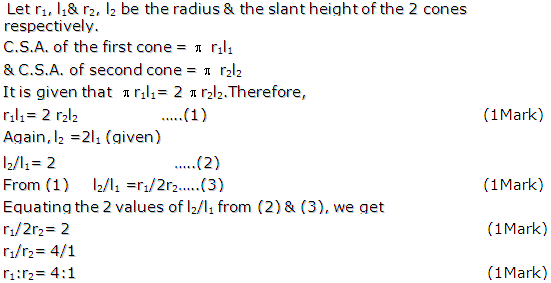
Comments
Post a Comment