Q1. You reach your hand into a bag of Scrabble tiles. You pull out one tile and find it has letter A. You pull out one more tile. What is the probability that it will be a letter Z?
Solution
There is a  chance that the first tile will be an A.But once you have that tile, there are only 25 left.
So, the probability of the second tile being a Z =
chance that the first tile will be an A.But once you have that tile, there are only 25 left.
So, the probability of the second tile being a Z = 
chance that the first tile will be an A.But once you have that tile, there are only 25 left.
So, the probability of the second tile being a Z =
Q2. Sum of the probability of happening and not happening of an event is:
Solution
A probability of 0 means that an event is impossible and a probability of 1 means that an event is certain.
Therefore, the sum of happening and not happening of an event = 1
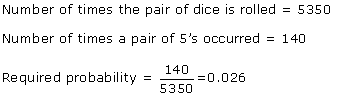
Q3. A pair of dice was rolled 5350 times. A pair of 5's occurred 140 times. What is the empirical probability of a pair of 5's?
Solution
Q4. A die is thrown 400 times. The frequency of the outcomes of the events are given as under:
Outcomes
1
2
3
4
5
6
Frequency
70
65
60
75
62
68
Find the probability of:
(i) Occurrence of an even number.
(ii) Occurrence of a number less than 2.
Solution
Total number of frequencies = 400
(i) Even numbers are = 2, 4, 6
Therefore frequencies of all even numbers = 65 + 75 + 68 = 208

 Probability of occurrence of an even number
  (ii) Probability of getting a number less than 2 =
Probability of occurrence of an even number
(ii) Probability of getting a number less than 2 =
Q5. Which one of the following cannot be the probability of an event?
- 1) 0
-
2)

-
3)

- 4) 1
Solution
The probability of an event lies between 0 and 1. Hence, it cannot be negative. Therefore,  is not a possible probability of an event.
is not a possible probability of an event.
Q6. Following distribution gives the weight of 38 students of a class.
Weight in kg.
31 - 35
36 - 40
41 - 45
46 - 50
51 - 55
56 - 60
61 - 65
66 - 70
71 - 75
No. of students
9
5
14
3
1
2
2
1
1
Find the probability that weight of student in the class is
(i) at most 60 kg.
(ii) at least 36 kg.
(iii) not more than 50 kg.
Solution
Total number of students = 38
(i) Number of students whose weight is at most 60 kg = 9 + 5 + 14 + 3 + 1 + 2 = 34
 Probability that weight of student is at most 60 kg
  (ii) No. of students whose weight is at least 36 kg
= 5 + 14 + 3 + 1 + 2 + 2 + 1 + 1 = 29
Probability that the weight of a student is at least 36 kg =
(ii) No. of students whose weight is at least 36 kg
= 5 + 14 + 3 + 1 + 2 + 2 + 1 + 1 = 29
Probability that the weight of a student is at least 36 kg =  (iii) No. of students whose weight is not more than 50 kg
= 9 + 5 + 14 + 3 = 31
Probability that the weight of a student is not more than 50 kg =
(iii) No. of students whose weight is not more than 50 kg
= 9 + 5 + 14 + 3 = 31
Probability that the weight of a student is not more than 50 kg = 
Probability that weight of student is at most 60 kg
(ii) No. of students whose weight is at least 36 kg
= 5 + 14 + 3 + 1 + 2 + 2 + 1 + 1 = 29
Probability that the weight of a student is at least 36 kg =
(iii) No. of students whose weight is not more than 50 kg
= 9 + 5 + 14 + 3 = 31
Probability that the weight of a student is not more than 50 kg =
Q7. In a survey, out of 200 students, it is observed that 125 students like mathematics. What is the probability of the students who do not like mathematics?
-
1)

-
2)

-
3)

-
4)

Solution
Total number of students = 200
Number of students who like Mathematics = 125
Number of students who do not like Mathematics = 200 - 125
= 75
P(do not like Mathematics) = 
Q8. 
Solution
(i) P(at least two heads ) =  (ii) P(3 tails) = P(no head) =
  (iii) P(at most one head) =
(ii) P(3 tails) = P(no head) =
(iii) P(at most one head) =
Q9. The age (in years) of workers are as follows:
Age (in yrs)
10 - 19
20 - 29
30 - 39
40 - 49
50 - 59
60 and above
No. of workers
5
40
26
15
8
6
If a worker is selected at random, find the probability that the person is:
(a) 30 years or more
(b) below 50 years
Solution
Total no. of workers = 100
(a) Number of workers who are 30 years or more = 26 + 15 + 8 + 6 = 55
P(30 yrs or more) =  (b) Number of workers who are below 50 years = 5 + 40 + 26 + 15 = 86
P(below 50 yrs) =
(b) Number of workers who are below 50 years = 5 + 40 + 26 + 15 = 86
P(below 50 yrs) = 
(b) Number of workers who are below 50 years = 5 + 40 + 26 + 15 = 86
P(below 50 yrs) =
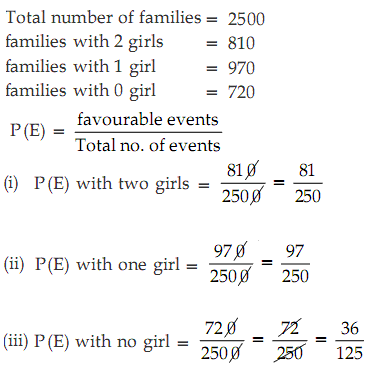
Q10. 
Solution
Q11. In making a math project, a teacher found out that 26 people took two to three hours, 14 people took three to four hours and 10 people took more than four hours to complete a particular assignment. What is the experimental probability that the assignment can be done in less than four hours?
Solution

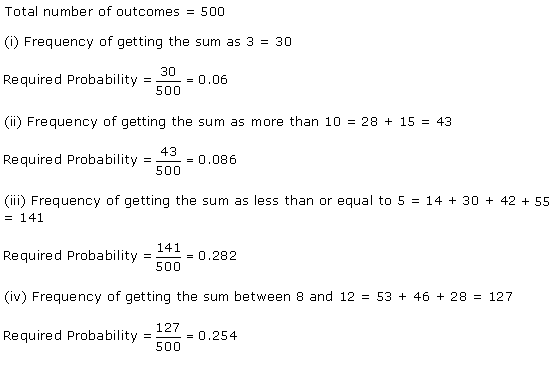
Q12. Two dice are thrown simultaneously 500 times. Each time the sum of two numbers appearing on them is noted and recorded in the following table:
Sum
2
3
4
5
6
7
8
9
10
11
12
Frequency
14
30
42
55
72
75
70
53
46
28
15
From the above data, what is the probability of getting a sum
(i) more than 10 (ii) between 8 and 12.
Solution
Total number of trials = 500
(i) P(sum more than 10) =  (ii) P(sum between 8 and 12) =
(ii) P(sum between 8 and 12) =
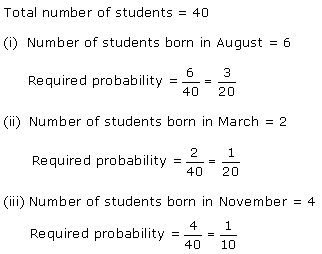
Q13. 
Solution
Q14. The percentage of marks obtained by a student in monthly unit test are given below:
Unit Test
1
II
III
IV
V
% Marks
70
72
65
68
85
Find the probability that the student gets
(a) more than 70% marks
(b) more than 90% marks
Solution
Total number of tests = 5
(a) Marks greater than 70% = 72 and 85, hence in 2 tests.
P(student gets more than 70% marks) =  (b) Marks more than 90 = 0, hence in 0 tests.
P(student gets more than 90% marks) =
(b) Marks more than 90 = 0, hence in 0 tests.
P(student gets more than 90% marks) = 
(b) Marks more than 90 = 0, hence in 0 tests.
P(student gets more than 90% marks) =
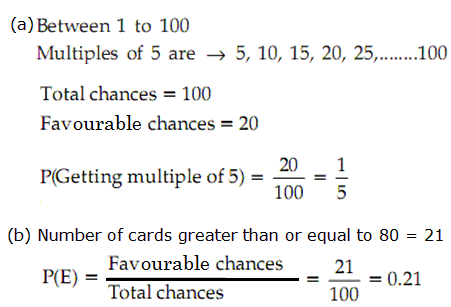
Q15. 
Solution
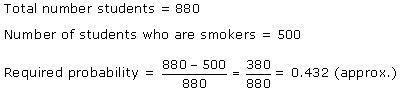
Q16. A survey at a university was conducted among 880 students. Of these, 500 identified themselves as "smokers". Compute the empirical probability that a randomly selected student is not from a "smoker".
Solution
Q17. A bag contains cards numbered from 1 to 25. A card is drawn at random from the bag. Find the probability that selected card bears number which is multiple of 2 or 3.
Solution
Total number of outcomes = 25
Multiples of 2 or 3 between 1 and 25 are
2, 3, 4, 6, 8, 9, 10, 12, 14, 15, 16, 18, 20 ,21, 22, 24
Number of favourable outcomes = 16
P(E) = 

Q18. In a survey of 364 children aged 2-4 years, it was found that 91 liked to eat potato chips. If a child is selected at random, the probability that he/she does not like to eat potato chips is:
Solution
Out of 364 children, 91 like to eat potato chips.
Number of children who do not like to eat potato chips
= 364 - 91
= 273
Probability of children who do not like to eat potato chips
=  = 0.75
= 0.75
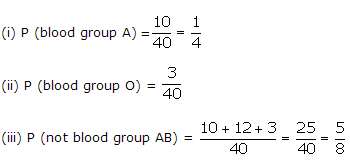
Q19. The following data shows the blood groups of 40 students of a class:
Blood group
A
AB
B
O
No. of students
10
15
12
3
A student is selected at random from the class. Find the probability that the child:
(i) has blood group A
(ii) has blood group O
(iii) does not have blood group AB
Solution
Q20. A survey of 10 student is done regarding the likes and dislike about the subject mathematics. The data are given below:
Views
Number of students
Likes
80
Dislikes
20
Find the probability that a student chosen randomly
(a) likes mathematics
(b) does not like mathematics
Solution
Total students = 100
(i) P(like Mathematics) =  (ii) P(dislike Mathematics) =
(ii) P(dislike Mathematics) =
Q21. 
Solution
(a) Let E be the event that student is from grade 3.
Then, P(E) =  (b) Let F be the event that student is not in grade 2, 3, 4, 5 or grade 6.
i.e. student is in grade 1
Thus, P(F) =
(b) Let F be the event that student is not in grade 2, 3, 4, 5 or grade 6.
i.e. student is in grade 1
Thus, P(F) = 
(b) Let F be the event that student is not in grade 2, 3, 4, 5 or grade 6.
i.e. student is in grade 1
Thus, P(F) =
Q22. In an experiment, 100 drawing pins were dropped on a floor. 73 landed point up and the rest landed point down. A pin is selected at random and dropped. What is the probability that the pin will land point down?
Solution
Number of pins landing point down = 100 - 73 = 27
Probability of pin landing point down =  = 0.27
= 0.27
Q23. 
Solution
Q24. Three unbiased coins are tossed together. Find the probability of getting
(i) Two heads
(ii) At least two heads
(iii) No head
Solution
Sample cases = {HHH, HHT, HTH, HTT, THH, THT, TTH, TTT} = 8 cases
(i) P(two heads) =  (ii) P(at least 2 heads) =
  (iii) P(No head) =
(ii) P(at least 2 heads) =
(iii) P(No head) =
Q25. 
Solution
Q26. The weekly pocket money of students are given in the following table:
Pocket Money (in Rs)
Number of students
145
7
140
4
159
10
171
6
158
3
147
8
165
12
Find the probability that the weekly pocket money of a student is:
(a) Rs 159 (b) more than Rs 159
(c) Less than Rs 159
Solution
Total number of students = 50
(a) P(weekly pocket money of student is Rs 159) =  (b) P(weekly pocket money of student is more than Rs 159) =
  (c) P (weekly pocket money of student is less than Rs 159) =
(b) P(weekly pocket money of student is more than Rs 159) =
(c) P (weekly pocket money of student is less than Rs 159) =
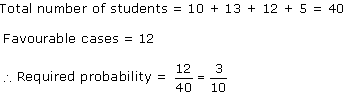
Q27. In a medical examination of students of a class, the following blood groups were recorded:
Solution
Q28. 
Solution
Q29. When a thumbtack is tossed, there are two possible outcomes. If the empirical probability of "point up" is fixed to be 0.73, what should be the probability of "point down"?
Solution
P(point up) = 0.73P(point down) 1 - 0.73 = 0.27(Since, the sum of probabilities is 1)
Q30. A bag contains 12 balls out of which x are white. If one ball is taken out from the bag, find the probability of getting a white ball. If 6 more white balls are added to the bag and the probability now for getting a white ball is double the previous one, find the value of x.
Solution
No. of white balls = x
Total no. of balls = 12
P(white ball) =  If 6 white balls are added:
Total balls = 18
White balls = x + 6
If 6 white balls are added:
Total balls = 18
White balls = x + 6
 According to the question:

If 6 white balls are added:
Total balls = 18
White balls = x + 6
According to the question:
Q31. 
Solution
Q32. 
Solution
Q33. 
Solution
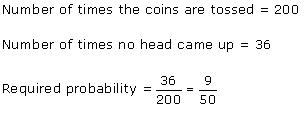
Total number of tosses = 200
P(two headscome up) = 

Q34. 
Solution
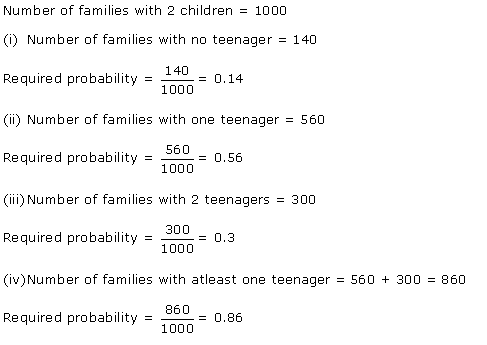
Q35. In a sample survey of 640 people, it was found that 400 people have a secondary school certificate. If a person is selected at random, the probability that the person does not have such certificate is
Solution
People having secondary school certificate = 400
People who do not have secondary school certificate = 640 - 400 = 240
Therefore, probability that the person selected does not have the certificate

Q36. One card is drawn at random from a well shuffled deck of 52 cards. Find the probability for getting a face card.
Solution
Here favourable outcomes = 4(Kings) + 4(Queens) + 4(Jacks) = 12
Total number of equally likely cases = 52
Thus, Required probability = 
Q37. Two dice are thrown 400 times. Each time sum of two numbers appearing on their tops is noted as given in the following table:
Sum
2
3
4
5
6
7
8
9
10
11
12
Frequency
14
20
32
45
62
65
60
43
36
18
5
What is the probability of getting a sum
(i) 5 ?
(ii) more than 10 ?
(iii) between 5 and 10?
Solution
(i) P(5) =  (ii) P(more than 10) =
  (iii) P(between 5 and 10) =
(ii) P(more than 10) =
(iii) P(between 5 and 10) =
Q38. 
Solution
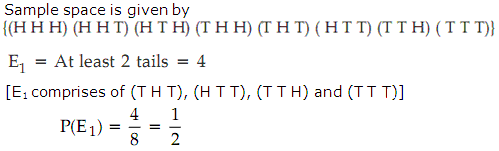
When three coins are tossed simultaneously,
Q39. 
Solution

Q40. 
Solution
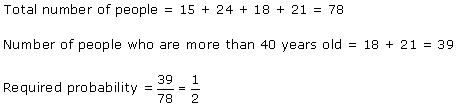
Q41. Two coins are tossed simultaneously 1000 times with the following frequencies of different outcomes:
Outcomes
2 Heads
1 Head
No Head
Frequency
190
560
250
Find the probability of occurrence of each of these events.
Solution
P (2 heads) =  P (1 head) =
  P (no head) =
P (1 head) =
P (no head) =
Q42. Three coins are tossed simultaneously 200 times with the following frequencies of different outcomes:
Outcomes
3 heads
2 heads
1 head
No heads
Frequency
23
72
77
28
Find the probability of getting
(i) 3 heads
(ii) at least two heads
(iii) two heads and one tail.
Solution
Total number of trials = 200
(i) P(getting 3 heads) =  (ii) P(at least two heads) =
  (iii) P(two heads and one tail) =
(ii) P(at least two heads) =
(iii) P(two heads and one tail) =
Q43. Fifty seeds were selected at random from each of the 5 bags of seeds and kept under standardized conditions favorable for germination. After 20 days the number of seeds which had germinated in each collection were counted and recorded as follows:
Bags
1
2
3
4
5
Number of seeds Germinated
40
48
42
39
41
What is the probability of germination of:
(i) More than 40 seeds in a bag?
(ii) 49 seeds in a bag?
(iii) More than 35 seeds in a bag?
Solution
 (i) P(more than 40 seeds in a bag) =
  (ii) P(49 seeds in a bag) =
  (iii) P(more than 35 seeds) =
Q44. Following table shows the marks obtained by 30 students in a class test:
Marks Obtained
70
58
60
52
65
75
68
Number of Students
3
5
4
7
6
2
3
Find the probability that a student secures
(a) 60 marks
(b) less than 60 marks.
Solution
Total no. of students = 30
(a) Probability of a student getting 60 marks =  (b) Number of students who got less than 60 marks = 5 + 7 = 12
Probability of a student getting less than 60 marks =
(b) Number of students who got less than 60 marks = 5 + 7 = 12
Probability of a student getting less than 60 marks = 
(b) Number of students who got less than 60 marks = 5 + 7 = 12
Probability of a student getting less than 60 marks =
Comments
Post a Comment