Q1. Any solution of the linear equation 2x + ny = 9 in two variables, is of the form:
-
1)

-
2)
 ; where n is a real number
-
3)
 ; where n is a real number
-
4)

Solution
2x + ny = 9
2x = 9
x =  Therefore, solution is of the form :
 ; where n is a real number
Therefore, solution is of the form :; where n is a real number
Q2. If the line represented by the equation 3x +  y = 8 passes through the points (2,2), then the value of is
y = 8 passes through the points (2,2), then the value of isSolution
3x + y = 8
3(2) + (2) = 8
6 + 2 = 8
2 = 2
= 1
y = 8
3(2) + (2) = 8
6 + 2 = 8
2 = 2
= 1
Q3. The point of the form (a, a) always lies on
Solution
The point of the form (a, a) always lies on the line x - y = 0 or y = x
As for x = a, we have:
x = y
 a = y
y = a
a = y
y = a
a = y
y = a
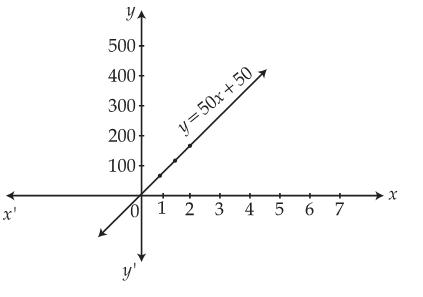
Q4. The food charges in a hostel are as
follows:
For the first day, the charges are Rs. 100
and for the subsequent days it is Rs. 50 per day. Taking the number of days
as x and total charges as Rs. y, write a linear equation for this information
and draw its graph.
Solution
Number
of days = x
Total
charges = y
According
to question,
y = 100 + (x - 1)  50
= 100 + 50x - 50
y = 50x + 50
x
1
2
3
y
100
150
200
50
= 100 + 50x - 50
y = 50x + 50
x
1
2
3
y
100
150
200
50
= 100 + 50x - 50
y = 50x + 50
x
1
2
3
y
100
150
200
Q5. Equation of x-axis is:
Solution
Equation of x-axis is y = 0.
Q6. The linear equation 5x - y = 2x - 1 has
Solution
5x - y = 2x - 1
5x - 2x - y + 1 = 0
3x - y + 1 = 0
A linear equation in two variables has infinitely many solutions.
Q7. If the point (2, -1) lies on the graph of the equation 3x + ky = 4, then the value of k is
Solution
3x + ky = 4
Point (2, -1) lies on the graph of this equation.
 3(2) + k(-1) = 4
6 - k = 4
k = 2
3(2) + k(-1) = 4
6 - k = 4
k = 2
3(2) + k(-1) = 4
6 - k = 4
k = 2
Q8. The sum of twice the odd number and the even number is 10.Write a linear equation for this information. Also find the odd number if the even number is 4
Solution
Let the odd number be x and an even number be y
Twice the odd number and even number is 10.
So,
 Now, even number =4
 So the odd number is 3
Now, even number =4
So the odd number is 3
Q9. Which of the following is not the solution of linear equation 
-
1)

-
2)

-
3)

-
4)

Solution
Let us check whether is a solution of linear equation  Substituting x =
 and y = in the LHS of equation we get

is a solution of linear equation
Substituting x = and y = in the LHS of equation we get
Q10. Which of the following is the solution of linear equation 
Solution
Substitute (x,y) as(-1,5) in the linear equation 
 Since L.H.S=R.H.S, so (-1,5) is the solution of
Since L.H.S=R.H.S, so (-1,5) is the solution of
Q11. I am three times as old as my son. Five
years later, I shall be two and a half times as old as my son. How old I am
and how old is my son?
Solution
Let
age of my son = x years
My
age = 3x
After
five yrs:
3x
+ 5 =  (x + 5)
6x
+ 10 = 5x + 25
x
= 15Age of son = 15 years
Age
of father (i.e. my age) = 3
(x + 5)
6x
+ 10 = 5x + 25
x
= 15Age of son = 15 years
Age
of father (i.e. my age) = 3 15 yrs = 45 years
(x + 5)
6x
+ 10 = 5x + 25
x
= 15Age of son = 15 years
Age
of father (i.e. my age) = 3 15 yrs = 45 years
Q12. For what value of k, x = 2 and y = -1 is a solution of x + 3y - k = 0?
Solution
x + 3y - k = 0
Substituting the given values of x and y,
2 + 3(-1) - k = 0
2 - 3 - k =0
-1 - k = 0
k = -1
Q13. Laxmi purchases some bananas and some oranges .Each banana costs Rs.2 while each orange costs Rs.3. If the total amount paid by Laxmi was Rs.30 and the number of oranges purchased by her was 6, then how many bananas did she purchase?
Solution
Let us assume that Laxmi purchased x bananas and y oranges.
Since each banana costs Rs.2, x bananas cost Rs.2 × x = Rs.2x
Similarly, each orange costs Rs.3.
Thus, y oranges cost Rs.3 × y = Rs.3y
Thus, the total amount paid by Laxmi is Rs. (2x + 3y), which equals Rs.30
Thus, we can express the given information in the form of a linear equation as
2x + 3y =3 0
Now, we know that Laxmi purchased 6 oranges, i.e., the value of y is 6.
Substitute this value of y in the equation 2x + 3y = 30, thereby reducing it to a linear equation in one variable.
We can then solve the equation to obtain the value of x.
 Thus, we see that the value of x is 6, i.e., Laxmi purchased 6 bananas.
Thus, we see that the value of x is 6, i.e., Laxmi purchased 6 bananas.
Q14. Solve for x:

Solution

Q15. Draw the graph of the linear equation
2x + 3y = 12
(i) Write the co-ordinates of a point where
graph intersects x-axis.
(ii) From the graph show whether points (3,
2) and (-3, 6) are the solutions of the equation.
Solution
2x + 3y = 12
x
0
3
-3
y
4
2
6
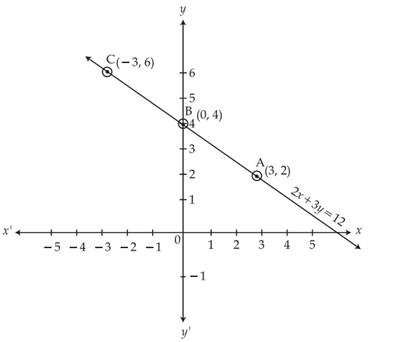 (i) Co-ordinates of point where graph
intersects x-axis is :
As
the point is on x axis, so,y=0.
so
2x=12
x=6
the
point on x- axis will be:(6,0).
(ii)
Point (3,2) and (-3,6) lie on graph
(i) Co-ordinates of point where graph
intersects x-axis is :
As
the point is on x axis, so,y=0.
so
2x=12
x=6
the
point on x- axis will be:(6,0).
(ii)
Point (3,2) and (-3,6) lie on graph
 (3, 2) and (-3, 6) are solutions of the
equation.
(3, 2) and (-3, 6) are solutions of the
equation.
(i) Co-ordinates of point where graph
intersects x-axis is :
As
the point is on x axis, so,y=0.
so
2x=12
x=6
the
point on x- axis will be:(6,0).
(ii)
Point (3,2) and (-3,6) lie on graph
(3, 2) and (-3, 6) are solutions of the
equation.
Q16. The linear equation 2x + 5y = 8 has:
Solution
A linear equation has infinitely many solutions.
Q17. Express 3x = 5y in the form of ax + by + c
= 0 and hence indicate the values of a, b and c.
Solution
3x
- 5y + 0 = 0
 a = 3, b = -5, c = 0
a = 3, b = -5, c = 0
Q18. If the point (-1, -5) lie on the graph of
3x = ay + 7, then find the value of 'a'.
Solution
(-1,
-5) lies on the graph of 3x = ay + 7
 3(-1) = a(-5) + 7
 -3 = -5a + 7
5a = 7 + 3
-3 = -5a + 7
5a = 7 + 3

3(-1) = a(-5) + 7
-3 = -5a + 7
5a = 7 + 3
Q19. If a linear equation has solutions (-2,2), (0,0) (2,-2) then it is of the form:
Solution
For (-2, 2):
-2 + 2 = 0
For (0, 0):
0 + 0 = 0
For (2, -2):
2 + (-2) = 0
Hence, x + y = 0 is the equation for which given points are the solution.
Q20. Which of the following is a solution of the equation 4x + 3y = 16?
Solution
4x + 3y = 16
For (2, 3):
LHS
= 4(2) + 3(3)
= 8 + 9
=17  RHS
For (1, 4):
LHS
= 4(1) + 3(4)
= 4 + 12
= 16 = RHS
For (2, 4):
LHS
= 4(2) + 3(4)
= 8 + 12
= 20 RHS
For (1, 3):
LHS
= 4(1) + 3(3)
= 4 + 9
= 13 RHS
Therefore, (1, 4) is the solution.
RHS
For (1, 4):
LHS
= 4(1) + 3(4)
= 4 + 12
= 16 = RHS
For (2, 4):
LHS
= 4(2) + 3(4)
= 8 + 12
= 20 RHS
For (1, 3):
LHS
= 4(1) + 3(3)
= 4 + 9
= 13 RHS
Therefore, (1, 4) is the solution.
RHS
For (1, 4):
LHS
= 4(1) + 3(4)
= 4 + 12
= 16 = RHS
For (2, 4):
LHS
= 4(2) + 3(4)
= 8 + 12
= 20 RHS
For (1, 3):
LHS
= 4(1) + 3(3)
= 4 + 9
= 13 RHS
Therefore, (1, 4) is the solution.
Q21. If the point (2k - 3, k + 2) lies on the
graph of the equation 2x + 3y + 15 = 0, find value of k.
Solution
Since
(2k - 3, k + 2) lies on 2x + 3y + 15 = 0
 2(2k
- 3) + 3(k + 2) + 15 = 0
4k
- 6 + 3k + 6 + 15 = 0
7k
+ 15 = 0
2(2k
- 3) + 3(k + 2) + 15 = 0
4k
- 6 + 3k + 6 + 15 = 0
7k
+ 15 = 0

2(2k
- 3) + 3(k + 2) + 15 = 0
4k
- 6 + 3k + 6 + 15 = 0
7k
+ 15 = 0
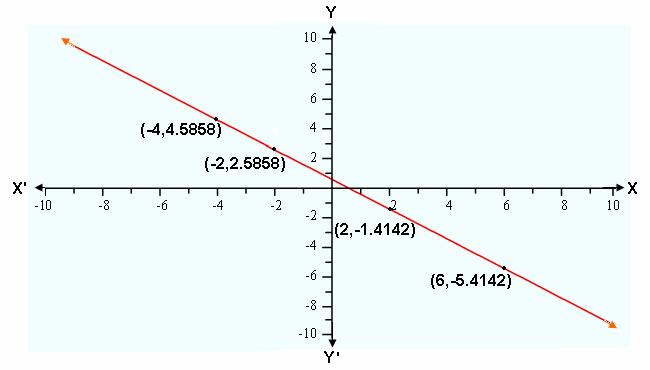
Q22. Draw the graph of following linear equation:
 ? (Take
  )
)
? (Take )Solution
Let us simplify the given linear equation
 Let us find the solutions in ordered pair in the form of table as follows:
X
2
6
-2
-4
Y
-1.4142
-5.4142
2.5858
4.5858
Let us find the solutions in ordered pair in the form of table as follows:
X
2
6
-2
-4
Y
-1.4142
-5.4142
2.5858
4.5858
Let us find the solutions in ordered pair in the form of table as follows:
X
2
6
-2
-4
Y
-1.4142
-5.4142
2.5858
4.5858
Q23. Any point on the x-axis is of the form:
Solution
For any point to lie on x-axis, value of y will always be 0.
Therefore, (x, 0) will the point.
Q24. Point P(2,-3) lies on the line represented by the equation:
Solution
Consider the equation 2x + y = 1.
For x = 2 and y = -3,
LHS = 2(2) + (-3) = 4 - 3 =1 = RHS
Therefore, P(2, -3) lies on the linerepresented by the equation 2x + y = 1.
Q25. Which of the following is not a linear equation?
Solution
A linear equation is one which can be expressed as y = mx + c. Since in equation 0x + 0y + c = 0, x and y do not exist hence it is not a linear equation.
Q26. Which of the following is a linear equation in one variable?
Solution
A linear equation in one variable involve only one variable is of the form ax + b = 0, where a  0.
Clearly, from amongst the given options. x + 5 = 6 is a linear equation in one variable.
0.
Clearly, from amongst the given options. x + 5 = 6 is a linear equation in one variable.
0.
Clearly, from amongst the given options. x + 5 = 6 is a linear equation in one variable.
Q27. Express y in terms of x, given that 2x - 5y
= 7. Check whether the point (-3, -2) is on the given line.
Solution
2x
- 5y = 7
5y
= 2x - 7
 For (-3, -2):
2x - 5y = 7
LHS
= 2(-3) -5(-2)
= -6 + 10
= 4
For (-3, -2):
2x - 5y = 7
LHS
= 2(-3) -5(-2)
= -6 + 10
= 4  RHSThe point (-3,
-2) is not on the given line.
RHSThe point (-3,
-2) is not on the given line.
For (-3, -2):
2x - 5y = 7
LHS
= 2(-3) -5(-2)
= -6 + 10
= 4 RHSThe point (-3,
-2) is not on the given line.
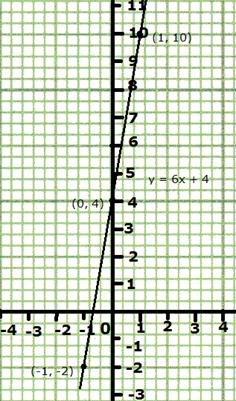
Q28. The taxi fare for the first km is Rs. 10
and fare for subsequent distance is Rs. 6 per km. If the distance covered is
x km and total fare is Rs. y, write a linear equation for this statement and
draw its graph.
Solution
Given,
Taxi
fare for first kilometer = Rs. 10
Taxi
fare for subsequent distance = Rs. 6
Total
distance covered = x
Total
fare = y
Since
the fare for first kilometer = Rs. 10
According
to problem,
Fare
for (x - 1) kilometer = 6(x-1)
So,
the total fare = 6(x-1) + 10
 y = 6(x-1) + 10
 y
= 6x - 6 + 10
y
= 6x + 4
Hence,
y = 6x + 4 is the required linear equation.
x
-1
0
1
y
-2
4
10
y
= 6x - 6 + 10
y
= 6x + 4
Hence,
y = 6x + 4 is the required linear equation.
x
-1
0
1
y
-2
4
10
y = 6(x-1) + 10
y
= 6x - 6 + 10
y
= 6x + 4
Hence,
y = 6x + 4 is the required linear equation.
x
-1
0
1
y
-2
4
10
Q29. The linear equation x = 5 can be written in two variables as:
Solution
x = 5
(1)x + (0)y = 5
1.x + 0.y + (-5) = 0
Q30. The point lying on the equation 2x - y = 5 is:
Solution
Consider the point (2, -1).
LHS = 2(2) - (-1) = 4 + 1 = 5 = RHS
Since, LHS = RHS, point (2, -1) lies on the equation 2x - y = 5.
Q31. The number of line(s) passing through a point (3,4) is (are):
Solution
Infinite numbers of lines pass through a single point i.e. (3, 4) here.
Q32. Find four solutions of the equation 2x - y = 4.
Solution
2x - y = 4
Or, y = 2x - 4 …………equation
(1)
Putting x
= 0 in equation (1),
y = (2 x 0) - 4 = 0 - 4 = -4
Putting x
= 1 in equation (1),
y = (2 x 1) - 4 = 2 - 4 = -2
Putting x
= 2 in equation (1),
y = (2 x 2) - 4 = 4 - 4 = 0
Putting x
= 3 in equation (1),
y = (2 x 3) - 4 = 6 - 4 = 2
Hence,
four solutions of equation 2x - y = 4
are (0, -4), (1, -2), (2, 0), (3, 2).
Q33. Sum of the digits of a two digit number is
12. If 18 is added to the original number the digits interchange their
places. Write two linear equations representing these situations.
Solution
Let
the unit's digit be x and the ten's digit be y.
Sum of the digits of a two digit number is given
to be 12.
 x + y = 12 …….(i)
Original
number = 10y + x
Number
obtained on reversing the digits = 10x + y
According
to the question:
10y
+ x + 18 = 10x + y
x + y = 12 …….(i)
Original
number = 10y + x
Number
obtained on reversing the digits = 10x + y
According
to the question:
10y
+ x + 18 = 10x + y
 9x - 9y = 18
x - y = 2 …….(ii)
(i)
and (ii) are the required equations.
9x - 9y = 18
x - y = 2 …….(ii)
(i)
and (ii) are the required equations.
x + y = 12 …….(i)
Original
number = 10y + x
Number
obtained on reversing the digits = 10x + y
According
to the question:
10y
+ x + 18 = 10x + y
9x - 9y = 18
x - y = 2 …….(ii)
(i)
and (ii) are the required equations.
Q34. Give two solutions of the equation x + 3y =
8.
Solution
Solution
1:
For
x = 1,
x
+ 3y = 8
1
+ 3y = 8
3y
= 7
y
=  (x,
y) = (1, )
Solution
2:
For
x = 2,
x
+ 3y = 8
2
+ 3y = 8
3y
= 6
y
= 2
(x,
y) = (2, 2)
(x,
y) = (1, )
Solution
2:
For
x = 2,
x
+ 3y = 8
2
+ 3y = 8
3y
= 6
y
= 2
(x,
y) = (2, 2)
(x,
y) = (1, )
Solution
2:
For
x = 2,
x
+ 3y = 8
2
+ 3y = 8
3y
= 6
y
= 2
(x,
y) = (2, 2)
Q35. Sum of the digits of a two digit number is
14. If we add 18 to the original number, the digits interchange their places.
Write two equations for these two statements.
Solution
Let
the unit's digit of the number be x and ten's digit be y.
 x + y = 14 ……….(i)
Original
number = 10y + x
Number
obtained on reversing the digits = 10x + y
According
to question,
10y
+ x + 18 = 10x+ y
x + y = 14 ……….(i)
Original
number = 10y + x
Number
obtained on reversing the digits = 10x + y
According
to question,
10y
+ x + 18 = 10x+ y
 9x - 9y = 18
x - y = 2 ………..(ii)
9x - 9y = 18
x - y = 2 ………..(ii)
x + y = 14 ……….(i)
Original
number = 10y + x
Number
obtained on reversing the digits = 10x + y
According
to question,
10y
+ x + 18 = 10x+ y
9x - 9y = 18
x - y = 2 ………..(ii)
Q36. Draw the graph of the equation 3x + y = 5
and write the co-ordinates of the points where the line intersects x-axis and
y-axis.
Solution
3x + y = 5x
0
1
2
y
5
2
-1
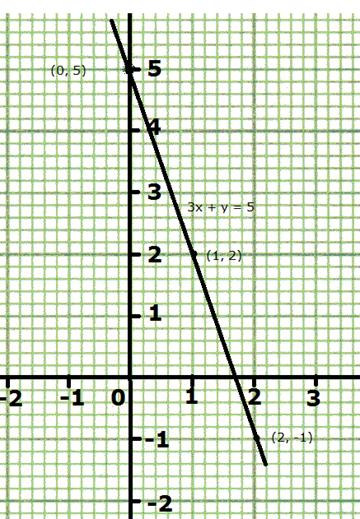 Graph
meets y-axis at (0,5) and x-axis at
Graph
meets y-axis at (0,5) and x-axis at 
Graph
meets y-axis at (0,5) and x-axis at
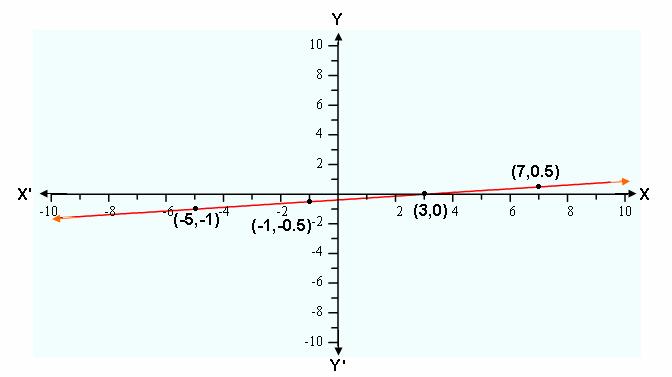
Q37. By graphical method , find the solutions of the linear equation  .
.
.Solution
Let us simplify the above linear equation
 Let us find the solutions in ordered pair in the form of table as follows:
x
-5
-1
3
7
Y
-1
-0.5
0
0.5
Let us find the solutions in ordered pair in the form of table as follows:
x
-5
-1
3
7
Y
-1
-0.5
0
0.5
Let us find the solutions in ordered pair in the form of table as follows:
x
-5
-1
3
7
Y
-1
-0.5
0
0.5
Q38. Draw the graphs of the equations 2x - y = 3
and 3x +2y = 1 on the same coordinate axes. Also, find the point of
intersection of the two lines from the graphs.
Solution
2x
- y = 3
x
-1
1
3
y
-5
-1
3
3x
+ 2y = 1
x
-1
1
3
y
2
-1
-4
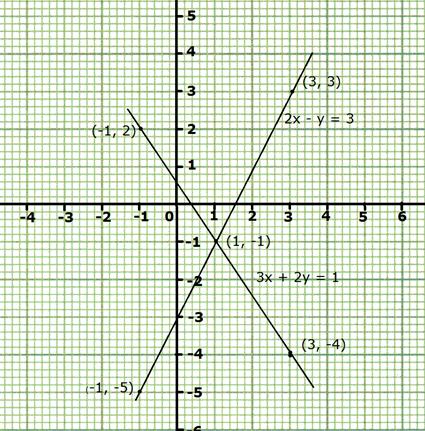 Point
of intersection of the two lines is (1,-1).
Point
of intersection of the two lines is (1,-1).
Point
of intersection of the two lines is (1,-1).
Q39. Ram invested some amount at 6% simple interest and some amount at 9% simple interest. At the end of the year, he earned Rs.1200 as interest on the two amounts.
Write a linear equation in two variables to represent the above statement.
Solution
Let the amount invested at 6% simple interest be Rs.x and that invested at 9% simple interest be Rs.y.
Thus, interest earned at the end of first year on Rs.x = 6% of Rs.x = Rs. Similarly, interest earned at the end of first year on Rs.y = 9% of Rs.y = Rs.
 Thus, total amount earned as interest
  , which equals Rs.1200
Thus, the given information can be represented as a linear equation as:
, which equals Rs.1200
Thus, the given information can be represented as a linear equation as:

Similarly, interest earned at the end of first year on Rs.y = 9% of Rs.y = Rs.
Thus, total amount earned as interest , which equals Rs.1200
Thus, the given information can be represented as a linear equation as:
Q40. The parking charges of a car in a parking lot are Rs. 30 for the first two hours and Rs. 10 for subsequent hours. Take total parking time to be x hours and total charges as Rs. y, write a linear equation in two variables to express the above statement. Draw a graph for the linear equation and find the charges for five hours using the graph.
Solution
Parking charges for first 2 hrs = Rs 30
Parking charges for subsequent hrs = Rs 10
Total park time = x hours
Total charges = Rs y
 y = 30 + 10(x- 2)
y = 30 + 10x - 20
10x - y = -10
x
1
2
3
y
20
30
40
y = 30 + 10(x- 2)
y = 30 + 10x - 20
10x - y = -10
x
1
2
3
y
20
30
40
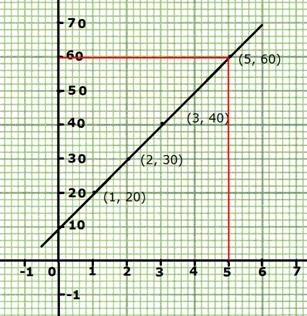 From the graph, it is clear that for five hours, parking charges will be Rs 60.
y = 30 + 10(x- 2)
y = 30 + 10x - 20
10x - y = -10
x
1
2
3
y
20
30
40
From the graph, it is clear that for five hours, parking charges will be Rs 60.
Q41. After 5 years, the age of father will be
two times the age of the son. Write a linear equation in two variables to
represent this statement.
Solution
Let
father's present age be = x years
Son's
present age = y years
After
5 years father's age will be = (x + 5) years
After
5 years son's age will be = (y + 5) years
According
to the question:
x
+ 5 = 2(y + 5)
x + 5 = 2y + 10
x
- 2y = 10 - 5
x
- 2y = 5
Q42. Find the value of a, for which the equation
2x + ay = 5 has (1,-1) as a solution. Find two more solutions for the
equation obtained.
Solution
2x
+ ay = 5
As (1,-1) is a solution of the equation, so it will
satisfy this equation.
 2(1)
+ a(-1) = 5
2
- a = 5
a = 2 -
5 = -3
Equation
is 2x - 3y = 5
For
x = 2, we have:
2(2)
- 3y = 5
4
- 3y = 5
3y
= -1
y
= -
2(1)
+ a(-1) = 5
2
- a = 5
a = 2 -
5 = -3
Equation
is 2x - 3y = 5
For
x = 2, we have:
2(2)
- 3y = 5
4
- 3y = 5
3y
= -1
y
= - For
x = 4, we have:
2(4)
- 3y = 5
8
- 3y = 5
3y
= 3
y
= 3
Solutions
are (2,-) and (4,3).
For
x = 4, we have:
2(4)
- 3y = 5
8
- 3y = 5
3y
= 3
y
= 3
Solutions
are (2,-) and (4,3).
2(1)
+ a(-1) = 5
2
- a = 5
a = 2 -
5 = -3
Equation
is 2x - 3y = 5
For
x = 2, we have:
2(2)
- 3y = 5
4
- 3y = 5
3y
= -1
y
= -
For
x = 4, we have:
2(4)
- 3y = 5
8
- 3y = 5
3y
= 3
y
= 3
Solutions
are (2,-) and (4,3).
Q43. A fraction is such that if the numerator is multiplied by 3 and the denominator is reduced by 3, we get 15. Write linear equation to represent this information and also draw graph of the linear equation.
Solution
Let the numerator be x and the denominator be y
Numerator is multiplied by 3=3x
Denominator is reduced by 3=y-3
New fraction formed=
 Let us find the solutions in ordered pair in the form of table as follows:
X
0
-5
2
-4
Y
3
2
3.6
2.2
Let us find the solutions in ordered pair in the form of table as follows:
X
0
-5
2
-4
Y
3
2
3.6
2.2
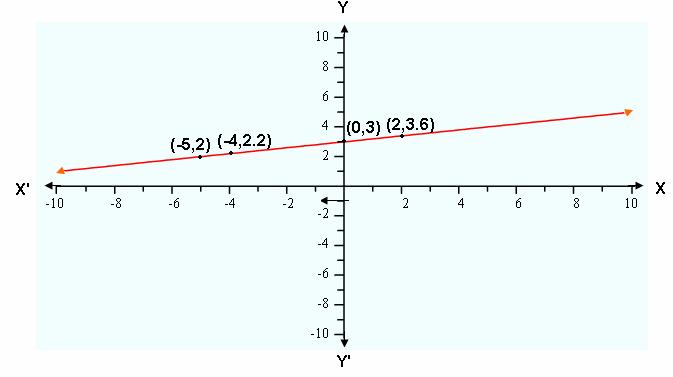
Let us find the solutions in ordered pair in the form of table as follows:
X
0
-5
2
-4
Y
3
2
3.6
2.2
Q44. Which of the following pair is a solution of the equation 2x - 3y = 7
Solution
LHS:
2(5) - 3(1)
= 10 - 3
= 7 = RHS
(5,1) is the solution of the equation 2x - 3y = 7.
Q45. Ashish and Deepak contribute for a charity.
The contribution of Ashish is  the contribution
of Deepak. Write a linear equation to represent the above and drawn the
graph. From the graph, find the contribution of Ashish if Deepak contributes
Rs. 50.
the contribution
of Deepak. Write a linear equation to represent the above and drawn the
graph. From the graph, find the contribution of Ashish if Deepak contributes
Rs. 50.
the contribution
of Deepak. Write a linear equation to represent the above and drawn the
graph. From the graph, find the contribution of Ashish if Deepak contributes
Rs. 50.Solution
y=
 x
10
20
50
y
4
8
20
x
10
20
50
y
4
8
20
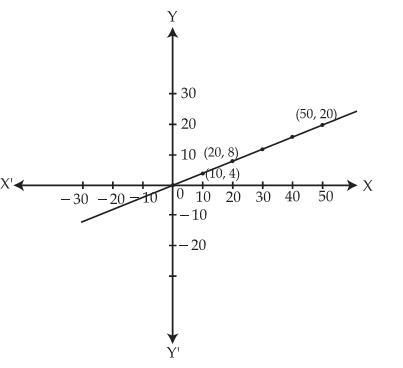 From
the graph, contribution of Ashish when Deepak contributes Rs 50 = Rs 20
From
the graph, contribution of Ashish when Deepak contributes Rs 50 = Rs 20
x
10
20
50
y
4
8
20
From
the graph, contribution of Ashish when Deepak contributes Rs 50 = Rs 20
Q46. Find the coordinates of the points where
the line 2x - y = 3 meets both the axis.
Solution
On
x axis, y = 0
 2x - 0 = 3
 On
y axis, x = 0
0 - y = 3
y = -3
Point
= (0,-3)
Therefore,
required points are
On
y axis, x = 0
0 - y = 3
y = -3
Point
= (0,-3)
Therefore,
required points are  and (0, -3).
2x - 0 = 3
On
y axis, x = 0
0 - y = 3
y = -3
Point
= (0,-3)
Therefore,
required points are and (0, -3).
Q47. Solve the equation 2x + 1 = x - 3 and
represent the solution on:
(i) The number line
(ii) The Cartesian plane.
Solution
2x
+ 1 = x- 3
2x
- x = -3 - 1
x
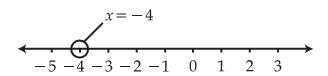
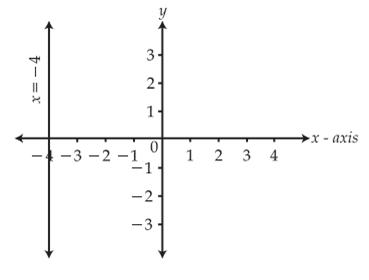
= -4
(i)
Representation on number line
 (ii)
Representation on Cartesian plane
(ii)
Representation on Cartesian plane
(ii)
Representation on Cartesian plane
Q48. Draw the graph of the equation 3x + 4y = 12
and find the coordinates of the points of intersection of the graph with
axes.
Solution
3x
+ 4y = 12
x
0
2
4
6
y
3
1.5
0
-1.5
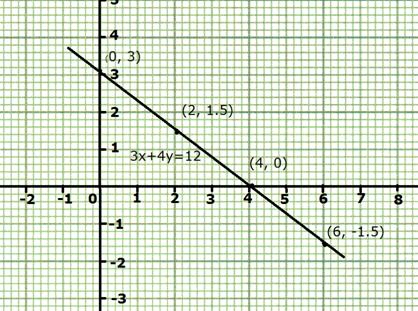 Co-ordinates
of point of intersection with x-axis = (4,0)
Co-ordinates
of point of intersection with y-axis = (0,3)
Co-ordinates
of point of intersection with x-axis = (4,0)
Co-ordinates
of point of intersection with y-axis = (0,3)
Co-ordinates
of point of intersection with x-axis = (4,0)
Co-ordinates
of point of intersection with y-axis = (0,3)
Q49. Solve for x:

Solution

Q50. A fraction is such that if the numerator is multiplied by 3 and the denominator is reduced by 3, we get 18/11. Write linear equation to represent this information.
Solution
Let the numerator be x and the denominator be y
Numerator is multiplied by 3=3x
Denominator is reduced by 3=y-3
New fraction formed=

Q51. From the choices given below, choose the
equation whose graph is given in figure
 (a) 2x + y = 6 (B) y = 2x+ 4
(c) 2 (x- 1) + 3y = 4 (D) 2x - 3y = 6
(a) 2x + y = 6 (B) y = 2x+ 4
(c) 2 (x- 1) + 3y = 4 (D) 2x - 3y = 6
(a) 2x + y = 6 (B) y = 2x+ 4
(c) 2 (x- 1) + 3y = 4 (D) 2x - 3y = 6Solution
For
(-3, 4)
(a)
2x + y = 6
LHS = 2(- 3) + 4
= -6 + 4 = -2
-2  6
(b)
y = 2x + 4
4 = 2(-3) + 4
4 -6 + 4
(c)
2 (x - 1) + 3y = 4
2(-3-1)
+ 3(4) = 4
2(-4) + 12 = 4
-8 + 12 = 4
4 = 4
(d) 2x - 3y = 6
2(-3) -3(4) 6
Since,
(-3, 4) is solution of 2(x-1) + 3y = 4
6
(b)
y = 2x + 4
4 = 2(-3) + 4
4 -6 + 4
(c)
2 (x - 1) + 3y = 4
2(-3-1)
+ 3(4) = 4
2(-4) + 12 = 4
-8 + 12 = 4
4 = 4
(d) 2x - 3y = 6
2(-3) -3(4) 6
Since,
(-3, 4) is solution of 2(x-1) + 3y = 4
 Given graph is of
equation 2 (x - 1) + 3y = 4
Given graph is of
equation 2 (x - 1) + 3y = 4
6
(b)
y = 2x + 4
4 = 2(-3) + 4
4 -6 + 4
(c)
2 (x - 1) + 3y = 4
2(-3-1)
+ 3(4) = 4
2(-4) + 12 = 4
-8 + 12 = 4
4 = 4
(d) 2x - 3y = 6
2(-3) -3(4) 6
Since,
(-3, 4) is solution of 2(x-1) + 3y = 4
Given graph is of
equation 2 (x - 1) + 3y = 4
Q52. The graph of the equation of the form y=mx is a line which always passes through:
Solution
(0, 0).
The equation of a straight line with gradient m passing through the origin is given by y = mx.
Q53. Express the equation 5x = -y in the general
form and indicate the values of a, b and c.
Solution
5x
= -y
 5x + y = 0
Comparing
this equation with general form ax + by + c = 0, we have:
a
= 5, b = 1, c = 0
5x + y = 0
Comparing
this equation with general form ax + by + c = 0, we have:
a
= 5, b = 1, c = 0
5x + y = 0
Comparing
this equation with general form ax + by + c = 0, we have:
a
= 5, b = 1, c = 0
Q54. Solve for x : 
Solution
Solve

 6(13x- 47) = 30(x - 5)
13x - 47 = 5(x - 5)
13x - 47 = 5x - 25
13x - 5x = -25 + 47
8x = 22
6(13x- 47) = 30(x - 5)
13x - 47 = 5(x - 5)
13x - 47 = 5x - 25
13x - 5x = -25 + 47
8x = 22

6(13x- 47) = 30(x - 5)
13x - 47 = 5(x - 5)
13x - 47 = 5x - 25
13x - 5x = -25 + 47
8x = 22
Q55. Express y in terms of x from the equation
3x + 2y = 8 and check whether the point (4, -2) lies on the line.
Solution
2y
= 8 - 3x
 For
pt. (4, -2)
3
For
pt. (4, -2)
3
 4 + 2 (-2) = 8
12
- 4 = 8
8
= 8
L.H.S.
= R.H.S.
4 + 2 (-2) = 8
12
- 4 = 8
8
= 8
L.H.S.
= R.H.S.
 (4, -2) lies on the line
For
pt. (4, -2)
3
4 + 2 (-2) = 8
12
- 4 = 8
8
= 8
L.H.S.
= R.H.S.
(4, -2) lies on the line
Q56. A and B are two friends. A is elder to B by
5 years. B's sister C is half the age of B while A's father D is 8 years
older than twice the age of B. If the present age of D is 48 years, find the
present ages of A, B and C.
Solution
Let
the age of the sister C be x years
Age
of B = 2x years
Age
of A = (2x + 5) years
Age
of D, A's father = [2
(2x) + 8]
= 4x + 8
According
to the question:
4x + 8 = 48
 x
= 10
Therefore,
Age
of C = x = 10 yrs
Age
of B = 2x = 20 yrs
Age
of A = 2x + 5 = 25 yrs.
x
= 10
Therefore,
Age
of C = x = 10 yrs
Age
of B = 2x = 20 yrs
Age
of A = 2x + 5 = 25 yrs.
x
= 10
Therefore,
Age
of C = x = 10 yrs
Age
of B = 2x = 20 yrs
Age
of A = 2x + 5 = 25 yrs.
Q57. The sum of the 10% of one number and 20% of the other number is equal to the 5 more then the 15% of the sum of two numbers.
Write a linear equation in two variables to represent above statement .
Solution
Let the first number be x
Let the second number be y
10% of first number= 20% of second number=
 According to the given information

20% of second number=
According to the given information
Q58. Given geometric representation of x + 3 = 0
as an equation
(i) in one variable
(ii) in two variables.
Solution
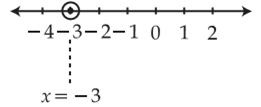
(i)
x + 3 = 0  x= -3
x= -3
 (ii)
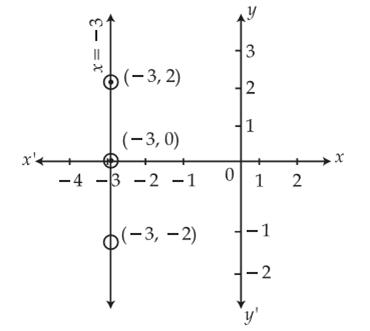
x + 3 = 0 can be written as 1x + 0y + 3 = 0
x
-3
-3
-3
y
-2
0
2
(ii)
x + 3 = 0 can be written as 1x + 0y + 3 = 0
x
-3
-3
-3
y
-2
0
2
x= -3
(ii)
x + 3 = 0 can be written as 1x + 0y + 3 = 0
x
-3
-3
-3
y
-2
0
2
Q59. Sita bought 18 apples for Rs 45 and 12 oranges for Rs 25.
What will be the linear equation of above statement ?
Solution
Let the apple be denoted by A Oranges be denoted by O.
Sita bought 18 apples which is equal to 18A and 12 oranges which is equal to 12O
Total cost of 18 apples and 12 oranges=Rs45+Rs25=Rs70
Thus, the given information can be represented as a linear equation as:
18A+12O=70
Q60. Find the value of ‘ k’ if x=1 and y= is a solution of the equation
 ?
?
is a solution of the equation
?Solution
Substituting x=1 and y= in above equation we get

Q61. Find four solutions of the following linear
equation in two variables.
2 (x + 3) -3 (y - 1) = 0
Solution
2
(x + 3) -3 (y - 1) = 0
2x
+ 6 - 3y + 3 = 0
2x
- 3y = -9
Solutions
can be calculated as below:
(i)
When x = 0, we have:
-3y = -9
y = 3
(x, y) = (0, 3)
(ii)
When y = 0, we have:
2x = -9
x = -4.5
(x, y) = (-4.5, 0)
(iii)
When y = 1, we have:
2x - 3 = -9
2x = -6
x
= -3
(x, y) = (-3, 1)
(iv)
When y = -1, we have:
2x - (-3) = -9
2x + 3 = -9
2x = -12
x = -6
(x, y) = (-6, -1)
The
four solutions of the given equation are (0, 3), (-4.5, 0), (-3, 1), (-6, -1).
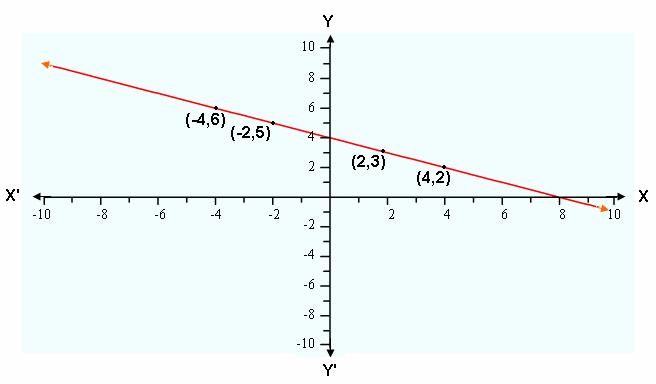
Q62. The sum of the twice the first number and thrice of the second number is equal to the 12 more than the fifty percent of first number.
Represent the above information in the form of linear equation and also draw the graph
Solution
Let the first number be x
Second number be y
According to the given information we have
 Let us plot the graph of the equation
  Let us find the solutions in ordered pair in the form of table as follows:
X
4
-2
2
4
Y
6
5
3
2
Let us find the solutions in ordered pair in the form of table as follows:
X
4
-2
2
4
Y
6
5
3
2
Let us plot the graph of the equation
Let us find the solutions in ordered pair in the form of table as follows:
X
4
-2
2
4
Y
6
5
3
2
Q63. Two pens and three pencils together cost
Rs. 20. Represent this statement as a linear equation in two variables and
given two solutions for it. Also verify if (4,2) is a solution of the
equation formed.
Solution
Let
cost of pen be x.
And
cost of pencil by y.
 2x + 3y = 20
Put x = 2
2x
+ 3y = 20
2(2)
+ 3y = 20
4
+ 3y = 20
3y
= 16
y
=
2x + 3y = 20
Put x = 2
2x
+ 3y = 20
2(2)
+ 3y = 20
4
+ 3y = 20
3y
= 16
y
=  (x,
y) = (2,
(x,
y) = (2,  )
Put x = 3
2x
+ 3y = 20
2(3)
+ 3y = 20
6
+ 3y = 20
3y
= 14
y
=
)
Put x = 3
2x
+ 3y = 20
2(3)
+ 3y = 20
6
+ 3y = 20
3y
= 14
y
=  (x,
y) = (3,
(x,
y) = (3,  )
Put x = 4 and y = 2
LHS
= 2
)
Put x = 4 and y = 2
LHS
= 2 4 + 32 = 8 + 6 = 14
  20
(4,
2) is not a solution of the given equation.
20
(4,
2) is not a solution of the given equation.
2x + 3y = 20
Put x = 2
2x
+ 3y = 20
2(2)
+ 3y = 20
4
+ 3y = 20
3y
= 16
y
=
(x,
y) = (2, )
Put x = 3
2x
+ 3y = 20
2(3)
+ 3y = 20
6
+ 3y = 20
3y
= 14
y
=
(x,
y) = (3, )
Put x = 4 and y = 2
LHS
= 24 + 32 = 8 + 6 = 14 20
(4,
2) is not a solution of the given equation.
Q64. Solve for x:

Solution

Q65. If (2,- 5) point is given, find the equation of a line on which it lies. How many such equations are there? Draw the graph of one such equation.
Solution
There are infinitely many linear equations which are satisfied by the coordinates of the point (2,- 5).
For example, line passing through the point (2,- 5) are satisfied by some of the Linear equations are as follows:
 Let us draw the graph of the equation
  .
Simplify the equation
.
Simplify the equation  we get
 Let us find the solutions in ordered pair in the form of table as follows:
X
-4
-2
2
0
4
Y
10
5
-5
0
-10
Let us find the solutions in ordered pair in the form of table as follows:
X
-4
-2
2
0
4
Y
10
5
-5
0
-10
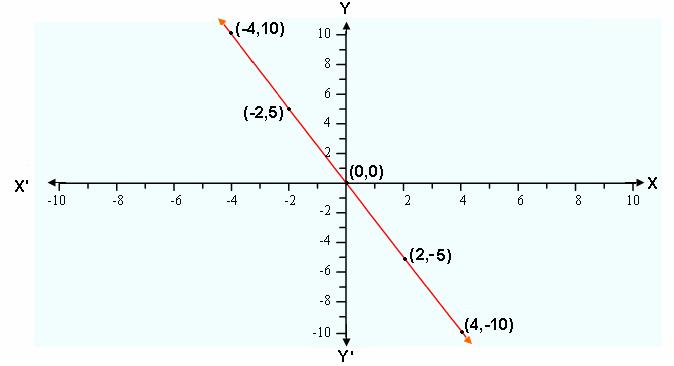
Let us draw the graph of the equation .
Simplify the equation we get
Let us find the solutions in ordered pair in the form of table as follows:
X
-4
-2
2
0
4
Y
10
5
-5
0
-10
Q66. Express y in terms x in equation 2x - 3y =
12. Find the points where the line represented by this equation cuts x-axis
and y-axis.
Solution
2x
- 3y = 12
3y
= 2x - 12
 On
x-axis
On
x-axis 
 (6,0)
is the point where the line will cut the x - axis.
On
y-axis
(6,0)
is the point where the line will cut the x - axis.
On
y-axis  x = 0
x = 0
 (0,
-4) is the point where the line will cut the y- axis.
(0,
-4) is the point where the line will cut the y- axis.
On
x-axis
(6,0)
is the point where the line will cut the x - axis.
On
y-axis x = 0
(0,
-4) is the point where the line will cut the y- axis.
Q67. John age is 10 years less than three times his son’s age. If John son is 20 years old, then how old is John?
Solution
Let us assume that John age is x years and his son’s age is y years.
A linear equation in two variables can be formed to represent the given statement as
x = 3y – 10
We know that the age of John’s son is 20 years. This implies that the value of y is 20.
Substituting this value of y in the equation x = 3y – 10, we get:
x = 3 × 20 – 10
Þ x = 60 – 10
Þ x = 50
Thus, John’s age is 50 years.
Q68. 4 years ago, age of a mother was 3 times
the age of her daughter. Write a linear equation to represent this situation
and draw its graph.
Solution
Let
present age of daughter be x years.
4
years ago age of daughter was (x - 4) years
Let present age of mother be y years.
 Mother's age, 4 years ago = (y - 4) years
According to the question:
y - 4 = 3(x - 4)
Mother's age, 4 years ago = (y - 4) years
According to the question:
y - 4 = 3(x - 4)
 y - 4 = 3x - 12
3x -
y = 8
x
1
2
3
y
-5
-2
1
y - 4 = 3x - 12
3x -
y = 8
x
1
2
3
y
-5
-2
1
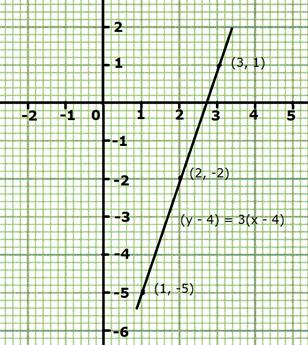
Mother's age, 4 years ago = (y - 4) years
According to the question:
y - 4 = 3(x - 4)
y - 4 = 3x - 12
3x -
y = 8
x
1
2
3
y
-5
-2
1
Q69. Draw the graphs of the equations x + y - 10
= 0 and x - y + 4 = 0 on the same graph paper.
Solution
For
x + y - 10 = 0
x
1
2
3
y
9
8
7
For
x - y + 4 = 0
x
6
2
1
y
10
6
5
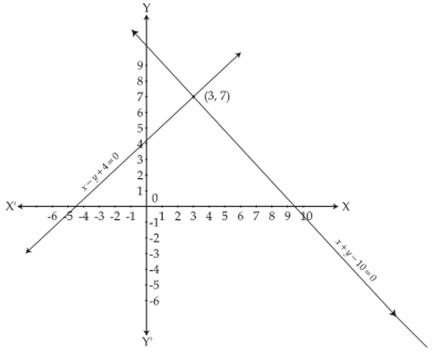
Q70. One tenth of the number is equivalent to 20 more than the 10% of the other number. Represent this information in the equivalent linear equation of two variables
Solution
Let the one number be x
Let the other number be y
According to the given information,

Q71. Solve the following equation:

Solution
 4x
-4 - 3x + 6 = 12
x + 2 = 12
x = 12 - 2 = 10
4x
-4 - 3x + 6 = 12
x + 2 = 12
x = 12 - 2 = 10
Q72. If one of the angle of the triangle is equal to the sum of the other two angles .Express this information into equivalent linear equation of two variables
and also find the angles of triangle id measure of one of the angle is 60 degree.
Solution
Let the first angle = x
Let the second angle=y
According to the given information, Third angle=x+y
We know that sum of angles in a triangle is equal to 180 degree.
So,
X+y+(x+y)=180
2x+2y=180
X+y=90 (i)
Now measure of one angle=60 degree.
Substituting in (i) we get
60+y=90
y=90-60=30
Third angle=x+y=60+30=90
Thus angles of triangle are 60, 30 and 90 degrees
Q73. Draw the graphs of each of the equation x -
2y - 3 = 0 and 4x + 3y - 1 = 0 on the same graph.
Solution
x
- 2y - 3 = 0
x
5
1
3
y
1
-1
0
4x
+ 3y - 1 = 0
x
-2
1
-5
y
3
-1
7
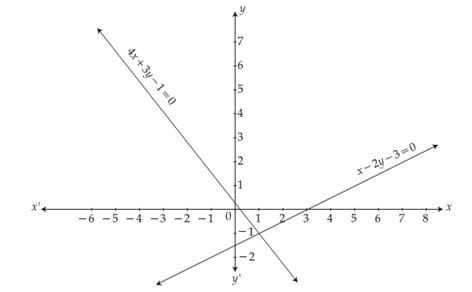
Comments
Post a Comment