Q1. Which one of the following statement is true?
Solution
Statement (A) is incorrect as through a single point infinite number of lines can pass.
Statement (B) is incorrect as through 2 distinct points, one and only one line can pass which contains both the points.
Statement (D) is incorrect as, if the 2 circles are equal then their radii are also equal.
Statement (C) is correct i.e. 2 distinct lines cannot have more than one point in common.
Q2. How many points can be common in two distinct straight lines?
Solution
Two distinct lines can intersect only at one point.
Hence there can be only one point common to the two distinct lines.
Q3. The things which are double of same things are:
Solution

Q4. A proof is required for:
Solution
Theorem
Q5. 'Two intersecting lines cannot be parallel to the same line' is stated in the form of:
Solution
A postulate
Q6. The number of line segments determined by three collinear points is:
Solution
Three non-collinear points determines three line segments.
Q7. A surface is that which has
Solution
A surface is that which has both length and breadth.
Q8. If the point P lies in between M and N and C is midpoint of MP then:
Solution
MC + CN = MN
Q9. 'Lines are parallel if they do not intersect' - is stated in the form of:
Solution
A definition
Q10. How does Euclid's fifth postulate imply the existence of parallel lines? Give a mathematical proof.
Solution
Euclid's 5th postulate states that:
If a straight line falling on two straight lines makes the interior angles on the same side of it taken together less than two right angles, then the two straight lines, if produced indefinitely, meet on that side on which the sum of angles is less than two right angles.
This implies that if n intersects lines l and m and if  . In that case, producing line l and m further will meet in the side of
 1 and 2 which is less than 180o
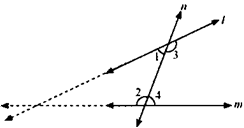 If
If  In that case, the lines l and m neither meet at the side of 1 and 2 nor at the side of 3 and 4.
Implying that the lines l and m will never intersect each other.
Therefore, the lines are parallel.
In that case, the lines l and m neither meet at the side of 1 and 2 nor at the side of 3 and 4.
Implying that the lines l and m will never intersect each other.
Therefore, the lines are parallel.
. In that case, producing line l and m further will meet in the side of1 and 2 which is less than 180o
If
In that case, the lines l and m neither meet at the side of 1 and 2 nor at the side of 3 and 4.
Implying that the lines l and m will never intersect each other.
Therefore, the lines are parallel.
Q11. Define:
(A) line segment
(B) radius of a circle
Solution
(A) A line segment is a part of line between two points.
(B) Radius of a circle is defined as the distance between center and a point on its circumference.
Q12. Define : (A) a
square
(B) Perpendicular lines
Solution
Square
- A square is a rectangle with a pair of consecutive sides equal.
Perpendicular
lines - Two lines are perpendicular, if the angle between them is 90o.
Q13. In
figure, AC= XD, C is midpoint of AB and D is midpoint of XY. Using a Euclid's
axiom, show that AB= XY.

Solution
AB
= 2AC (C is midpoint of AB)
XY
= 2XD (D is midpoint of XY)
Also AC = XD (Given)
Therefore,
2AC = 2 XD
Hence,
AB = XY
because
things which are double of same things are equal to one another.
Q14. Which of the following is an example of a geometrical line?
Solution
Meeting place of two walls is an example of a geometrical line.
Q15. Prove
that every line segment has one and only one midpoint.
Solution
Suppose C and C' are two mid points of segment
AB
Then AC =  AB
and AC' = AB
AC = AC' [Things which are equal to the same
thing are equal to one another.]
This is possible only when C and C' coincide.
Hence every line segment has one and only one
midpoint.
AB
and AC' = AB
AC = AC' [Things which are equal to the same
thing are equal to one another.]
This is possible only when C and C' coincide.
Hence every line segment has one and only one
midpoint.
AB
and AC' = AB
AC = AC' [Things which are equal to the same
thing are equal to one another.]
This is possible only when C and C' coincide.
Hence every line segment has one and only one
midpoint.
Q16. 
Solution
(i) Only one(ii) Only one(iii) NoneBecause, the axiom to Euclid's Postulate 2 states that: Given two distinct points, there is a unique line that passes through them.
Q17. If
a point C lies between two points A and B such that AC = BC, then prove that
AC =  AB. Explain by drawing the figure.
AB. Explain by drawing the figure.Solution
Given :AC = BC
 Add AC to both sides
AC + AC = BC + AC
(If equals are added to equals, the wholes are
equal)
Add AC to both sides
AC + AC = BC + AC
(If equals are added to equals, the wholes are
equal) 2AC
= AB
Hence, AC = AB
2AC
= AB
Hence, AC = AB
Add AC to both sides
AC + AC = BC + AC
(If equals are added to equals, the wholes are
equal)
2AC
= AB
Hence, AC = AB
Q18. In
figure, if PS = RQ then prove that PR = SQ.

Solution
In
fig., we have PS = RQ
 PR + RS = RS + SQ
By
subtracting, RS, we get
PR
= SQ
Hence
proved.
PR + RS = RS + SQ
By
subtracting, RS, we get
PR
= SQ
Hence
proved.
PR + RS = RS + SQ
By
subtracting, RS, we get
PR
= SQ
Hence
proved.
Q19. If x > y then, there exists a z such that x = y + z. What is the condition on z? State the postulate to which this statement corresponds.
Solution

Q20. 
Solution
Let l and m be two lines intersecting at point A Let us suppose they intersect at one more point Bi.e l and m pass through two distinct points A and B.But, the Euclid's Postulate 2 states that: Given two distinct points, there is a unique line that passes through them. So, our supposition is incorrectTherefore, two distinct lines can not have more than one point in common.
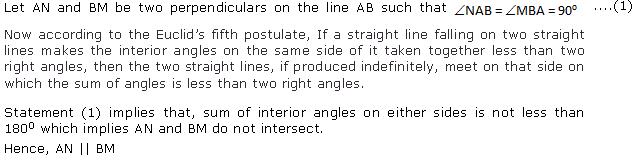
Q21. By using the Euclid's postulates and Axioms, show that two lines perpendicular to the same lines are parallel to each other.
Solution
Comments
Post a Comment