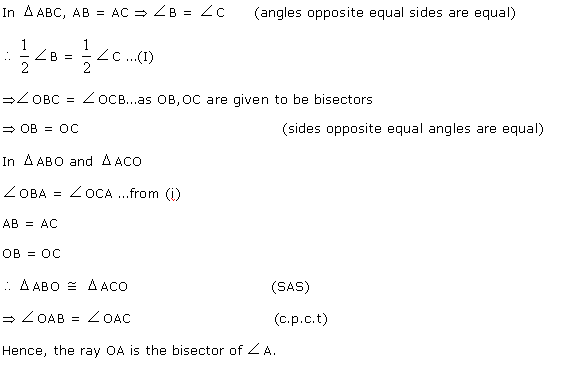
Q1. Prove that the sum of any two sides of a triangle is greater than twice the length of median drawn to the third side.
Solution
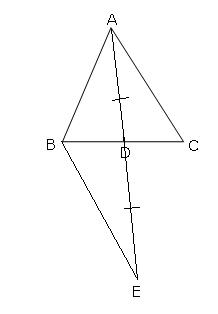 Given: In triangle ABC, AD is the median drawn from A to BC.
To prove: AB + AC > AD
Construction: Produce AD to E so that DE = AD, Join BE.
Proof:
Now in
Given: In triangle ABC, AD is the median drawn from A to BC.
To prove: AB + AC > AD
Construction: Produce AD to E so that DE = AD, Join BE.
Proof:
Now in  ADC and EDB,
AD = DE (by const)
DC = BD(as D is mid-point)
ADC and EDB,
AD = DE (by const)
DC = BD(as D is mid-point)
 ADC = EDB (vertically opp. s)
Therefore,
In ABE, ADC
ADC = EDB (vertically opp. s)
Therefore,
In ABE, ADC  EDB(by SAS)
This gives, BE = AC.
AB + BE > AE
AB + AC > 2AD (
EDB(by SAS)
This gives, BE = AC.
AB + BE > AE
AB + AC > 2AD ( AD = DE and BE = AC)
Hence the sum of any two sides of a triangle is greater than the median drawn to the third side.
AD = DE and BE = AC)
Hence the sum of any two sides of a triangle is greater than the median drawn to the third side.
Q2. If  then which of the following is true:
then which of the following is true:Solution
By CPCT, CA = RP
Q3. In
figure, if AB = AD,  x = w and y = z then prove that AP = AQ.

x = w and y = z then prove that AP = AQ.
Solution
Given:
ABCD is a quadrilateral; Q and P are
point on DC and BC respectively.
To
prove: AP = AQ
Proof
: Since, w = x and y = z
Adding, we get
w
+ z = x + y
 DAC = BAC
In
DAC = BAC
In
 ADC and BAC
 In
QAC and PAC
In
QAC and PAC
 Hence
AP = AQ.
Hence
AP = AQ.
w = x and y = z
Adding, we get
w
+ z = x + y
DAC = BAC
In
ADC and BAC
In
QAC and PAC
Hence
AP = AQ.
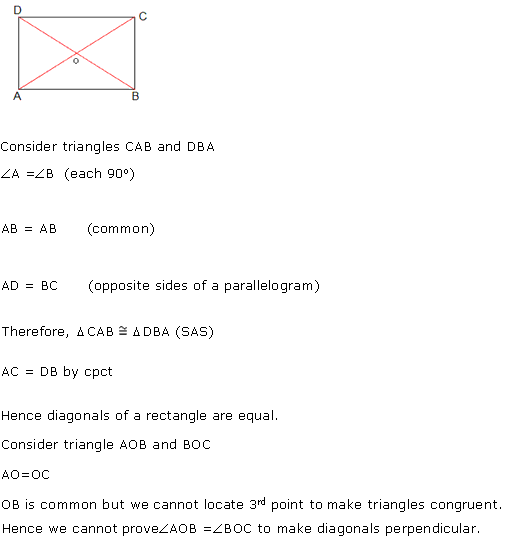
Q4. Prove that diagonals of a rectangle are equal but not perpendicular.
Solution
Q5. Two equilateral triangles are congruent when:
Solution
Their sides are equal
Q6. In figure, AC = AE, AB = AD and  BAD = EAC show that BC = DE.

BAD = EAC show that BC = DE.
Solution
Given: AC = AE, AB = AD and BAD = EAC
To prove: BC = DE
Proof:BAD = EAC (given)
 BAD + DAC = EAC + DAC
BAC = DAE
Now
BAD + DAC = EAC + DAC
BAC = DAE
Now  ABC and ADE

BAD = EAC
To prove: BC = DE
Proof:BAD = EAC (given)
BAD + DAC = EAC + DAC
BAC = DAE
Now ABC and ADE
Q7. Given  OAP
OAP  OBP in below figure, the criteria by which the triangles are congruent:

OAP OBP in below figure, the criteria by which the triangles are congruent:
Solution
Since two sides and included angles are equal, the criteria is SAS.
Q8. 
-
1) QR= 5 cm,
 R= 600
-
2) QP = 5 cm, P= 600
-
3) QR= 5 cm, Q= 400
-
4) QP= 5 cm, R = 600
Solution

Q9. In fig., it is given that  ABD
ABD  BAC. Name the criteria by which the triangles are congruent.

ABD BAC. Name the criteria by which the triangles are congruent.
Solution
The triangles are congruent by RHS criterion.
Q10. In figure, D and
E are points on the base BC of a  ABC such that BD = CE and AD = AE. Prove that ABE
  ACD.
ACD.
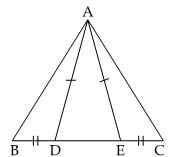
ABC such that BD = CE and AD = AE. Prove that ABE ACD.
Solution
In
ACD and ABE
AD
= AE (given)
BD
= EC (given)
 BD
+ DE = DE + EC
BE
= CD
BD
+ DE = DE + EC
BE
= CD
 ADC
= AEB (
ADC
= AEB ( AD = AE)

Q11. In  ABC, AB = AC. D is point inside ABC such that BD = DC. Prove that
  ABD = ACD.

ABC, AB = AC. D is point inside ABC such that BD = DC. Prove that ABD = ACD.
Solution
Here,
AB
= AC
 ABC = ACB (Angles
opp. to equal sides are equal)
Also,
BD = DC
DBC
= DCB
(Angles opp. to equal sides are equal)
Subtracting,
ABC
- DBC = ACB - DCB
ABC = ACB (Angles
opp. to equal sides are equal)
Also,
BD = DC
DBC
= DCB
(Angles opp. to equal sides are equal)
Subtracting,
ABC
- DBC = ACB - DCB
 ABD = ACD
ABC = ACB (Angles
opp. to equal sides are equal)
Also,
BD = DC
DBC
= DCB
(Angles opp. to equal sides are equal)
Subtracting,
ABC
- DBC = ACB - DCB
ABD = ACD
Q12. A point O is taken inside an equilateral four sided figure ABCD such that its distances from the angular points D and B are equal. Show that AO and OC are in one and the same straight line.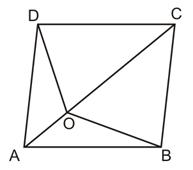
Solution
In  AOD and AOB
AD = AB (given)
AO =AO (common side)
OD = OB (given)
AOD and AOB
AD = AB (given)
AO =AO (common side)
OD = OB (given)
 AOD
AOD  AOB (SSS congruence rule)
 AOD = AOB (c.p.c.t)
Similarly, DOC BOC (SSS congruence rule)
DOC = BOC (c.p.c.t)
AOD + AOB + DOC + BOC = 360o (angles at a point)
2AOD + 2DOC = 360o
AOD + DOC = 180o
Hence, AO and OC are in one and the same straight line.
AOD = AOB (c.p.c.t)
Similarly, DOC BOC (SSS congruence rule)
DOC = BOC (c.p.c.t)
AOD + AOB + DOC + BOC = 360o (angles at a point)
2AOD + 2DOC = 360o
AOD + DOC = 180o
Hence, AO and OC are in one and the same straight line.
AOD and AOB
AD = AB (given)
AO =AO (common side)
OD = OB (given)
AOD AOB (SSS congruence rule)
AOD = AOB (c.p.c.t)
Similarly, DOC BOC (SSS congruence rule)
DOC = BOC (c.p.c.t)
AOD + AOB + DOC + BOC = 360o (angles at a point)
2AOD + 2DOC = 360o
AOD + DOC = 180o
Hence, AO and OC are in one and the same straight line.
Q13. In fig., if AC = BC,  DCA = ECB and DBC = EAC then Prove that BD = AE.
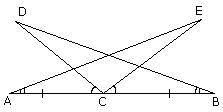
DCA = ECB and DBC = EAC then Prove that BD = AE.
Solution
Given that 

 … (i)
Now in
… (i)
Now in  DBC and EAC
 [from (i)]
BC = AC (Given)
[from (i)]
BC = AC (Given)
 (Given)
 (ASA Congruence)
Therefore, BD =AE (CPCT)
(ASA Congruence)
Therefore, BD =AE (CPCT)
Q14. In ∆ABC, AB = AC, AD = AE, ∠BAD = ∠CAE, then

Solution
In ∆ABD and ∆ACE,
AB = AC
∴ ∠ABD = ∠ACE Opposite angles of equal sides
∠BAD = ∠CAE
∆ABD ≅ ∆ACE ASA
Ar(∆ABD) = Ar(∆ACE)
Ar(∆ABD) + ar(∆ADE) = Ar(∆ACE) + ar(∆ADE)
Ar(∆ABE) = ar(∆ACD)
Q15. In ΔABC if AB = BC then:
-
1)
 A = B
A = B
-
2) B > C
-
3) A < C
-
4) A = C
Solution

Q16. If length of the largest side of a triangle is 12 cm then other two sides of triangle can be:
Solution
Since, in a triangle, the sum of two sides is greater than the third side therefore other two sides are: 4.8 cm, 8.2 cm.
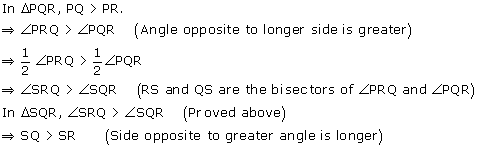
Q17. In the figure PQ > PR, QS and RS are the bisectors of  Q and R respectively. Prove that SQ > SR.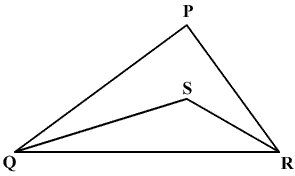
Q and R respectively. Prove that SQ > SR. Solution
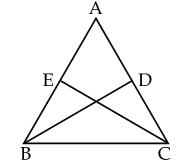
Q18. In figure, ABC is
an isosceles triangle with AB = AC, BD and CE are two medians of the
triangle, prove that BD = CE.
Solution
In
 EBC and DCB,
AB
= AC (given)
EBC and DCB,
AB
= AC (given)
 i.e.,
BE = CD
i.e.,
BE = CD
 C =
B (
C =
B ( AB = AC)
BC
= BC (common)
AB = AC)
BC
= BC (common)
 Thus, CE = BD (By c.p.c.t.)
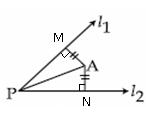
Q19. In fig., A is a point equidistant
from two lines l1 and l2 intersecting at a point P.
Show that AP bisects the angle between l1 and l2.

Solution
Given: A point A equidistant from 2 lines  intersecting at a point P.
To prove: AP bisects angle between
intersecting at a point P.
To prove: AP bisects angle between
 Proof:
In
Proof:
In  APM and APN
AM = AN (Given)
APM and APN
AM = AN (Given)
 AMP = ANP = 90o (Given)
AP=AP (Common)
AMP = ANP = 90o (Given)
AP=AP (Common)

 (RHS
congruency rule)
APM = APN
(RHS
congruency rule)
APM = APN
intersecting at a point P.
To prove: AP bisects angle between
Proof:
In APM and APN
AM = AN (Given)
AMP = ANP = 90o (Given)
AP=AP (Common)
(RHS
congruency rule)
APM = APN
Q20. 
Solution
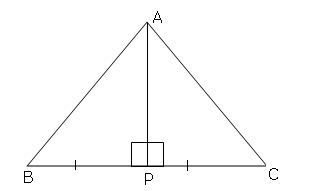
Q21. Prove
that  ABC is an isosceles triangle if median AP is perpendicular
to the base BC:
ABC is an isosceles triangle if median AP is perpendicular
to the base BC:
ABC is an isosceles triangle if median AP is perpendicular
to the base BC:Solution


Q22. In  ABC, if AB > BC then:
ABC, if AB > BC then:-
1)

 A = B
A = B
-
2) C < A
-
3) C =A
-
4) C> A
Solution
Angle opp. to bigger side is greater.
Therefore, C> A
C> A
Q23. Prove that two triangles are
congruent if any two angles and the included side of one triangle is equal to
any two angles and the included side
of the other triangle.
Solution
Given: Two triangles  ABC and DEF such that
  B = E, C = F
and BC = EF.
To prove: ABC
B = E, C = F
and BC = EF.
To prove: ABC  DEF
DEF
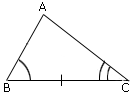
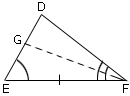 Proof:
Case I: If AB = DE then in ABC and DEF,
AB = DE [by supposition]
BC = EF [given]
and B = E [given]
Thus, ABC DEF [SAS criterion]
Case II: If AB < DE
Take a point G on ED such that EG = AB. Join GF.
In ABC and GEF, we have
AB = GE [by supposition]
BC = EF [given]
B = E [given]
Thus, ABC GEF [SAS criterion]
Proof:
Case I: If AB = DE then in ABC and DEF,
AB = DE [by supposition]
BC = EF [given]
and B = E [given]
Thus, ABC DEF [SAS criterion]
Case II: If AB < DE
Take a point G on ED such that EG = AB. Join GF.
In ABC and GEF, we have
AB = GE [by supposition]
BC = EF [given]
B = E [given]
Thus, ABC GEF [SAS criterion]
 ACB = GFE [corresponding parts of congruent
triangles are equal]
But ACB = DFE [given]
GFE = DFE,
This is only possible when FG coincides with FD or G coincides with D.
AB must be equal to DE and hence, ABC DEF (by SAS)
Case III: If AB > ED
With a similar argument (as in case II), we may conclude that
ABC
ACB = GFE [corresponding parts of congruent
triangles are equal]
But ACB = DFE [given]
GFE = DFE,
This is only possible when FG coincides with FD or G coincides with D.
AB must be equal to DE and hence, ABC DEF (by SAS)
Case III: If AB > ED
With a similar argument (as in case II), we may conclude that
ABC  DEF
(by SAS)
Thus, ABC DEF.
DEF
(by SAS)
Thus, ABC DEF.
ABC and DEF such that B = E, C = F
and BC = EF.
To prove: ABC DEF
Proof:
Case I: If AB = DE then in ABC and DEF,
AB = DE [by supposition]
BC = EF [given]
and B = E [given]
Thus, ABC DEF [SAS criterion]
Case II: If AB < DE
Take a point G on ED such that EG = AB. Join GF.
In ABC and GEF, we have
AB = GE [by supposition]
BC = EF [given]
B = E [given]
Thus, ABC GEF [SAS criterion]
ACB = GFE [corresponding parts of congruent
triangles are equal]
But ACB = DFE [given]
GFE = DFE,
This is only possible when FG coincides with FD or G coincides with D.
AB must be equal to DE and hence, ABC DEF (by SAS)
Case III: If AB > ED
With a similar argument (as in case II), we may conclude that
ABC DEF
(by SAS)
Thus, ABC DEF.
Q24. In
figure, AC= AE, AB= AD and  BAD = EAC. Prove that BC= DE.

BAD = EAC. Prove that BC= DE.
Solution
Join
DE
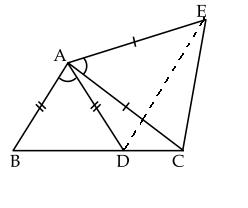

 --------- (i)

 BC
= DE (CPCT)
BC
= DE (CPCT)
--------- (i)
BC
= DE (CPCT)
Q25. 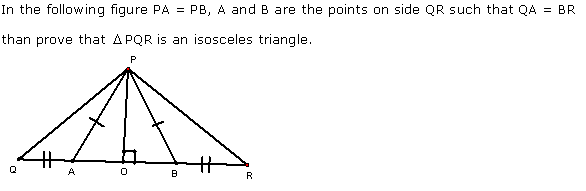
Solution
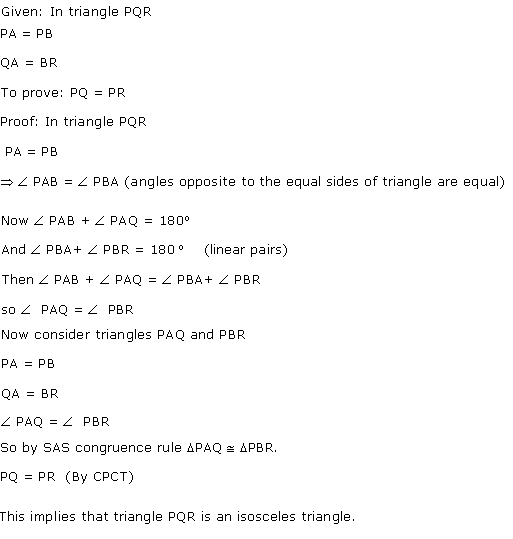
Q26. In figure, D is
the mid-point of base BC, DE and DF are perpendiculars to AB and AC
respectively such that DE = DF. Prove that  B = C.

B = C.
Solution
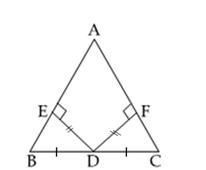 In
In
 BED and CFD
BED
= DFC = 90o
BD = DC
(D is the mid-point of BC)
ED = FD (given)
BED and CFD
BED
= DFC = 90o
BD = DC
(D is the mid-point of BC)
ED = FD (given)
 B =
C (By c.p.c.t)
B =
C (By c.p.c.t)
Q27. In
figure, AP and DP are bisectors of two adjacent angles A and D of a
quadrilateral ABCD. Prove that 2 APD = B + C.

APD = B + C.
Solution
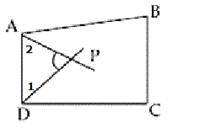





 APD =
APD =  (B +C)
2[APD] = B + C
(B +C)
2[APD] = B + C
Q28. If AD is the bisector of  A of
A of  ABC, show that AB > DB.
A of ABC, show that AB > DB.Solution
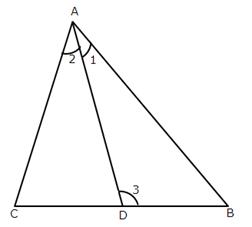 Given: AD is the bisector of A
To prove: AB > DB.
Proof : Since AD is bisector,
Given: AD is the bisector of A
To prove: AB > DB.
Proof : Since AD is bisector,  But 3 > 2
 3 > 1
So, AB > DB (side opp. to greater angle is larger).
3 > 1
So, AB > DB (side opp. to greater angle is larger).
Q29. In
figure, AB = BC, AD = EC. Prove that  ABE
ABE  CBD.
CBD.

ABE CBD.
Solution
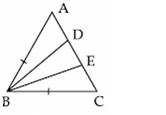 AD = EC (Given)
Adding DE both side
AD + DE = EC + DE
AE = CD
In
AD = EC (Given)
Adding DE both side
AD + DE = EC + DE
AE = CD
In  ABE and DBC
BA = BC (given)
ABE and DBC
BA = BC (given)
 A = C (angles opposite to equal sides are equal)
AE = CD
(by (i))
A = C (angles opposite to equal sides are equal)
AE = CD
(by (i))
 ABE
ABE  DBC [by SAS]
Q30. In figure, D is a point on side BC of  such that AD=AC. Show AB>AD.
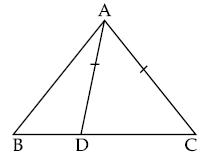
such that AD=AC. Show AB>AD.
Solution

Q31. In
figure,  QPR = PQR and M and N are respectively points on sides QR
and PR of
QPR = PQR and M and N are respectively points on sides QR
and PR of  PQR, such that QM = PN. Prove that OP = OQ, where O is the
point of intersection of PM and QN.
PQR, such that QM = PN. Prove that OP = OQ, where O is the
point of intersection of PM and QN.

QPR = PQR and M and N are respectively points on sides QR
and PR of PQR, such that QM = PN. Prove that OP = OQ, where O is the
point of intersection of PM and QN.
Solution


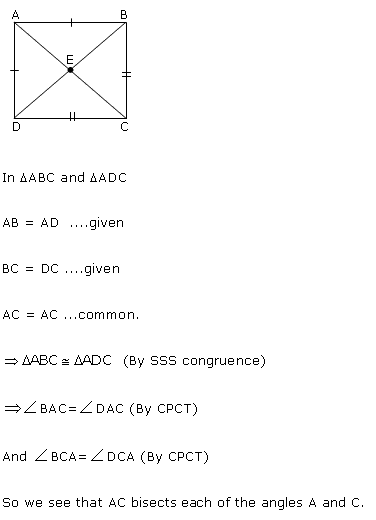
Q32. ABCD is a quadrilateral in which AB = AD, BC = DC. AC and BD intersect at E. Prove that, AC bisects each of the angles A and C.
Solution
Q33. In  ABC, D is the midpoint of BC. The perpendiculars from
D to AB and AC are equal. Prove that ABC is isosceles.
ABC, D is the midpoint of BC. The perpendiculars from
D to AB and AC are equal. Prove that ABC is isosceles.
ABC, D is the midpoint of BC. The perpendiculars from
D to AB and AC are equal. Prove that ABC is isosceles.Solution
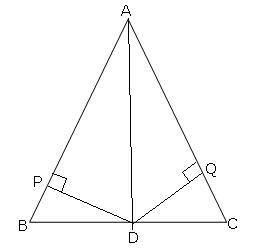 Given:
D is the midpoint of BC and PD = DQ
To
prove: ABC is isosceles
Proof:
In
BDP and CDQ
BD = DC
(D is mid-point)
PD = QD
(given)
Given:
D is the midpoint of BC and PD = DQ
To
prove: ABC is isosceles
Proof:
In
BDP and CDQ
BD = DC
(D is mid-point)
PD = QD
(given)
 BPD = CQD (each 90
degrees)
Therefore, BDP
BPD = CQD (each 90
degrees)
Therefore, BDP  CDQ (By RHS)
So, BP = CQ
… (1) (By CPCT)
Again
in APD and AQD
AD = AD
(common)
PD = QD
(given)
APD = AQD (each 90
degrees)
Therefore, APD AQD (By RHS)
So, PA = QA
… (2) (By CPCT)
Adding (1) and (2), we get
BP + PA = CQ + QA
Or, AB = AC.
CDQ (By RHS)
So, BP = CQ
… (1) (By CPCT)
Again
in APD and AQD
AD = AD
(common)
PD = QD
(given)
APD = AQD (each 90
degrees)
Therefore, APD AQD (By RHS)
So, PA = QA
… (2) (By CPCT)
Adding (1) and (2), we get
BP + PA = CQ + QA
Or, AB = AC.
Q34. In the given figure,  ABD = 130° and EAC = 120°. Prove that AB > AC.
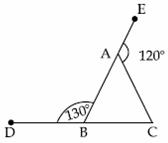
ABD = 130° and EAC = 120°. Prove that AB > AC.
Solution
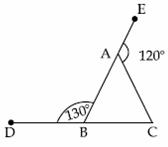 1300+
1300+ ABC = 1800[linear pair]
 ABC = 180o-130o = 50o ….(i)
In
ABC = 180o-130o = 50o ….(i)
In  ABC, side BA is extended to E
So EAC = ABC+ACB (exterior angle is equal to the sum of pair ofinterior opposite angles)
ACB = 1200 - 500 = 700
InABC,ACB> ABC
Thus, AB>AC [side opposite to greater angle is larger]
ABC, side BA is extended to E
So EAC = ABC+ACB (exterior angle is equal to the sum of pair ofinterior opposite angles)
ACB = 1200 - 500 = 700
InABC,ACB> ABC
Thus, AB>AC [side opposite to greater angle is larger]
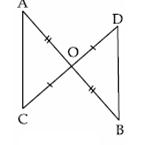
Q35. In
fig., O is the mid-point of AB and CD. Prove that AC = BD.
Solution
OB= OA (O is the mid-point of AB)
 OC=OD (O is the mid-point of CD)
By SAS rule,
OC=OD (O is the mid-point of CD)
By SAS rule,


Q36. In a ΔDEF, if  D = 30° E = 60° then which side of the triangle is longest and which side is shortest?
D = 30° E = 60° then which side of the triangle is longest and which side is shortest?Solution
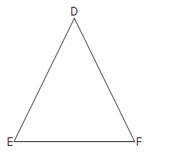 In
In  DEF,
DEF,
 D + E + F = 180o(Angle sum property)
 30o + 60o +F = 180o
F = 90o
F = 90o is the largest angle
30o + 60o +F = 180o
F = 90o
F = 90o is the largest angle DE is longest side
D = 30o is the smallest angle EF is smallest side
DE is longest side
D = 30o is the smallest angle EF is smallest side
Q37. In fig., if AB = AC and PB = QC, then by which congruence criterion  PBC
PBC QCB
QCB

PBCQCB
Solution
In PBCand QCB
PB = QC(given)
 B = C(as AB = AC)
BC = BC(common)
Therefore, PBCQCB(by SAS)
B = C(as AB = AC)
BC = BC(common)
Therefore, PBCQCB(by SAS)
PBCand QCB
PB = QC(given)
B = C(as AB = AC)
BC = BC(common)
Therefore, PBCQCB(by SAS)
Q38. In triangle ABC, AD is a median. BL and CM are perpendiculars on the median (or the median extended). Prove that BL = CM.
Solution
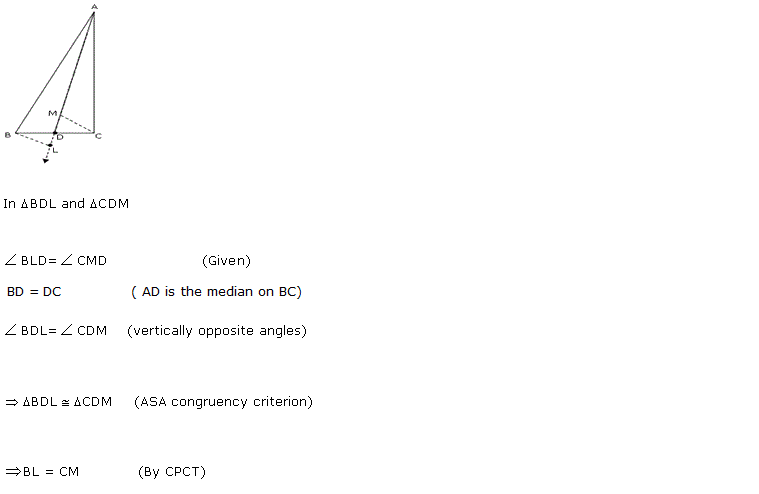
Q39. In  ABC, if
  A = 50o and B = 60o, then the greatest side is:
ABC, if A = 50o and B = 60o, then the greatest side is:Solution
Third C = 180o - 50o - 60o = 70o
Since C is largest, so the side opposite to C that is AB is greatest.
C = 180o - 50o - 60o = 70o
Since C is largest, so the side opposite to C that is AB is greatest.
Q40. In fig., D is any point on the base BC produced of an isosceles triangle  ABC. Prove that AD > AB.
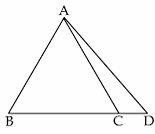
ABC. Prove that AD > AB.
Solution
Given: D is any point on the base BC produced of an isosceles triangle ABC.
To prove: AD > AB
Proof : AB = AC (Since, ABC is an isosceles triangle)

 ABC = ACB(angles opposite equal sides are equal)
In
ABC = ACB(angles opposite equal sides are equal)
In  ACD, ext ACB > ADC

ABC = ACB(angles opposite equal sides are equal)
In ACD, ext ACB > ADC
Q41. In a triangle ABC, AB = 3 cm, BC = 3.5 cm and CA = 6.5 cm. Is it possible to construct this triangle? Give reason for your answer.
Solution
The construction of the triangle with the given sides is not possible as the sum of any two sides must be greater than the third side, which is not true in this case. Here, AB + BC = 6.5 AC = 6.5 So, we see that the required condition is not satisfied.
Q42. Two isosceles triangles are on opposite sides of a common base, then by which criterion can we say ABD
ABD  ACD?
ACD?
ABD ACD?Solution
In the two triangles ABD and ACD,
AB = AC,
BD = CD,
AD = AD.
ABD ACD by SSS
ABD ACD by SSS
Q43. In
right triangle ABC, C = 90°, M is mid point of hypotenuse AB. C is joined to
M and produced to a point D such that DM =CM. Point D is joined to point B.
Show that
(i)
ΔAMC  ΔBMD (ii)
  DBC = ACB.
ΔBMD (ii) DBC = ACB.Solution
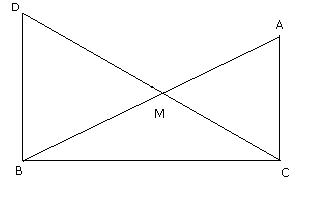 (i)
In
(i)
In
 AMC and BMD
AM = BM (Given)
AMC and BMD
AM = BM (Given)
 AMC
= BMD (Vertically
opposite angle)
MC = MD (given)
By SAS congruency
AMC
= BMD (Vertically
opposite angle)
MC = MD (given)
By SAS congruency
 (ii)
(ii)


Q44. In fig., if AB = AC and BD = DC.  ABD and ACD are congruent by which criterion.

ABD and ACD are congruent by which criterion.
Solution
By SSS.
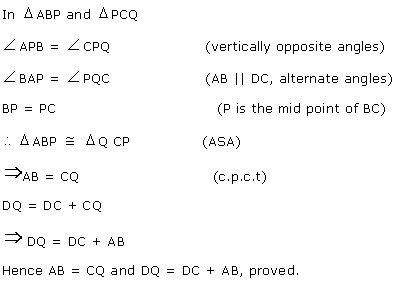
Q45. In the given figure, ABCD is a quadrilateral in which AB || DC and P is the mid point of BC. On producing, AP and DC meet at Q. Prove that(i) AB = CQ,(ii) DQ = DC + AB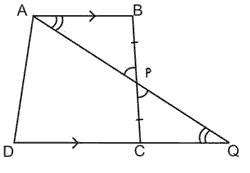
Solution
Q46. In figure , AB > AC, BO and CO are the bisectors of  B and C respectively. Show that OB > OC.
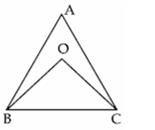
B and C respectively. Show that OB > OC.
Solution
AB>AC (given)
Therefore  C > B[angle opposite to the longer side is greater]
So
C > B[angle opposite to the longer side is greater]
So  C >
C >  B
i.e. OCB > OBC
Therefore OB > OC
B
i.e. OCB > OBC
Therefore OB > OC
C > B[angle opposite to the longer side is greater]
So C > B
i.e. OCB > OBC
Therefore OB > OC
Q47. 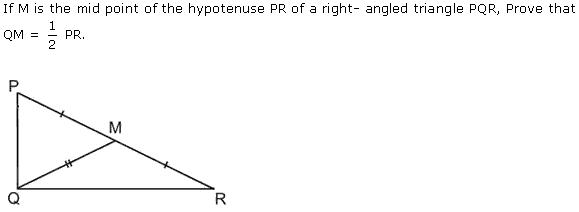
Solution
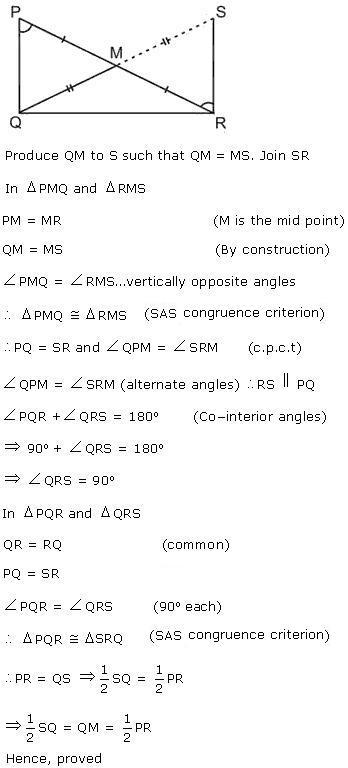
Q48. 
Solution
 Since the measure of angle Q is least so the side opposite to Q is smallest.
Q49. The side BC of  ABC is produced on both sides. Prove that the sum of the two exterior angles so formed is greater than
  A by 180o.
ABC is produced on both sides. Prove that the sum of the two exterior angles so formed is greater than A by 180o.Solution
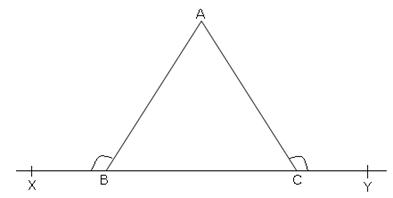 Given: Side BC of ABC is produced on both sides.
To prove: ext B + ext C > A
Proof:
ext B + ext C = 180o -B + 180o - C
= 360o - (B + C)
= 360o - (180o - A)
= 180o + A
Hence, ext B + ext C > A.
Given: Side BC of ABC is produced on both sides.
To prove: ext B + ext C > A
Proof:
ext B + ext C = 180o -B + 180o - C
= 360o - (B + C)
= 360o - (180o - A)
= 180o + A
Hence, ext B + ext C > A.
Q50. ΔABC is an isosceles triangle with AB = AC, side BA is produced to D such that AB = AD. Prove that  BCD is right angle.
BCD is right angle.
Solution
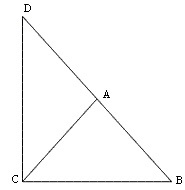
 is an isosceles triangle with
AB = AC [given]
is an isosceles triangle with
AB = AC [given]


 Add (1) and (3)





Q51. In
an isosceles  ABC with AB = AC, BD and CE are two medians. Prove
that BD = CE.
ABC with AB = AC, BD and CE are two medians. Prove
that BD = CE.
ABC with AB = AC, BD and CE are two medians. Prove
that BD = CE.Solution
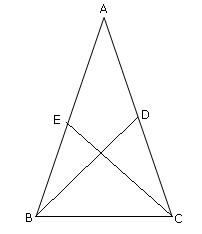 Given:
In an isosceles ABC with AB = AC, BD and CE are two medians.
To
Prove: BD = CE
Proof:
In triangles ABD and ACE
AB
= AC (given)
AD
= AE (as D and E are the
mid-points of AC and AB)
Given:
In an isosceles ABC with AB = AC, BD and CE are two medians.
To
Prove: BD = CE
Proof:
In triangles ABD and ACE
AB
= AC (given)
AD
= AE (as D and E are the
mid-points of AC and AB)
 A
= A
Therefore,
triangles ABD and ACE are congruent by SAS.
Hence,
BD = CE by CPCT.
A
= A
Therefore,
triangles ABD and ACE are congruent by SAS.
Hence,
BD = CE by CPCT.
Q52. In
the following figure, AD is a median of  and BL and CM
are perpendiculars drawn from B and C respectively on AD and AD produced
respectively. Prove That BL=CM.
and BL and CM
are perpendiculars drawn from B and C respectively on AD and AD produced
respectively. Prove That BL=CM.

and BL and CM
are perpendiculars drawn from B and C respectively on AD and AD produced
respectively. Prove That BL=CM.
Solution

Q53. A triangle can have:
Solution
Two acute angles
Q54.  ABC is an isosceles triangle in which AB =
AC. Side BA is produced to D such that AD = AB. Show that
ABC is an isosceles triangle in which AB =
AC. Side BA is produced to D such that AD = AB. Show that  BCD is a right angle.
ABC is an isosceles triangle in which AB =
AC. Side BA is produced to D such that AD = AB. Show that BCD is a right angle.Solution
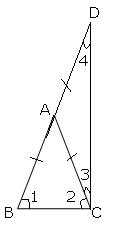 Given:
ABC is an isosceles triangle in which AB = BC
BA
is produced to D such that AB = AD
To
prove: BCD = 90o
Proof:
In ABC
AB = AC
Given:
ABC is an isosceles triangle in which AB = BC
BA
is produced to D such that AB = AD
To
prove: BCD = 90o
Proof:
In ABC
AB = AC
 1 = 2 … (i)
Similarly,
3 = 4 … (ii)
In
BCD, by angle sum property,
1
+ (2 + 3) + 4 = 180o
2
+ (2 + 3) + 3 = 180o
2(2 + 3) = 180o
2
+ 3 = 90o
BCD
= 90o
1 = 2 … (i)
Similarly,
3 = 4 … (ii)
In
BCD, by angle sum property,
1
+ (2 + 3) + 4 = 180o
2
+ (2 + 3) + 3 = 180o
2(2 + 3) = 180o
2
+ 3 = 90o
BCD
= 90o
Q55. In ΔABC, AB = AC,  A = 36°. If the internal bisector of C meet AB at D, prove that AD = BC.
A = 36°. If the internal bisector of C meet AB at D, prove that AD = BC.Solution
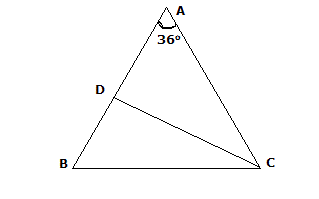 AB = AC
 C = B [angles opposite to equal sides are equal]
In
C = B [angles opposite to equal sides are equal]
In  ABC A + B + C = 180o [Angle sum property of ]
 36o + 2C = 180o
2C = 144o
36o + 2C = 180o
2C = 144o
 C = 72o
DCA =
C = 72o
DCA = 
 DCA = DAC = 36o
AD = CD [sides opposite to equal angles are equal] … (i)
In CDB
AB C +
DCA = DAC = 36o
AD = CD [sides opposite to equal angles are equal] … (i)
In CDB
AB C +  C + CDB = 180o
72o + 36o + CDB = 180o
CDB = 180o - 72o - 36o
CDB = 72o
C + CDB = 180o
72o + 36o + CDB = 180o
CDB = 180o - 72o - 36o
CDB = 72o
 CDB = DBC = 72o
BC = CD [sides opposite to equal angles are equal] … (ii)
AD = BC (Using (i) and (ii))
CDB = DBC = 72o
BC = CD [sides opposite to equal angles are equal] … (ii)
AD = BC (Using (i) and (ii))
Q56. In  ABC, AB = AC. X and Y are points on AB and AC such
that AX = AY. Prove that ABY
ABC, AB = AC. X and Y are points on AB and AC such
that AX = AY. Prove that ABY  ACX
ACX

ABC, AB = AC. X and Y are points on AB and AC such
that AX = AY. Prove that ABY ACX
Solution
In
s
ABY and ACX,
AB
= AC (given)
AX
= AY (given)
 A
= A (common)
By
SAS, ABY ACX
A
= A (common)
By
SAS, ABY ACX
s
ABY and ACX,
AB
= AC (given)
AX
= AY (given)
A
= A (common)
By
SAS, ABY ACX
Q57. In fig., if  a > b then prove that PQ > PR.

a > b then prove that PQ > PR.
Solution
 a = P + R[Exterior angle property]
b = P + Q
a > b given
a = P + R[Exterior angle property]
b = P + Q
a > b given

 R > Q
R > Q
 PQ > PR(sides opposite to larger angles are longer)
Hence proved.
PQ > PR(sides opposite to larger angles are longer)
Hence proved.
Q58. In an
isosceles triangle ABC with AB = AC the bisector of  B and C intersect each other at O. Join A to O. Show that :
(i) OB
= OC (ii) AO bisect A
B and C intersect each other at O. Join A to O. Show that :
(i) OB
= OC (ii) AO bisect A
B and C intersect each other at O. Join A to O. Show that :
(i) OB
= OC (ii) AO bisect ASolution
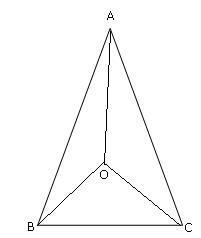 Given:
An isosceles triangle ABC with AB = AC.
To
prove : (1) OB = OC (2) AO bisector A
Construction:
Join AO
Proof:
ABC = ACB
(given)
Given:
An isosceles triangle ABC with AB = AC.
To
prove : (1) OB = OC (2) AO bisector A
Construction:
Join AO
Proof:
ABC = ACB
(given)
 So
OB = OC
(2)
In
So
OB = OC
(2)
In  AOB and AOC
OB = OC
AB = AC
AO = AO
Thus
AOB
AOB and AOC
OB = OC
AB = AC
AO = AO
Thus
AOB  ABC (By
SSS)
Hence, OAB = OAC (By CPCT)
ABC (By
SSS)
Hence, OAB = OAC (By CPCT)
Q59. In fig., PR > PQ and PS bisects  QPR. Prove that PSR > PSQ.

QPR. Prove that PSR > PSQ.
Solution
In  PQR
PR>PQ (given)
PQR
PR>PQ (given)

 PQR>PRQ [Angle opp. to larger side is greater]
PQR+1>PRQ+2 … (i) [1= 2 given]
In PQS and PSR
PQR+1+PSQ = 1800 and
PRQ+2+PSR= 1800
PQR+1 = 1800-PSQ and
PQR+2 = 1800-PSR
1800-PSQ>1800-PSRfrom (i)
PSR-PSQ>0
PSR>PSQ
PQR>PRQ [Angle opp. to larger side is greater]
PQR+1>PRQ+2 … (i) [1= 2 given]
In PQS and PSR
PQR+1+PSQ = 1800 and
PRQ+2+PSR= 1800
PQR+1 = 1800-PSQ and
PQR+2 = 1800-PSR
1800-PSQ>1800-PSRfrom (i)
PSR-PSQ>0
PSR>PSQ
PQR
PR>PQ (given)
PQR>PRQ [Angle opp. to larger side is greater]
PQR+1>PRQ+2 … (i) [1= 2 given]
In PQS and PSR
PQR+1+PSQ = 1800 and
PRQ+2+PSR= 1800
PQR+1 = 1800-PSQ and
PQR+2 = 1800-PSR
1800-PSQ>1800-PSRfrom (i)
PSR-PSQ>0
PSR>PSQ
Q60. In figure , if OA = OB, OD= OC then  by congruence rule:

by congruence rule:
Solution
 also, OA = OB, OD= OC
SAS
also, OA = OB, OD= OC
SAS
Q61. It is not possible to construct a triangle when its sides are:
Solution
In a triangle, the sum of two sides is always greater than third side. But in option (B), 2.2 + 3.1 = 5.3 < 5.4.
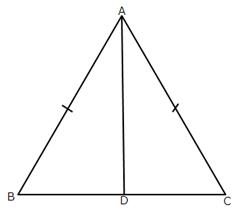
Q62. AD
is an altitude of an isosceles triangle ABC in which AB = AC. Show that AD is
also the median of the triangle.
Solution
Given:
AD is an altitude of an isosceles triangle ABC in which AB = AC
To
prove: AD is also the median of the triangle
Proof:
 In
In
 ABD and ACD,
AB
= AC (given)
ABD and ACD,
AB
= AC (given)
 ADB
= ADC (each 90o)
AD
= AD (common)
ADB
= ADC (each 90o)
AD
= AD (common)
 ABD
ABD  ACD
(By SAS)
BD = DC
ACD
(By SAS)
BD = DC
 AD is the median.
In
ABD and ACD,
AB
= AC (given)
ADB
= ADC (each 90o)
AD
= AD (common)
ABD ACD
(By SAS)
BD = DC
AD is the median.
Q63. 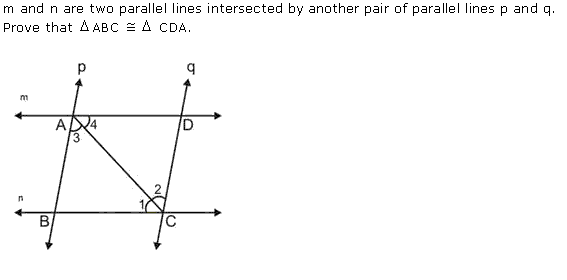
Solution
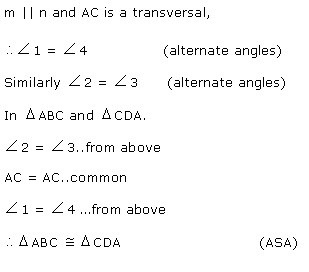
Q64. In
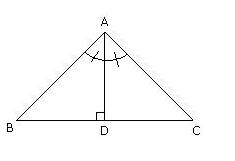
 ABC, the bisector AD of
  A is perpendicular to side BC. Show that ABC is an isosceles triangle.
ABC, the bisector AD of A is perpendicular to side BC. Show that ABC is an isosceles triangle.Solution



 (By C.PC.T)
Hence,
ABC is an isosceles triangle.
(By C.PC.T)
Hence,
ABC is an isosceles triangle.
Q65. 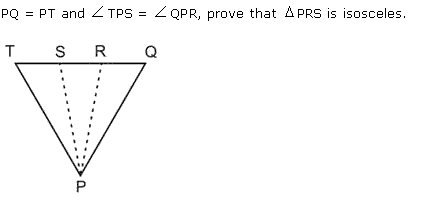
Solution
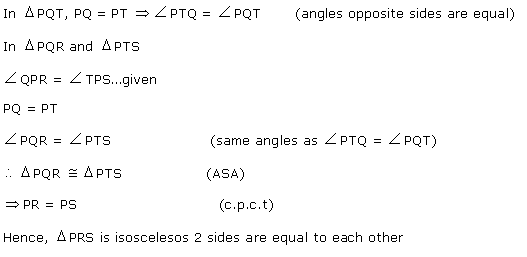
Q66. It is given that AB = EF, BC = DE, AB  BD and FE CE. Prove that
  ABD
ABD  FEC.
FEC.
BD and FE CE. Prove that ABD FEC.Solution

Q67. In figure, AB = AC, D is the point in the interior of  ABC such that
  DBC = DCB. Prove that AD bisects BAC of ABC.

ABC such that DBC = DCB. Prove that AD bisects BAC of ABC.
Solution

 AD = AD common

 Hence, AD is bisector of
Q68. 
Solution
Q69. 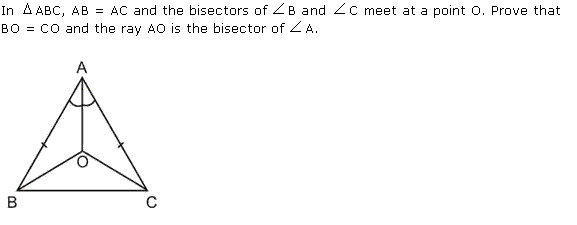
Solution
Q70. 
Solution
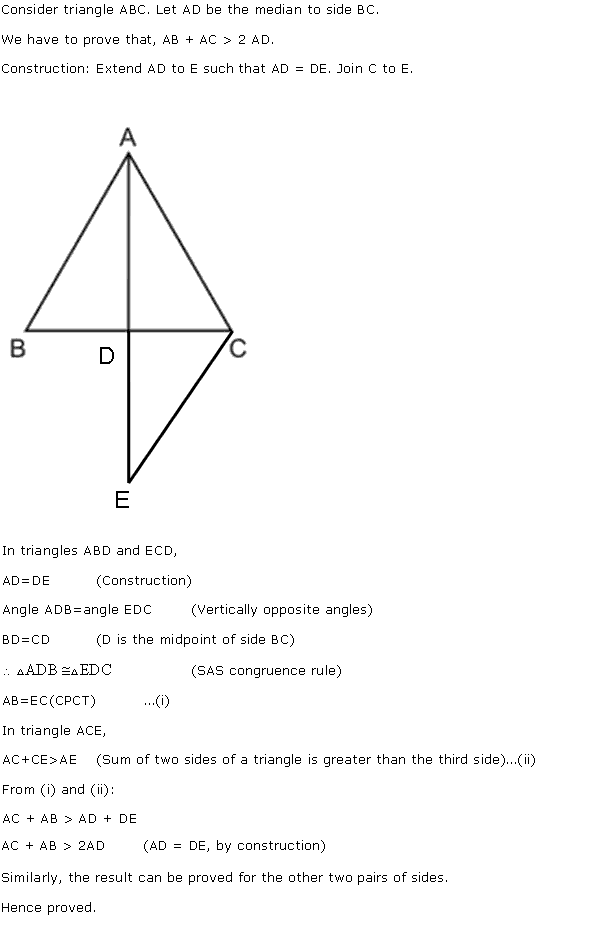
Q71. In
right triangle ABC, right angled at C, M is the mid-point of
hypotenuse
AB. C is joined to M and produced to a point D
such
that DM = CM. Point D is joined to point B (see the given figure). Show that:
(i)  AMC
AMC  BMD
(ii)
BMD
(ii)  DBC is a right angle.
(iii) DBC ACB
(iv) CM =
DBC is a right angle.
(iii) DBC ACB
(iv) CM =  AB
AB

AMC BMD
(ii) DBC is a right angle.
(iii) DBC ACB
(iv) CM = AB
Solution
In
AMC and BMD
AM
= BM (M is
midpoint of AB)
AMC
= BMD (vertically
opposite angles)
CM
= DM (given)
 AMC @
BMD (by SAS congruence rule)
AC = BD (by
CPCT)
And
ACM = BDM (by
CPCT)
(ii)
We have ACM = BDM
But ACM and BDM are alternate interior angles
Since
alternate angles are equal.
Hence,
we can say that DB || AC
AMC @
BMD (by SAS congruence rule)
AC = BD (by
CPCT)
And
ACM = BDM (by
CPCT)
(ii)
We have ACM = BDM
But ACM and BDM are alternate interior angles
Since
alternate angles are equal.
Hence,
we can say that DB || AC
 DBC
+ ACB = 180º (co-interior
angles)
DBC
+ 90º = 180º
DBC = 90º
(iii) Now in DBC and ACB
DB
= AC (Already
proved)
DBC
= ACB (each
90
DBC
+ ACB = 180º (co-interior
angles)
DBC
+ 90º = 180º
DBC = 90º
(iii) Now in DBC and ACB
DB
= AC (Already
proved)
DBC
= ACB (each
90 )
BC
= CB (Common)
)
BC
= CB (Common)
 DBC ACB (SAS
congruence rule)
(iv) We have DBC ACB
AB = DC (by
CPCT)
AB = 2 CM
CM =AB
DBC ACB (SAS
congruence rule)
(iv) We have DBC ACB
AB = DC (by
CPCT)
AB = 2 CM
CM =AB
AMC and BMD
AM
= BM (M is
midpoint of AB)
AMC
= BMD (vertically
opposite angles)
CM
= DM (given)
AMC @
BMD (by SAS congruence rule)
AC = BD (by
CPCT)
And
ACM = BDM (by
CPCT)
(ii)
We have ACM = BDM
But ACM and BDM are alternate interior angles
Since
alternate angles are equal.
Hence,
we can say that DB || AC
DBC
+ ACB = 180º (co-interior
angles)
DBC
+ 90º = 180º
DBC = 90º
(iii) Now in DBC and ACB
DB
= AC (Already
proved)
DBC
= ACB (each
90)
BC
= CB (Common)
DBC ACB (SAS
congruence rule)
(iv) We have DBC ACB
AB = DC (by
CPCT)
AB = 2 CM
CM =AB
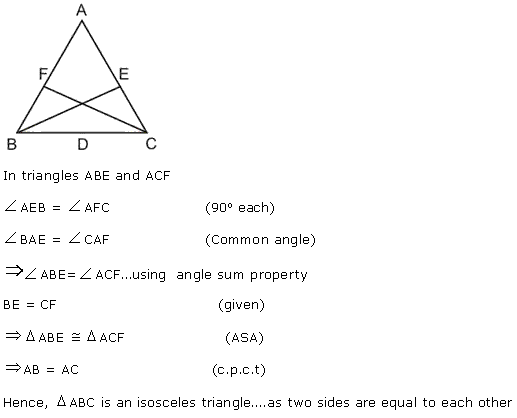
Q72. If the altitudes from two vertices of a triangle to the opposite sides are equal, prove that the triangle is isosceles.
Solution
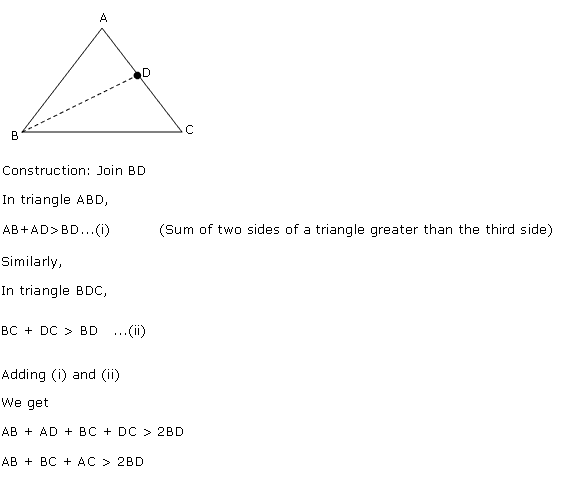
Q73. In triangle ABC, D is a point on AC, Prove that, the value of the perimeter of triangle ABC is greater than twice the length of BD.
Solution
Q74. 
Solution
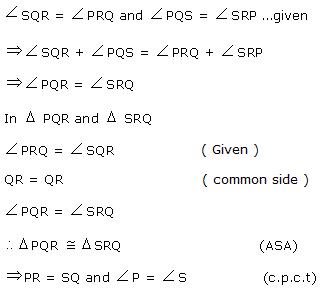
Q75. Prove that angles opposite to equal sides of a triangle are equal.
Solution
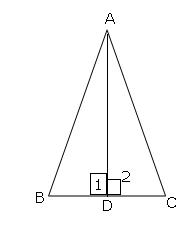 Given: In triangle ABC, AB = AC.
To prove:
Given: In triangle ABC, AB = AC.
To prove:  B = C
Construction: Draw AD perpendicular to BC.
Proof:
In
B = C
Construction: Draw AD perpendicular to BC.
Proof:
In  ADB and ADC
AB = AC(given)
1 = 2(each 90o)
AD = AD(common)
Therefore, In ADB
ADB and ADC
AB = AC(given)
1 = 2(each 90o)
AD = AD(common)
Therefore, In ADB  ADC(By RHS)
Thus, B = C(By cpct)
Hence proved.
ADC(By RHS)
Thus, B = C(By cpct)
Hence proved.
Q76. In
figure, two sides AB and BC and the median AM of  ABC are respectively equal to sides DE and EF and the
median DN of DEF. Prove that ABC
ABC are respectively equal to sides DE and EF and the
median DN of DEF. Prove that ABC  DEF.
DEF.

ABC are respectively equal to sides DE and EF and the
median DN of DEF. Prove that ABC DEF.
Solution
Given:
AB = DE, BC = EF and AM = DN
To
prove: ABC DEF
Proof:
In
ABM DEN
AB
= DE (given)
AM
= DN (given)
BM
= EN (as M and N are the
respective mid-points and BC = EF)
Therefore,
ABM DEN
(by SSS)
Thus,
 B = E (By cpct) … (1)
Again in ABC
and DEF
B = E by (1)
AB
= DE (given)
BC
= EF (given)
Therefore,
ABC DEF (By
SAS)
Hence
proved.
B = E (By cpct) … (1)
Again in ABC
and DEF
B = E by (1)
AB
= DE (given)
BC
= EF (given)
Therefore,
ABC DEF (By
SAS)
Hence
proved.
ABC DEF
Proof:
In
ABM DEN
AB
= DE (given)
AM
= DN (given)
BM
= EN (as M and N are the
respective mid-points and BC = EF)
Therefore,
ABM DEN
(by SSS)
Thus,
B = E (By cpct) … (1)
Again in ABC
and DEF
B = E by (1)
AB
= DE (given)
BC
= EF (given)
Therefore,
ABC DEF (By
SAS)
Hence
proved.
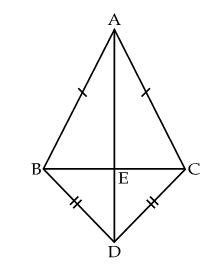
Q77. In figure, two
isosceles triangles have a common base, prove that line segment joining their
vertices bisects the common base at right angles.
Solution
In
 ABD and ACD,
AB
= AC (given)
BD
= DC (given)
AD
= AD (common)
Therefore, ABD
ABD and ACD,
AB
= AC (given)
BD
= DC (given)
AD
= AD (common)
Therefore, ABD
 ACD (By SSS
rule)
So,
ACD (By SSS
rule)
So,
 BAD = CAD (By cpct) ... (1)
In
ABE and ACE,
AB
= AC (given)
AE
= AE (common)
BAD
= DAC (By
(1)) ...(2)
Therefore, ABE
ACE (By SAS)
BAD = CAD (By cpct) ... (1)
In
ABE and ACE,
AB
= AC (given)
AE
= AE (common)
BAD
= DAC (By
(1)) ...(2)
Therefore, ABE
ACE (By SAS)
 BE = CE (By cppt)
And, BEA = CEA (cpcpt)
But, BEA
+ CEA = 180o
BEA = 90o
BE = CE (By cppt)
And, BEA = CEA (cpcpt)
But, BEA
+ CEA = 180o
BEA = 90o
Q78. 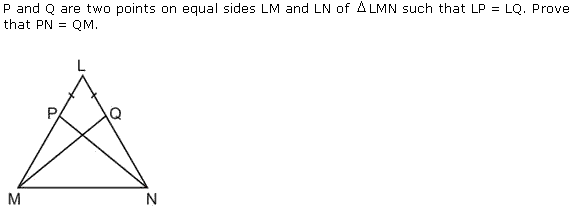
Solution
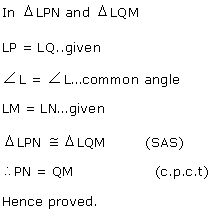
Q79. In the given figure, x > y. Show that LM > LN.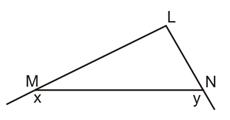
Solution
 LMN + x = 180o (linear pair)
LNM + y = 180o (linear pair)
LMN + x = 180o (linear pair)
LNM + y = 180o (linear pair)
 LMN + x = LNM + y
But, it is given that x > y.
LMN < LNM
LMN + x = LNM + y
But, it is given that x > y.
LMN < LNM
 LM > LN (side opposite greater angle is greater)
Q80. Two sides AB and BC and median AM
of  ABC are respectively equal to the sides PQ and QR
and median PN of PQR. Show that ABM
ABC are respectively equal to the sides PQ and QR
and median PN of PQR. Show that ABM  PQN.
PQN.
ABC are respectively equal to the sides PQ and QR
and median PN of PQR. Show that ABM PQN.Solution
Given : in which AB=PQ,BC=QR and median AM=PN
To Prove:
in which AB=PQ,BC=QR and median AM=PN
To Prove: 
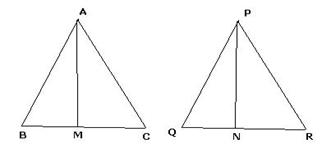 Proof
Proof  BC = QR
 AB=PQ and AM=PN (Given)
Therefore,
AB=PQ and AM=PN (Given)
Therefore,  (by SSS)
in which AB=PQ,BC=QR and median AM=PN
To Prove:
Proof BC = QR
AB=PQ and AM=PN (Given)
Therefore, (by SSS)
Q81. Show that in a right angled triangle the hypotenuse is the longest side.
Solution
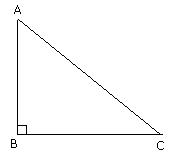 Given :A right angledtriangle ABC,
  B = 90o
To Prove:Hypotenuse AC in the longest side.
(i) AC > AB(ii)AC > BC
Proof: Now in
B = 90o
To Prove:Hypotenuse AC in the longest side.
(i) AC > AB(ii)AC > BC
Proof: Now in  ABC
ABC = 90o
But CAB + BCA +CBA = 180o
ABC
ABC = 90o
But CAB + BCA +CBA = 180o
 Thus BCA < 90o and CAB < 90o
 (Side opposite to greater angle is larger)
Thus AC is the longest side
(Side opposite to greater angle is larger)
Thus AC is the longest side
Q82. In  ABC, BD and CE are two altitudes such that BD = CE.
Prove that ABC is isosceles.
ABC, BD and CE are two altitudes such that BD = CE.
Prove that ABC is isosceles.
ABC, BD and CE are two altitudes such that BD = CE.
Prove that ABC is isosceles.Solution
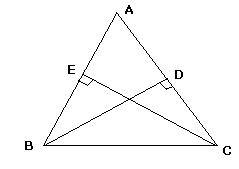 In ABD and ACE
 ADB=
AEC= 900
BAD=
CAE (common
angle)
BD = CE (given)
By AAS Criteria
ABD
ADB=
AEC= 900
BAD=
CAE (common
angle)
BD = CE (given)
By AAS Criteria
ABD
 ACE
AB = AC (CPCT)
Hence, ABC is isosceles.
ACE
AB = AC (CPCT)
Hence, ABC is isosceles.
Q83. In figure, AB and CD are respectively the smallest and the longest sides of a quadrilateral ABCD, then show that  A > C and B > D.

A > C and B > D.
Solution
 Let us join AC.
In DABC
AB < BC (AB is smallest side of quadrilateral ABCD)
Let us join AC.
In DABC
AB < BC (AB is smallest side of quadrilateral ABCD)

 2 < 1 (angle opposite to smaller side is smaller) ... (1)
In DADC
AD < CD (CD is the largest side of quadrilateral ABCD)
4 < 3 (angle opposite to smaller side is smaller) ...(2)
On adding equations (1) and (2), we have
2 + 4 < 1 + 3
2 < 1 (angle opposite to smaller side is smaller) ... (1)
In DADC
AD < CD (CD is the largest side of quadrilateral ABCD)
4 < 3 (angle opposite to smaller side is smaller) ...(2)
On adding equations (1) and (2), we have
2 + 4 < 1 + 3
 C < A
A > C
Let us join BD.
C < A
A > C
Let us join BD.
 In DABD
AB < AD (AB is smallest side of quadrilateral ABCD)
8 < 5 (angle opposite to smaller side is smaller) ... (3)
In DBDC
BC < CD (CD is the largest side of quadrilateral ABCD)
7 < 6 (angle opposite to smaller side is smaller) ... (4)
On adding equations (3) and (4), we have
8 + 7 < 5 + 6
D < B
B > D
In DABD
AB < AD (AB is smallest side of quadrilateral ABCD)
8 < 5 (angle opposite to smaller side is smaller) ... (3)
In DBDC
BC < CD (CD is the largest side of quadrilateral ABCD)
7 < 6 (angle opposite to smaller side is smaller) ... (4)
On adding equations (3) and (4), we have
8 + 7 < 5 + 6
D < B
B > D
Q84. In
figure,  BCD = ADC and ACB = BDA. Prove that AD = BC and A = B.

BCD = ADC and ACB = BDA. Prove that AD = BC and A = B.
Solution
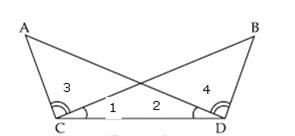
 1=
2 and 3 = 4
1+3 = 2+4
ACD
= BDC
In
1=
2 and 3 = 4
1+3 = 2+4
ACD
= BDC
In
 ACD and BDC
ADC
= BCD (given)
CD
= CD (COMMON)
ACD
= BDC [from (i)]
ACD
ACD and BDC
ADC
= BCD (given)
CD
= CD (COMMON)
ACD
= BDC [from (i)]
ACD
 BDC (ASA rule)
AD
= BC and A = B (CPCT)
BDC (ASA rule)
AD
= BC and A = B (CPCT)
Q85. ABCD is a square, X and Y are the points on the sides AB and DC respectively such that BY = CX. Prove that CY = BX and  CBY = BCX.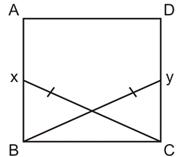
CBY = BCX.Solution
In the right triangles CBY and BCX
BY = CX (given)
CB = BC (common)
YCB = XBC (90o each)

 CBY
CBY  BCX (RHS congruence rule)
 CY = BX and CBY = BCX.
YCB = XBC (90o each)
CBY BCX (RHS congruence rule)
CY = BX and CBY = BCX.
Q86. In
fig., AD and BC are perpendiculars to a line segment AB such that AD = BC.
Prove that CD bisects AB at P.

Solution
In
 BCP and ADP
 B = A = 90o
APD = BPC (vertically
opp. angles)
And
BC = AD (given)
B = A = 90o
APD = BPC (vertically
opp. angles)
And
BC = AD (given)
 BCD
BCD  ADP (By AAS)
CP = DP
and AP = BP
Hence,
CD bisects AB at P.
ADP (By AAS)
CP = DP
and AP = BP
Hence,
CD bisects AB at P.
BCP and ADP
B = A = 90o
APD = BPC (vertically
opp. angles)
And
BC = AD (given)
BCD ADP (By AAS)
CP = DP
and AP = BP
Hence,
CD bisects AB at P.
Q87. 
Solution
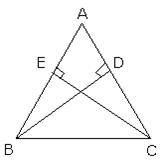

Q88. 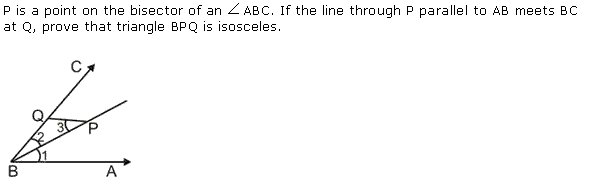
Solution
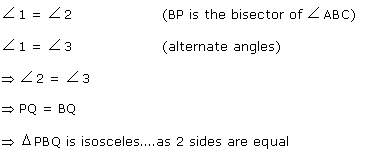
Q89. Show that of all line segment drawn from a given point not on it, the perpendicular line segment is the shortest.
Solution
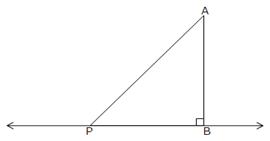 Let AB be a perpendicular to a line l and AP is any other line segment
In right
Let AB be a perpendicular to a line l and AP is any other line segment
In right  ABP ,
ABP ,  B > P (
 B = 90o)
Therefore, AP > AB.
(In a triangle, side opposite to larger angle is longer)
Hence, the result.
B = 90o)
Therefore, AP > AB.
(In a triangle, side opposite to larger angle is longer)
Hence, the result.
Q90. In
fig.,  ABC and DBC are two isosceles triangles on the same base BC
and the vertices A and D are on the same side of BC. AD is extended to meet
BC at P. Prove that AP bisects
ABC and DBC are two isosceles triangles on the same base BC
and the vertices A and D are on the same side of BC. AD is extended to meet
BC at P. Prove that AP bisects  A.
A.
 .
.
ABC and DBC are two isosceles triangles on the same base BC
and the vertices A and D are on the same side of BC. AD is extended to meet
BC at P. Prove that AP bisects A.
.Solution
Given:
Two isosceles triangles ABC and DBC.
To
Prove: AP bisects A.
Proof:
In
 ABD and ACD
AB
= AC (given)
BD
= CD (given)
AD
= AD (common)
ABD and ACD
AB
= AC (given)
BD
= CD (given)
AD
= AD (common)

 So by CPCTBAD
= CAD
So by CPCTBAD
= CAD
 AP bisects BAC.
A.
Proof:
In
ABD and ACD
AB
= AC (given)
BD
= CD (given)
AD
= AD (common)
So by CPCTBAD
= CAD
AP bisects BAC.
Q91. If the segments drawn perpendicular to the two sides of a triangle from the mid point of the third side be congruent and equally inclined to the third side, prove that the triangle is isosceles.
Solution
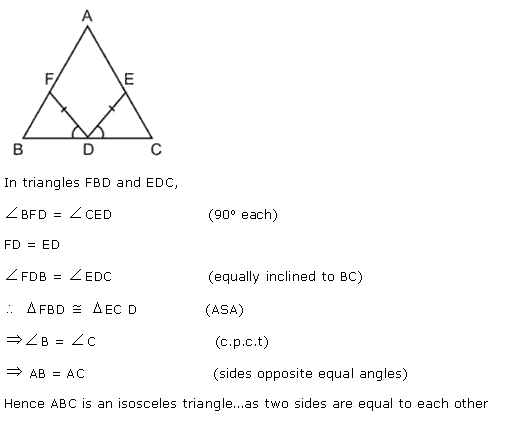
Q92. In
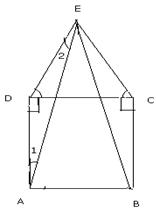
figure, ABCD is a square and  DEC is an equilateral triangle. Prove that:
(i)
ADE
DEC is an equilateral triangle. Prove that:
(i)
ADE  BCE (ii) AE = BE (iii)
  DAE = 15°

DEC is an equilateral triangle. Prove that:
(i)
ADE BCE (ii) AE = BE (iii) DAE = 15°
Solution



 But
But


Q93. In fig., if  ABD = ACE and AB = AC. Prove that BD = CE.

ABD = ACE and AB = AC. Prove that BD = CE.
Solution
In  ABD as ACE
AB = AC (given)
ABD = ACE (given)
BAD = CAE (common angle)
ABD as ACE
AB = AC (given)
ABD = ACE (given)
BAD = CAE (common angle)
 ABD
ABD  ACE (By ASA)
Thus, BD = CE (CPCT)
ACE (By ASA)
Thus, BD = CE (CPCT)
ABD as ACE
AB = AC (given)
ABD = ACE (given)
BAD = CAE (common angle)
ABD ACE (By ASA)
Thus, BD = CE (CPCT)
Q94. 
Solution
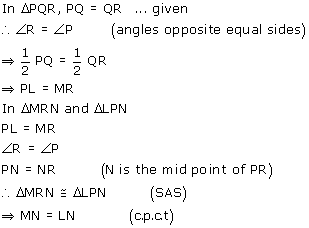
Q95. In  PQR, if PQ = QR and L, M and N are the mid points of the sides PQ, QR and RP respectively. Prove that LN = MN.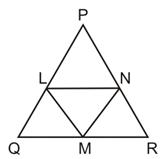
PQR, if PQ = QR and L, M and N are the mid points of the sides PQ, QR and RP respectively. Prove that LN = MN.Solution
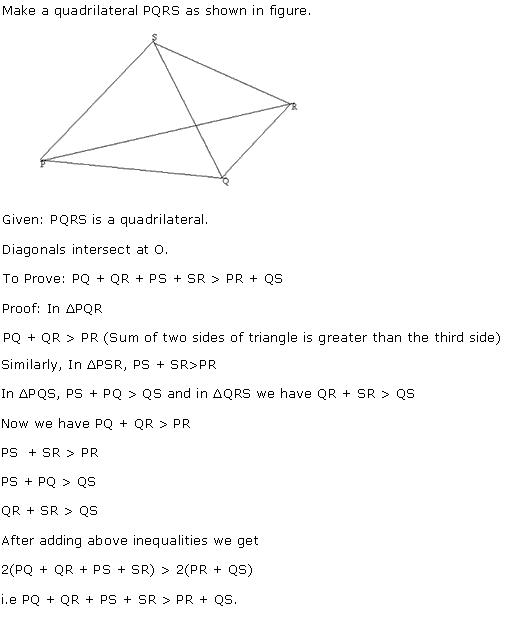
Q96. In quadrilateral PQRS the diagonals intersect at O than prove that PQ + QR + RS + PS > PR + QS.
Solution
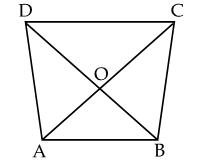
Q97. In figure, show that 2 (AC + BD) > (AB + BC + CD + DA)
Solution
In  OAB
OA + OB > AB ...(1)
In OBC
OB + OC > BC...(2)
In OCD,
OC + OD > CD...(3)
In ODA,
OD + OA > AD ...(4)
Adding (1), (2), (3) and (4)
2 (OA + OB + OC + OD) > AB + BC + DC + DA
2|(OA + OC) + (OB + OD)| > AB + BC + CD + DA
2 (AC+ BD) > AB + BC + CD + DA
OAB
OA + OB > AB ...(1)
In OBC
OB + OC > BC...(2)
In OCD,
OC + OD > CD...(3)
In ODA,
OD + OA > AD ...(4)
Adding (1), (2), (3) and (4)
2 (OA + OB + OC + OD) > AB + BC + DC + DA
2|(OA + OC) + (OB + OD)| > AB + BC + CD + DA
2 (AC+ BD) > AB + BC + CD + DA
OAB
OA + OB > AB ...(1)
In OBC
OB + OC > BC...(2)
In OCD,
OC + OD > CD...(3)
In ODA,
OD + OA > AD ...(4)
Adding (1), (2), (3) and (4)
2 (OA + OB + OC + OD) > AB + BC + DC + DA
2|(OA + OC) + (OB + OD)| > AB + BC + CD + DA
2 (AC+ BD) > AB + BC + CD + DA
Q98. In
fig., ABCD is a quadrilateral with AC = AD and AB bisects  A. Show that ΔABC
  ΔABD. What can
you say about BC and BD?
ΔABD. What can
you say about BC and BD?

A. Show that ΔABC ΔABD. What can
you say about BC and BD?
Solution
In
 ABC and ABD
AC
= AD (given)
ABC and ABD
AC
= AD (given)
 CAB
= DAB [AB is bisection of DAC]
AB
= AB (common)
So,
by SAS congruency
ABC
CAB
= DAB [AB is bisection of DAC]
AB
= AB (common)
So,
by SAS congruency
ABC
 ABD
BC
= BD (CPCT)
ABD
BC
= BD (CPCT)
ABC and ABD
AC
= AD (given)
CAB
= DAB [AB is bisection of DAC]
AB
= AB (common)
So,
by SAS congruency
ABC
ABD
BC
= BD (CPCT)
Q99. ABCD is a parallelogram, if the two diagonals are equal, find the measure of  ABC.
ABC.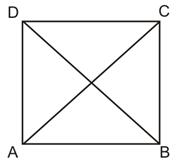
ABC.Solution
AB = CD and AD = BC (opposite sides of a parallelogram are equal)
In  ABD and BAC
AD = BC
BD = AC (Given)
AB = BA (Common)
ABD and BAC
AD = BC
BD = AC (Given)
AB = BA (Common)
 ABD
ABD  BAC (SSS congurence rule)
 BAD = ABC (c.p.c.t)
AD
BAD = ABC (c.p.c.t)
AD  BC and transversal AB intersects them at A and B.
BAD +ABC = 180o
ABC +ABC = 180o
2ABC = 180o
ABC = 90o
Hence, the measure of ABC = 90o
BC and transversal AB intersects them at A and B.
BAD +ABC = 180o
ABC +ABC = 180o
2ABC = 180o
ABC = 90o
Hence, the measure of ABC = 90o
ABD and BAC
AD = BC
BD = AC (Given)
AB = BA (Common)
ABD BAC (SSS congurence rule)
BAD = ABC (c.p.c.t)
AD BC and transversal AB intersects them at A and B.
BAD +ABC = 180o
ABC +ABC = 180o
2ABC = 180o
ABC = 90o
Hence, the measure of ABC = 90o
Q100. If two isosceles triangles have a
common base, prove that the line segment joining their vertices bisects the
common base at right angles.
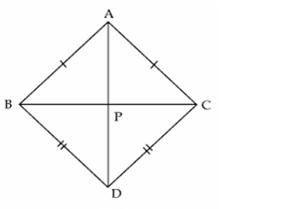
Solution
Since
AB = AC, BD = DC, AD = AD


 In
In  ABP and ACP
AB =
AC,
ABP and ACP
AB =
AC, 


 Hence,
AP bisects common base at right angle.
Hence,
AP bisects common base at right angle.
In ABP and ACP
AB =
AC,
Hence,
AP bisects common base at right angle.
Q101. In
figure, if AB=AC and DB=DC then prove that 

Solution

Q102. In
figure,  and O is the midpoint of AD. Show that
(i)
and O is the midpoint of AD. Show that
(i)  (ii) O is also the midpoint of BC.

and O is the midpoint of AD. Show that
(i)
(ii) O is also the midpoint of BC.
Solution
(i)
In

 (Alternate angle as AB||DC and BC
is transversal)
(Alternate angle as AB||DC and BC
is transversal)
 (Vertically opposite angles)
OA
= OD (Given)
(Vertically opposite angles)
OA
= OD (Given)
 (ii)
OB
= OC (CPCT)
So,
O is midpoint of BC.
(ii)
OB
= OC (CPCT)
So,
O is midpoint of BC.
(Alternate angle as AB||DC and BC
is transversal)
(Vertically opposite angles)
OA
= OD (Given)
(ii)
OB
= OC (CPCT)
So,
O is midpoint of BC.
Comments
Post a Comment