Q1. The diagonal of a square is 10 cm. Its area is:
Solution
Diagonal using Pythagoras Theorem:
a2 + a2 = 102
2a2 = 100
a2 = 100/2
a2=50
a=7.07 cm (where a is the length of the sides of the square.) Area = 7.072 = 50 cm2
Q2. Show that diagonals of a square are equal
and bisect each other at right angles.
Solution
 Let
the diagonals AC and BD of the square ABCD intersect each other at a point O.
We
need to prove AC = BD, OA = OC, OB = OD and
Let
the diagonals AC and BD of the square ABCD intersect each other at a point O.
We
need to prove AC = BD, OA = OC, OB = OD and  AOB = 90o
Now,
in
AOB = 90o
Now,
in  ABC and DCB,
AB
= DC (sides of square are
equal)
ABC
= DCB (all
interior angles are of 90o)
BC
= BC (common side)
ABC and DCB,
AB
= DC (sides of square are
equal)
ABC
= DCB (all
interior angles are of 90o)
BC
= BC (common side)
 ABC
ABC
 DCB (by SAS
congruency)
AC = DB (by
CPCT)
Hence,
the diagonals of a square are equal in length.
Now, in AOB and COD,
AOB
= COD (vertically
opposite angles)
ABO
= CDO (alternate
interior angles)
AB = CD (sides of square are equal)
AOB
COD (by AAS
congruence rule)
AO = CO and OB = OD (by CPCT)
Hence, the diagonals of a square
bisect each other.
Now in AOB and COB,
AO = CO
AB = CB (sides of square are equal)
BO = BO (common)
AOB
COB (by SSS
congruence)
AOB
= COB (by CPCT)
But, AOB + COB = 180o (linear
pair)
DCB (by SAS
congruency)
AC = DB (by
CPCT)
Hence,
the diagonals of a square are equal in length.
Now, in AOB and COD,
AOB
= COD (vertically
opposite angles)
ABO
= CDO (alternate
interior angles)
AB = CD (sides of square are equal)
AOB
COD (by AAS
congruence rule)
AO = CO and OB = OD (by CPCT)
Hence, the diagonals of a square
bisect each other.
Now in AOB and COB,
AO = CO
AB = CB (sides of square are equal)
BO = BO (common)
AOB
COB (by SSS
congruence)
AOB
= COB (by CPCT)
But, AOB + COB = 180o (linear
pair)
 2AOB = 180 o AOB = 90o
Hence,
the diagonals of a square bisect each other at right angles.
2AOB = 180 o AOB = 90o
Hence,
the diagonals of a square bisect each other at right angles.
Q3. Two parallel lines l and m are intersected by a transversal p. Show that the
quadrilateral formed by the bisectors of interior angles is a rectangle.
Solution
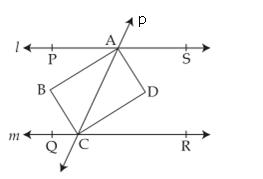 l||m and p intersects them at
points A and C respectively. Bisectors of interior angles intersect at B and
D.
Now
l||m and p intersects them at
points A and C respectively. Bisectors of interior angles intersect at B and
D.
Now
 PAC = ACR (alternate angles)

 AB||DC (as alternate angles are equal)
Similarly
BC||AD
ABCD is a parallelogram
Also
PAC + CAS = 180o
(Linear pair)
AB||DC (as alternate angles are equal)
Similarly
BC||AD
ABCD is a parallelogram
Also
PAC + CAS = 180o
(Linear pair)
 ABCD is a ||gm with one angle 90o
ABCD is a rectangle.
ABCD is a ||gm with one angle 90o
ABCD is a rectangle.
Q4. The diagonals of a parallelogram PQRS intersect at O. If  QOR = 90o and QSR = 50o, then ORS is:
QOR = 90o and QSR = 50o, then ORS is:Solution


Q5. Prove that the angle bisectors of a
parallelogram form a rectangle.
Solution
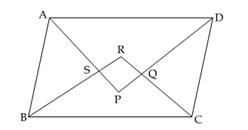 To
prove : PQRS is a rectangle
Proof : Since ABCD is a parallelogram
To
prove : PQRS is a rectangle
Proof : Since ABCD is a parallelogram

 A + B = 180o [angles on the same side of
transversal]
A + B = 180o [angles on the same side of
transversal]
 But
in
But
in  ABS, by angle sum property
ASB
= 90o
ABS, by angle sum property
ASB
= 90o
 RSP = 90o [
 ASB = RSP vert. opp. Angles]
Similarly
SRQ = 90o , RQP = 90o, and SPQ = 90o
Hence
PQRS is a rectangle.
ASB = RSP vert. opp. Angles]
Similarly
SRQ = 90o , RQP = 90o, and SPQ = 90o
Hence
PQRS is a rectangle.
Q6. ABCD is a parallelogram and line segments AX and CY bisect  A and C respectively. Prove that AX || CY.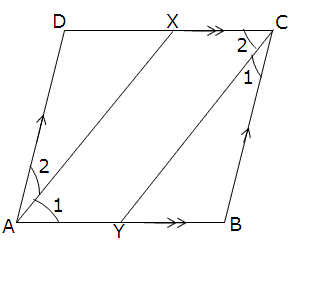
A and C respectively. Prove that AX || CY. Solution
A = C (opposite angles of parallelogram)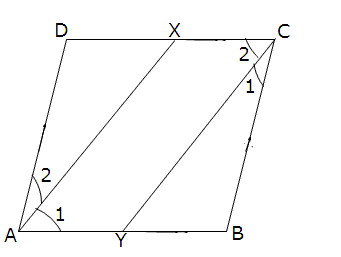
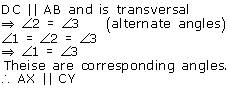
Q7. In a parallelogram ABCD, if  A = 60o, then D is equal to:
A = 60o, then D is equal to:Solution
 Adjacent angles of a parallelogram are supplementary.

Q8. ABCD is a parallelogram whose diagonals AC and BD intersect at O. A line through O intersect AB at P and DC at Q. Prove that:
ar( POA) = ar(QOC)
POA) = ar(QOC)Solution
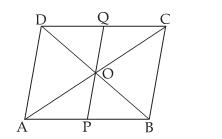 In POA and QOC, we have
 AOP = COQ [vertical opp. angle]
AO = OC [diagonals of a ||gm bisect each other]
PAC = QCA [ alt. interior angles]
AOP = COQ [vertical opp. angle]
AO = OC [diagonals of a ||gm bisect each other]
PAC = QCA [ alt. interior angles]
 [ASA criteria]
 [congruent figures are equal in areas]
Q9. Two consecutive angles of parallelogram are in the ratio 1 : 3, then the measure of the smaller angle is:
Solution
Let the angles be x and 3x.
The sum of the two consecutive angles of a parallelogram is 1800

Q10. ABCD is a quadrilateral and AP and DP are bisectors of  A and D. The value of x is:

A and D. The value of x is:
Solution
Given, ABCD is a quadrilateral.
Therefore, A + B + C + D = 360° .... (1)
Again, it is given that AP and DP are bisectors of A and D respectively.
So, in triangle APD, by angle sum property of triangle,
 From (1), we have
A + D +B + C = 360°
From (1), we have
A + D +B + C = 360°
 360° - 2APD +B + C = 360° [using (2)]
- 2APD +B + C = 0
B + C = 2APD
2APD = B + C
APD =
360° - 2APD +B + C = 360° [using (2)]
- 2APD +B + C = 0
B + C = 2APD
2APD = B + C
APD = 
A + B + C + D = 360° .... (1)
Again, it is given that AP and DP are bisectors of A and D respectively.
So, in triangle APD, by angle sum property of triangle,
From (1), we have
A + D +B + C = 360°
360° - 2APD +B + C = 360° [using (2)]
- 2APD +B + C = 0
B + C = 2APD
2APD = B + C
APD =
Q11. The diagonals AC and BD of a parallelogram ABCD intersect each other at the point O. If  DAC = 32o, AOB = 70o, then DBC is equal to:
DAC = 32o, AOB = 70o, then DBC is equal to:Solution


Q12. In the figure, P is the mid-point of side
BC of parallelogram ABCD such that  BAP = DAP. Prove that AD = 2CD.

BAP = DAP. Prove that AD = 2CD.
Solution
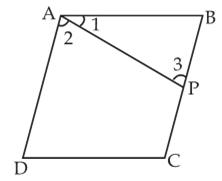 In
the figure,
1
= 2 (given)
But
2 = 3 (alternate interior angles)
In
the figure,
1
= 2 (given)
But
2 = 3 (alternate interior angles)
 1 = 3
AB = BP
(sides opp. to equal
angles are equal)
But
AB = CD (opposite sides of
||gm)
CD = BP
1 = 3
AB = BP
(sides opp. to equal
angles are equal)
But
AB = CD (opposite sides of
||gm)
CD = BP
 CD =
CD =  BC (Since,
P is the mid-point of BC)
2CD = BC
2CD = AD (Since,
BC = AD)
BC (Since,
P is the mid-point of BC)
2CD = BC
2CD = AD (Since,
BC = AD)
Q13. All the angles of a convex quadrilateral are congruent. However, not all its sides are congruent. What type of quadrilateral is it?
Solution
All the angles of a rectangle are equal and the pair of opposite sides is equal.
Thus, all the angles of rectangle are congruent, but all its sides are not congruent.
Q14. In a parallelogram ABCD, if  A = 75o, then B =?
A = 75o, then B =?Solution
In a parallelogram, adjacent angles are supplementary.
Therefore,

Q15. M is the mid point of side PQ of a parallelogram PQRS. A line through Q parallel to PS meets SR at N and PS produced at L. Prove that (i) PL = 2QR (ii) QL = 2QN. 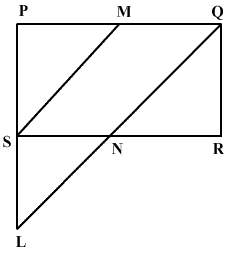
Solution
(i) In  PLQ, M is the mid point of PQ and MS
  QL
QL
 S is the mid point of PL
 PL = 2PS or PL = 2QR (
 ABCD is parallelogram PS = QR)
(ii) ABCD is parallelogram SR PQ or SN PQ
In LPQ, S is the mid point of PL and SN PQ
N is the mid point of QL
QL = 2QN
ABCD is parallelogram PS = QR)
(ii) ABCD is parallelogram SR PQ or SN PQ
In LPQ, S is the mid point of PL and SN PQ
N is the mid point of QL
QL = 2QN
PLQ, M is the mid point of PQ and MS QL
S is the mid point of PL
PL = 2PS or PL = 2QR (ABCD is parallelogram PS = QR)
(ii) ABCD is parallelogram SR PQ or SN PQ
In LPQ, S is the mid point of PL and SN PQ
N is the mid point of QL
QL = 2QN
Q16. In fig., PQRS is a rectangle. If  RPQ = 30o then the value of (x + y) is:

RPQ = 30o then the value of (x + y) is:
Solution
 Let the diagonals bisect each other at O.
Also the diagonals of a rectangle are equal.
Therefore,
OP = OQ
Let the diagonals bisect each other at O.
Also the diagonals of a rectangle are equal.
Therefore,
OP = OQ
 Now in
 Hence,
 180o
180o
Q17. The angles of a quadrilateral are in the ratio 3: 5: 9: 13. Find all the angles of the quadrilateral.
Solution
Let the angles be 3x, 5x, 9x, and 13x.
3x + 5x + 9x + 13x = 360o (angle sum of a quadrilateral)
 30x = 360o x =12o
Hence, the angles are 36o, 60o, 108o and 156o.
30x = 360o x =12o
Hence, the angles are 36o, 60o, 108o and 156o.
30x = 360o x =12o
Hence, the angles are 36o, 60o, 108o and 156o.
Q18. Which of the following is not a parallelogram?
Solution
A parallelogram has two pairs of parallel sides. The trapezium has only one pair of parallel sides. Hence, Trapezium is not a parallelogram.
Q19. Find the measure of each angle of a parallelogram, if one of its angles is 30o less than twice the smallest angle.
Solution
Let the smallest angle be x.
Then one of the angles is 2x – 30o
(2x – 30o) + x = 180o
(Interior angles on same side of transversal are supplementary)
 x = 70o
One angle = (2x – 30o) = 110o
Opposite angles of a parallelogram are equal
Hence, the four angles are 70o, 110o, 70o, 110o
x = 70o
One angle = (2x – 30o) = 110o
Opposite angles of a parallelogram are equal
Hence, the four angles are 70o, 110o, 70o, 110o
x = 70o
One angle = (2x – 30o) = 110o
Opposite angles of a parallelogram are equal
Hence, the four angles are 70o, 110o, 70o, 110o
Q20. ABCD is a rhombus. Show that diagonal AC
bisects  A as well as C and diagonal BD bisects B as well as D.
A as well as C and diagonal BD bisects B as well as D.Solution
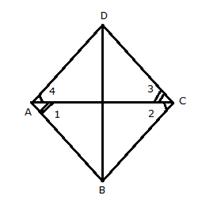 Let us join AC.
In
Let us join AC.
In  ABC,
BC = AB (Sides
of a rhombus are equal to each other)
ABC,
BC = AB (Sides
of a rhombus are equal to each other)
 1 = 2 (Angles
opposite to equal sides of a triangle are equal)
However, 1 = 3 (Alternate interior angles for parallel lines AB
and CD)
1 = 2 (Angles
opposite to equal sides of a triangle are equal)
However, 1 = 3 (Alternate interior angles for parallel lines AB
and CD)
 2 = 3
Therefore, AC bisects C.
Also, 2 = 4 (Alternate interior angles for || lines BC and
DA)
1 = 4
Therefore, AC bisects A.
Similarly,
it can be proved that BD bisects B and D as well.
2 = 3
Therefore, AC bisects C.
Also, 2 = 4 (Alternate interior angles for || lines BC and
DA)
1 = 4
Therefore, AC bisects A.
Similarly,
it can be proved that BD bisects B and D as well.
Q21. In a quadrilateral ABCD, the line segments bisecting  C and D meet at E. Prove that A + B = 2 CED.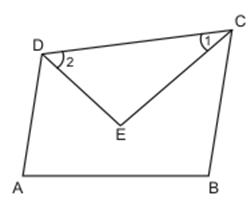
C and D meet at E. Prove that A + B = 2 CED. Solution
 In
In  DEC, 1+ 2 + CED = 180o (angle sum property of triangle)
 CED = 180o – (1+ 2)
A + B+ C+D = 360o (angle sum property of quadrilateral)
CED = 180o – (1+ 2)
A + B+ C+D = 360o (angle sum property of quadrilateral)

Q22. In the given figure, ABCD is a rhombus in which diagonals AC and BD intersect at O. Then measure of  AOB is.

AOB is.
Solution
The intersection of the diagonals of a rhombus form 90 degree (right) angles.
Q23. ABCD is a parallelogram. If  DAB = 60o and DBC = 80o find CDB.

DAB = 60o and DBC = 80o find CDB.
Solution
A
= C [opp.
Angles of ||gm]
 C = 60o
Now
in
C = 60o
Now
in  BDC
C
+ CDB + DBC = 180o.
60o
+ CDB + 80o = 180o
CDB
= 180o - 140o = 40o.
BDC
C
+ CDB + DBC = 180o.
60o
+ CDB + 80o = 180o
CDB
= 180o - 140o = 40o.
Q24. ABCD is a rhombus  ABC = 66o. Determine ACD.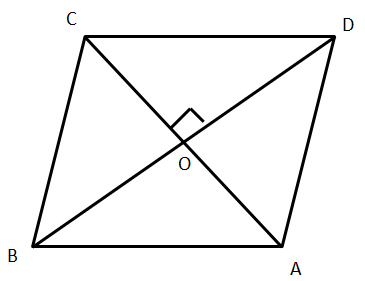
ABC = 66o. Determine ACD. Solution
ABC = ADC = 66o (opposite angles of a parallelogram)
 ODC = 33o (ODC = 1/2 ADC)
In
ODC = 33o (ODC = 1/2 ADC)
In  OCD,
ODC + OCD + COD = 180o
33o + OCD +90o = 180o nbsp; (COD = 90o, diagonals bisect at rt. angle)
OCD = 57o
Hence ACD = 57o
OCD,
ODC + OCD + COD = 180o
33o + OCD +90o = 180o nbsp; (COD = 90o, diagonals bisect at rt. angle)
OCD = 57o
Hence ACD = 57o
Q25. Show that the quadrilateral formed by
joining the mid-points of the sides of a rectangle is a rhombus.
Solution
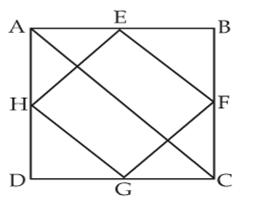 Given :-
ABCD is a rectangle and E,F,G,H are the midpoints of sides AB, BC< CD and
DA respectively.
To Prove:-
EFGH is a rhombus.
Proof:-In
Given :-
ABCD is a rectangle and E,F,G,H are the midpoints of sides AB, BC< CD and
DA respectively.
To Prove:-
EFGH is a rhombus.
Proof:-In
 ABC,
E and F
are the mid points of AB and BC respectively.
ABC,
E and F
are the mid points of AB and BC respectively.
 EF || AC and EF =
  AC
Similarly,
GH || AC and GH = AC
Hence, EF
|| GH and EF = GH
Thus, EFGH
is a parallelogram.
Now, in
triangles AEH and EBF,
AE=BE
AC
Similarly,
GH || AC and GH = AC
Hence, EF
|| GH and EF = GH
Thus, EFGH
is a parallelogram.
Now, in
triangles AEH and EBF,
AE=BE
 EAH = EBF
AH = BF
AEH
EAH = EBF
AH = BF
AEH  BEF and EH=EF
Therefore,
EFGH is a ||gm in which adjacent sides are equal.
Hence,
EFGH is a rhombus
BEF and EH=EF
Therefore,
EFGH is a ||gm in which adjacent sides are equal.
Hence,
EFGH is a rhombus
Q26. Three angles of a quadrilateral are 70o, 120o and 65o. The fourth angle of the quadrilateral is :
Solution
Sum of the four angles of a quadrilateral is 360o.
Let x be the measure of the fourth angle.
x + 70o + 120o + 65o = 360o
x + 255o = 360o
x = 360o - 255o
x = 105o
So, the measure of the fourth angle is 105o
Q27. In the given figure, LMNQ is a parallelogram in which  L = 75o and QMN = 60o. Find NQM and LQM.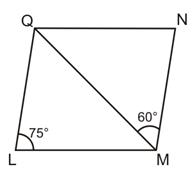
L = 75o and QMN = 60o. Find NQM and LQM. Solution
L +  M = 180o
  75o + LMO + 60o = 180o
LMO = 45o
LMO = NOM = 45o (alternate angles)
LOM = OMN= 60o (alternate angles)
75o + LMO + 60o = 180o
LMO = 45o
LMO = NOM = 45o (alternate angles)
LOM = OMN= 60o (alternate angles)
 LOM = 60o and NOM = 45o
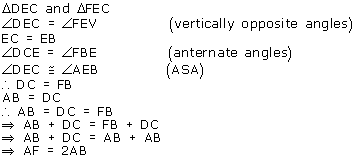
Q28. ABCD is a parallelogram and E is the mid point of side BC. If DE and AB when produced meet at F, prove that AF = 2AB. 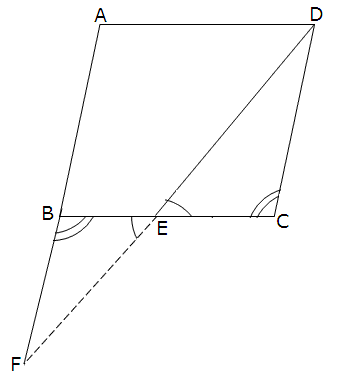
Solution
Q29. The length of the diagonal of the square is 10 cm. The area of the square is:
Solution
Let c be the diagonal, a and b are the lengths of the sides: a2 + b2 = c2
but, a = b
2a2 = 102 a2 = 100 / 2
a =  cm
Area = a2
=
cm
Area = a2
=  = 50 cm2
cm
Area = a2
=
= 50 cm2
Q30. ABCD is a square prove that diagonal BD bisects  B as well as D.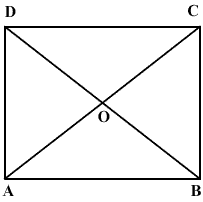
B as well as D. Solution
In triangles BAD and BCD
BA = CD,
BC = AD and BD = BD

 BAD
BAD  BCD (SSS)
 ABD = BCD
and ADB =
ABD = BCD
and ADB =  CDB
Hence, BD bisects B as well as D.
CDB
Hence, BD bisects B as well as D.
BAD BCD (SSS)
ABD = BCD
and ADB = CDB
Hence, BD bisects B as well as D.
Q31. In quadrilateral PQRS, if  P = 60o and Q : R : S = 2 : 3 : 7, then S =
P = 60o and Q : R : S = 2 : 3 : 7, then S = Solution
 P = 600
Sum of all angles of a quadrilateral is 360o.
P = 600
Sum of all angles of a quadrilateral is 360o.
 Q +R +S = (360-60)o = 300o…..(1)
It is given that Q : R : S = 2 : 3 : 7.
Let angles Q, R and S be 2x, 3x and 7x respectively.
From (1), we have:
2x + 3x + 7x = 3000
12x = 300o
x=25o
Q +R +S = (360-60)o = 300o…..(1)
It is given that Q : R : S = 2 : 3 : 7.
Let angles Q, R and S be 2x, 3x and 7x respectively.
From (1), we have:
2x + 3x + 7x = 3000
12x = 300o
x=25o
 S = 7x = 7
  25o = 175o
Q32. The angles of a quadrilateral are in the
ratio 3 : 5 : 9 : 13. Find all the angles of quadrilateral.
Solution
Let
the angles be 3x, 5x, 9x, 13x
3x
+ 5x + 9x + 12x = 360o.
 30x = 360o
x
= 120
30x = 360o
x
= 120
 Angles are 36o, 60o,
108o, 156o.
Angles are 36o, 60o,
108o, 156o.
30x = 360o
x
= 120
Angles are 36o, 60o,
108o, 156o.
Q33. Which of the following is not a parallelogram?
Solution
A Trapezium is not a parallelogram because it does not have both pair of opposite sides parallel.
Q34. Show that the diagonals of a rhombus are
perpendicular to each other.
Solution
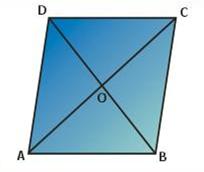 Given:
ABCD is a
rhombus. Diagonal AC and BD intersect at O.
To prove:
AC and BD
bisect each other at right angles.
Proof:
A rhombus
is a parallelogram such that,
AB = DC =
AD = BC ---(i)
Also, the
diagonals of a parallelogram bisect each other.
Hence, BO
= DO and AO = OC ---(ii)
Now,
compare
Given:
ABCD is a
rhombus. Diagonal AC and BD intersect at O.
To prove:
AC and BD
bisect each other at right angles.
Proof:
A rhombus
is a parallelogram such that,
AB = DC =
AD = BC ---(i)
Also, the
diagonals of a parallelogram bisect each other.
Hence, BO
= DO and AO = OC ---(ii)
Now,
compare  AOB and AOD,
AB = AD
(from (i) above)
BO = DO
(from (ii) above)
AO = AO
(common side)
Therefore,
AOB
AOB and AOD,
AB = AD
(from (i) above)
BO = DO
(from (ii) above)
AO = AO
(common side)
Therefore,
AOB  AOD (SSS Congruency Condition)
Therefore,
AOD (SSS Congruency Condition)
Therefore,
 AOB = AOD (corresponding parts)
BD is a
straight line segment.
Therefore,
AOB + AOD = 1800
But, AOB = AOD (Proved)
AOB = AOD = 1800/ 2 = 900
i.e., the
diagonals are perpendicular to each other.
AOB = AOD (corresponding parts)
BD is a
straight line segment.
Therefore,
AOB + AOD = 1800
But, AOB = AOD (Proved)
AOB = AOD = 1800/ 2 = 900
i.e., the
diagonals are perpendicular to each other.
Q35. Two angles of a quadrilateral are 50o and 80o and other two angles are in the ratio 8 : 15. Find the measure of the remaining two angles.
Solution
Let the angles be 8x and 15x.
The sum of the interior angles of a quadrilateral = 3600.
 Hence, other two angles are: 80o, 150o
Hence, other two angles are: 80o, 150o
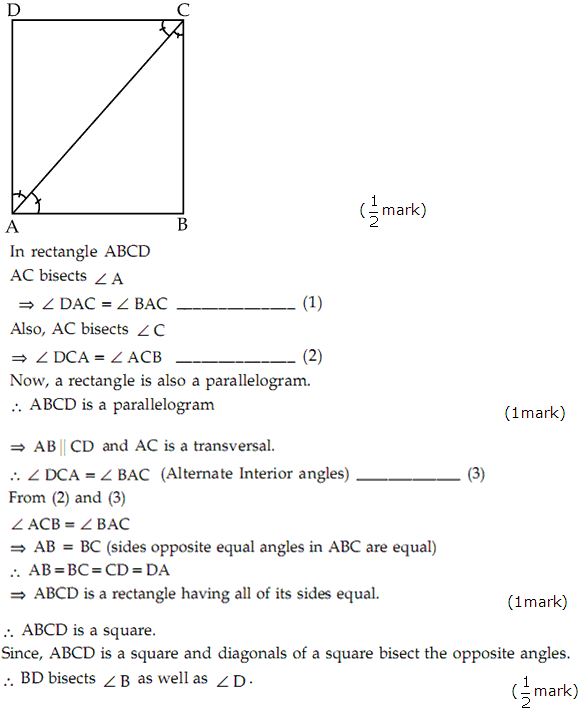
Q36. 
Solution
Q37. In fig., PQRS is a parallelogram in which  PSR = 125o, RQT is equal to

PSR = 125o, RQT is equal to
Solution
PSR = RQP = 125o ( since PQRS is a parallelogram, opposite angles will be equal)
PQT = 180o (PQT is a st. line)
PQR + RQT = 1800
1250 + RQT = 1800
RQT = 55o
Q38. In parallelogram ABCD, if  A = 2x + 15o, B = 3x - 25o, then value of x is:
A = 2x + 15o, B = 3x - 25o, then value of x is:Solution
In a parallelogram, the sum of adjacent angles = 1800
Therefore,
A + B = 1800
2x + 15o + 3x - 25o = 1800
5x -100 = 1800
5x = 1900
x = 38o
A + B = 1800
2x + 15o + 3x - 25o = 1800
5x -100 = 1800
5x = 1900
x = 38o
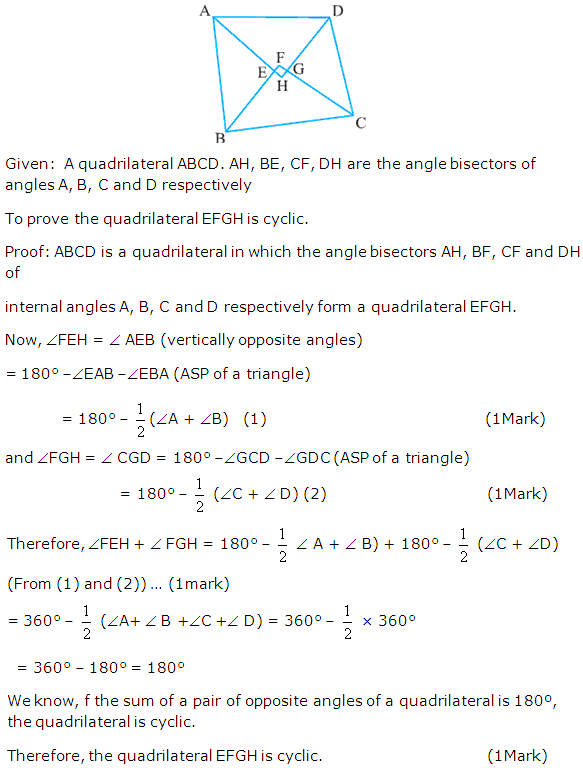
Q39. Prove that the quadrilateral formed (if possible) by the internal angle bisectors of any quadrilateral is cyclic.
Solution
Q40. If APB and CQD are parallel lines and a transversal PQ cut them at P and Q, then the bisectors of angles APQ, BPQ, CQP and PQD form a
Solution
 Rectangle PQRS is formed by the bisectors of angles APQ, BPQ, CQP and PQD.
Q41. ABCD is a parallelogram in which P, Q, R and S are the mid points of the sides AB, BC, CD and DA respectively. AC is a diagonal, show that PQRS is a parallelogram. 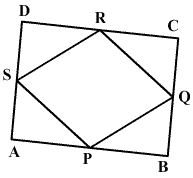
Solution
ABCD is a quadrilateral; P, Q, R and S are the mid points of the sides AB, BC, CD and DA respectively.
Join AC.
In  ABC, P and Q are the mid points of sides AB and BC respectively.
 PQ
PQ  AC and PQ =
  AC (i) (by mid point theorem)
In ADC, R and S are the mid points of sides CD and AD respectively.
RS AC and RS = AC (ii) (by mid point theorem)
From (i) and (ii)
PQ RS and PQ = RS
In the quadrilateral PQRS one pair of opposite sides is equal and parallel.
PQRS is a parallelogram.
AC (i) (by mid point theorem)
In ADC, R and S are the mid points of sides CD and AD respectively.
RS AC and RS = AC (ii) (by mid point theorem)
From (i) and (ii)
PQ RS and PQ = RS
In the quadrilateral PQRS one pair of opposite sides is equal and parallel.
PQRS is a parallelogram.
ABC, P and Q are the mid points of sides AB and BC respectively.
PQ AC and PQ = AC (i) (by mid point theorem)
In ADC, R and S are the mid points of sides CD and AD respectively.
RS AC and RS = AC (ii) (by mid point theorem)
From (i) and (ii)
PQ RS and PQ = RS
In the quadrilateral PQRS one pair of opposite sides is equal and parallel.
PQRS is a parallelogram.
Q42. Three angles of a quadrilateral are 60o, 110o and 86o, the fourth angle of the quadrilateral is:
Solution
Let fourth angle be x.
Sum of the angles of a quadrilateral = 3600
600 + 1100 + 860 + x = 3600
2560 + x = 3600
x = 104o
Q43. D, E and F respectively are the mid-points of the sides BC, CA and AB of  ABC. Show that ar(DEF) =
ABC. Show that ar(DEF) = Solution
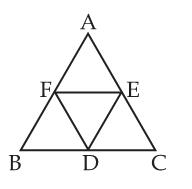 D
and E are mid points of BC and AC.
D
and E are mid points of BC and AC.
 DE||AB and DE =
  (Mid-point
Theorem)
Similarly,
E and F are mid points of AC and AB.
EF||BC and EF =
(Mid-point
Theorem)
Similarly,
E and F are mid points of AC and AB.
EF||BC and EF =  In
quadrilateral BDEF, DE||BF and FE||BD
BDEF is a parallelogram
Similarly,
DCEF and AFDE are parallelograms.
We know
that diagonal of a parallelogram divides it into two triangles of equal area.
In
quadrilateral BDEF, DE||BF and FE||BD
BDEF is a parallelogram
Similarly,
DCEF and AFDE are parallelograms.
We know
that diagonal of a parallelogram divides it into two triangles of equal area.
 Area (BFD) = Area (DEF) (For parallelogram BDEF)
Area (CDE) = Area (DEF) (For
parallelogram DCEF)
Area (AFE) = Area (DEF) (For
parallelogram AFDE)
Area (AFE) = Area (BFD) = Area (CDE) = Area (DEF)
Also,
Area (AFE) + Area (BDF) + Area (CDE) + Area (DEF) = Area (ABC)
Area (BFD) = Area (DEF) (For parallelogram BDEF)
Area (CDE) = Area (DEF) (For
parallelogram DCEF)
Area (AFE) = Area (DEF) (For
parallelogram AFDE)
Area (AFE) = Area (BFD) = Area (CDE) = Area (DEF)
Also,
Area (AFE) + Area (BDF) + Area (CDE) + Area (DEF) = Area (ABC)
 Area (DEF) + Area (DEF) + Area (DEF) + Area (DEF) = Area (ABC)
4 Area (DEF) = Area (ABC)
Area (DEF) = Area
Area (DEF) + Area (DEF) + Area (DEF) + Area (DEF) = Area (ABC)
4 Area (DEF) = Area (ABC)
Area (DEF) = Area
 (ABC)
(ABC)
Q44. The lengths of the diagonals of a rhombus are 24 cm and 18 cm respectively. Find the length of each side of the rhombus.
Solution
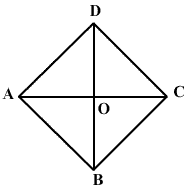 Let ABCD be the rhombus. Diagonal AC = 24 cm and BD = 18 cm.
Diagonals of a rhombus bisect each other at right angles.
Let ABCD be the rhombus. Diagonal AC = 24 cm and BD = 18 cm.
Diagonals of a rhombus bisect each other at right angles.
 AO = OC = 12 cm and OB = OD = 9 cm and
  AOD = 90o
In right
AOD = 90o
In right  AOD, AO = 12 cm and OD = 9 cm
By Pythagoras theorem, AD2 = AO2 + OD2
AOD, AO = 12 cm and OD = 9 cm
By Pythagoras theorem, AD2 = AO2 + OD2
 AD2 = (12)2 + (9)2
AD = 15 cm
All sides of a rhombus are equal.
Hence, each side of the rhombus = 15 cm
AD2 = (12)2 + (9)2
AD = 15 cm
All sides of a rhombus are equal.
Hence, each side of the rhombus = 15 cm
Q45. 
Solution
Q46. In the given figure, PQRS is a parallelogram and  R is 100o then Q is

R is 100o then Q is
Solution
The adjacent angles of a parallelogram are supplementary.
R + Q = 180o
1000 + Q = 180o
Q = 80o
R + Q = 180o
1000 + Q = 180o
Q = 80o
Q47. Show that if the diagonals of a
quadrilateral bisect each other at right angles, then it is a rhombus.
Solution
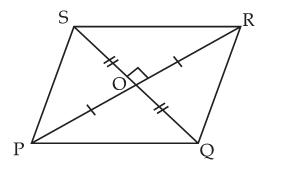 In
In
 SOR and QOR,
SO
= QO
SOR and QOR,
SO
= QO
 SOR
= QOR = 90o
OR
= OR (common)
SOR
= QOR = 90o
OR
= OR (common)
 Similarly,
 And,
we get, PQ = QR = RS = SP
Hence,
PQRS is a rhombus.
And,
we get, PQ = QR = RS = SP
Hence,
PQRS is a rhombus.
Q48. Diagonals of a parallelogram ABCD intersect
at point O. Through O, a line is drawn to intersect AD at P and BC at Q. Show
that PQ divides the parallelogram into two parts of equal area.
Solution
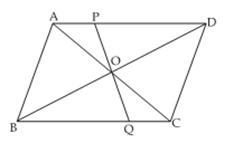 Since
diagonals of parallelogram divide it into two triangles of equal area.
Area(
Since
diagonals of parallelogram divide it into two triangles of equal area.
Area( ABC) = area(ACD)
 area (quad ABQO) + (COQ) = area(quad. CDPO) + area(AOP)
...(1)
In
AOP and COQ,
area (quad ABQO) + (COQ) = area(quad. CDPO) + area(AOP)
...(1)
In
AOP and COQ,
 AOP
= COQ (vert. opp. Angles)
OA
= OC(diagonals of a||gm bisect each other)
OAP
= OCQ (alternate angles)
AOP
= COQ (vert. opp. Angles)
OA
= OC(diagonals of a||gm bisect each other)
OAP
= OCQ (alternate angles)
 (ASA congruence)
 ....(2)
From
(1) and (2), we have:
area(quad.
ABQO) + area(
....(2)
From
(1) and (2), we have:
area(quad.
ABQO) + area( ) = area(quad. CDPO) + area(
 )
Hence,
area(quad. ABQP) = area(quad. CDQP)
)
Hence,
area(quad. ABQP) = area(quad. CDQP)
Q49. In a parallelogram PQRS, if  P = (3x
- 5)0, Q = (2x + 15)o find the value of x.
P = (3x
- 5)0, Q = (2x + 15)o find the value of x.
P = (3x
- 5)0, Q = (2x + 15)o find the value of x.Solution
P
+ Q = 180o [Angles on the same side of a
transversal are supplementary]
3x
- 5 + 2x + 15 = 1800
5x
= (180 - 10)0
5x
= 170o
x
= 34o
Q50. If the three angles of a quadrilateral are 70o, 95o and 105o, then the fourth angle is:
Solution
The sum of angles in a quadrilateral is 3600.
Let fourth angle be x.
Therefore,
700 + 950 + 1050 + x = 3600(angle sum property)
x = 3600 - 270o
x = 90o
Q51. If there are three or more parallel lines
and the intercepts made by them on one transversal are equal, then the
corresponding intercepts by any other transversal are also equal.
Solution
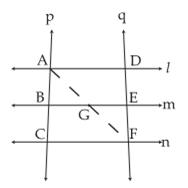 Given: l,
m and n are three parallel lines intersected by transversals p and q such
that l, m and n cut off equal
intercepts AB and BC on p.
To
prove: l, m and n cut off equal
intercept DE and EF on q also.
Proof:
Join AF, suppose it intersect line m at G In
Given: l,
m and n are three parallel lines intersected by transversals p and q such
that l, m and n cut off equal
intercepts AB and BC on p.
To
prove: l, m and n cut off equal
intercept DE and EF on q also.
Proof:
Join AF, suppose it intersect line m at G In  ACF, B is the mid-point AC [
 AB = BC]
And BG||CF
AB = BC]
And BG||CF
 G is the mid-point of AF [Converse of mid point theorem]
In
AFD, G is the mid point of AF and GE||AD
E is the mid point of DF
G is the mid-point of AF [Converse of mid point theorem]
In
AFD, G is the mid point of AF and GE||AD
E is the mid point of DF
 DE = EF
Hence
l, m and n cut off equal intercepts
DE and EF on q.
DE = EF
Hence
l, m and n cut off equal intercepts
DE and EF on q.
Q52. The sides ML and ON of a quadrilateral are produced as shown in the figure. Prove that x + y = a + b 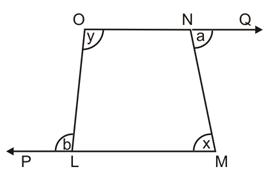
Solution
 L + b = 180o (linear pair)
 L = 180o – b
Also N + a = 180o
N = 180o – a
L + M + N + O = 360o (sum of the angles of a quadrilateral)
(180o – b) + x + (180o – a) + y = 360o
x + y = a + b
L = 180o – b
Also N + a = 180o
N = 180o – a
L + M + N + O = 360o (sum of the angles of a quadrilateral)
(180o – b) + x + (180o – a) + y = 360o
x + y = a + b
Q53. In the given figure, PN and RM are perpendiculars to the diagonal QS of a parallelogram PQRS. Prove that  PNS
PNS  RMQ and PN = RM.
PNS RMQ and PN = RM. Solution
PS||QR and SQ is a transversal

 1 = 2 (alternate interior angles)
In PNS and RMQ
PNS = RMQ (90o each)
1 = 2
PS = QR
PNS RMQ (AAS)
1 = 2 (alternate interior angles)
In PNS and RMQ
PNS = RMQ (90o each)
1 = 2
PS = QR
PNS RMQ (AAS)
 PN = RM (c.p.c.t)
1 = 2 (alternate interior angles)
In PNS and RMQ
PNS = RMQ (90o each)
1 = 2
PS = QR
PNS RMQ (AAS)
PN = RM (c.p.c.t)
Q54. In the figure, AB||DE, AB = DE, AC||DF, AC
= DF. Prove that BC||EF and BC = EF.

Solution
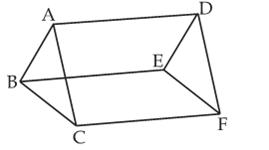 In
quadrilateral ABED
AB||DE,
AB = DE (Given)
In
quadrilateral ABED
AB||DE,
AB = DE (Given)
 ABED is a ||gm (Quadrilateral with one pair of
opposite sides equal and parallel.)
ABED is a ||gm (Quadrilateral with one pair of
opposite sides equal and parallel.)
 AD = BE, AD||BE ....(I)
In
quadrilateral ACFD
AC|DF, AC = DF
ACFD is a ||gm
AD = BE, AD||BE ....(I)
In
quadrilateral ACFD
AC|DF, AC = DF
ACFD is a ||gm
 AD||CF, AD= CF ...(II)
From
I and II
BE||CF
and BE = CF
BCFE is a ||gm
BC||EF and BC = EF (opposite sides of ||gm are
parallel and equal)
AD||CF, AD= CF ...(II)
From
I and II
BE||CF
and BE = CF
BCFE is a ||gm
BC||EF and BC = EF (opposite sides of ||gm are
parallel and equal)
Q55. Points A and B are in the same sides of a
line l. AD and BE are
perpendiculars to l, meeting l at D and E respectively. C is the
mid-point of AB. Prove that CD = CE

Solution
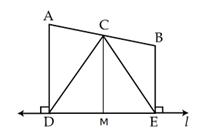 Draw
CM
Draw
CM  l
AC = CB (Given)
DM
= ME (by construction)
l
AC = CB (Given)
DM
= ME (by construction)
 (by construction)
CM
= CM (Common)
(by construction)
CM
= CM (Common)
 (by SAS cong. Rule)
CD
= CE (by cpct)
(by SAS cong. Rule)
CD
= CE (by cpct)
Q56. In the given figure, ABCD is a trapezium in
which AB||CD and AD = BC . Show that
 (i)
(i)  A = B
(ii) C = D
(iii)
A = B
(ii) C = D
(iii) 
(i) A = B
(ii) C = D
(iii) Solution
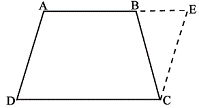 Construction
: Produce AB and draw a line CE || AD.
Proof :
(i)
Since AD || CE and transversal AE cuts them at A and E respectively.
A + E = 180°
...(1)
Since AB
|| CD and AD || CE, AECD is a parallelogram.
AD = CE
BC = CE (AD = BC (given))
Thus, In
Construction
: Produce AB and draw a line CE || AD.
Proof :
(i)
Since AD || CE and transversal AE cuts them at A and E respectively.
A + E = 180°
...(1)
Since AB
|| CD and AD || CE, AECD is a parallelogram.
AD = CE
BC = CE (AD = BC (given))
Thus, In  BCE, we have
BC = CE
CBE = CEB
180° -B = E
B + E = 180° ...(2)
from (1)
and (2), we get,
A + E = B + E
A = B
(ii)
Since A = B
BAD = ABD
180° - BAD = 180° - ABD
ADB = BCD
D = C
i.e. C = D
(iii)
In ABC and BAD,
we have BC
= AD (given)
AB = AB
(common)
A = B (proved above)
(SAS
Congruence condition)
BCE, we have
BC = CE
CBE = CEB
180° -B = E
B + E = 180° ...(2)
from (1)
and (2), we get,
A + E = B + E
A = B
(ii)
Since A = B
BAD = ABD
180° - BAD = 180° - ABD
ADB = BCD
D = C
i.e. C = D
(iii)
In ABC and BAD,
we have BC
= AD (given)
AB = AB
(common)
A = B (proved above)
(SAS
Congruence condition)
Q57. The diagonals of rhombus are 12 cm and 16 cm. The length of the side of rhombus is:
Solution
Diagonals of a rhombus are perpendicular bisectors of each other, making 4 right triangles with perpendiculars and heights 6 and 8 as diagonals of rhombus bisect each other .The side of the rhombus will be hypotenuse.
Using Pythagoras theorem:
 Side = 10 cm
Side = 10 cm
Q58. 
Solution
Q59. Show that the quadrilateral formed by
joining the mid-points of the sides of a rhombus taken in order, form a
rectangle.
Solution
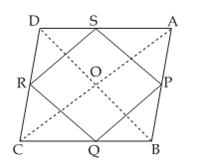 Let ABCD be a rhombus and P, Q, R and
S be the mid-points of sides AB, BC, CD and DA respectively.
In
Let ABCD be a rhombus and P, Q, R and
S be the mid-points of sides AB, BC, CD and DA respectively.
In  ABD and BDC we have
 From (i) and (ii) we get
PQRS is a ||gm
As diagonals of a rhombus bisect
each other at right angles.
From (i) and (ii) we get
PQRS is a ||gm
As diagonals of a rhombus bisect
each other at right angles.
 AC
AC  BD
Since SP||BD, PQ||AC and AC BD
BD
Since SP||BD, PQ||AC and AC BD
 From above results, we have
||gm PQRS is a
rectangle.
From above results, we have
||gm PQRS is a
rectangle.
Q60. Prove that the diagonals of a rhombus are perpendicular to each other.
Solution
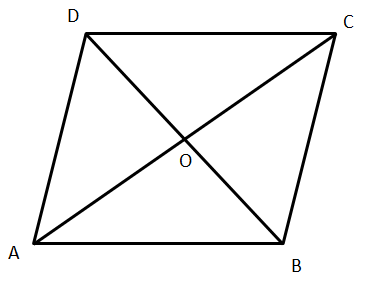 ABCD is a rhombus.
  AB = BC = DC
BO = OD; and AO = OC (rhombus is a parallelogram, diagonals bisect each other)
In
AB = BC = DC
BO = OD; and AO = OC (rhombus is a parallelogram, diagonals bisect each other)
In  BOC and DOC
BO = DO,
BC = DC and OC = OC
BOC
BOC and DOC
BO = DO,
BC = DC and OC = OC
BOC DOC (SSS)
 BOC = DOC (c.p.c.t)
BOC + DOC = 180o (linear pair)
Or BOC = DOC = 90o
Hence, diagonals of a rhombus are perpendicular to each other.
BOC = DOC (c.p.c.t)
BOC + DOC = 180o (linear pair)
Or BOC = DOC = 90o
Hence, diagonals of a rhombus are perpendicular to each other.
Q61. ABCD is a parallelogram and line segments
AX and CY bisect angles A and C. Show that AX||YC.

Solution
 1
= 2, 3 = 4 And A=C
AD=BC
D=B
1
= 2, 3 = 4 And A=C
AD=BC
D=B
 (by ASA rule)
DX
= BY
(by ASA rule)
DX
= BY  BY = DX
AB
= CD
AB
- BY = DC - DX
AY
= CX
AY||CX
BY = DX
AB
= CD
AB
- BY = DC - DX
AY
= CX
AY||CX
 AYCX is a parallelogram
AX||CY
OR,
A = C
(Opposite
angles of parallelogram ABCD)
Therefore,
AYCX is a parallelogram
AX||CY
OR,
A = C
(Opposite
angles of parallelogram ABCD)
Therefore,
 A = C
i.e., YAX = YCX …(1)
Also, AYC + YCX = 180º (Because YA || CX)…. (2)
Therefore,
AYC + YAX = 180º [From (1) and (2)]
So, AX ||
CY (As interior angles on the same side of the transversal are supplementary)
A = C
i.e., YAX = YCX …(1)
Also, AYC + YCX = 180º (Because YA || CX)…. (2)
Therefore,
AYC + YAX = 180º [From (1) and (2)]
So, AX ||
CY (As interior angles on the same side of the transversal are supplementary)
Q62. Prove that if the diagonals of a
quadrilateral bisect each other, then it is a parallelogram.
Solution
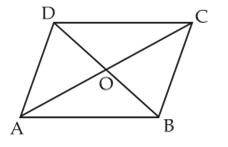 OA
= OC and OB = OD [Given]
OA
= OC and OB = OD [Given]
 AOB
= DOC
[vertically opp. angles]
AOB
= DOC
[vertically opp. angles]
 [SAS congruence]
Therefore
[SAS congruence]
Therefore
 ABO = CDO (cpct)
From
this, we get AB||CD ...(i)
Similarly BC||AD ...(ii)
ABO = CDO (cpct)
From
this, we get AB||CD ...(i)
Similarly BC||AD ...(ii)
 From (i) and (ii) ABCD is a ||gm.
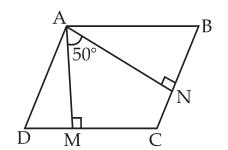
Q63. The angle between the two altitudes of
parallelogram through the vertex of an obtuse angle is 50o. Find
the angles of parallelogram.
Solution


Q64. 
Solution
Q65. LMNO is a rectangle with  QPR = 35o. Determine SQR.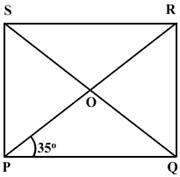
QPR = 35o. Determine SQR. Solution
Let the diagonals PR and QS intersect at O.
OP = OQ (diagonals of a rectangle are equal and bisect each other.)
 OPQ = OQP or QPR = SQP
SQP = 35o
PQR = 90o
SQP + SQR = 90o
OPQ = OQP or QPR = SQP
SQP = 35o
PQR = 90o
SQP + SQR = 90o
 SQR = 90o – 35o = 55o
Hence SQR = 55o
SQR = 90o – 35o = 55o
Hence SQR = 55o
OPQ = OQP or QPR = SQP
SQP = 35o
PQR = 90o
SQP + SQR = 90o
SQR = 90o – 35o = 55o
Hence SQR = 55o
Q66. Diagonals PR and QS of quadrilateral PQRS
intersect at T such that PT = TR. If PS = QR, show that ar ( PTS) = ar (RTQ).
PTS) = ar (RTQ).Solution
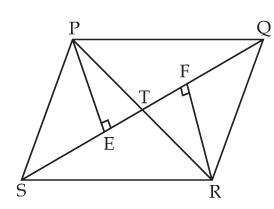 Given:
In quad. PQRS, diagonals PR and QS intersect at T.
To
prove: area(PTS) = area(RTQ)
Construction
: From P and R, draw perpendiculars to QS, namely PE and RF
Proof
: (a) In PET and RTF,
TP
= TR (given)
Given:
In quad. PQRS, diagonals PR and QS intersect at T.
To
prove: area(PTS) = area(RTQ)
Construction
: From P and R, draw perpendiculars to QS, namely PE and RF
Proof
: (a) In PET and RTF,
TP
= TR (given)
 PTE
= RTF (vert. opp. angles)
PET
= RFT = 90o
PTE
= RTF (vert. opp. angles)
PET
= RFT = 90o
 (AAS congruence)
 area(PTE) = area(RTF) (congruent figures have equal
area) ...(1)
And
PE = RF (CPCT)
Now,
in PSE and RQF,
PES
= RFQ (right angle)
PE
= RF (proved above)
PS
= QR (given)
So,
area(PTE) = area(RTF) (congruent figures have equal
area) ...(1)
And
PE = RF (CPCT)
Now,
in PSE and RQF,
PES
= RFQ (right angle)
PE
= RF (proved above)
PS
= QR (given)
So,
 (RHS
congruence)
Area
(PSE) = area(RQF) ...(2)
Adding
(1) and (2), we have:
Area(PTE)
+ area(PSE) = area(RTF) + area(RQF)
Or,
area(PTS) = area(RTQ)
(RHS
congruence)
Area
(PSE) = area(RQF) ...(2)
Adding
(1) and (2), we have:
Area(PTE)
+ area(PSE) = area(RTF) + area(RQF)
Or,
area(PTS) = area(RTQ)
Q67. Two adjacent angles of a parallelogram are
in the ratio 2 : 3. Find the measures of all the four angles of the
parallelogram.
Solution
Let
the two angles be 2x, 3x
2x
+ 3x = 180o (adj. angles are supplementary)
5x
= 180 o
x
= 36 o
2x
= 72o, 3x = 108o
The
four angles are 72o, 108o, 72o, 108o
Q68. In a parallelogram, show that the angle bisectors of two adjacent angles intersect at right angle.
Solution
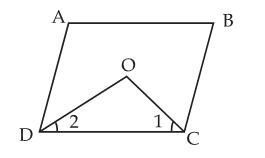

 Therefore, the angle bisectors of two adjacent angles intersect at right angle.
Q69. ABC is a triangle right angled at C. A line
through the mid point M of hypotenuse AB and parallel to BC intersects AC at
D. Show that:
(i) D is the mid point of AC
(ii) MD  AC.
AC.
AC.Solution
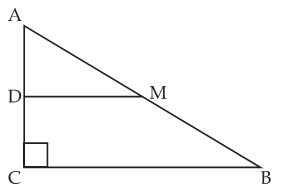 (i)
If a line is drawn parallel to one side of a triangle through the mid point
of the second side, then it bisects the third side.
(i)
If a line is drawn parallel to one side of a triangle through the mid point
of the second side, then it bisects the third side.
 D is the mid-point of AC
(ii) MD||BC
D is the mid-point of AC
(ii) MD||BC
 (corresponding angles)
 MD AC
MD AC
Q70. 
Solution
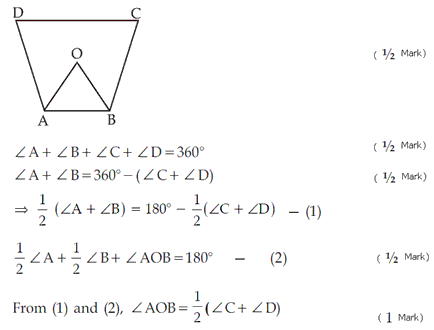
Q71. In the figure, PQRS is a square. M is the
midpoint of PQ and AB  RM.
Prove that RA = RB.
RM.
Prove that RA = RB.

RM.
Prove that RA = RB.
Solution
In
 APM and BQM
 APM
= BQM = 90o
AMP
= BMQ
(vertically opp. s.)
PM
= QM (M is the mid point)
APM
= BQM = 90o
AMP
= BMQ
(vertically opp. s.)
PM
= QM (M is the mid point)
 (ASA congruence rule)
AM
= MB (c.p.c.t)
In
AMR and BMR
AM
= MB
AMR
= BMR = 90o
RM
= RM
(ASA congruence rule)
AM
= MB (c.p.c.t)
In
AMR and BMR
AM
= MB
AMR
= BMR = 90o
RM
= RM
 (SAS congruence rule)
Hence
RA = RB (c.p.c.t)
(SAS congruence rule)
Hence
RA = RB (c.p.c.t)
APM and BQM
APM
= BQM = 90o
AMP
= BMQ
(vertically opp. s.)
PM
= QM (M is the mid point)
(ASA congruence rule)
AM
= MB (c.p.c.t)
In
AMR and BMR
AM
= MB
AMR
= BMR = 90o
RM
= RM
(SAS congruence rule)
Hence
RA = RB (c.p.c.t)
Q72. D and E are the mid-point of sides AB and
AC respectively of triangle ABC. If the perimeter of  ABC = 35 cm, find the perimeter of ADE.
ABC = 35 cm, find the perimeter of ADE.Solution
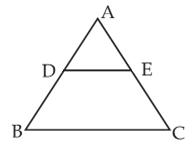 As
D and E the mid-point of AB and AC.
As
D and E the mid-point of AB and AC.
 AD
=
AD
=  AB and AE = AC
DE
= BC (mid-point
theorem)
Perimeter of ADE = AD + DE + AE
=
AB and AE = AC
DE
= BC (mid-point
theorem)
Perimeter of ADE = AD + DE + AE
=  = perimeter of ABC
Perimeter of ADE =
= perimeter of ABC
Perimeter of ADE =  35 cm = 17.5
cm
35 cm = 17.5
cm
Q73. ABCD is a parallelogram in which  A = 60o. If bisectors of A and B meets at P. Prove that AD = DP, PC = BC, DC = 2AD

A = 60o. If bisectors of A and B meets at P. Prove that AD = DP, PC = BC, DC = 2AD
Solution
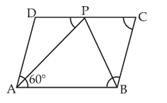 (i) ABCD
is a parallelogram in which A = 60°.
AP and PB are the bisector of A and B respectively.
PAB = PAD = 30° (AP bisects A)
AB || CD
and AP is the transversal.
(i) ABCD
is a parallelogram in which A = 60°.
AP and PB are the bisector of A and B respectively.
PAB = PAD = 30° (AP bisects A)
AB || CD
and AP is the transversal.
 PAB = APD = 30° (Alternate
angles)
In
PAB = APD = 30° (Alternate
angles)
In  APD,
PAD = APD = 30°
PD = AD ...(1) (Equal sides have equal
angles opposite to them in a trangle)
(ii)
AD || BC and AB is the transversal.
A + B = 180° (Sum of
adjacent interior angles is 180°)
APD,
PAD = APD = 30°
PD = AD ...(1) (Equal sides have equal
angles opposite to them in a trangle)
(ii)
AD || BC and AB is the transversal.
A + B = 180° (Sum of
adjacent interior angles is 180°)
 60° + B = 180°
B = 120°
PBA = PBC = 60° (PB is
bisector B)
PBA = BPC = 60° (Alternate
angles)
In PBC,
BPC = PBC = 60°
BC = PC ...(2) (Equal sides have equal
angles opposite to them)
(iii) CD =
DP + PC
CD = AD + BC [Using (1) and (2)]
CD = AD + AD [AD = BC (Opposite sides of
parallelogram are equal)]
CD = 2AD
60° + B = 180°
B = 120°
PBA = PBC = 60° (PB is
bisector B)
PBA = BPC = 60° (Alternate
angles)
In PBC,
BPC = PBC = 60°
BC = PC ...(2) (Equal sides have equal
angles opposite to them)
(iii) CD =
DP + PC
CD = AD + BC [Using (1) and (2)]
CD = AD + AD [AD = BC (Opposite sides of
parallelogram are equal)]
CD = 2AD
Q74. In a parallelogram ABCD, E and F are mid
points of sides AB and CD. Show that line segment AF and CE trisect the
diagonal BD.
Solution
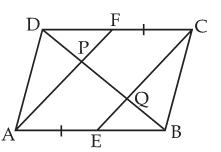 ABCD is a
parallelogram.
ABCD is a
parallelogram.
 AB || CD
And hence,
AE || FC
Again, AB
= CD (Opposite sides of parallelogram ABCD)
AB || CD
And hence,
AE || FC
Again, AB
= CD (Opposite sides of parallelogram ABCD)
 AB =CD
AE = FC (E and F are mid-points of side
AB and CD)
In
quadrilateral AECF, one pair of opposite sides (AE and CF) is parallel and
equal to each other.
Therefore,
AECF is a
parallelogram.
In
AB =CD
AE = FC (E and F are mid-points of side
AB and CD)
In
quadrilateral AECF, one pair of opposite sides (AE and CF) is parallel and
equal to each other.
Therefore,
AECF is a
parallelogram.
In
 DCQ,
DF
= CF (given)
PF||QC
DP = PQ
....(i)
(by converse of mid-point
them)
In
ABP,
AE
= BE (given)
AP
|| EQ
PQ = QB ….(ii) (by converse of mid-point them)So, DP =
PQ = QB
Hence,
line segment AF and CE trisect the diagonal BD.
DCQ,
DF
= CF (given)
PF||QC
DP = PQ
....(i)
(by converse of mid-point
them)
In
ABP,
AE
= BE (given)
AP
|| EQ
PQ = QB ….(ii) (by converse of mid-point them)So, DP =
PQ = QB
Hence,
line segment AF and CE trisect the diagonal BD.
Q75. Prove that the triangles formed by joining in pairs, the mid points of the three sides of a triangle are congruent to each other.
Solution
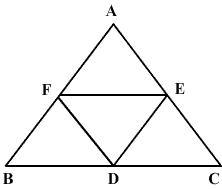 ABC is a triangle in which D, E and F are the mid points of the sides BC, CA and AB respectively.
F and E are the mid points of AB and AC respectively
ABC is a triangle in which D, E and F are the mid points of the sides BC, CA and AB respectively.
F and E are the mid points of AB and AC respectively
 FE
FE  BC and FE =
  BC (By mid point theorem)
 FE = BD
In
FE = BD
In  AFE and FBD,
AF = FB
FE = BD
AFE and FBD,
AF = FB
FE = BD
 AFE = FBD (corresponding angles)
AFE
AFE = FBD (corresponding angles)
AFE  FBD (SAS)
Similarly you can prove that the other pairs of triangles are also congruent.
FBD (SAS)
Similarly you can prove that the other pairs of triangles are also congruent.
Q76. PQRS is a parallelogram and X and Y are points on the diagonal QS such that SX = QY. Prove that PXRY is a parallelogram. 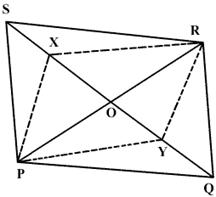
Solution
Join PR to meet QS at O
OQ = OS (diagonals of a parallelogram bisect each other)
QY = SX
 OQ - QY = OS - SX
 OY = OX
Thus in quadrilateral PXRY, diagonals PR and XY are such that
OX = OY and OP = OR
That is the diagonals bisect each other.
Hence, PXRY is a parallelogram.
OY = OX
Thus in quadrilateral PXRY, diagonals PR and XY are such that
OX = OY and OP = OR
That is the diagonals bisect each other.
Hence, PXRY is a parallelogram.
OQ - QY = OS - SX
OY = OX
Thus in quadrilateral PXRY, diagonals PR and XY are such that
OX = OY and OP = OR
That is the diagonals bisect each other.
Hence, PXRY is a parallelogram.
Q77. M, N and P are the mid points of AB, AC and BC respectively. If MN = 3 cm, NP = 3.5 cm and MP = 2.5 cm. Calculate BC, AB and AC. 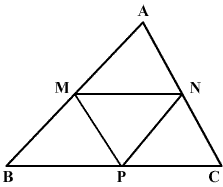
Solution
By mid point theorem

 BC = 2MN = 6 cm, AC = 2MP = 5 cm and AB = 2NP = 7 cm
BC = 2MN = 6 cm, AC = 2MP = 5 cm and AB = 2NP = 7 cm
Q78. In the figure PQRS is a parallelogram and X, Y are the points on the diagonal QS, such that SX = QY. Prove that quadrilateral PYRX is a parallelogram. 
Solution
 Join PROQ = OS (diagonals of a parallelogram bisect each other)QY = SX
 OQ - QY = OS - SXOY = OXIn quadrilateral PXRYAO = OXOX =OYThus, the diagonals of the quadrilateral
PXY are bisecting each other
PXRY is a parallelogram.
OQ - QY = OS - SXOY = OXIn quadrilateral PXRYAO = OXOX =OYThus, the diagonals of the quadrilateral
PXY are bisecting each other
PXRY is a parallelogram.
Q79. Prove that the triangle formed by joining the mid points of the sides of an isosceles triangle is an isosceles triangle.
Solution
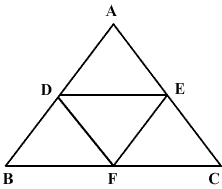 An isosceles triangle ABC
In
An isosceles triangle ABC
In  ABC, AB = AC
D, E and F are the mid points of sides AB, AC and BC respectively.
By mid point theorem
ABC, AB = AC
D, E and F are the mid points of sides AB, AC and BC respectively.
By mid point theorem

 EF = DF
In DEF, EF = DF.
Hence, DEF is an isosceles triangle.
EF = DF
In DEF, EF = DF.
Hence, DEF is an isosceles triangle.
Q80. ABCD is a parallelogram. E and F are the mid points of the sides AB and CD respectively. Prove that the segments CE and AF trisect the diagonal BD. 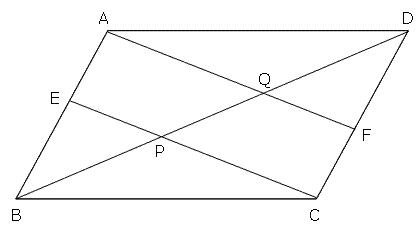
Solution
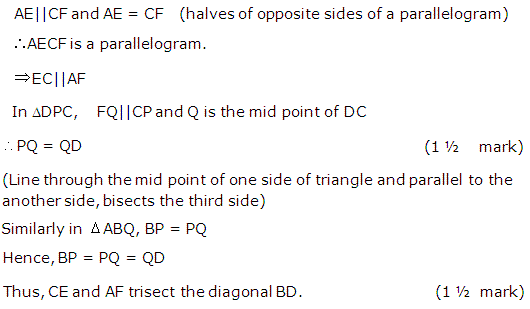
AE||CF and AE = CF (halves of opposite sides of a parallelogram)
Therefore, AECF is a parallelogram.
So, EC||AF
In  DPC, FQ||CP and F is the mid point of DC
So, PQ = QD
(Line through the mid point of one side of triangle and parallel to the another side, bisects the third side)
Similarly in ABQ, BP = PQ
Hence, BP = PQ = QD
Thus, CE and AF trisect the diagonal BD.
DPC, FQ||CP and F is the mid point of DC
So, PQ = QD
(Line through the mid point of one side of triangle and parallel to the another side, bisects the third side)
Similarly in ABQ, BP = PQ
Hence, BP = PQ = QD
Thus, CE and AF trisect the diagonal BD.
DPC, FQ||CP and F is the mid point of DC
So, PQ = QD
(Line through the mid point of one side of triangle and parallel to the another side, bisects the third side)
Similarly in ABQ, BP = PQ
Hence, BP = PQ = QD
Thus, CE and AF trisect the diagonal BD.
Q81. The two opposite angles of a parallelogram
are (3x - 10)o and (2x + 35)o. Find the measure of all
the four angles of the parallelogram.
Solution
3x
- 10 = 2x + 35 (opp.  s of a ||gm are equal)
x
= 45
s of a ||gm are equal)
x
= 45
 (3x - 10)o = (135 - 10)o
= 125o
Adjacent
angle = 180o - 125o = 55o
Thus,
the four angles of the parallelogram are 125o, 55o, 125o,
55o.
(3x - 10)o = (135 - 10)o
= 125o
Adjacent
angle = 180o - 125o = 55o
Thus,
the four angles of the parallelogram are 125o, 55o, 125o,
55o.
s of a ||gm are equal)
x
= 45
(3x - 10)o = (135 - 10)o
= 125o
Adjacent
angle = 180o - 125o = 55o
Thus,
the four angles of the parallelogram are 125o, 55o, 125o,
55o.
Q82. In a parallelogram PQRS, the bisectors of
adjacent angles R and S intersect each other at the point O. Prove that  ROS = 90o.
ROS = 90o.Solution
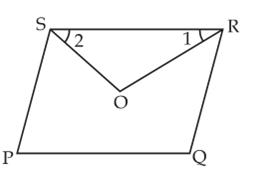 Proof
: PQRS is ||gm
R
+ S = 180o (co-interior angels)
Proof
: PQRS is ||gm
R
+ S = 180o (co-interior angels)
 1 + 2 = 90o
In
1 + 2 = 90o
In
 ROS
1
+ 2 + ROS = 180o
900
+ ROS = 180o
ROS=
90o
ROS
1
+ 2 + ROS = 180o
900
+ ROS = 180o
ROS=
90o
Q83. If PQRS is a rhombus with  PQR = 55o, find PRS.
PQR = 55o, find PRS.Solution
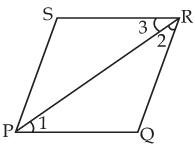 In
triangle PQR,
PQ
= QR (sides of rhombus)
In
triangle PQR,
PQ
= QR (sides of rhombus)
 (angles opposite to equal sides are equal)
55o
+ 1 + 2 = 180o (Angle sum property of a
triangle)
21 = 180o - 55o = 125o
1
= 62.5o
(angles opposite to equal sides are equal)
55o
+ 1 + 2 = 180o (Angle sum property of a
triangle)
21 = 180o - 55o = 125o
1
= 62.5o
 PRS = 3 = 1 = 62.5o (alternate interior angles)
Q84. Prove that the bisectors of any two
consecutive angles of parallelogram intersect at right angles.
Solution
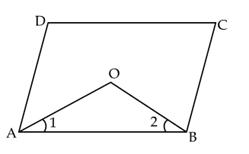 As
ABCD is a parallelogram
As
ABCD is a parallelogram
 AD||BC and AB is a transversal.
 DAB + ABC = 180o [Angles on the same side of transversal]
 1
+ 2 = 90o
In
1
+ 2 = 90o
In
 AOB ,1 + 2 + AOB = 180o
90o + AOB = 180o
AOB = 90o
Therefore,
the bisectors of any two consecutive angles of parallelogram intersect at
right angles.
AOB ,1 + 2 + AOB = 180o
90o + AOB = 180o
AOB = 90o
Therefore,
the bisectors of any two consecutive angles of parallelogram intersect at
right angles.
Q85.  In fig., ABCD is a trapezium in which
AB||DC. E is the mid point of AD and F is a point on BC such that EF||DC.
Prove that F is the mid point of BC.
In fig., ABCD is a trapezium in which
AB||DC. E is the mid point of AD and F is a point on BC such that EF||DC.
Prove that F is the mid point of BC.
In fig., ABCD is a trapezium in which
AB||DC. E is the mid point of AD and F is a point on BC such that EF||DC.
Prove that F is the mid point of BC.Solution
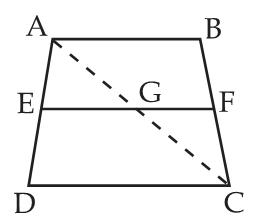 Join
AC.
In
Join
AC.
In
 ADC
ADC  EF||DC,
and E is the mid-point of AD
EF||DC,
and E is the mid-point of AD
 G is the mid-point of AC (by mid-point theorem)
In
CAB
GF||AC
G is the mid-point of CA
F is the mid-point of BC (by mid-point theorem)
G is the mid-point of AC (by mid-point theorem)
In
CAB
GF||AC
G is the mid-point of CA
F is the mid-point of BC (by mid-point theorem)
Q86. Prove that the diagonals of a parallelogram
divide it into two congruent triangles.
Solution
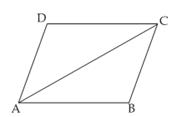 Given
: A ||gm
ABCD
To prove :
Given
: A ||gm
ABCD
To prove :
 Construction
: Join AC
Proof
: Since ABCD is a ||gm
Construction
: Join AC
Proof
: Since ABCD is a ||gm
 AB||DC and AD||BC
Now AB||DC and AC is a transversal
AB||DC and AD||BC
Now AB||DC and AC is a transversal
 DCA = BAC
[alt. interior angles]
Again AB||DC and AC is the transversal
DCA = BAC
[alt. interior angles]
Again AB||DC and AC is the transversal
 Hence
diagonals of a ||gm divide it into two congruent triangles.
Hence
diagonals of a ||gm divide it into two congruent triangles.
Q87. Show that bisectors of angles of a
parallelogram form a rectangle.
Solution
P,
Q, R and S are the points of intersection of bisectors of the angles of the
parallelogram.
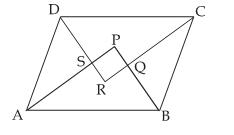 In
In
 ADS,
ADS,
 DAS
+ ADS =
DAS
+ ADS = 
 (A and D are interior angles on the same side of the
transversal)
Also
in ADS,
DAS
+ ADS + DSA = 180o (angle sum property)
(A and D are interior angles on the same side of the
transversal)
Also
in ADS,
DAS
+ ADS + DSA = 180o (angle sum property)
 Similarly,
it can be shown that APB or SPQ = 90o
Also,
SRQ = RQP = 90o
Hence,
PQRS is a rectangle.
Similarly,
it can be shown that APB or SPQ = 90o
Also,
SRQ = RQP = 90o
Hence,
PQRS is a rectangle.
In
ADS,
DAS
+ ADS =
(A and D are interior angles on the same side of the
transversal)
Also
in ADS,
DAS
+ ADS + DSA = 180o (angle sum property)
Similarly,
it can be shown that APB or SPQ = 90o
Also,
SRQ = RQP = 90o
Hence,
PQRS is a rectangle.
Q88. ABCD is a square and on the side DC, an
equilateral triangle is constructed. Prove that
(i) AE = BE and (ii)  DAE = 15o

DAE = 15o
Solution
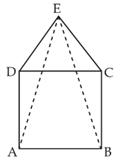 AD
= BC (sides of a square)
DE
= CE (sides of equilateral
triangle)
ADE = BCE = 90o + 60o = 150o
AD
= BC (sides of a square)
DE
= CE (sides of equilateral
triangle)
ADE = BCE = 90o + 60o = 150o
 (BY SAS
congruence theorem)
(BY SAS
congruence theorem)
 AE
= BE
ADE
= 90o + 60o = 150o
As
AD=DC(sides of a square)
DC=DE
so,
AD=DE
ADE=DEA
AE
= BE
ADE
= 90o + 60o = 150o
As
AD=DC(sides of a square)
DC=DE
so,
AD=DE
ADE=DEA
 DAE =
DAE =  = 15o
= 15o
Q89. PQRS is a parallelogram and  SPQ = 60o. If the bisectors of P and Q meet at point A on RS, prove that A is the
mid-point of RS.
SPQ = 60o. If the bisectors of P and Q meet at point A on RS, prove that A is the
mid-point of RS.
SPQ = 60o. If the bisectors of P and Q meet at point A on RS, prove that A is the
mid-point of RS.Solution
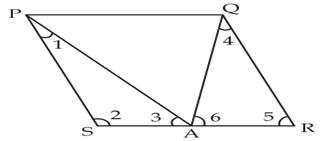 SPQ
= 60o = QRS (opposite angles of a parallelogram)
PQR
= PSR = 120o (adjacent angles of a
parallelogram)
As
PA and QA bisect P and Q
SPQ
= 60o = QRS (opposite angles of a parallelogram)
PQR
= PSR = 120o (adjacent angles of a
parallelogram)
As
PA and QA bisect P and Q
 1 = 30o and 4 = 60o
In
1 = 30o and 4 = 60o
In
 PSA, 1 = 30o , 2 = 120 o
So,
using angle sum property, we get, 3 = 30o
PS = SA ...(1)
(In
a , sides opp. to equal angles are equal)
Similarly,
QRA, 4 = 60o and 6 = 60o
QR = AR ...(2)
But
PS = QR (opposite sides of a parallelogram) ...(3)
From
(1), (2) and (3),
SA
= AR
A
is the mid-point of RS.
PSA, 1 = 30o , 2 = 120 o
So,
using angle sum property, we get, 3 = 30o
PS = SA ...(1)
(In
a , sides opp. to equal angles are equal)
Similarly,
QRA, 4 = 60o and 6 = 60o
QR = AR ...(2)
But
PS = QR (opposite sides of a parallelogram) ...(3)
From
(1), (2) and (3),
SA
= AR
A
is the mid-point of RS.
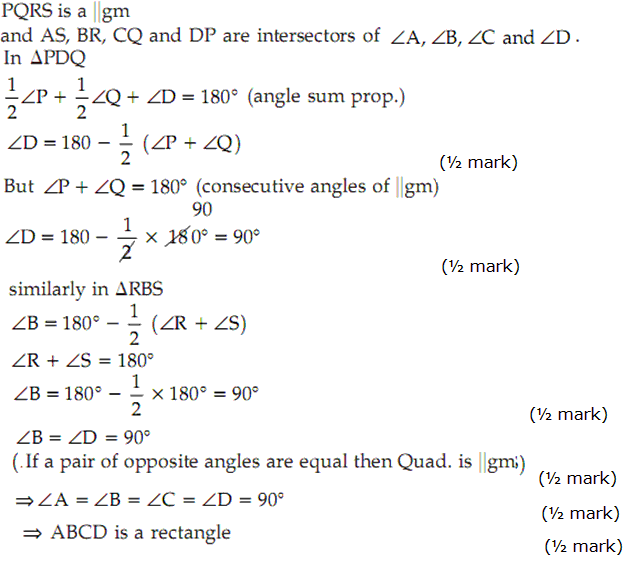
Q90. 
Solution
Q91. Diagonal AC of a parallelogram bisects  A. Show that:
(i) it
bisects C also
(ii)
ABCD is a rhombus
A. Show that:
(i) it
bisects C also
(ii)
ABCD is a rhombus
A. Show that:
(i) it
bisects C also
(ii)
ABCD is a rhombusSolution
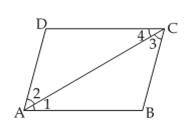 (i) 1
= 2 (given)
But
1 = 4, 2 = 3 (alt. int.
angles)
(i) 1
= 2 (given)
But
1 = 4, 2 = 3 (alt. int.
angles)
 3 = 4
3 = 4
 AC bisects C
(ii) Now, 1 = 4, 2 = 3 (alt. int.
angles)
AC = AC
(Common)
AC bisects C
(ii) Now, 1 = 4, 2 = 3 (alt. int.
angles)
AC = AC
(Common)
 (by ASA rule)
BC = DC (cpct)
But, AB =
DC [Given]
AB = BC = CD = AD
Hence,
ABCD is a rhombus.
(by ASA rule)
BC = DC (cpct)
But, AB =
DC [Given]
AB = BC = CD = AD
Hence,
ABCD is a rhombus.
Q92. In triangle ABD, D, E and F are mid-points
of sides AB, BC and CA respectively. Show that  ABC
is divided into four congruent triangles by joining D, E and F.
ABC
is divided into four congruent triangles by joining D, E and F.

ABC
is divided into four congruent triangles by joining D, E and F.
Solution
As
D and E are mid-points of AB and BC of ABC,
 DE||AC
Similarly
DF||BC, EF||AB
ADEF, BDFE and DFCE are all parallelograms.
DE
is the diagonal of the parallelogram BDFE.
DE||AC
Similarly
DF||BC, EF||AB
ADEF, BDFE and DFCE are all parallelograms.
DE
is the diagonal of the parallelogram BDFE.

 (Since, a diagonal of a parallelogram divides it into
two congruent triangles)
Similarly,
(Since, a diagonal of a parallelogram divides it into
two congruent triangles)
Similarly,
 and
and  Thus,
all the four triangles, BDE, FED, EFC and DAF, are congruent.
Thus,
all the four triangles, BDE, FED, EFC and DAF, are congruent.
ABC,
DE||AC
Similarly
DF||BC, EF||AB
ADEF, BDFE and DFCE are all parallelograms.
DE
is the diagonal of the parallelogram BDFE.
(Since, a diagonal of a parallelogram divides it into
two congruent triangles)
Similarly,
and
Thus,
all the four triangles, BDE, FED, EFC and DAF, are congruent.
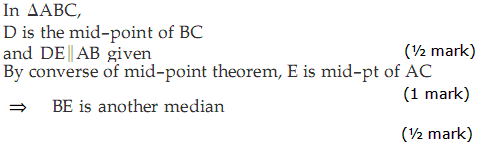
Q93. In the figure, AD is the median and DE||AB,
Prove that BE is also a median.

Solution
AD
is a median (Given)
Therefore,
'D' is the mid-point of BC (by definition of median)
DE||AB (Given)
 E is the mid-point of AC (converse
of mid-point theorem)
E is the mid-point of AC (converse
of mid-point theorem)
 BE is a median (by definition of median)
E is the mid-point of AC (converse
of mid-point theorem)
BE is a median (by definition of median)
Q94. Characterize the following statements a TRUE or FALSE and give reason for your answer.
If a pair of adjacent sides of a parallelogram is equal, it must be a rhombus or a square.
Solution
True. Because a square and a rhombus are both parallelograms having all sides equal, the difference between the two being that in a square all angles are right angles where as in a rhombus the angles are not right angles.
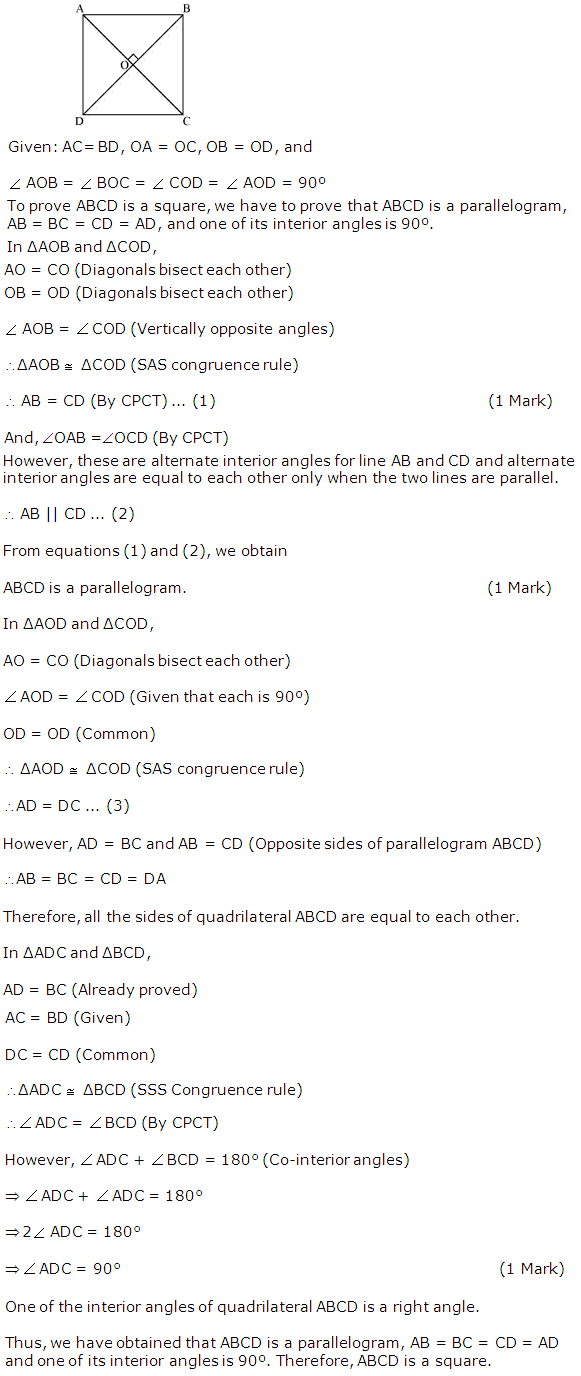
Q95. Show that if the diagonals of a quadrilateral are equal and bisect each other at right angles, then it is a square.
Solution
Q96. In  ABC, AB = 5 cm, BC = 8 cm and AC = 7 cm. If D
and E are respectively mid-points of AB and AC respectively, determine the
length of DE. Given reasons.
ABC, AB = 5 cm, BC = 8 cm and AC = 7 cm. If D
and E are respectively mid-points of AB and AC respectively, determine the
length of DE. Given reasons.
ABC, AB = 5 cm, BC = 8 cm and AC = 7 cm. If D
and E are respectively mid-points of AB and AC respectively, determine the
length of DE. Given reasons.Solution
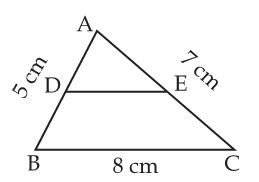 Join
DE. D and E are mid-points of AB and AC respectively.
Join
DE. D and E are mid-points of AB and AC respectively.
 DE||BC, DE =
  BC [Mid-point Theorem]

Q97. In the figure, it is given that BDEF and
FDCE are parallelograms. If BD = 4 cm, determine CD.

Solution
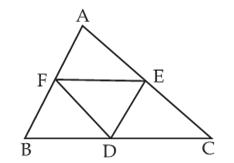 BDEF
and FDCE are ||gms and BD = 4 cm (Given)
BDEF
and FDCE are ||gms and BD = 4 cm (Given)
 BD = FE
...(I) (opposite sides of ||gm
BDEF)
In
||gm FDCE, CD = FE ...(II)
(opposite sides are equal in ||gm)
From
I and II
BD
= CD = 4 cm.
BD = FE
...(I) (opposite sides of ||gm
BDEF)
In
||gm FDCE, CD = FE ...(II)
(opposite sides are equal in ||gm)
From
I and II
BD
= CD = 4 cm.
Q98. In a  ABC median AD is produced to X such that AD = DX. Prove that ABXC is a parallelogram.

ABC median AD is produced to X such that AD = DX. Prove that ABXC is a parallelogram.
Solution
In quadrilateral ABXC, AD = DX and BD = DC
This shows that the diagonals of the quadrilateral ABXC bisect each other.
Therefore ABXC is a parallelogram.
Q99. Prove that the line drawn through the mid point of one side of a triangle, parallel to another side, intersects the third side at its mid point.
Solution
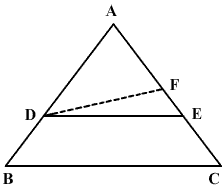 ABC is a triangle;
D is the mid point of AB.
To prove that E is the mid point of AC.
Let F be the mid point of the side AC and not the point E.
Join DF
In
ABC is a triangle;
D is the mid point of AB.
To prove that E is the mid point of AC.
Let F be the mid point of the side AC and not the point E.
Join DF
In  ABC, D is the mid point of AB and DE
  BC
F is the mid point of AC,
BC
F is the mid point of AC,
 by mid point theorem,
DF BC, also DE BC
Thus two intersecting lines DE and DF are parallel to the same line BC
This is not possible.
So F can not be the mid point of AC.
Hence, E is the mid point of AC.
by mid point theorem,
DF BC, also DE BC
Thus two intersecting lines DE and DF are parallel to the same line BC
This is not possible.
So F can not be the mid point of AC.
Hence, E is the mid point of AC.
Q100. ABCD is a rectangle with  ABD = 40o. Determine DBC.

ABD = 40o. Determine DBC.
Solution
ABC = 90o
 ABD + DBC = 90o
40o + DBC = 90o
DBC = 50o
ABD + DBC = 90o
40o + DBC = 90o
DBC = 50o
Q101. In the figure of  PQR, PS and RT are medians and SM||RT. Prove
that QM =
PQR, PS and RT are medians and SM||RT. Prove
that QM =  PQ.
PQ.

PQR, PS and RT are medians and SM||RT. Prove
that QM = PQ.
Solution
Proof
: In PQR, PS is median
 S is the mid-point of QR
In
QRT, S is the mid-point of QR and SM||RT
M is the mid-point of QT (mid-point theorem)
i.e.
QM = MT
Since
T is the mid-point of PQ
i.e.,
QT = PT
QM
+ MT = PT
QM
+ QM = PT
2QM
= PT
But
PT =
S is the mid-point of QR
In
QRT, S is the mid-point of QR and SM||RT
M is the mid-point of QT (mid-point theorem)
i.e.
QM = MT
Since
T is the mid-point of PQ
i.e.,
QT = PT
QM
+ MT = PT
QM
+ QM = PT
2QM
= PT
But
PT =  PQ,
2QM
= PQ
QM
= PQ
PQ,
2QM
= PQ
QM
= PQ
PQR, PS is median
S is the mid-point of QR
In
QRT, S is the mid-point of QR and SM||RT
M is the mid-point of QT (mid-point theorem)
i.e.
QM = MT
Since
T is the mid-point of PQ
i.e.,
QT = PT
QM
+ MT = PT
QM
+ QM = PT
2QM
= PT
But
PT = PQ,
2QM
= PQ
QM
= PQ
Comments
Post a Comment