Q1. A triangle and a rhombus are on the same base and between the same parallels. Then the ratio of area of triangle to that rhombus is:
Solution
A rhombus is also a parallelogram.
We know that a triangle and a parallelogram lying on the same base and between same parallels have area in the ratio 1: 2.
Thus, the ratio of area of triangle to that rhombus is 1: 2.
Q2. In  ABC, E is the mid-point of median AD. Area(
 BED)=
BED)=
ABC, E is the mid-point of median AD. Area(BED)=-
1)

-
2)

-
3)

- 4) None of the above
Solution
 We know that a median divides the triangle into two triangles of equal areas.
As AD is the median of ABC.
We know that a median divides the triangle into two triangles of equal areas.
As AD is the median of ABC.
 Now, E is the mid-point of median AD, so BE is the median of ABD.

Q3. In the given figure, ABCD is parallelogram
and AE  DC. If
AB is 20 cm and the area of parallelogram ABCD is 80 cm2, find AE.
DC. If
AB is 20 cm and the area of parallelogram ABCD is 80 cm2, find AE.

DC. If
AB is 20 cm and the area of parallelogram ABCD is 80 cm2, find AE.
Solution
AB
= 20 cm
AB
= CD (opposite sides of a ||gm)
CD
= 20 cm
ar(||gm
ABCD) = base  height
80
= 20 AE
height
80
= 20 AE
 AE
= 4 cm
AE
= 4 cm
height
80
= 20 AE
AE
= 4 cm
Q4. Prove that parallelograms on the same base
and between the same parallels are equal in area.
Solution
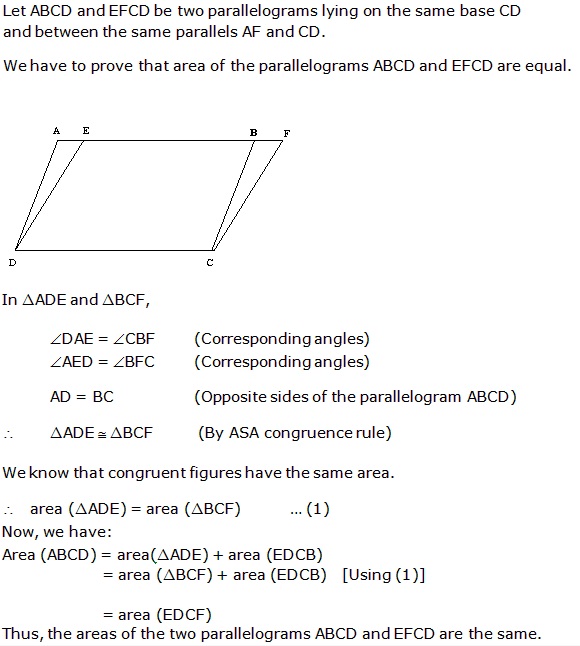
 Let ABCD and EFCD
be two parallelograms lying on the same base CD and between the same
parallels AF and CD.
We
have to prove that area of the parallelograms ABCD and EFCD are equal.
In
Let ABCD and EFCD
be two parallelograms lying on the same base CD and between the same
parallels AF and CD.
We
have to prove that area of the parallelograms ABCD and EFCD are equal.
In
 ADE and BCF,
 DAE = CBF (Corresponding
angles)
AED = BFC (Corresponding
angles)
AD
= BC (Opposite sides of the
parallelogram ABCD)
DAE = CBF (Corresponding
angles)
AED = BFC (Corresponding
angles)
AD
= BC (Opposite sides of the
parallelogram ABCD)
 ADE
ADE  BCF (By ASA congruence rule)
We know that congruent figures have the same area.
area (ADE) = area (BCF) …
(1)
Now, we have:
area (ABCD) = area(ADE) + area (EDCB)
= area (BCF) + area (EDCB) [Using
(1)]
= area (EDCF)
Thus, the areas of the two parallelograms ABCD and
EFCD are the same.
BCF (By ASA congruence rule)
We know that congruent figures have the same area.
area (ADE) = area (BCF) …
(1)
Now, we have:
area (ABCD) = area(ADE) + area (EDCB)
= area (BCF) + area (EDCB) [Using
(1)]
= area (EDCF)
Thus, the areas of the two parallelograms ABCD and
EFCD are the same.
Q5. In given figure, if ABCD is a parallelogram then length of BE is :
Solution
 Let perpendicular from D meet AB at F.
In parallelogram ABCD, BC = AD = 3 cm
[Opposite sides of a parallelogram are equal]
We know that:
Area of a parallelogram = Base
Let perpendicular from D meet AB at F.
In parallelogram ABCD, BC = AD = 3 cm
[Opposite sides of a parallelogram are equal]
We know that:
Area of a parallelogram = Base  Corresponding altitude
Area of parallelogram ABCD = AB DF = AD BE
6 cm 4 cm = 3 cm BE
BE =
Corresponding altitude
Area of parallelogram ABCD = AB DF = AD BE
6 cm 4 cm = 3 cm BE
BE =  BE = 8 cm
Q6. D and E are the points on the sides AB and AC respectively of triangle ABC such that DE||BC. If area of  DBC = 15 cm2 then area of EBC is:
DBC = 15 cm2 then area of EBC is:Solution
 From the figure,
DBC and EBC are triangles on the same base BC and between the same parallels DE and BC, therefore they are equal in area.
Hence, area(EBC) = 15 cm2
From the figure,
DBC and EBC are triangles on the same base BC and between the same parallels DE and BC, therefore they are equal in area.
Hence, area(EBC) = 15 cm2
Q7. A point E is taken as the midpoint of the
side BC of a parallelogram ABCD. AE and DC are produced to meet at F. Prove
that ar ( ADF) = ar(ABFC).
ADF) = ar(ABFC).Solution
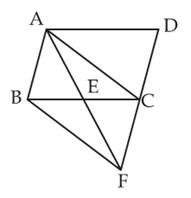 In
triangles ABE and CFE,
BE
= CE (E is the mid-point
of BC)
In
triangles ABE and CFE,
BE
= CE (E is the mid-point
of BC)
 (vertically opposite angles)
 (AB||CD and CD is produced to CF)
 ABE
ABE
 FCE (ASA
criteria)
FCE (ASA
criteria)
 AB
= CF
Now,
AB = CD, as ABCD is a parallelogram.
Therefore,
AB = CF = CD
AB
= CF
Now,
AB = CD, as ABCD is a parallelogram.
Therefore,
AB = CF = CD
 C is midpoint of FD
In
parallelogram ABFC, AF is the diagonal, therefore,
ar(ABF) = ar(ACF) ……(i)
In
ADF,
AC
is the median, since CD = CF
Therefore,
ar(ACF) = ar(ACD) ……(ii)
From
(i) and (ii)
ar(ABF) = ar(ACD)
Adding
ar(ACF) to both sides,
ar(ABF) + ar(ACF) = ar(ACD) + ar(ACF)
ar(||gm
ABFC) = ar(ADF)
C is midpoint of FD
In
parallelogram ABFC, AF is the diagonal, therefore,
ar(ABF) = ar(ACF) ……(i)
In
ADF,
AC
is the median, since CD = CF
Therefore,
ar(ACF) = ar(ACD) ……(ii)
From
(i) and (ii)
ar(ABF) = ar(ACD)
Adding
ar(ACF) to both sides,
ar(ABF) + ar(ACF) = ar(ACD) + ar(ACF)
ar(||gm
ABFC) = ar(ADF)
Q8. Prove that the triangles between the same parallels and on the same base are equal in area.
Solution
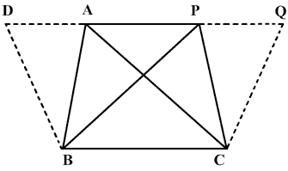
 ABC and PBC are on the same base BC and between the same parallels BC and AP.
To Prove: ar (ABC) = ar (PBC)
Construction; Through B, draw BD
ABC and PBC are on the same base BC and between the same parallels BC and AP.
To Prove: ar (ABC) = ar (PBC)
Construction; Through B, draw BD  CA intersecting PA produced at D, and Through C draw CQ BP intersecting BP produced at Q.
Proof: BCQP is a parallelogram with diagonal PC.
CA intersecting PA produced at D, and Through C draw CQ BP intersecting BP produced at Q.
Proof: BCQP is a parallelogram with diagonal PC.
 ar (BCP) =
  ar (BCQP)
Again BCAD is also a parallelogram with diagonal AB
ar (ABC) = ar (ADBC)
Since parallelogram BCQP and parallelogram BCAD are on the same base BC and between the same parallels BC and DQ;
ar (BCQP) = ar (BCAD)
ar (BCQP)
Again BCAD is also a parallelogram with diagonal AB
ar (ABC) = ar (ADBC)
Since parallelogram BCQP and parallelogram BCAD are on the same base BC and between the same parallels BC and DQ;
ar (BCQP) = ar (BCAD)
 ar (BCQP) = ar (BCAD)
ar (BCP) = ar (ABC)
Hence ar (ABC) = ar (BCP)
ar (BCQP) = ar (BCAD)
ar (BCP) = ar (ABC)
Hence ar (ABC) = ar (BCP)
Q9. Find the area of quadrilateral ABCD, if AB || CD and AB = CD is as shown in figure : 
Solution
If a triangle and a parallelogram are on the same base and between the same parallels, then the area of the triangle is equal to half the area of the parallelogram.
Area of parallelogram = 2 (Area of Triangle CDE)
.gif) = 32 cm2
= 32 cm2
= 32 cm2
Q10. 
Solution
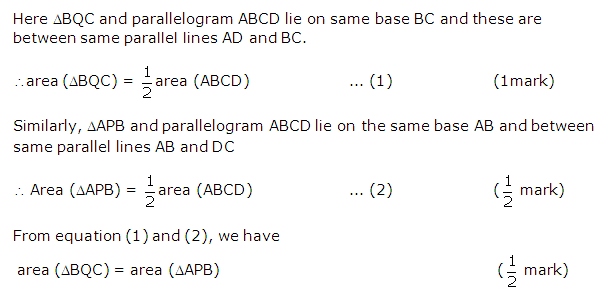
Q11. 
Solution
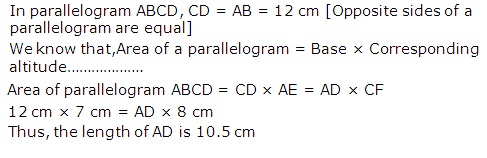
Q12. If a triangle and a square are on the same base and between the same parallels, then the ratio of area of triangle to the area of square is
Solution
We know that if a triangle and a parallelogram are on the same base and between the same parallels, then the area of the triangle is equal to half the area of the parallelogram.
A square is a parallelogram.
Therefore, required ratio = 1 : 2
Q13. In the given fig., M, N are points on sides
PQ and PR respectively of  PQR such that ar(QRN) = ar(QRM). Show that MN||QR.

PQR such that ar(QRN) = ar(QRM). Show that MN||QR.
Solution
QRN
and QRM are on the same base QR and having equal areas.
 They lie between the same parallel lines
MN||QR
They lie between the same parallel lines
MN||QR
Q14. PQRS and ABRS are parallelograms and X is
any point on side BR. Show that:
(i) area PQRS = area ABRS
(ii) area AXS =  area PQRS
area PQRSSolution
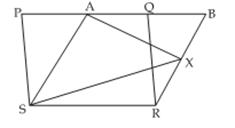 PQRS
and ABRS are parallelograms on the same base SR and between the same
parallels SR and PB.
PQRS
and ABRS are parallelograms on the same base SR and between the same
parallels SR and PB.
 area PQRS = area ABRS ...
(i)
area PQRS = area ABRS ...
(i)
 AXS
and parallelogram ABRS are on the same base AS and between the same parallels
AS and BR.
AXS
and parallelogram ABRS are on the same base AS and between the same parallels
AS and BR.
 area
area  ... (ii)
From
(i) and (ii),
area
... (ii)
From
(i) and (ii),
area
 AXS = area PQRS
Q15. 
Solution
Q16. ABCD is a parallelogram of area 900 sq. cm. AP is drawn perpendicular to BC and AQ is perpendicular to DC. If AP = 24 cm and AQ = 18.75 cm. Calculate (i) AB (ii) BC (iii) area of  ABC.
ABC. 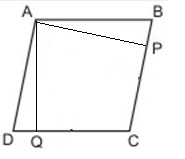
ABC. Solution
Area of parallelogram = base  corresponding altitude.
Area of parallelogram ABCD = BC AP
900 = BC 24
corresponding altitude.
Area of parallelogram ABCD = BC AP
900 = BC 24
 BC = 37.5 cm.
Also, 900 = AB 18.75
AB = 48 cm.
BC = 37.5 cm.
Also, 900 = AB 18.75
AB = 48 cm.

corresponding altitude.
Area of parallelogram ABCD = BC AP
900 = BC 24
BC = 37.5 cm.
Also, 900 = AB 18.75
AB = 48 cm.
Q17. The ratio of the areas of two parallelograms on the same base and between the same parallels is:
Solution
The areas of two parallelograms on the same base and between the same parallels are equal.
Hence, ratio of their areas is 1 : 1
Q18. If the base of a parallelogram is 8 cm and its altitude is 5 cm, then its area is equal to
Solution
Area of parallelogram = base  height
= 8 5 cm2
= 40 cm2
height
= 8 5 cm2
= 40 cm2
height
= 8 5 cm2
= 40 cm2
Q19. If each diagonal of a quadrilateral separates it into two triangles of equal area, then show that the quadrilateral is a parallelogram.
Solution
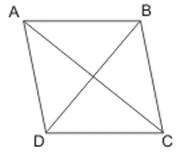 ar(
ar( ABD) = ar(BDC) and ar(ACB) = ar(ADC)
ar(ABD) + ar(BDC) = ar(Quad. ABCD)
2ar(ABD) = ar(Quad. ABCD)
ar(ABD) =
ABD) = ar(BDC) and ar(ACB) = ar(ADC)
ar(ABD) + ar(BDC) = ar(Quad. ABCD)
2ar(ABD) = ar(Quad. ABCD)
ar(ABD) =  ar(Quad. ABCD)
Similarly ar(ADC) =
ar(Quad. ABCD)
Similarly ar(ADC) =  ar(Quad. ABCD)
 ar(ABD) = ar(ADC)
ABD and ADC are on the same base AD
Altitude from B of the
ar(ABD) = ar(ADC)
ABD and ADC are on the same base AD
Altitude from B of the  ABD = altitude from C of the ADC
 AD
AD  BC Similarly, AB DC
Quadrilateral ABCD is a parallelogram (opposite sides are parallel)
BC Similarly, AB DC
Quadrilateral ABCD is a parallelogram (opposite sides are parallel)
Q20. Find the figure which has two polygons having the same area:

Solution
In figure (d), PQRA and BQRS are the two polygons which lie between the same parallels and on the same base. So, they have equal areas.
Q21. In a parallelogram ABCD, P is a point in interior of parallelogram ABCD. If ar (||gm ABCD) = 18 cm2 then [ar APD) + ar(CPB)] is :
APD) + ar(CPB)] is :Solution
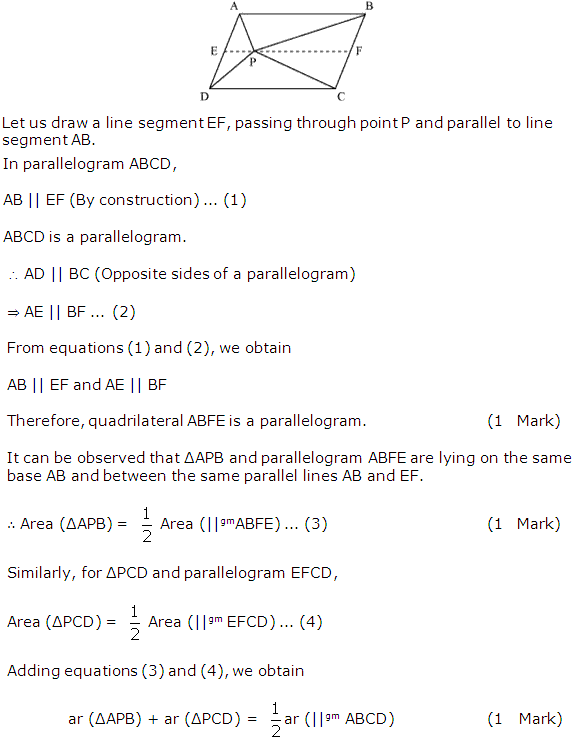
 Let us draw a line segment MN, passing through point P and parallel to line segment AD.
In parallelogram ABCD,
MN || AD (By construction) ... (1)
ABCD is a parallelogram.
Let us draw a line segment MN, passing through point P and parallel to line segment AD.
In parallelogram ABCD,
MN || AD (By construction) ... (1)
ABCD is a parallelogram.
 AB || DC (Opposite sides of a parallelogram)
 AM || DN ... (2)
From equations (1) and (2), we obtain
MN || AD and AM || DN
Therefore, quadrilateral AMND is a parallelogram.
It can be observed that APD and parallelogram AMND are lying on the same base AD and between the same parallel lines AD and MN.
Area (APD) =
AM || DN ... (2)
From equations (1) and (2), we obtain
MN || AD and AM || DN
Therefore, quadrilateral AMND is a parallelogram.
It can be observed that APD and parallelogram AMND are lying on the same base AD and between the same parallel lines AD and MN.
Area (APD) = Area (AMND) ... (3)
Similarly, for PCB and parallelogram MNCB,
Area (PCB) =Area (MNCB) ... (4)
Adding equations (3) and (4), we obtain
Area (APD) + Area (PCB) = Area (AMND) + Area (MNCB)
Area (APD) + Area (PCB) = Area(ABCD) = 9 cm2
Area (AMND) ... (3)
Similarly, for PCB and parallelogram MNCB,
Area (PCB) =Area (MNCB) ... (4)
Adding equations (3) and (4), we obtain
Area (APD) + Area (PCB) = Area (AMND) + Area (MNCB)
Area (APD) + Area (PCB) = Area(ABCD) = 9 cm2
Q22. ABCDE is pentagon. A line through B
parallel to AC meets DC produced at F. Show that
(i) Area ACB = Area ACF
(ii) area AEDF = area ABCDE
Solution
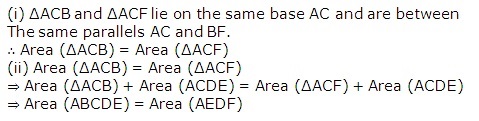
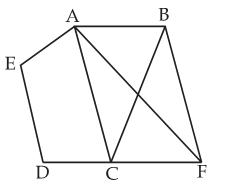 (i)
We know, AC||BF
ACF
and ACB are triangles between the same parallels and on the same base AC.
Therefore,
area ACF = area ACB
(ii)
Now, area ACF = area ACB
Add
area AEDC on both the sides,
ar
AEDC + ar ACF = ar AEDC + ar ACB
(i)
We know, AC||BF
ACF
and ACB are triangles between the same parallels and on the same base AC.
Therefore,
area ACF = area ACB
(ii)
Now, area ACF = area ACB
Add
area AEDC on both the sides,
ar
AEDC + ar ACF = ar AEDC + ar ACB
 area AEDF = area ABCDE
Q23. 
Solution
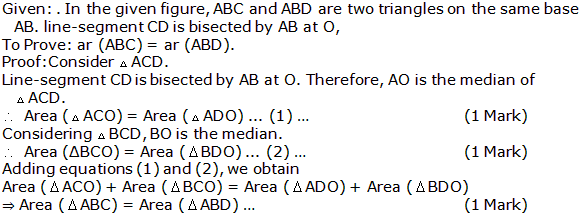
Q24.  ABC and ABD are on the same base AB. If line segment CD is
bisected by AB at O, show that ar (ABC) = ar(ABD)
ABC and ABD are on the same base AB. If line segment CD is
bisected by AB at O, show that ar (ABC) = ar(ABD)

ABC and ABD are on the same base AB. If line segment CD is
bisected by AB at O, show that ar (ABC) = ar(ABD)
Solution
ABC
and ABD are on same base AB
O
is the mid point of CD (Given)
In
ACD, AO is the median
 ar (AOC) = ar (AOD)
...(I)
[Median divides a triangle into two
triangles of equal area]
In
BCD, BO is the median
ar (BOC) = ar (DOB) ...(II)
Adding
I and II
ar(AOC) + ar(BOC) = ar(AOD) + ar (DOB)
...(III)
From
III, ar (ABC) = ar(ABD)
ar (AOC) = ar (AOD)
...(I)
[Median divides a triangle into two
triangles of equal area]
In
BCD, BO is the median
ar (BOC) = ar (DOB) ...(II)
Adding
I and II
ar(AOC) + ar(BOC) = ar(AOD) + ar (DOB)
...(III)
From
III, ar (ABC) = ar(ABD)
Q25. ABCD is a parallelogram. If E and F are mid points of sides AB and CD and diagonal AC is joined then ar (FCBE) : ar (CAB) is:
Solution
 Join EF. Since E and F are midpoints of AB and DC respectively, therefore EF divides parallelogram ABCD into two parallelograms (AEFD and FCBE) of equal areas.
 Now,
Now,  ACB and parallelogram ABCD lie on the same base and between the same parallels, therefore, area ofACB is half the area of parallelogram ABCD.
 From (i) and (ii),
ar(FCBE) = ar(CAB)
Hence, the ratio = 1 : 1
From (i) and (ii),
ar(FCBE) = ar(CAB)
Hence, the ratio = 1 : 1
Q26. In the given figure, M is a point in the interior of a parallelogram PQRS. Show that
 (i) ar(
 PMQ) + ar(MRS) =
  (||gm PQRS)
(ii) ar(PMS) + ar(MQR) = ar(PMQ) + ar(MRS)
(||gm PQRS)
(ii) ar(PMS) + ar(MQR) = ar(PMQ) + ar(MRS)
(i) ar(PMQ) + ar(MRS) = (||gm PQRS)
(ii) ar(PMS) + ar(MQR) = ar(PMQ) + ar(MRS)Solution
Const : Draw a line parallel to SR through M and a line parallel to SP through M
Proof : (i)
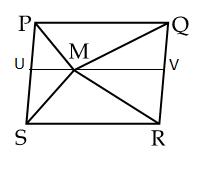 In parallelogram PQRS,
PQ || UV(by construction) ……(i)
PS || QR(opp. sides of a parallelogram)
Therefore, PU || QV……(ii)
From (i) and (ii),
PQ || UV and PU || QR
Therefore, quadrilateral PUVQ is a parallelogram.
It can be observed that PMQ and parallelogram PQVU lie on the same base PQ and between the same parallels PQ and UV
In parallelogram PQRS,
PQ || UV(by construction) ……(i)
PS || QR(opp. sides of a parallelogram)
Therefore, PU || QV……(ii)
From (i) and (ii),
PQ || UV and PU || QR
Therefore, quadrilateral PUVQ is a parallelogram.
It can be observed that PMQ and parallelogram PQVU lie on the same base PQ and between the same parallels PQ and UV
 Similarly, for MRS and parallelogram SRVU,
 adding (iii) and (iv)
 (ii)
(ii)
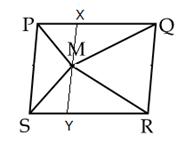 In parallelogram PQRS,
PS || XY(by construction) ……(vi)
PQ || SR(opp. sides of a parallelogram)
Therefore, PX || SY……(vii)
From (vi) and (vii),
PS || XY and PX || SY
Therefore, quadrilateral PSYX is a parallelogram.
It can be observed that PMS and parallelogram PSYX lie on the same base PS and between the same parallels PS and XY
In parallelogram PQRS,
PS || XY(by construction) ……(vi)
PQ || SR(opp. sides of a parallelogram)
Therefore, PX || SY……(vii)
From (vi) and (vii),
PS || XY and PX || SY
Therefore, quadrilateral PSYX is a parallelogram.
It can be observed that PMS and parallelogram PSYX lie on the same base PS and between the same parallels PS and XY
 Similarly, for MRQ and parallelogram XYRQ,
 adding (viii) and (ix)
 From (v) and (x)


In parallelogram PQRS,
PQ || UV(by construction) ……(i)
PS || QR(opp. sides of a parallelogram)
Therefore, PU || QV……(ii)
From (i) and (ii),
PQ || UV and PU || QR
Therefore, quadrilateral PUVQ is a parallelogram.
It can be observed that PMQ and parallelogram PQVU lie on the same base PQ and between the same parallels PQ and UV
Similarly, for MRS and parallelogram SRVU,
adding (iii) and (iv)
(ii)
In parallelogram PQRS,
PS || XY(by construction) ……(vi)
PQ || SR(opp. sides of a parallelogram)
Therefore, PX || SY……(vii)
From (vi) and (vii),
PS || XY and PX || SY
Therefore, quadrilateral PSYX is a parallelogram.
It can be observed that PMS and parallelogram PSYX lie on the same base PS and between the same parallels PS and XY
Similarly, for MRQ and parallelogram XYRQ,
adding (viii) and (ix)
From (v) and (x)
Q27. In the figure if ar(||gm ABCD) = 30 cm2, then ar( AEB) is:

AEB) is:
Solution
If a triangle and a parallelogram are on the same base and between the same parallels, then the area of the triangle is equal to half the area of the parallelogram.
Therefore, ar(AEB) = 15 cm2
AEB) = 15 cm2
Q28. ABCD is a parallelogram of area 100 cm2. AE is drawn perpendicular to BC and AF is drawn perpendicular to DC. If AE = 8 cm and AF is equal to 6.25 cm, then AB is 
Solution
Area of a parallelogram = base  corresponding altitude
100 = DC 6.25
corresponding altitude
100 = DC 6.25  DC = 16 cm.
DC=AB =16 cm................[ Opposite sides of a parallelogram are equal.]
AB =16 cm
DC = 16 cm.
DC=AB =16 cm................[ Opposite sides of a parallelogram are equal.]
AB =16 cm
corresponding altitude
100 = DC 6.25 DC = 16 cm.
DC=AB =16 cm................[ Opposite sides of a parallelogram are equal.]
AB =16 cm
Q29. 
Solution
Q30. 
Solution
Q31. ABCD is a trapezium in which, AB  DC and DC = 40 cm and AB = 60 cm. If X and Y are, respectively, the mid points of AD and BC, prove that XY = 50 cm.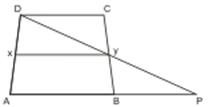
DC and DC = 40 cm and AB = 60 cm. If X and Y are, respectively, the mid points of AD and BC, prove that XY = 50 cm. Solution
Join DY and produce it to meet AB produced at P.
In  BYP and CYD
 BYP =CYD (vertically opposite angles)
DCY =PBY (alternate angles)
BY = CY (given)
BYP
BYP =CYD (vertically opposite angles)
DCY =PBY (alternate angles)
BY = CY (given)
BYP  CYD (ASA)
 DY = YP and DC = BP
Y is the mid point of DP
Also, X is the mid point of AD
DY = YP and DC = BP
Y is the mid point of DP
Also, X is the mid point of AD
 Hence XY = 50 cm.
BYP and CYD
BYP =CYD (vertically opposite angles)
DCY =PBY (alternate angles)
BY = CY (given)
BYP CYD (ASA)
DY = YP and DC = BP
Y is the mid point of DP
Also, X is the mid point of AD
Hence XY = 50 cm.
Q32. 
Solution
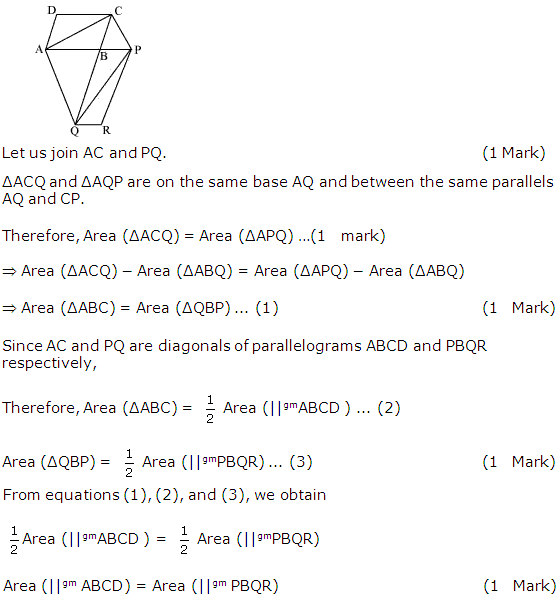
Q33. The side AB of a parallelogram ABCD is
produced to any point P. A line through A and parallel to CP meets CB
produced at Q and then parallelogram PBQR is completed. Show that area ABCD =
area PBQR.
Solution
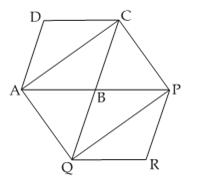 Join
AC and PQ.
Join
AC and PQ.  ACQ and APQ lie on the same base AQ and between the same
parallels CP and AQ
ACQ and APQ lie on the same base AQ and between the same
parallels CP and AQ
 area ACQ = area APQ
 area ACQ - area ABQ = area APQ - area ABQ
area ABC = area PBQ
2 area ABC = 2 area PBQ … (i)
AC
is the diagonal of parallelogram ABCD.
area ABC = area ADC =
area ACQ - area ABQ = area APQ - area ABQ
area ABC = area PBQ
2 area ABC = 2 area PBQ … (i)
AC
is the diagonal of parallelogram ABCD.
area ABC = area ADC =  area ABCD
 = 2 area ABC ... (ii)
Similarly,
area PBQR = 2 area PBQ ... (iii)
From
(i), (ii) and (iii),
area
ABCD = area PBQR
area ABCD
area ABCD = 2 area ABC ... (ii)
Similarly,
area PBQR = 2 area PBQ ... (iii)
From
(i), (ii) and (iii),
area
ABCD = area PBQR
Q34. If medians of a triangle ABC intersects at
G show that
ar ( AGB) = ar (AGC) = ar(BGC) =
  ar (ABC).

AGB) = ar (AGC) = ar(BGC) = ar (ABC).
Solution
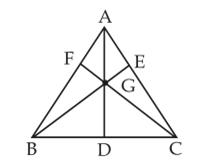 In
ABC, AD is the median
Ar(ABD) = ar(ACD)
...(i)
In
GBC, GD is the median
In
ABC, AD is the median
Ar(ABD) = ar(ACD)
...(i)
In
GBC, GD is the median
 (GBD) =ar(GCD)
...(ii)
Subtracting
equation (ii) from equation (i)
Ar(ABD) - ar(GBD) = ar(ACD) - ar(GCD)
Ar(AGB) = ar(AGC)
Similarly,
arAGB = ar(BGC)
arABC = arAGB + arBGC + arAGB
= arAGB + arAGB + arAGB
= 3 arAGB
(GBD) =ar(GCD)
...(ii)
Subtracting
equation (ii) from equation (i)
Ar(ABD) - ar(GBD) = ar(ACD) - ar(GCD)
Ar(AGB) = ar(AGC)
Similarly,
arAGB = ar(BGC)
arABC = arAGB + arBGC + arAGB
= arAGB + arAGB + arAGB
= 3 arAGB
 ar ABC = ar(AGB)
Q35. Show that line segment joining the mid points of a pair of opposite sides of a parallelogram, divides it into two equal parallelograms.
Solution
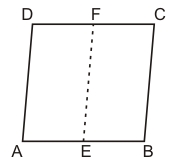 Since ABCD is a parallelogram
 AB = DC and AB
  DC
DC

 AE = DF and AE DF
Quadrilateral ABCD is a parallelogram.
Similarly, quadrilateral EBCF is also a parallelogram.
AEFD and EBCF are two parallelograms on the same base EF and between the same parallels, AD and BC.
ar(AEFD) = ar(EBCF)
AE = DF and AE DF
Quadrilateral ABCD is a parallelogram.
Similarly, quadrilateral EBCF is also a parallelogram.
AEFD and EBCF are two parallelograms on the same base EF and between the same parallels, AD and BC.
ar(AEFD) = ar(EBCF)
Q36. P and Q are any two points lying on the
sides DC and AD respectively of a parallelogram ABCD. Show that:
ar( APB) = ar(BQC)

APB) = ar(BQC)
Solution
Since APB and ||gm ABCD are on the same base AB
and between the same parallels AB and DC
 ar(APB) =
  ....(i)
Similarly ar(BQC) = ...(ii)
From (i) and (ii) we have
....(i)
Similarly ar(BQC) = ...(ii)
From (i) and (ii) we have

APB and ||gm ABCD are on the same base AB
and between the same parallels AB and DC
ar(APB) = ....(i)
Similarly ar(BQC) = ...(ii)
From (i) and (ii) we have
Q37. In triangle ABC, D is the mid point of AB. P is any point on BC. CQ  PD meets AB at Q. Show that ar (BPQ) =
  ar (ABC).
PD meets AB at Q. Show that ar (BPQ) = ar (ABC). Solution
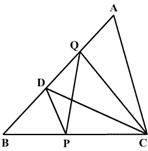 Given:
  ABC in which D is the mid point of AB.PD CQ
Construction: Join C to D and Q to P.
Proof: CD is a median of the ABC
ABC in which D is the mid point of AB.PD CQ
Construction: Join C to D and Q to P.
Proof: CD is a median of the ABC
 ar (BCD) = ar (DAC)
PDC and PDQ are on the same base PD and between the same parallels PD and CQ.
ar (PDC) = ar (PDQ)
ar (BCD) = ar (ABC) (median divides a triangle into two triangles of equal area)
ar (BPD) + ar (PDC) = ar (ABC)
ar (BPD) + ar (PDQ) = ar (ABC)
Hence ar (BPQ) = ar (ABC) ( BPD + PDQ = BPQ)
ar (BCD) = ar (DAC)
PDC and PDQ are on the same base PD and between the same parallels PD and CQ.
ar (PDC) = ar (PDQ)
ar (BCD) = ar (ABC) (median divides a triangle into two triangles of equal area)
ar (BPD) + ar (PDC) = ar (ABC)
ar (BPD) + ar (PDQ) = ar (ABC)
Hence ar (BPQ) = ar (ABC) ( BPD + PDQ = BPQ)
Q38. In the given figure, if parallelogram ABCD and rectangle ABEF are of equal area then:

-
1) Perimeter of ABCD = (perimeter of ABEF)
- 2) Perimeter of ABCD < perimeter of ABEF
- 3) Perimeter of ABCD = perimeter of ABEF
- 4) Perimeter of ABCD > perimeter of ABEF
Solution
Consider ∆AFD, right angled at F.
AD is the hypotenuse and FD and AF are the base and height of triangle.
Since, hypotenuse is the longest side in a right angled triangle.
 AD > AF
Perimeter of parallelogram ABCD = AB + BC + CD + DA
= 2 AB + 2 AD
= 2 (AB + AD)
> 2 (AB + AF) [ As AD > AF ]
Perimeter of rectangle ABEF = 2 (AB + AF)
Thus, Perimeter of parallelogram ABCD > Perimeter of rectangle ABEF.
AD > AF
Perimeter of parallelogram ABCD = AB + BC + CD + DA
= 2 AB + 2 AD
= 2 (AB + AD)
> 2 (AB + AF) [ As AD > AF ]
Perimeter of rectangle ABEF = 2 (AB + AF)
Thus, Perimeter of parallelogram ABCD > Perimeter of rectangle ABEF.
AD > AF
Perimeter of parallelogram ABCD = AB + BC + CD + DA
= 2 AB + 2 AD
= 2 (AB + AD)
> 2 (AB + AF) [ As AD > AF ]
Perimeter of rectangle ABEF = 2 (AB + AF)
Thus, Perimeter of parallelogram ABCD > Perimeter of rectangle ABEF.
Q39. Show that the median of a triangle divides
it into two triangles of equal areas.
Solution
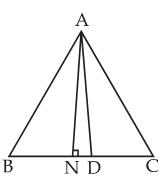 Const.-
Draw AN
Const.-
Draw AN  BC
Now
ar(
BC
Now
ar( ADB) =
  ar(ADC) =
  Since
BD = DC
ar(ADB) = ar(ADC)
Since
BD = DC
ar(ADB) = ar(ADC)
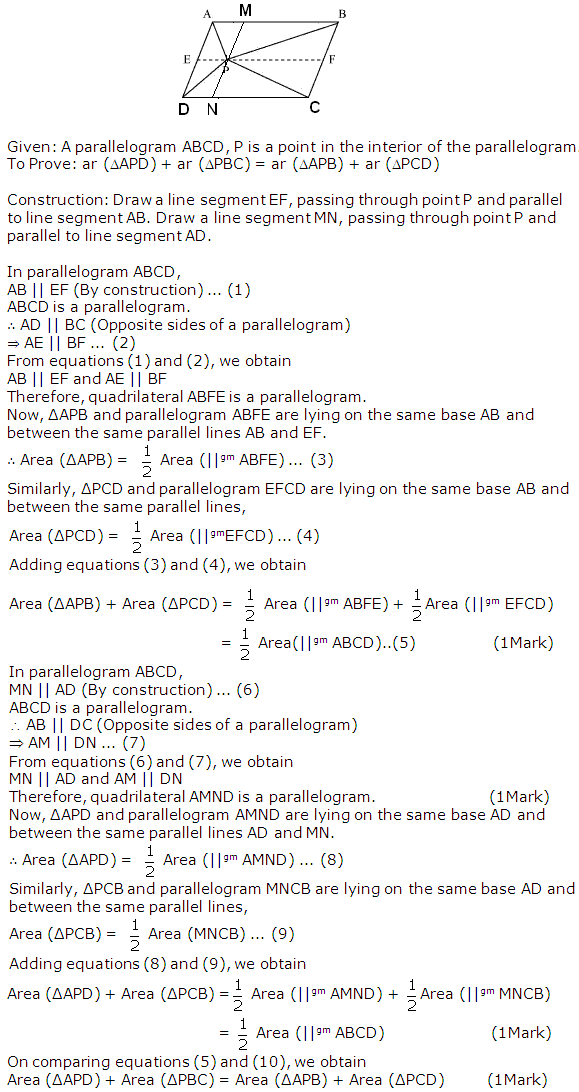
Q40. P is a point in the interior of a
parallelogram ABCD. Show that
(i) Area APB + Area PCD =  area ABCD
(ii)
Area APD + Area PBC = area APB + area PCD
area ABCD
(ii)
Area APD + Area PBC = area APB + area PCD
area ABCD
(ii)
Area APD + Area PBC = area APB + area PCDSolution
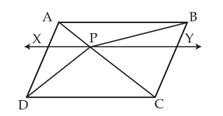 (i)
Through point P draw a line parallel to AB.
Now,
AXYB and XDCY are two parallelograms.
(i)
Through point P draw a line parallel to AB.
Now,
AXYB and XDCY are two parallelograms.

 area APB + area PCD = (area AXYB +
area XDCY)
area APB + area PCD = area ABCD …..(1)
(ii)
Similarly, we draw a line MN parallel to AD through P.
area APB + area PCD = (area AXYB +
area XDCY)
area APB + area PCD = area ABCD …..(1)
(ii)
Similarly, we draw a line MN parallel to AD through P.
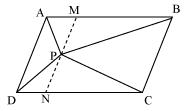 Now,
AMND and MNCB are two parallelograms.
Now,
AMND and MNCB are two parallelograms.
 area APD + area BPC
= (area AMND +
area MNCB)
area APD + area BPC = area ABCD …….(2)
Comparing
(1) and (2),
area
APB + area PCD = area APD + area BPC
area APD + area BPC
= (area AMND +
area MNCB)
area APD + area BPC = area ABCD …….(2)
Comparing
(1) and (2),
area
APB + area PCD = area APD + area BPC
Q41. In a parallelogram ABCD, AB = 20 cm. The altitude corresponding to the side AB and AD are 14 cm and 10 cm respectively. Find AD. 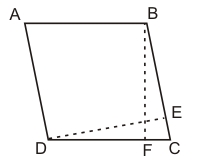
Solution
Area of parallelogram = base x altitude
 AB x BF = BC x DE
 20 x 14 = BC x 10
BC = 28 cm
AD = BC (opposite sides of a parallelogram)
AD = 28 cm.
20 x 14 = BC x 10
BC = 28 cm
AD = BC (opposite sides of a parallelogram)
AD = 28 cm.
AB x BF = BC x DE
20 x 14 = BC x 10
BC = 28 cm
AD = BC (opposite sides of a parallelogram)
AD = 28 cm.
Q42. If the diagonals AC, BD of a quadrilateral ABCD, intersect at O, and divide it into four triangles of equal area, Show that the quadrilateral is a parallelogram. 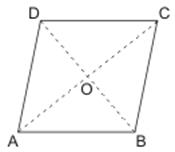
Solution
ar (AOD) = ar (BOC)
 ar (AOD) + ar (AOB) = ar (BOC) + ar (AOB)
ar (ABD) = ar (ABC)
Thus,
ar (AOD) + ar (AOB) = ar (BOC) + ar (AOB)
ar (ABD) = ar (ABC)
Thus,  ABD and ABC have the same base AB and have equal areas. So their corresponding altitudes must be equal.
 Altitude from D of ABD = Altitude from C of ABC
 DC
DC  AB. Similarly, AD BC
Hence, quadrilateral ABCD is a parallelogram.
AB. Similarly, AD BC
Hence, quadrilateral ABCD is a parallelogram.
ar (AOD) + ar (AOB) = ar (BOC) + ar (AOB)
ar (ABD) = ar (ABC)
Thus, ABD and ABC have the same base AB and have equal areas. So their corresponding altitudes must be equal.
Altitude from D of ABD = Altitude from C of ABC
DC AB. Similarly, AD BC
Hence, quadrilateral ABCD is a parallelogram.
Q43. If area of parallelogram ABCD is 25 cm2 and on the same base CD, a triangle BCD is given such that area BCD = x cm2, then value of x is
Solution
 If a triangle and a parallelogram are on the same base and between same parallels then area of triangle is half the area of parallelogram.
Therefore, area of triangle BCD = x =
If a triangle and a parallelogram are on the same base and between same parallels then area of triangle is half the area of parallelogram.
Therefore, area of triangle BCD = x =  25 cm2 = 12.5 cm2
Q44. If E, F, G and H are respectively the mid points of the sides of a parallelogram ABCD, show that ar(EFGH) =  ar(ABCD).
ar(ABCD).Solution
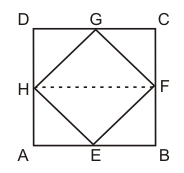 Join HF.
Since H and f are the mid points of Ad and BC respectively,
Join HF.
Since H and f are the mid points of Ad and BC respectively,
 ABCD is a parallelogram
 AD = BC and AD
  BC
BC
 AH = BF and AH BF
ABFH is a parallelogram
Since parallelogram FHAB and
AH = BF and AH BF
ABFH is a parallelogram
Since parallelogram FHAB and  FHE are on the same base and between the same parallels HF and AB,

Q45. 
Solution
Q46. In the figure AP  BQ CR. Prove that ar (AQC) = ar (PBR).

BQ CR. Prove that ar (AQC) = ar (PBR).
Solution
Triangles ABQ and PBQ are on the same base BQ and between the same parallels AP and BQ.
 ar (ABQ) = ar (PBQ) …(ii)
Similarly, triangles BCQ and BRQ are on the same base BQ and between the same parallels BQ and CR.
ar (ABQ) = ar (PBQ) …(ii)
Similarly, triangles BCQ and BRQ are on the same base BQ and between the same parallels BQ and CR.
 ar (BCQ) = ar (BRQ) …(i)
Adding (i) and (ii)
ar (ABQ) + ar (BCQ) = ar (PBQ) + ar (BRQ)
ar (BCQ) = ar (BRQ) …(i)
Adding (i) and (ii)
ar (ABQ) + ar (BCQ) = ar (PBQ) + ar (BRQ)
 ar (AQC) = ar (PBR)
ar (ABQ) = ar (PBQ) …(ii)
Similarly, triangles BCQ and BRQ are on the same base BQ and between the same parallels BQ and CR.
ar (BCQ) = ar (BRQ) …(i)
Adding (i) and (ii)
ar (ABQ) + ar (BCQ) = ar (PBQ) + ar (BRQ)
ar (AQC) = ar (PBR)
Q47. In a parallelogram PQRS, Take a point A on RS and join P and Q. In how many parts, the parallelogram is divided? What are the shapes of these Parts? Divide the parallelogram into two parts of equal area.
Solution
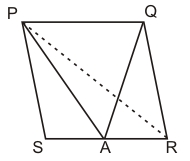 PQRS is a parallelogram. A is a point on SR
By joining A to P and Q, parallelogram is divided into three parts.
Each part is triangular in shape. Three triangles are
PQRS is a parallelogram. A is a point on SR
By joining A to P and Q, parallelogram is divided into three parts.
Each part is triangular in shape. Three triangles are  PSA, PAQ and QAR.
The diagonals of a parallelogram divide it into two parts of equal area.
PSA, PAQ and QAR.
The diagonals of a parallelogram divide it into two parts of equal area.
Q48. 
Solution
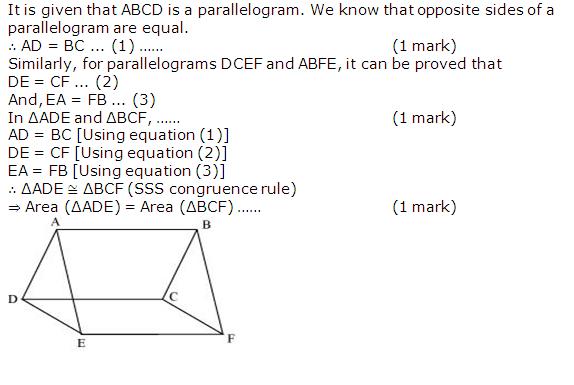
Q49. Given a triangle ABC and E is mid point of median AD of  ABC. If ar(BED) = 20 cm2, then ar(ABC) is:
ABC. If ar(BED) = 20 cm2, then ar(ABC) is:Solution
 In
In  ABC, AD is the median.
 ar(ABD) = ar(ADC) ... (i)
[Median divides the triangle into two equal parts]
Again, in ADB, BE is a median.
ar(ABE) = ar(BDE) ... (ii)
From (i), we have
ar(ABD) = ar(ABC) ... (iii)
From (ii), we have
ar(BED) = ar(ABD) ... (iv)
From (iii) and (iv), we have
ar(BED) =
ar(ABD) = ar(ADC) ... (i)
[Median divides the triangle into two equal parts]
Again, in ADB, BE is a median.
ar(ABE) = ar(BDE) ... (ii)
From (i), we have
ar(ABD) = ar(ABC) ... (iii)
From (ii), we have
ar(BED) = ar(ABD) ... (iv)
From (iii) and (iv), we have
ar(BED) =  ar(ABC)
 20 =
20 =  ar(ABC)
ar (ABC) = 80 cm2
ar(ABC)
ar (ABC) = 80 cm2
Q50. A point D is taken on the base BC of a  ABC and AD is produced to E, such
that DE = AD. Show that ar (BCE) = ar(ABC).
ABC and AD is produced to E, such
that DE = AD. Show that ar (BCE) = ar(ABC).
ABC and AD is produced to E, such
that DE = AD. Show that ar (BCE) = ar(ABC).Solution
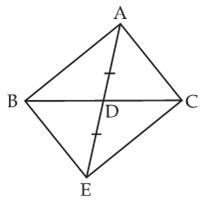 In
ACE, since D is the mid-point of AE,
In
ACE, since D is the mid-point of AE,
 CD is the median
Hence,
ar(ADC) = ar(EDC) (1)
Similarly,
ar(ADB) = ar(EDB) (2)
Adding
(1) and (2),
ar(ADC) + ar(ADB) = ar(EDC) + ar(EDB)
CD is the median
Hence,
ar(ADC) = ar(EDC) (1)
Similarly,
ar(ADB) = ar(EDB) (2)
Adding
(1) and (2),
ar(ADC) + ar(ADB) = ar(EDC) + ar(EDB)
 ar(ABC) = ar(BCE)
Q51. ABCD and BCFE are parallelograms. If area of triangle EBC = 480 sq. cm. Calculate (i) area of parallelogram ABCD
(ii) area of parallelogram BCFE. 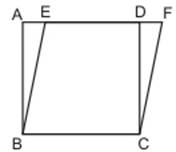
Solution
 EBC and parallelogram ABCD are on the same base BC and between the same parallels AD and BC.
 ar (ABCD) = 2 ar (EBC)
Hence, ar (ABCD) = 2
ar (ABCD) = 2 ar (EBC)
Hence, ar (ABCD) = 2  480= 960 sq. cm
Parallelogram ABCD and BCEF are on the same base BC and between the same parallels AF and BC.
ar (ABCD) = ar (BCEF) = 960 sq. cm
480= 960 sq. cm
Parallelogram ABCD and BCEF are on the same base BC and between the same parallels AF and BC.
ar (ABCD) = ar (BCEF) = 960 sq. cm
Q52. Diagonals AC and BD of a quadrilateral ABCD intersect at O in such a way that ar (AOD) = ar (BOC). Prove that ABCD is a trapezium. 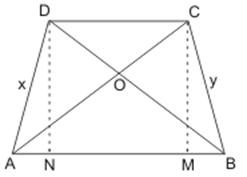
Solution
Draw DN  AB and CM AB.
ar (AOD) = ar (BOC)
AB and CM AB.
ar (AOD) = ar (BOC)
 ar (AOD) + ar (AOB) = ar (BOC) + ar (AOB)
ar (ABD) = ar (ABC)
ar (AOD) + ar (AOB) = ar (BOC) + ar (AOB)
ar (ABD) = ar (ABC)
 AB
AB  DN = AB CM
DN = CM
But, DN
DN = AB CM
DN = CM
But, DN  CM as DN and CM are perpendicular to AB.
  DCMN is a parallelogram.
DC AB
Hence, ABCD is a trapezium.
DCMN is a parallelogram.
DC AB
Hence, ABCD is a trapezium.
AB and CM AB.
ar (AOD) = ar (BOC)
ar (AOD) + ar (AOB) = ar (BOC) + ar (AOB)
ar (ABD) = ar (ABC)
AB DN = AB CM
DN = CM
But, DN CM as DN and CM are perpendicular to AB. DCMN is a parallelogram.
DC AB
Hence, ABCD is a trapezium.
Q53. In the given figure, ABCD is a
quadrilateral. A line through D parallel to AC meets BC produced at E. Prove
that ar( ABE) = ar quad. ABCD)

ABE) = ar quad. ABCD)
Solution
Proof:
ACD and ACE are on the same base AC and between the same
parallels as AC||DE.
 ...(1)
On
adding ar(ABC) to both sides:
ar(ACE) + ar(ABC) = ar(ACD) + ar(ABC)
ar(ABE) =
ar(quad. ABCD)
...(1)
On
adding ar(ABC) to both sides:
ar(ACE) + ar(ABC) = ar(ACD) + ar(ABC)
ar(ABE) =
ar(quad. ABCD)
ACD and ACE are on the same base AC and between the same
parallels as AC||DE.
...(1)
On
adding ar(ABC) to both sides:
ar(ACE) + ar(ABC) = ar(ACD) + ar(ABC)
ar(ABE) =
ar(quad. ABCD)
Q54. Prove that of all the parallelograms of the given sides, a rectangle has the greatest area.
Solution
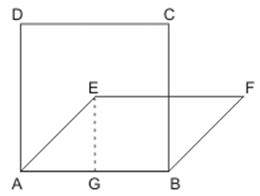 ABCD is a rectangle and ABFE is a parallelogram, such that
AD = BC = AE = BF
Area of rectangle = base x altitude
= AB x AD
Area of parallelogram ABFC = base x altitude
nbsp; = AB x EG
In
ABCD is a rectangle and ABFE is a parallelogram, such that
AD = BC = AE = BF
Area of rectangle = base x altitude
= AB x AD
Area of parallelogram ABFC = base x altitude
nbsp; = AB x EG
In  AGE, AE > EG (AE is the hypotenuse of right triangle)
But AD = AE
AGE, AE > EG (AE is the hypotenuse of right triangle)
But AD = AE
 AD > EG
Hence, ar(rectangle ABCD) > ar (parallelogram ABFE)
AD > EG
Hence, ar(rectangle ABCD) > ar (parallelogram ABFE)
Q55. Prove that the parallelograms on the same
base and between same parallels are equal in area.
Solution
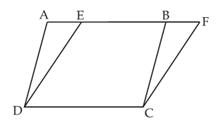 Given
: To ||gm ABCD and EFCD are on the same base DC and between
the same parallels AF and DC
To
prove: ar(||gm ABCD) = ar(||gm EFCD)
Proof
: In
Given
: To ||gm ABCD and EFCD are on the same base DC and between
the same parallels AF and DC
To
prove: ar(||gm ABCD) = ar(||gm EFCD)
Proof
: In  ADE and BCF
 DAE
= CBF
AED
= BFC
[Corresponding 's]
DAE
= CBF
AED
= BFC
[Corresponding 's]
 ADE = BCF (Angle sum property of a triangle)
AD
= BC (opposite sides of the ||gm)
ADE = BCF (Angle sum property of a triangle)
AD
= BC (opposite sides of the ||gm)
 ar(ADE) = ar(BCF) (Congruent figure have equal areas)
Now,
ar(ABCD) = ar(ADE) + ar(EDCB)
= ar(BCF) +
ar(EDCB)
= ar(EFCD)
So,
||gm ABCD and ||gm EFCD are equal in area.
ar(ADE) = ar(BCF) (Congruent figure have equal areas)
Now,
ar(ABCD) = ar(ADE) + ar(EDCB)
= ar(BCF) +
ar(EDCB)
= ar(EFCD)
So,
||gm ABCD and ||gm EFCD are equal in area.
Q56. ABCD is a parallelogram in which CD = 15
cm, its corresponding altitude AM is 8 cm and CN  AD. If
CN = 10 cm, then find the length of AD.
AD. If
CN = 10 cm, then find the length of AD.

AD. If
CN = 10 cm, then find the length of AD.
Solution
ar
(||gm ABCD) = base  Altitude
= CD AM
= 15 cm 8 cm
= 120 cm2
Again
ar(||gm ABCD) = AD CN
120 = AD 10
Altitude
= CD AM
= 15 cm 8 cm
= 120 cm2
Again
ar(||gm ABCD) = AD CN
120 = AD 10
 AD = 12 cm
Altitude
= CD AM
= 15 cm 8 cm
= 120 cm2
Again
ar(||gm ABCD) = AD CN
120 = AD 10
AD = 12 cm
Q57. XY is a line parallel to the side BC of a  ABC. BE
  AC and CF AB meets XY at E and F respectively. Show that ar (ABE) = ar (ACF).

ABC. BE AC and CF AB meets XY at E and F respectively. Show that ar (ABE) = ar (ACF).
Solution
Given: ABC, such that BE AC and CF AB
Proof: since YE BC and BE CY
 BCYE is a parallelogram.
Similarly, BCFX is a parallelogram.
Parallelograms BCFX and BCYE are on the same base BC and between same parallels BC and EF,
ar (BCYE) = ar (BCFX) …(i)
ar (ABE) =
BCYE is a parallelogram.
Similarly, BCFX is a parallelogram.
Parallelograms BCFX and BCYE are on the same base BC and between same parallels BC and EF,
ar (BCYE) = ar (BCFX) …(i)
ar (ABE) =  ar (BCYE) …(ii) ( on same base and between same parallels)
Similarly ar (ACF) = ar (BCFX) …(iii)
From (i), (ii) and (iii)
Hence ar (ABE) = ar (ACF)
ar (BCYE) …(ii) ( on same base and between same parallels)
Similarly ar (ACF) = ar (BCFX) …(iii)
From (i), (ii) and (iii)
Hence ar (ABE) = ar (ACF)
ABC, such that BE AC and CF AB
Proof: since YE BC and BE CY
BCYE is a parallelogram.
Similarly, BCFX is a parallelogram.
Parallelograms BCFX and BCYE are on the same base BC and between same parallels BC and EF,
ar (BCYE) = ar (BCFX) …(i)
ar (ABE) = ar (BCYE) …(ii) ( on same base and between same parallels)
Similarly ar (ACF) = ar (BCFX) …(iii)
From (i), (ii) and (iii)
Hence ar (ABE) = ar (ACF)
Q58. 
Solution
Q59. Diagonal AC and BD of a quadrilateral ABCD
intersect at O in such a way that ar (AOD) = ar (BOC). Prove that ABCD is a trapezium.
Solution
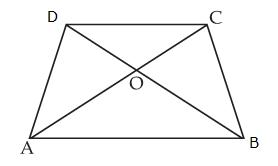 Given,
area (AOD) = area (BOC)
Given,
area (AOD) = area (BOC)
 area (AOD) + area (AOB) = area (BOC) + area (AOB)
area (ABD) = area (ABC)
But,
triangle ABD and ABC are on the same base AB and have equal area.
area (AOD) + area (AOB) = area (BOC) + area (AOB)
area (ABD) = area (ABC)
But,
triangle ABD and ABC are on the same base AB and have equal area.
 They are
between the same parallels
AB||DC
Hence,
ABCD is a trapezium.
[Since, a
pair of opposite sides is parallel]
They are
between the same parallels
AB||DC
Hence,
ABCD is a trapezium.
[Since, a
pair of opposite sides is parallel]
Q60. PQRS is a trapezium with PQ||SR. A line
parallel to PR intersects PQ at L and QR at M. Prove that ar( PSL) = ar (PRM)
PSL) = ar (PRM)Solution
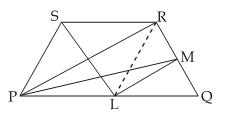 ar
PSL) = ar (PRL) …(i) [Two
triangles having same base (PL) and between same parallels (PL and SR) are
equal in area]
ar
(PRL) = ar(PRM) ….(ii) [Two triangles having same base (PR) and
between same parallels (PR and LM) are equal in area]
From
(i) and (ii),
ar
PSL) = ar (PRL) …(i) [Two
triangles having same base (PL) and between same parallels (PL and SR) are
equal in area]
ar
(PRL) = ar(PRM) ….(ii) [Two triangles having same base (PR) and
between same parallels (PR and LM) are equal in area]
From
(i) and (ii),
 ar(PSL) = ar(PRM)
Q61. In the figure, ABCD is a trapezium in which
AB||DC. Prove that ar( AOD) = ar(BOC).

AOD) = ar(BOC).
Solution
AB||CD
 ar(ADC) = ar(BCD)
[Triangles
on the same base and between the same set of parallel lines have equal area]
Subtracting
ar(DOC) from both sides, we get,
ar(ADC) - ar(DOC) = ar(BCD) - ar(DOC)
ar(AOD) = ar(BOC)
ar(ADC) = ar(BCD)
[Triangles
on the same base and between the same set of parallel lines have equal area]
Subtracting
ar(DOC) from both sides, we get,
ar(ADC) - ar(DOC) = ar(BCD) - ar(DOC)
ar(AOD) = ar(BOC)
ar(ADC) = ar(BCD)
[Triangles
on the same base and between the same set of parallel lines have equal area]
Subtracting
ar(DOC) from both sides, we get,
ar(ADC) - ar(DOC) = ar(BCD) - ar(DOC)
ar(AOD) = ar(BOC)
Q62. ABCDE is a pentagon. A line through B is parallel to AC meets DC produced at F. Show that ar (ABC) = ar (ACF).

Solution
AC  BF, since
  ABC and
  ACF are on the same base AC and between the same parallels AC and BF
 ar (ABC) = ar (ACF)
BF, since ABC and ACF are on the same base AC and between the same parallels AC and BF
ar (ABC) = ar (ACF)
Q63. In the figure, PQ||DC||AB. Prove that ar( ACP) = ar(BDQ)

ACP) = ar(BDQ)
Solution
PQ||DC
ar(PDC) = ar(QCD)
...(I)
[Triangle
between same parallels and on the same base]
ACD
and CDB are on same base CD and between same parallels,
CD||AB
ar(ACD)
= ar(CDB) …(II)
Adding
(I) and (II),
ar(PDC)
+ ar(ACD) = ar(QCD) + ar(CDB)
 ar(ACP) = ar(BDQ)
PDC) = ar(QCD)
...(I)
[Triangle
between same parallels and on the same base]
ACD
and CDB are on same base CD and between same parallels,
CD||AB
ar(ACD)
= ar(CDB) …(II)
Adding
(I) and (II),
ar(PDC)
+ ar(ACD) = ar(QCD) + ar(CDB)
ar(ACP) = ar(BDQ)
Comments
Post a Comment