Q1. The
coordinates of the origin
Solution
The
coordinates of the origin is (0, 0).
Q2. Two
points having the
same
abscissae but different ordinates lie on
Solution
According
to the question, two points have the same x coordinate
but different y coordinate. These points are (x, a),
(x, b), ….
Hence, a line is parallel to the y-axis
Q3. A
point lies on x-axis at a distance of 9 units from y-axis. What are its
coordinates? What will be its coordinates if it lies on y axis at a distance
of -9 units from x-axis?
Solution
Since the point lies on x-axis at a distance of
9 units from y-axis. Its coordinates will be (9, 0). If it lies on y axis at a distance of -9 units
from x-axis, its coordinates will be
(0, -9)
Q4. Plot
the points A (3,0), B (3,3) and C (0,3) in a Cartesian plane. Join OA, AB, BC
and CO, where O represents the origin. Name the figure so formed and write
its one property.
Solution
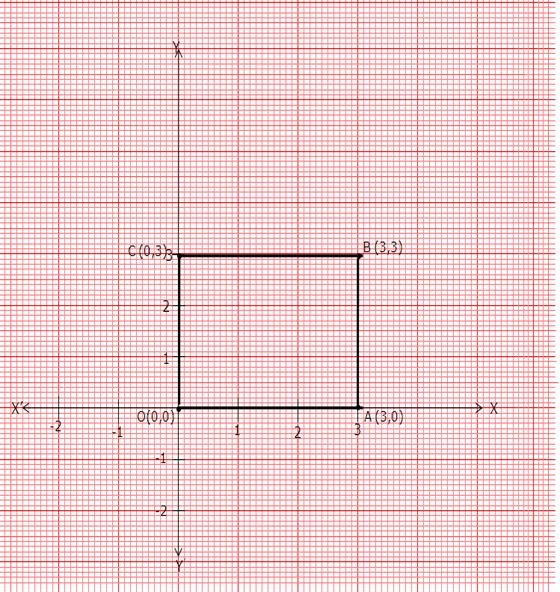 The figure obtained is a square
OABC with each side 3 units.
Where: O(0,0),A(3,0),B(3,3,) And C(0,3).
All
sides of the square are equal ,i.e. OA=AB=BC=OC.
The figure obtained is a square
OABC with each side 3 units.
Where: O(0,0),A(3,0),B(3,3,) And C(0,3).
All
sides of the square are equal ,i.e. OA=AB=BC=OC.
Q5. What are the coordinates of
the foot of the perpendicular drawn from (4, 3) on the y-axis?
Solution
(0, 3) is the coordinate of the foot
of the
perpendicular
drawn from (4, 3) on the y-axis.
Q6. Plot
the points (3,2), (-2,2), (-2,-2) and (3,-2) in the Cartesian plane. Join
these points and name the figure so formed.
Solution
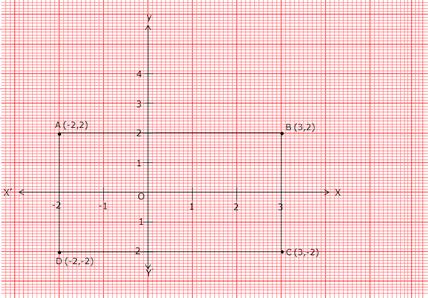 ABCD is a rectangle.
Q7. Plot
the point P(2,-6) on graph paper and from it draw PM and PN as perpendicular
to x - axis and y - axis, respectively. Write the coordinates of the points M
and N.
Solution
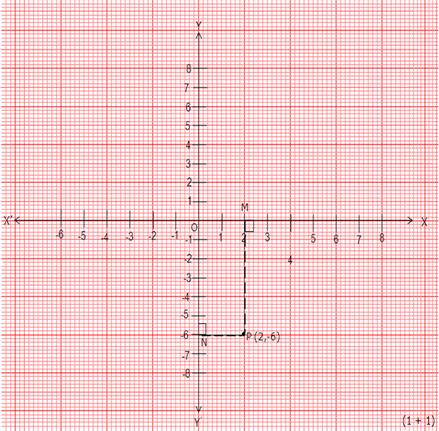 From
P(2,-6) we draw perpendiculars PM to
x-axis and perpendicular PN to y-axis then, Coordinates of :- N(0,-6) and M (2,0)
From
P(2,-6) we draw perpendiculars PM to
x-axis and perpendicular PN to y-axis then, Coordinates of :- N(0,-6) and M (2,0)
Q8. The point whose abscissa is -3 and lies on x-axis is.
Solution
Given x = -3 and point on x-axis is of the form (x,0).So, (-3,0) is the required point.
Q9. Two points having different abscissae
but the
same
ordinates lie on
Solution
According
to the question, two points have different x coordinates but the same y coordinate. These points are (a, y),
(b, y), ….
Hence,
a line is parallel to the x-axis.
Q10. In figure,
AOB is a triangle with coordinates of A and O as (4,0)
and (0,0). If AB = 5, find the coordinates of B.

Solution
 52 = 42 + OB2
OB2 = 25 - 16 = 9
Thus, OB =
52 = 42 + OB2
OB2 = 25 - 16 = 9
Thus, OB =  3
B is on +ve side of y-axis
3
B is on +ve side of y-axis
 Co-
ordinates of B are (0, 3).
Co-
ordinates of B are (0, 3).
Q11. If
the abscissa of a point is y and the ordinate is x, then the
coordinates of the point are
Solution
According to the question, the
x coordinate is y and the y coordinate is x.
Hence, the coordinates of the point are (y,
x).
Q12. Point (-3,-5) lies in the ______ quadrant.
Solution
The given point lies in third quadrant since both the coordinates are negative.
Q13. Point (0,4) lies:
Solution
On y axis
Q14. What is the ordinate of a point (-3,
-9)?
Solution
The y coordinate is
called an
ordinate.
Q15. Plot
the points O(0,0), B(16,0), C(16,12) on the graph paper. Join points O, B and
C. Name the figure.
Solution
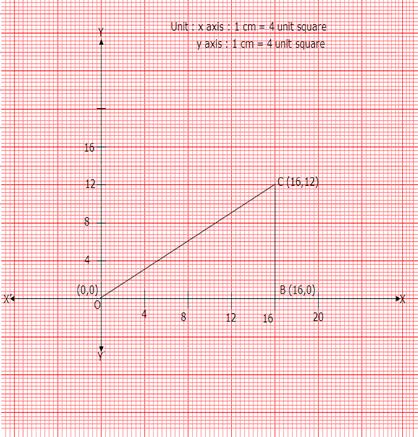 Here OBC forms a right angled triangle
Q16. Draw a quadrilateral whose vertices are (3,2), (2,3), (-4,5) and (5,-3).
Solution
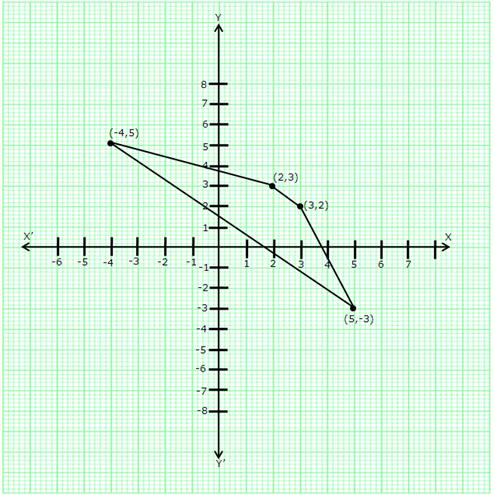
Q17. Where would the point (x, y) lie if x ≠ y ≠ 0 and either x > 0 and y < 0 or x < 0 and y > 0?
Solution
x < 0, y > 0 which is (-, +); hence, it would lie in the 2nd quadrant.
x > 0 , y > 0 which is (+, -); hence, it would be lie in the 4th quadrant.
Q18. Ram, Shyam and Anil are three friends standing at three different positions. Ram and Anil are in opposite direction but are at equal distance from Shyam. Shyam is at origin and position of Ram is (0,8). If the abscissa of position of Anil is 0, then what are the coordinates of Anil's position?
Solution
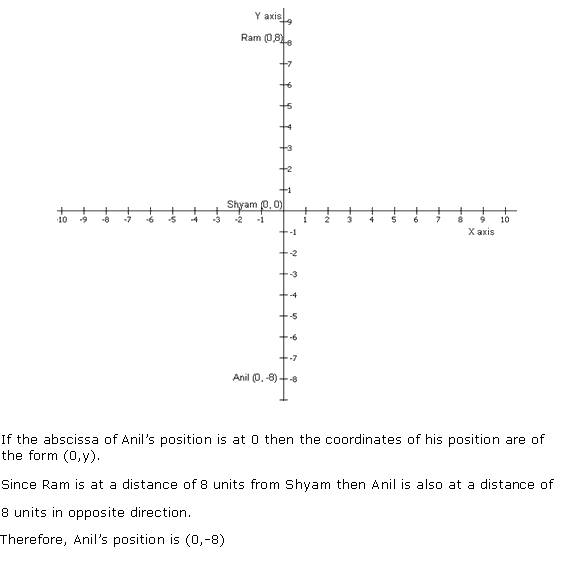
Q19. The
perpendicular distance of the point (-5, 4) from the x-axis is
Solution
The perpendicular distance of the
point (-5, 4) from the x-axis is always the y coordinate. Hence,
it is 4 units.
Q20. In
which quadrant do the given points lie?
(a)
(2, -1) (b) (-1, 7) (c)
(-2, -3) (d) (4, 5)
Solution
(a) 4th
quadrant (b) 2nd
quadrant
(c) 3rd
quadrant (d) 1st
quadrant
Q21. In
figure, ABCD is a square. Find the co-ordinates of point A and D.

Solution
A
= (-1,3)
D
= (2,-2)
Q22. The
following table gives the number of pairs of shoes and their corresponding
price. Plot these as ordered pairs and join them. What type of graph do you
get?
Number
of pairs of shoes
1
2
3
4
5
6
Corresponding
prices (in hundred or rupees)
5
10
15
20
25
30
Solution
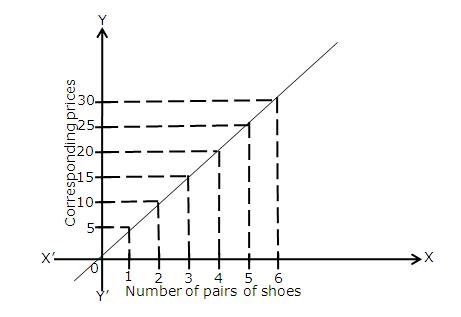 The
graph obtained is a straight line.
The
graph obtained is a straight line.
Q23. In which quadrant does the point (-1, 3) lie?
Solution
Point (-1, 3) lies in II quadrant.
Q24. Which of the following is correct?
Solution
A, B and C are incorrect.
Q25. The origin lies on the
Solution
The origin is the
intersection of both axes. Hence, it lies on both axes.
Q26. If the coordinates of two
points are A (-2, 5) and B (4, -6), then (abscissa of
A) - (abscissa of B) is
Solution
Abscissa
of A is -2 and abscissa of B is -6.
(abscissa of A) - (abscissa of B) = -2 - (-6) = -2 + 6 = 4
Q27. In
the figure,  is an equilateral triangle with coordinates of
vertices B and C as (-4, 0) and (4, 0) respectively. Find the coordinates of
the point A
is an equilateral triangle with coordinates of
vertices B and C as (-4, 0) and (4, 0) respectively. Find the coordinates of
the point A

is an equilateral triangle with coordinates of
vertices B and C as (-4, 0) and (4, 0) respectively. Find the coordinates of
the point A
Solution

Q28. Mark the points (2,2), (2, -2), (-2,-2) and (-2,2) on a graph paper and join these points. Name the figure that you obtain. Also, find the area of the figure so obtained.
Solution
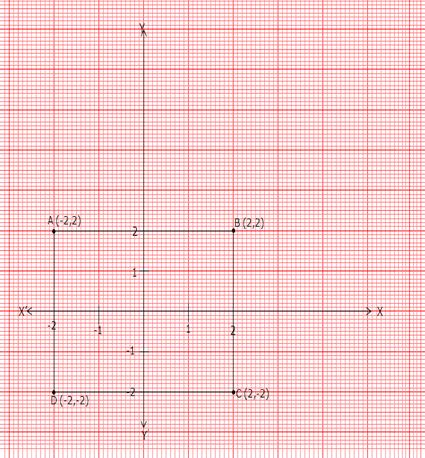 The figure obtained is a square.
Area of square =side x side
= 4
The figure obtained is a square.
Area of square =side x side
= 4  4=16 sq. units
Q29. A point (x, y) lies  in the
in the Solution
If then either x or y
is negative.
Hence, the point lies in the second and fourth quadrants.
then either x or y
is negative.
Hence, the point lies in the second and fourth quadrants.
Q30. In the given (i) Write the x-coordinates and the y-coordinates of the points P , Q, R. (ii) The coordinates of point S (iii) Find the abscissa of the point T (iv) Find the point whose coordinates are ( 5, 3) (v) Find the ordinates of points P and R. 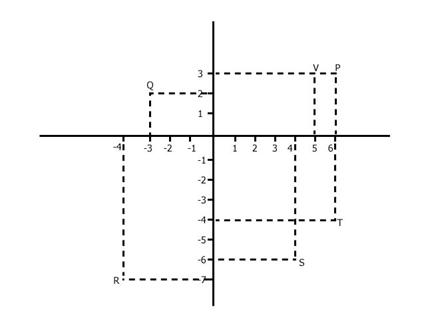
Solution
(i) P ( 6, 3) ; Q ( -3, 2) ; R( -4, -7)
(ii) S (4,-6)
(iii) 6
(iv) V
(v) 3 and -7
Q31. Find the area of the triangle formed by (0,4),(0,0),(3,0).
Solution
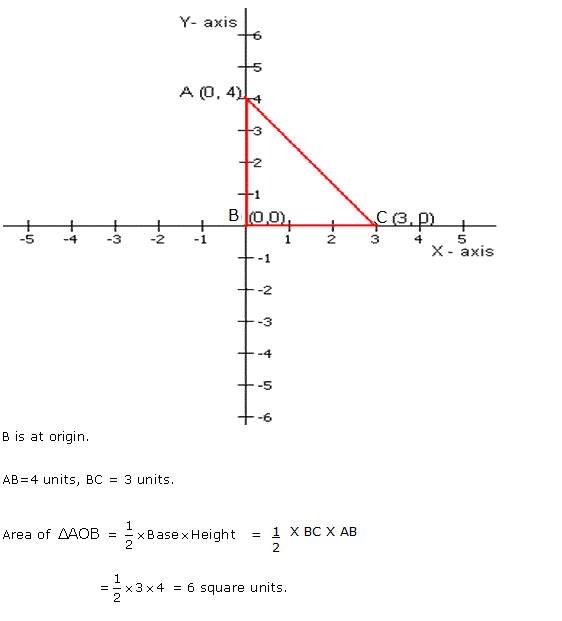
Q32. Observe figure,
and answer the following:
 (A) co-ordinate
of B.
(B) Point
identified by the co-ordinates (-2, -3).
(C) Abscissa of
point D.
(D) Ordinate of
point H.
(E) Points with
same abscissa.
(F) Points with
same ordinate.
(A) co-ordinate
of B.
(B) Point
identified by the co-ordinates (-2, -3).
(C) Abscissa of
point D.
(D) Ordinate of
point H.
(E) Points with
same abscissa.
(F) Points with
same ordinate.
(A) co-ordinate
of B.
(B) Point
identified by the co-ordinates (-2, -3).
(C) Abscissa of
point D.
(D) Ordinate of
point H.
(E) Points with
same abscissa.
(F) Points with
same ordinate.Solution
(A)
(2,3)
(B)
A
(C)
0
(D)
0
(E)
B,G
(E)
M,H
Q33. The
point from which distances are marked is called
Solution
The
point from which distances are marked is called the origin.
Q34. In figure,  ABC is an equilateral triangle with co-ordinate of B and C as (1,0), (5,0). Find the co-ordinate of vertex A.

ABC is an equilateral triangle with co-ordinate of B and C as (1,0), (5,0). Find the co-ordinate of vertex A.
Solution
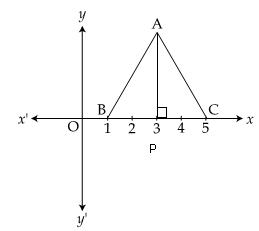 In equilateral triangle ABC,
BC = 4 unit, AC = 4 unit, AB = 4 unit
Drop a perpendicular from A to x-axis.
AP2 = AB2 - BP2
= (4)2 - (2)2
= 16 - 4 = 12
AP =
In equilateral triangle ABC,
BC = 4 unit, AC = 4 unit, AB = 4 unit
Drop a perpendicular from A to x-axis.
AP2 = AB2 - BP2
= (4)2 - (2)2
= 16 - 4 = 12
AP =  So co-ordinates of A are
Q35. The
following table gives the number of pens and their corresponding costs. Plot these as ordered pairs and join
them. What type of graph do you get?
Number
of Pens
1
2
4
5
7
8
Price
in rupees
3
6
12
15
21
24
Solution
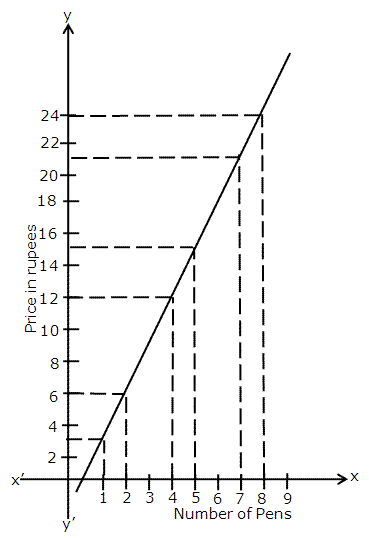 The
graph is a straight line.
The
graph is a straight line.
Q36. The perpendicular distance of a
point from the x - axis is 4 units and the perpendicular distance from the y
- axis is 5 units. Write the coordinates of such a point if it lies in the
(i) I Quadrant (ii) II Quadrant
(iiii) III Quadrant (iv) IV Quadrant
Solution
(i) In the first quadrant, the coordinates of
the required point will be (5,4).
(ii) In the second quadrant, the coordinates of
the required point will be (-5,4).
(iii) In the third quadrant, the coordinates of
the required point will be (-5,-4).
(iv) In the fourth quadrant, the coordinates of
the required point will be (5,-4).
Q37. Plot
the points (2,3) (-2,3) (-2,-3) and (2,-3) on a graph sheet. Join these points.
Name the figure obtained. Also, find the area of the figure so obtained.
Solution
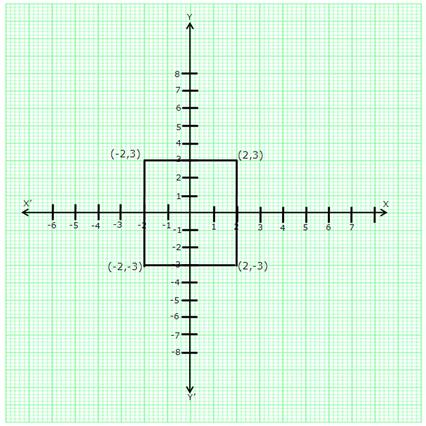 Rectangle
of length 6 units
Breadth
4 cm
Area
= 4
Rectangle
of length 6 units
Breadth
4 cm
Area
= 4  6 = 24 (units)2
Q38. Which
of the following points lie on x-axis? Which on y-axis?
A(0,2),
B(5,6), C(-3,0), D(0,-3), E(0,4), F(6,0), G(3,0)
Solution
If
x-coordinate of a point is zero then it lies on y-axis and if y-coordinate is
zero then it lies on x-axis.
Points
on x-axis : C(-3,0), F(6,0), G(3,0)
Points
on y-axis : A(0,2), D(0,-3), E(0,4)
Q39. In figure,  and
and  are equilateral triangle. Find coordinates of point C and D.

and are equilateral triangle. Find coordinates of point C and D.
Solution
Coordinates of point C are (0, a).
Coordinates of point D are (0, -a).
Q40. The
point (4, -6) lies in the
Solution
In the 3rd quadrant, the x
coordinate is positive and the y coordinate is negative.
Q41. A car starts from the center of city and in each consecutive hour it covers a distance of 20km (along north), 16 km (along east), 24 km (along south) and 20 km (along west) respectively. Assuming the centre of city to be the origin, north-south direction is along y axis and west-east direction is along x axis; show the various position of the car on the Cartesian plane. Also, find how far is the car from x and y axis respectively at its final position.
Solution
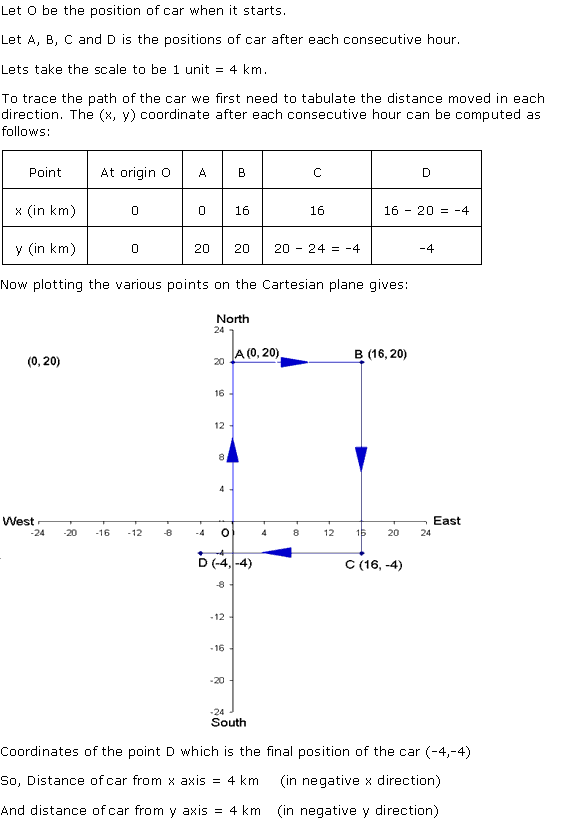
Q42. Which of the following represents a line parallel to x-axis?
Solution
y + 2 = 2y - 5
2y - y = 2 + 5
y = 7
Since for all the values of x, value of y = 7, therefore, the line will be parallel to x-axis.
Q43. What would be the coordinates of the foot of perpendicular drawn from (3,2) on y-axis?
Solution
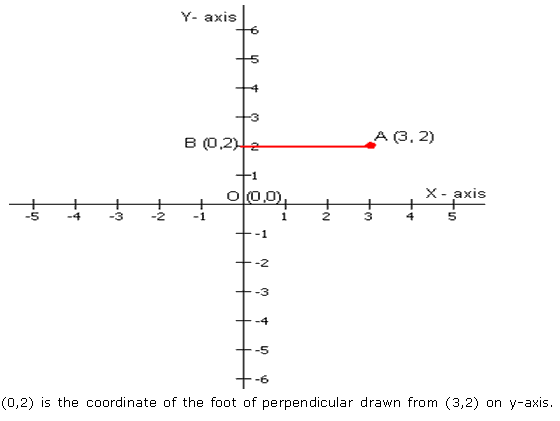
Q44. Which
of the following point lies in the first quadrant?
Solution
In
the first quadrant, both coordinates are positive.
Q45. Which of the following points do not lie on the line 3y = 6 - 2x.(i) (3,0)(ii) (2,2)(iii) (0,2)
Solution
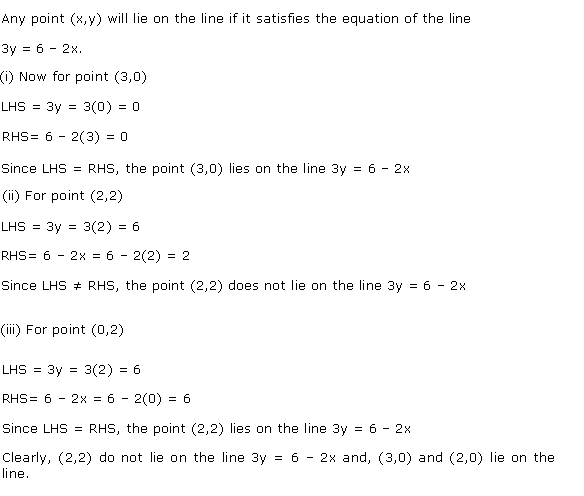
Q46. In
fig., ABCD is a rectangle with length 6 cm and breadth 3 cm. O is the mid-point
of AB. Find the coordinates of A, B, C and D.

Solution
ABCD is a rectangle where AB = CD= 6cm
AD = BC
= 3cm
As O is the midpoint of AB, OA=OB=3cm
So, co-ordinates of A will be O(0,0)+3 units in
x'-axis = (-3,0)
 Co-ordinates of A (-3,0)
Similarly co-ordinates of B (3,0)
Again, BC=3
So, co-ordinates of C will be B(3,0)+3 units in
y-axis = (3,3)
Similarly co-ordinates of D (-3,3)
Co-ordinates of A (-3,0)
Similarly co-ordinates of B (3,0)
Again, BC=3
So, co-ordinates of C will be B(3,0)+3 units in
y-axis = (3,3)
Similarly co-ordinates of D (-3,3)
Co-ordinates of A (-3,0)
Similarly co-ordinates of B (3,0)
Again, BC=3
So, co-ordinates of C will be B(3,0)+3 units in
y-axis = (3,3)
Similarly co-ordinates of D (-3,3)
Q47. 
Solution
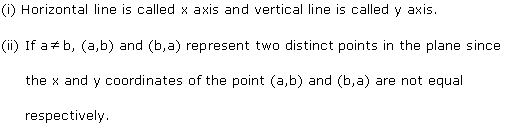
Q48. Using the graph given below, find the following :
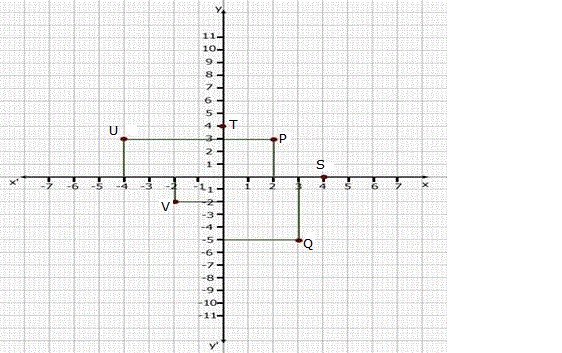
(i) Abssica of P (ii) Ordinate of Q(iii) Coordinate of V(iv) Point on X axis(v) Point of Y axis (vi) Point in I quadrant(vii) Point in II quadrant(viii) Point in III quadrant(ix) Point in IV quadrant
Solution
(i) Abscissa of P is 2(ii) Ordinate of Q is - 5(iii) V (-2,2)(iv) S (4,0)(v) T (0,4)(vi) P (2,3)(vii) U (-4,3)(viii) V (-2,2)(ix) Q (3,-5)
Q49. The
perpendicular distance of a point from the x-axis is 2 units and the
perpendicular distance from the y-axis is 3 units. Write the co-ordinates of
the point if it lies in the:
(i) I
Quadrant (ii) II Quadrant
(iii)
III Quadrant (iv) IV Quadrant
Solution
x
co-ordinate  3, y co-ordinate 2

3, y co-ordinate 2
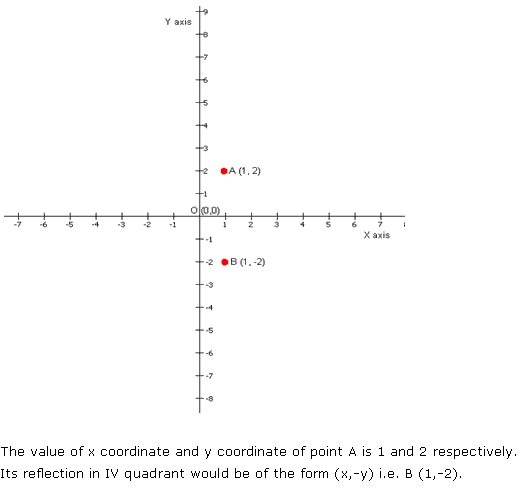
Q50. What would be the reflection of (1,2) in IV quadrant?
Solution
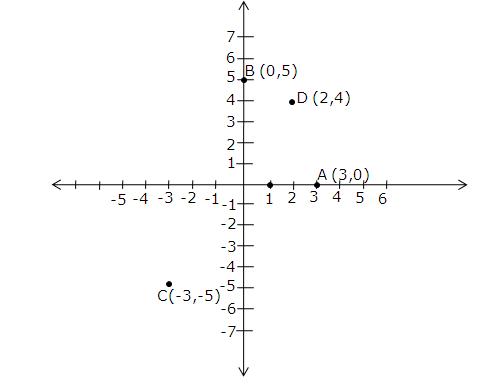
Q51. Locate
the following points in the Cartesian plane:
A(3,0),
B(0,5), C(-3,-5) and D(2,4).
Solution
Comments
Post a Comment